dinsdag 28 april 2020


Tech by VICE

How NSO Group Helps Countries Hack Targets


The controversial Israeli spyware company is more involved in hacking targets than previously believed, according to sources.

By Lorenzo Franceschi-Bicchierai and Joseph Cox
Oct 31 2019, 6:40pm

IMAGE: JACK GUEZ/AFP VIA GETTY IMAGES
A blockbuster lawsuit involving the most popular chat app in the world and the most infamous spyware company in the world has given us concrete details about how the secretive Israeli spy firm NSO Group helps countries hack journalists, activists, and other targets around the world.

WhatsApp, which is owned by Facebook, filed a lawsuit against NSO Group in a California court on Tuesday. NSO makes Pegasus, a surveillance product that hacks cellphones and is used by government agencies around the world to intercept and read data on the hacked devices. WhatsApp alleges that NSO was sending malware to take control of phones via WhatsApp and was using Facebook infrastructure as part of its hacking campaign.

Pegasus has been used by Saudi Arabia, Mexico, United Arab Emirates, and other countries with questionable and poor records on human rights to hack activists, dissidents, and journalists, according to internet watchdog Citizen Lab, which monitors spyware for the University of Toronto.
Few outside of the governments that use Pegasus have details about how the software actually works, but screenshots of the software and a contract included in the WhatsApp lawsuit have helped confirm some of Motherboard's own reporting about how Pegasus is implemented. In simple terms, NSO provides hacking as a streamlined service, which means a lot of the actual tech is in the company’s own control, and NSO can offer hands-on assistance to the government employees who use it. In public statements, NSO has tried to distance itself from the actual hacking.
“We have no way to know what they do it the system,” Omri Lavie, one of NSO’s co-founders, said on a podcast in 2017, according to a translation on an Israeli website. “I don’t want to know. I don’t want to be an intelligence partner.”
The contract and our reporting suggests that NSO is much more involved in hacking its targets than it has publicly said. NSO has maintained that it merely sells tools to governments and that it does not have specific knowledge of who its clients hack.
Do you work or used to work at NSO Group? We’d love to hear from you. Using a non-work phone or computer, you can contact Lorenzo Franceschi-Bicchierai securely on Signal at +1 917 257 1382, OTR chat at lorenzofb@jabber.ccc.de, or email lorenzo@motherboard.tv. You can contact Joseph Cox securely on Signal on +44 20 8133 5190, Wickr on josephcox, OTR chat on jfcox@jabber.ccc.de, or email joseph.cox@vice.com.

That's important, because WhatsApp accused the Israeli surveillance software maker of using WhatsApp’s servers to help its government customers around the world target more than 1,400 people in 20 countries, including more than “100 cases of abusive targeting of human rights defenders,” according Citizen Lab, who helped WhatsApp in its investigation. It's one thing to help a government spy on suspected terrorists and child abusers and another to help authoritarian governments target activists and dissidents critical of those governments, as the United Nations's Special Rapporteur on Free Expression David Kaye pointed out in a letter to NSO sent earlier this month, which noted there is a "legacy of harm" facilitated by NSO.
A source who works in the offensive cybersecurity industry and is familiar with NSO software said in an online chat that in at least some cases, NSO customers are given an interface to work with the company to use its tools.
“You get a big server installation. You get a website,” they said, referring to an interface where customers can input target information—such as a phone number—as well as see the target’s data after they get hacked.
NSO also helps some customers craft phishing messages that the target is more likely to click.
“Then engineers help you setup a believable message that sends to targets [sic] via your infrastructure,” the source added.
NSO-interface-map
NSO-interface-calendar
SCREENSHOTS OF NSO’S CUSTOMER INTERFACE, TAKEN FROM AN OLD LEAKED BROCHURE
NSO employees not only help customers set up the system, but troubleshoot it for them. Some NSO engineers, who are essentially IT support for customers, sit in the same room when operations are run, according to the source, who said they have seen NSO’s products in action, and who asked to remain anonymous to discuss sensitive topics. (A second source with direct knowledge of NSO’s operations confirmed that customers get a server, an interface. A third source confirmed some customers have NSO engineers on site.)
Most customers don’t have visibility into the tools used in the attack; they just type in a target phone number and NSO's system handles the rest.

This description of NSO's level of involvement is backed up by a contract included in the WhatsApp lawsuit. The level of support NSO gives customers depends on how much the customer pays.
That 2015 contract, between the National Communication Authority of the Republic of Ghana, NSO, and a local reseller, shows the spyware company offering four levels of customer support for Pegasus. Ghana's purchase of NSO tools was previously reported by Ghana Business News.
NSO offers four tiers of support. At the lower end, NSO says it will provide basic software and hardware installations and troubleshooting. For Tier 4, the contract says NSO will offer technical support by an "R&D [research and development] Engineer," including "Isolating, tracking and fixing operational issues," and "Technical evaluation and allocation of defect reports within R&D."
"The Company will provide the End User with assistance in operating, managing and configuring the System as well as resolving any Software technical issues," another part of the contract reads. The "Support Period Consideration" costs 22 percent of the overall system price, which for Ghana was $8 million, according to the contract.
Ghana-NSO-Contract
THE FOUR TIERS OF SUPPORT THAT NSO CUSTOMERS CAN CHOOSE FROM, ACCORDING TO A CONTRACT WITH THE GHANA GOVERNMENT.
The contract also details the specific hardware NSO provides to the client to operate the system itself. In the Ghana case, this laundry list includes Dell produced servers and Intel processors.
The NSO staff may not press the Enter key to actually hack the target, but they are involved in essentially every other step of the process, according to the sources.

Mexico, which has spent a reported $80 million on NSO software between 2011 and 2017, flew a phone to NSO’s offices so that the engineers could install spyware on it before the phone was delivered to the infamous drug cartel leader Joaquin “el Chapo” Guzman, according to Israeli publication Ynet News.
Pegasus customers, then, get a locked-down workstation that’s as easy to use as possible, since some customers don’t have the knowledge, skills, or time to learn the intricacies of hacking targets who use modern smartphones made by Google and Apple.
We asked NSO four specific yes or no questions. A company spokesperson responded with this statement: “Under no circumstances does NSO operate the systems that are licensed to our customers; to do so would violate many laws and regulations, as well as our own policies. NSO’s products are only provided to intelligence and law enforcement agencies after a strict licensing and vetting process, and after training the clients use the system on their own for preventing and investigating terror and serious crime.”
”NSO does not operate its technology itself,” the company said. ”In the event of potential or suspected misuse, the company retains the contractual right to investigate the products’ use and would be able to identify the phone numbers used, with the cooperation of the end user. This would only occur under the context of an investigation.”

Saudi Arabia, which has been reported to be an NSO customer, came under fire last year for killing former Washington Post reporter Jamal Khashoggi. After Khashoggi’s death, news reports revealed that his close circle of friends was targeted with NSO spyware.
After public pressure mounted on the company, NSO said that its software wasn’t used against Khashoggi. It is unclear how NSO can simultaneously say it does not know who its clients target while stating its software was not used against a specific person.
“It is possible that some companies are making genuine attempts to address the charges of complicity in surveillance-based repression and abuses,” Kaye wrote in his letter to NSO. “There are, however, virtually no public disclosure and accountability processes to verify such claims.”
Subscribe to our new cybersecurity podcast, CYBER.

zondag 26 april 2020

AfD trennt sich von Fraktionssprecher wegen Faschismusvorwürfen


Die ZEIT | LinkedIn

AfD trennt sich von Fraktionssprecher wegen Faschismusvorwürfen
Christian Lüth sprach von Anfang an für die Partei, er war ein mächtiger Strippenzieher hinter den Kulissen. Nun hat ihn die AfD überraschend freigestellt.
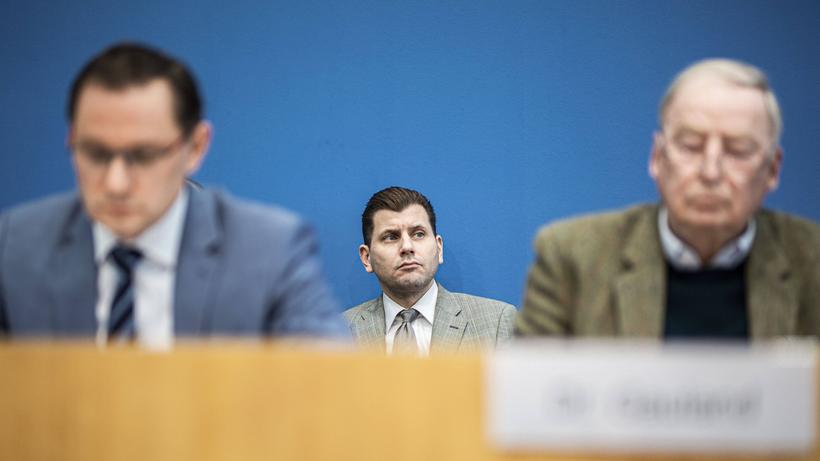
Christian Lüth: AfD-Bundesvorsitzender Tino Chrupalla, Christian Lüth und Alexander Gauland, Fraktionsvorsitzender der Partei im Bundestag (von links nach rechts), aufgenommen am 24. Februar während einer Pressekonferenz nach der Wahl zur Hamburger BürgerschaftAfD-Bundesvorsitzender Tino Chrupalla, Christian Lüth und Alexander Gauland, Fraktionsvorsitzender der Partei im Bundestag (von links nach rechts), aufgenommen am 24. Februar während einer Pressekonferenz nach der Wahl zur Hamburger Bürgerschaft © Florian Gaertner/​imago images


Die Alternative für Deutschland hat ihren langjährigen Partei- und Fraktionspressesprecher Christian Lüth am Freitag "mit sofortiger Wirkung freigestellt". Das hat ZEIT ONLINE exklusiv aus Kreisen der Partei erfahren. Die Freistellung Lüths ist ein überraschender Schritt, denn der 43-Jährige arbeitete seit den Anfangstagen der AfD 2013 für die Partei und gilt als enger Vertrauter der Parteiführung und im Besonderen des Ehrenvorsitzenden und Fraktionsvorsitzenden Alexander Gauland.
Der Freistellung vorausgegangen war ein Gespräch vor einigen Wochen, an dem auch der aktuelle Parteichef Tino Chrupalla teilgenommen haben soll. Daraufhin leitete die AfD eine "arbeitsrechtliche Prüfung" ein, die am Ende vergangener Woche zum Rauswurf von Lüth führte. Die Entscheidung der Personalie habe Gauland selbst getroffen und danach den Fraktionsvorstand informiert. Die Prüfung soll durch den Juristen und Düsseldorfer AfD-Bundestagsabgeordneten Roman Reusch erfolgt sein. Parteichef Chrupalla bestätigte die Entlassung am Sonntag ZEIT ONLINE.
Grund für den Rauswurf soll nach Informationen von ZEIT ONLINE unter anderem auch Lüths Einstellung zum Nationalsozialismus gewesen sein. 
Christian Lüth soll sich wiederholt selbst als "Faschist" bezeichnet haben und mit Bezug auf seinen Großvater von seiner "arischen" Abstammung gesprochen haben. 
Wolfgang Lüth war Korvettenkapitän und hatte im Zweiten Weltkrieg als U-Boot-Kommandant der Kriegsmarine gekämpft. Dafür hatte er von Adolf Hitler persönlich das Eiserne Kreuz erhalten. Aus arbeitsrechtlichen Gründen wollte sich Tino Chrupalla nicht zu den genauen Gründen der Freistellung äußern. 
Nach einem Studium der Wirtschaftsinformatik in Stuttgart wechselte Christian Lüth an die FU Berlin und studierte Politikwissenschaft. Nach seinem Diplomabschluss arbeitete er als Mitarbeiter eines FDP-Abgeordneten im Bundestag. Nach zwei Jahren wechselte er zur FDP-nahen Friedrich-Naumann-Stiftung, wo er als Projektleiter nach Honduras ging. 2011 wollte er ins damals von FDP-Minister Dirk Niebel geführte Bundesministerium für wirtschaftliche Zusammenarbeit zurück nach Berlin wechseln. Als der Versuch scheiterte, arbeitete er wieder als Mitarbeiter eines FDP-Bundestagsabgeordneten.
Nachdem die FDP 2013 nicht wieder in den Bundestag gewählt wurde, orientierte sich Lüth um und heuerte nach sieben Jahren im Umfeld der Liberalen nun bei der AfD an. Zuerst wirkte er als Pressesprecher der AfD, nach dem Einzug der Partei in den Bundestag 2017 dann als Sprecher der AfD-Bundestagsfraktion. 
Damals berichtete der Stern, dass Lüth seinen  Lebenslauf geschönt haben soll. Im politischen Berlin gilt Lüth schon lange als wenig verlässlicher Ansprechpartner, er soll sich Journalisten gegenüber aggressiv verhalten und sie wiederholt angelogen haben, sein Spitzname unter einigen Berichterstattern war seitdem "Lügen-Lüth". 
Auf Anfrage war Christian Lüth am Sonntag nicht erreichbar, um sich zu den Vorwürfen zu äußern. 
https://www.zeit.de/politik/deutschland/2020-04/christian-lueth-afd-entlassung-fraktionssprecher-rechtsradikalismus

Germany's Covid-19 expert: 'For many, I'm the evil guy crippling the economy'


Germany's Covid-19 expert: 'For many, I'm the evil guy crippling the economy'


Germany’s leading coronavirus expert Christian Drosten on Merkel’s leadership, the UK response and the ‘prevention paradox’


ChristianChristian Drosten: ‘Herd immunity is not the whole story.’ Photograph: Reuters

Sun 26 Apr 2020 

Christian Drosten, who directs the Institute of Virology at the Charité Hospital in Berlin, was one of those who identified the Sars virus in 2003. As the head of the German public health institute’s reference lab on coronaviruses, he has become the government’s go-to expert on the related virus causing the current pandemic.
In an exclusive interview, Drosten admits he fears a second deadly wave of the virus. He explains why Angela Merkel has an advantage over other world leaders – and why the “prevention paradox” keeps him awake at night.
Q: Germany will start to lift its lockdown gradually from Monday. What happens next?
A: 
At the moment, we are seeing half-empty ICUs in Germany. This is because we started diagnostics early and on a broad scale, and we stopped the epidemic – that is, we brought the reproduction number [a key measure of the spread of the virus] below 1. Now, what I call the “prevention paradox” has set in. People are claiming we over-reacted, there is political and economic pressure to return to normal. The federal plan is to lift lockdown slightly, but because the German states, or Länder, set their own rules, I fear we’re going to see a lot of creativity in the interpretation of that plan. I worry that the reproduction number will start to climb again, and we will have a second wave.
Q: If the lockdown were kept in place longer, could the disease be eradicated?
A:
 There is a group of modellers in Germany who suggest that by prolonging lockdown here for another few weeks, we could really suppress virus circulation to a considerable degree – bringing the reproduction number below 0.2. I tend to support them but I haven’t completely made up my mind. The reproduction number is just an average, an indication. It doesn’t tell you about pockets of high prevalence such as senior citizens’ homes, where it will take longer to eradicate the disease, and from where we could see a rapid resurgence even if lockdown were extended.
Q: If there were such a resurgence, could it be contained?
A:
 Yes, but it can’t happen based on human contact-tracing alone. We now have evidence that almost half of infection events happen before the person passing on the infection develops symptoms – and people are infectious starting two days prior to that. That means that human contact-tracers working with patients to identify those they’ve been exposed to are in a race against time. They need help to catch all those potentially exposed as quickly as possible – and that will require electronic contact-tracing.
Germany: number of coronavirus deaths per day
Starting from day of first reported death
Apr0100200300400500117
Data from Johns Hopkins University at 18:01 UTC 26 Apr 2020
Q: How close we are to achieving herd immunity?
A:
 To achieve herd immunity we need 60-70% of the population to carry antibodies to the virus. The results of antibody tests suggest that in Europe and the US, in general, we are in the low single digits, but the tests are not reliable – all of them have problems with false positives – and herd immunity is also not the whole story. It assumes complete mixing of the population, but there are reasons – in part to do with the social networks people form – why the whole population may not be available for infection at any given time. Networks shift, and new people are exposed to the virus. Such effects can drive waves of infection. Another factor that could impact herd immunity is whether other coronaviruses – those that cause the common cold, for example – offer protection to this one. We don’t know, but it’s possible.
Q: Should all countries be testing everybody?
A:
 I’m not sure. Even in Germany, with our huge testing capacity, and most of it directed to people reporting symptoms, we have not had a positivity rate above 8%. So I think targeted testing might be best, for people who are really vulnerable – staff in hospitals and care homes, for example. This is not fully in place even in Germany, though we’re moving towards it. The other target should be patients in the first week of symptoms, especially elderly patients who tend to come to hospital too late at the moment – when their lips are already blue and they need intubation. And we need some kind of sentinel surveillance system, to sample the population regularly and follow the development of the reproduction number.
Q: What is known about the seasonality of the virus?
A:
 Not a lot. The Harvard modelling group led by Marc Lipsitch has suggested that transmission might slow over the summer, but that it will be a small effect. I don’t have better data.
Q: Can we say for sure that the pandemic started in China?I think so. On the other hand, I don’t assume that it started at the food market in Wuhan. It is more likely to have started where the animal – the intermediate host – was bred.
Q: What do we know about that intermediate host – is it the “poor pangolin”, as it’s come to be known?
A:
 I don’t see any reason to assume that the virus passed through pangolins on its way to humans. There is an interesting piece of information from the old Sars literature. That virus was found in civet cats, but also in raccoon dogs – something the media overlooked. Raccoon dogs are a massive industry in China, where they are bred on farms and caught in the wild for their fur. If somebody gave me a few hundred thousand bucks and free access to China to find the source of the virus, I would look in places where raccoon dogs are bred.
Q: Will it be useful to identify patient zero – the first human to have been infected with this virus?
A
: No. Patient zero is almost certain to have acquired a virus that is very similar to some of the first sequenced viruses, so it wouldn’t help us solve our current problem. I don’t think you could even argue that it would help us prevent future coronavirus pandemics, because humanity will be immune to the next Sars-related coronavirus, having been exposed to this one. Other coronaviruses could pose a threat – a prime candidate is the Middle East respiratory syndrome (Mers) virus – but to understand that threat we have to study how Mers viruses are evolving in camels in the Middle East.
Q: Are human activities responsible for the spillover of coronaviruses from animals into people?Coronaviruses are prone to switch hosts when there is opportunity, and we create such opportunities through our non-natural use of animals – livestock. Livestock animals are exposed to wildlife, they are kept in large groups that can amplify the virus, and humans have intense contact with them – for example through the consumption of meat – so they certainly represent a possible trajectory of emergence for coronaviruses. Camels count as livestock in the Middle East, and they are the host of the Mers virus as well as human coronavirus 229E – which is one cause of the common cold – while cattle were the original hosts for coronavirus OC43, which is another.
Confirmed cases of Covid-19 for selected countries
Showing the number of cases since the day of the 100th case, using a log scale. Data correct at 23.59 UTC 25 April
01020304050607080901001,00010,000100,0001,000,000FranceGermanyItalyJapanSpainUKUSAustraliaChina
Source: Johns Hopkins CSSE Note: The CSSE states that its numbers rely upon publicly available data from multiple sources, which do not always agree

Q: Flu has always been thought to pose the greatest pandemic risk. Is that still the case?
A: Certainly, but we can’t rule out another coronavirus pandemic. After the first Ebola outbreak, in 1976, people thought it would never come back again, but it took less than 20 years to do so.
Q: Is all the science being done around this coronavirus good science?
A:
 No! Early on, in February, there were many interesting preprints [scientific papers that have not yet been peer-reviewed] around. Now you can read through 50 before you find something that’s actually solid and interesting. A lot of research resources are being wasted.
Q: Angela Merkel has been praised for her leadership during this crisis. What makes her a good leader?She’s extremely well-informed. It helps that she’s a scientist and can handle numbers. But I think it mainly comes down to her character – her thoughtfulness and ability to reassure. Maybe one of the distinguishing features of a good leader is that they are not using this present situation as a political opportunity. They know how counterproductive that would be.
Q: From where you stand, how is the UK handling the situation?
A:
 It’s clear that testing was implemented a little bit too late in the UK. Public Health England was in a position to diagnose the disease very early on – we worked with them to make the diagnostic test – but rollout in Germany was driven in part by market forces, which made it fast, and that wasn’t the case in the UK. Now, though, I have the impression that the UK is really gaining momentum in this regard, and that it is coordinating testing efforts better than Germany.
Q: What keeps you awake at night?
A:
 In Germany, people see that the hospitals are not overwhelmed, and they don’t understand why their shops have to shut. They only look at what’s happening here, not at the situation in, say, New York or Spain. This is the prevention paradox, and for many Germans I’m the evil guy who is crippling the economy. I get death threats, which I pass on to the police. More worrying to me are the other emails, the ones from people who say they have three kids and they’re worried about the future. It’s not my fault, but those ones keep me awake at night.

GOP memo urges anti-China assault over coronavirus


Politics, Policy, Political News - POLITICO


GOP memo urges anti-China assault over coronavirus

The Senate Republican campaign arm distributed the 57-page strategy document to candidates.


Donald Trump

President Donald Trump has repeatedly touted a ban on travel from China as a key success in curbing the spread of coronavirus. | Drew Angerer/Getty Images


04/24/2020 04:41 PM EDT

The National Republican Senatorial Committee has sent campaigns a detailed, 57-page memo authored by a top Republican strategist advising GOP candidates to address the coronavirus crisis by aggressively attacking China.

The memo includes advice on everything from how to tie Democratic candidates to the Chinese government to how to deal with accusations of racism. It stresses three main lines of assault: That China caused the virus “by covering it up,” that Democrats are “soft on China,” and that Republicans will “push for sanctions on China for its role in spreading this pandemic.”

“Coronavirus was a Chinese hit-and-run followed by a cover-up that cost thousands of lives,” the April 17 memo states.
The document urges candidates to stay relentlessly on message against the country when responding to any questions about the virus. When asked whether the spread of the coronavirus is Trump’s fault, candidates are advised to respond by pivoting to China.

“Don’t defend Trump, other than the China Travel Ban — attack China,” the memo states.

Republicans have indicated they plan to make China a centerpiece of the 2020 campaign. Trump’s reelection campaign recently released a web video painting Joe Biden as cozy with the authoritarian country. The pro-Trump super PAC America First Action has launched several TV commercials tying Biden to China.


Advisers to the president say polling shows China-focused attacks would be effective, and the reelection campaign has weighed a major TV ad campaign focused on the topic.
The NRSC memo shows that Republicans are also eager to make China an issue in down-ballot races. It was distributed by the Senate GOP campaign arm, though it was not explicitly drafted by or for the committee. It was authored by the political consulting firm of Brett O’Donnell, a veteran Republican strategist who has advised Secretary of State Mike Pompeo and Arkansas Sen. Tom Cotton.

Jesse Hunt, an NRSC spokesman, said: “We routinely send campaigns different documents and sources of information dozens of times per week. That’s the role of the party committee, especially in these volatile times.”

O’Donnell declined to comment.

The memo includes guidance on what Republican candidates can say when asked whether blaming China for the pandemic incites racism. Candidates are urged to respond by saying that, “No one is blaming Chinese Americans. This is the fault of the Chinese Communist Party for covering up the virus and lying about its danger. This caused the pandemic and they should be held accountable.”

“No one has suffered more from the murderous Communist Chinese Party dictatorship than the people of China,” the memo adds. “We stand with them against their corrupt government that caused this pandemic.”

The GOP’s planned China-focused assault, however, is complicated by Trump’s occasional praise for President Xi Jinping. The liberal organization American Bridge recently launched a commercial which plays a clip of the president praising Xi and declares that Trump “gave China his trust.”


--------------------------------------------------------------------

GOP  "Corona Big Book" 2020 electoral attackplan against the Democrates (PDF)