
’He’s mentally unstable’: Iranian American in Congress condemns Trump’s war and pushes for his removal
Democratic representative Yassamin Ansari says the war has only more deeply entrenched the Iranian regime
Donald Trump is an “evil human being” who “wants to be an emperor” and should be removed from office over the war in Iran, Yassamin Ansari, an Iranian American member of the US Congress, has told the Guardian.
Ansari, the daughter of Iranian immigrants who decades ago fled the regime, spoke out after the president threatened to wipe out Iran’s civilisation before backing down and announcing an uncertain two-week ceasefire.
As news of the truce broke on Tuesday night, Ansari said in a statement she was “momentarily relieved for the 90 million Iranians who just spent the worst 24 hours of their lives thinking they were about to face nothing short of a nuclear catastrophe”.
But the Arizona Democrat maintained that Trump’s dire promises of genocide and war crimes warrant intervention by the cabinet or Congress. Earlier on Tuesday, Ansari warned that the president represents a clear and present danger to Iran, the US and the world.
“There is no doubt in my mind he is mentally unstable and not all there but I also believe he is a deeply troubled, evil human being that only cares about himself and his family,” she said in a phone interview. “He has shown that throughout his entire life. He has shown that throughout his presidency by ripping away healthcare and basic necessities from the average American, while he and his family have made billions of dollars.”
On the presidential campaign trail, Ansari noted, Trump promised an “America first” ideology that would keep the country out of bitter foreign entanglements such as those in Vietnam, Afghanistan and Iraq. Instead his second term has gone in the opposite direction, with the president launching military strikes on seven countries.
“The one thing that even some Democrats were excited about when he was running for office was that he seemed to campaign on this promise of ending endless wars, and yet, over the last six months in particular, he has demonstrated he is not just a wannabe authoritarian but wants to be an emperor.”
She pointed to an array of rogue foreign policy manoeuvres: the possibly illegal abduction of Nicolás Maduro in Venezuela, threats to seize Greenland, the systematic ruin of the US’s standing within Nato and casual talk of taking over Cuba. And in Iran, she argues, the Trump administration has already committed what legal experts define as war crimes by deliberately bombing schools, bridges and hospitals.
“I cannot believe we are in this moment. I cannot believe that this is happening in the United States and I cannot believe there are not more people doing everything that they can to stop this.”
Ansari, 34, is the sole Iranian American Democrat in Congress. Her father came to the US in the early 1970s on a student visa and intended to go back but, in the wake of the Islamic revolution in 1979, deemed it unsafe to return. Her mother arrived in 1981, fleeing the regime’s clampdown on women’s rights. Some of Ansari’s extended family still live in Iran but, she said, are “in a constant state of anxiety about what is to come and what hell will break loose”.
In January this year, thousands of Iranians were killed in a violent crackdown on nationwide protests – the deadliest period of repression by the regime in decades. When the US and Israel launched military strikes on Iran on 28 February, Trump urged the people to rise up and overthrow their government.
Ansari reflected: “I knew in that moment that Iranians had recently undergone a horrific massacre at the hands of their own regime, where thousands were brutally murdered by the Islamic Republic for protesting and demanding a better future. Iranians have tried to rise up against their regime for 47 years to no avail and, because of that desperation, many were asking for intervention or foreign help.
“But I know Donald Trump: I’m an American congresswoman, I’ve been living this reality for 15 months and I have lived through the first Trump administration. I knew that these were false promises being made to Iranians.
“Donald Trump does not care about Americans; he doesn’t care about democracy or freedom or human rights for the American people; so in what world would we ever believe that he cares about freedom or human rights or democracy for Iranian people? It is just a fantasy.”
The death of Iran’s supreme leader, Ayatollah Ali Khamenei, at the dawn of the war brought thousands of Iranian Americans to the streets of US cities to celebrate, with some even imitating Trump’s YMCA dance routine. A group of Iranian Americans chanted “Thank you Trump!” at last month’s Conservative Political Action Conference (CPAC) in Texas. But others are having unsettling doubts.
Ansari said: “Similar to the 30% of Americans who are still blindly supporting Donald Trump and Maga despite the fact that every action he’s taking is against their interests, sadly there is a segment of the Iranian diaspora that is doing this. I think it’s wrong.
“But I can tell you that the tide has changed significantly as this war has gone on because even some of those who initially felt hope and this could lead to positive change have now seen the true intention of the United States and Israel and the action, which has been to bomb universities, commit war crimes, talk about Iranians as though they are animals.
“Donald Trump has said just in the last weekend that he will bomb the country into the stone ages, that there will be no civilisation left. Doesn’t get more apocalyptic than that.”
after newsletter promotion
If anything, the Islamic Revolutionary Guard Corps appears to have tightened its grip on power. Khamenei, who was 86, has been succeeded by his son, Mojtaba Khamenei, who is 56. Trump himself acknowledged this week that citizens know staging a protest could result in their execution. Ansari observed: “This regime has not gone anywhere. The regime in Iran is deeply entrenched.”
It is able to exploit the destruction of civilian infrastructure for its own propaganda purposes, she added. “They will be able to say, ‘Look, the United States and Israel are our enemies, as we’ve been saying.’ They’re not going anywhere. This is an ideological fanatical regime that is willing to die for the cause. There’s also an issue of just a lack of understanding of who they are dealing with when it comes to the Islamic Republic.
“Iranians are going to be worse off after this with all of their civilian infrastructure destroyed, a more repressive regime and an economy absolutely in shambles. There will be mass starvation in the country. There will be a food security crisis in the country. I’ve talked to people inside Iran about how hard it’s been and this joint fear of the bombs and the lack of regard for human life from those who are bombing Iran to the threat of the regime that will continue to crack down.”
The regime has deliberately cut off the internet to plunge the population into darkness, making communication nearly impossible. But this week Ansari spoke to a 25-year-old doctor in northern Iran using a VPN. “He described to me both the horrors that he witnessed in January during the massacres but also explained to me that, since this war has started, the price of everything has doubled and the economy was already in a horrific state.
“The message that he asked me to relay to the administration and publicly in the United States was: please do not hit civilian infrastructure, this only plays into the hands of the regime, this will only strengthen them and hurt the civilian population of this country that historically has always been very pro-west, that wants regime change, that wants a better future, and these actions that we’re taking are again completely playing into our enemy’s hands.”
This stands in contradiction to Trump’s recent press conference claims that the Iranian people actively welcome the American bombing of their cities. Ansari commented: “To say that they want the bombing of civilian infrastructure like bridges and power plants and schools and hospitals – that is absolutely incorrect and wrong and heartbreaking that the president of the United States would make such a disgusting claim.”
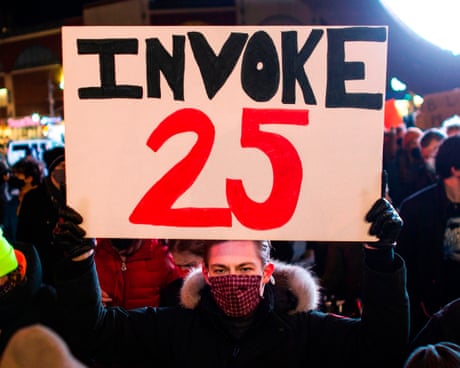
Ansari has called for the cabinet to step in and invoke the 25th amendment to the constitution to remove a president who is deemed unfit for office. “I do not understand how Vice-President JD Vance, who is somebody with a history of campaigning against endless wars, has not spoken up, has not started organising the cabinet to remove Donald Trump.”
Next week Ansari also intends to introduce articles of impeachment against Pete Hegseth, the defence secretary, for repeatedly violating his oath of office and duty to the constitution. “He has committed a number of impeachable offences throughout his tenure already and it is far past time that he go,” she explained.
“His willingness to carry out Donald Trump’s orders and commit war crimes so callously and without any remorse is not somebody that should be holding such an important position that could result in loss of life for not just thousands but millions of human beings, so I had no other choice but to file articles of impeachment and I expect to get a lot of support from colleagues.”
Ansari will be working to enlist colleagues and organise days of action and protest across the country. She warned: “I believe this is a five-alarm-fire moment like we have never before seen in our country’s history, at least in modern history, and we should all be doing what we can to stop it.”
The US and Iran have been estranged for more than a generation since the militant takeover of the US embassy in Tehran by Islamist revolutionaries in 1979 and holding for 444 days of 52 US hostages. President George W Bush put Iran in the “axis of evil” along with Iraq and North Korea; the Trump administration has labelled it the world’s leading state sponsor of terrorism. The Iranian embassy in Washington lies empty.
Ansari, who speaks Farsi and wrote her college thesis on Iran’s nuclear breakout capacity, thinks most Americans lack understanding of Iran. “We have had 47 years of a hostile relationship between the United States and Iran and, very tragically, most Americans don’t know what the average Iranian is like,” she said. “They don’t know this is a civilisation that dates back thousands of years, that originally was Zoroastrian; Islam came to the country much later.
“They don’t know about the food and the music and the very hospitable culture of Iranian people and traditions around the spring equinox and dance and singing. This is a very vibrant culture, a very educated population that very tragically has been repressed by a horrific regime for 47 years. But bombing the civilian infrastructure of a country like this will not liberate its people.”
https://www.theguardian.com/world/2026/apr/10/yassamin-ansari-representative-congress-iran-trump
