donderdag 12 december 2019

‘She was so dangerous’: where in the world is the notorious Ghislaine Maxwell?



‘She was so dangerous’: where in the world is the notorious Ghislaine Maxwell?

Emine Saner

Thu 12 Dec 2019 

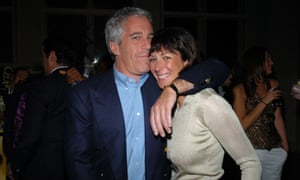
Ghislaine Maxwell with Jeffrey Epstein: the two seemed mutually dependent. Ghislaine Maxwell with Jeffrey Epstein: the two seemed mutually dependent. Photograph: Patrick McMullan via Getty Images

In the months since Jeffrey Epstein died in prison, his former partner has disappeared. Will she ever return to face her accusers?


R
iding up on a white horse, Ghislaine Maxwell made quite the impression. “She’s got the whole equestrian attire. She’s so elegant,” recalls Maria Farmer. Farmer was 26 and trying to build a career as an artist when she was invited to stay at a ranch in Ohio with Maxwell and run an art project.

It was the mid-90s and this was the second time the two had met. Farmer had encountered Maxwell and her friend Jeffrey Epstein at her New York Academy of Art graduate show. She would go on to work for the pair for a year, at the front desk of Epstein’s Manhattan mansion. She was perfectly placed to see who came to the house – and says she witnessed young teenagers being brought through the doors by Maxwell. Following an alleged sexual assault by Maxwell and Epstein, Farmer went to the police. She was ignored.
More than 20 years on, her account – along with the testimonies of several other women, including an allegation of abuse from her younger sister, Annie, who was 16 at the time – has helped to create a picture of Epstein as a prolific sex offender, who abused countless underage girls. It is a scandal that has drawn in other powerful men, most notably Prince Andrew. One woman, Virginia Giuffre, says she was trafficked by Epstein to have sex with Andrew on three occasions. He has repeatedly denied the allegations, most recently in his disastrous TV interview.
In July, Epstein was charged with sex trafficking, and in August he killed himself in his prison cell while awaiting trial. Since then, attention has turned to Maxwell, 57, his right-hand woman. Yet Maxwell has seemingly vanished. “From what we know, Ghislaine Maxwell was a principal enabler to Jeffrey Epstein when he was alive,” says the lawyer Dan Kaiser. Kaiser is representing Jennifer Araoz, one of the women who says she was raped by Epstein, and who is suing his estate, Maxwell and three other “enablers”.
Maxwell in 2001 at her London house standing behind Prince Andrew and Virginia Roberts (now Giuffre).
Pinterest
 Maxwell in 2001 at her London house standing behind Prince Andrew and Virginia Roberts (now Giuffre). Photograph: Rex/Shutterstock
“She was integral in maintaining the sex trafficking ring,” says Kaiser. “She provided important administrative services in terms of the hiring of recruiters, and management of those employees, the making of appointments and dates for interactions between Mr Epstein and the underage girls that were providing sexual services to him. She also maintained the ring by intimidating girls, by ensuring their silence.”
Kaiser continues: “Jeffrey Epstein couldn’t have done what he did for as long as he did it without the services of somebody like Ghislaine Maxwell. She is as culpable, in my judgment, as Jeffrey Epstein himself.” Maxwell has always denied the allegations and has never faced criminal charges. Her lawyer has not responded to a request for comment.
It is believed that Maxwell and Epstein met shortly after the death of her father, the media tycoon Robert Maxwell. After his suspicious fall from the yacht he had named after his daughter – the Lady Ghislaine – in 1991, a £460m black hole was discovered in his companies’ pension fund. Maxwell was the youngest, and said to be favourite, of his nine children. They were close, and she was devastated by his death.
She had moved to New York that year, after her father bought the New York Daily News. In London, she had become something of a socialite and she set about becoming the same in Manhattan. It is not known how Epstein and Maxwell met, but she is thought to have been his girlfriend initially. In a 2003 Vanity Fair profile, he described her as his “best friend”.
“She was always the most interesting, the most vivacious, the most unusual person in any room,” the journalist Vicky Ward wrote in that Vanity Fair profile. “Her Rolodex would blow away almost anyone else’s I can think of.” Her British accent – shaped by Marlborough College, then Oxford University – was considered exotic by 90s New Yorkers. She seemed unusually accomplished, too. If what has been said is true, she is a helicopter and submarine pilot and speaks four languages.
Maxwell with (from left) Donald Trump, Melania and Epstein, in 2001, at Mar-a-Lago.
Pinterest
 Maxwell with (from left) Donald Trump, Melania and Epstein, in 2001, at Mar-a-Lago. Photograph: Davidoff Studios/Getty Images
The journalist Conchita Sarnoff knew Maxwell and Epstein socially before the pair began dating, and later helped to expose Epstein’s crimes. She says of Maxwell: “She seemed in love when I first saw them together. I believe Jeffrey was taking care of her. I feel Ghislaine clung to Jeffrey because she felt protected by him.” She says Epstein, whom she describes as chilly, with limited social skills, “seemed less in love but more enamoured”.
Tom Bower, who authored a biography of Robert Maxwell, wrote in a piece for the Times in August that Maxwell “worshipped rich, domineering men”. In Epstein, a financier, she would have found someone who could restore the extravagant lifestyle she desired – after the death of her father, her finances were reduced. She and Epstein seemed mutually dependent – she on the financier’s money, he on her contacts and social ease.
Her social standing was such that it would probably be easier to list the influential people to whom Maxwell was not connected. She was close to Bill Clinton and attended Chelsea Clinton’s wedding; she donated to Hillary Clinton’s presidential campaign. There are photographs of Maxwell with Arianna Huffington, Elon Musk and Michael Bloomberg. She knew Donald Trump and members of the Kennedy family. She was connected to the British royal family through Prince Andrew and Sarah Ferguson. Maxwell and Epstein – who loaned Ferguson money to pay off debts – were guests of Andrew at events, including some at Windsor castle, Balmoral and Sandringham.
Prince Andrew, in his recent Newsnight interview, said guests at the parties and dinners in Epstein’s New York mansion included “academics, politicians, people from the United Nations”. But we know now that it was not just influential friends Maxwell cultivated. One of her friends, Euan Rellie, told Tatler: “Every single interesting, pretty, new girl to arrive in New York would end up going for tea with Ghislaine, then being introduced to Jeffrey. She was the acceptable face of a rather mysterious billionaire.”
To New York society, Maxwell legitimised Epstein. As the New Yorker writer Ariel Levy put it in Broken, her podcast about the Epstein case, if you’re a teenage girl and a man approaches you in a car “you know to keep on walking. But if it’s another woman, and she sounds all fancy and well-educated, you’re probably going to get in the car.”
Virginia Giuffre on Panorama. Giuffre claims she was trafficked by Jeffrey Epstein and forced to have sex with Prince Andrew when she was a teenager, allegations that Andrew has repeatedly denied.
Pinterest
 Virginia Giuffre on Panorama. Giuffre claims she was trafficked by Jeffrey Epstein and forced to have sex with Prince Andrew when she was a teenager, allegations that Andrew has repeatedly denied. Photograph: BBC Panorama/PA
“Ghislaine was key in making me feel safe,” Farmer says. “I trusted her because she is a woman. She would make us trust her, she would make us really care about her. My sister even said that she would feel so special if Ghislaine paid attention to her because she had that way about her, you know, the popular girl in school, she was one of those. She knew everybody.” Her voice cracks. “She was so dangerous.” Farmer says Maxwell would do anything to get what she wants, “and all of it for her is about power and money”.
She was charming initially, says Farmer. “Everyone [was] like: ‘This woman is so intelligent and interesting.’ She had a really great personality when you first met her.” But it didn’t take long for her to become verbally abusive towards the staff, she says. “I was one of the staff. I would have to go to Jeffrey and say: ‘Ghislaine’s verbally abusing me again.’ Then he would scream at her. It was all like ‘good cop, bad cop’, and they loved playing that game with everybody.”
Once, she says, Ivana Trump visited. “Quite often, with people like Ivana – powerful [people] – Ghislaine would say ‘Hop in the car, you can go on a ride with us’ and it was supposed to be my special little treat.” Then, as soon as they were back at the mansion, Maxwell would switch and shout at her, she says. She also says she could be threatening. “They had video cameras everywhere [in the house], and Ghislaine liked to intimidate by talking about the cameras. She’d say: ‘They’re watching you.’”
Farmer alleges that Maxwell would bring in a steady stream of young girls to the mansion, often saying she was casting for Victoria’s Secret, the lingerie company owned by Leslie Wexner, a close friend of Epstein. “It was really weird to me. I’m like [the] ‘models are so young’, and she said: ‘Yeah, but they need these models for Victoria’s Secret. They go as young as 13 now in modelling.’” Farmer alleges Maxwell would recruit teenagers from schools on the Upper East Side and in Central Park.
“Ghislaine controlled the girls,” said Sarah Ransome, who claims she was abused by Epstein, in a recent Panorama interview. “She would be the one getting all the girls in check. She knew what Jeffrey liked … this was very much a joint effort.” In the same documentary, Giuffre recalls travelling back to Maxwell’s house in London after a night at a club with Prince Andrew: “In the car, Ghislaine tells me that I have to do for Andrew what I do for Jeffrey.”
It is alleged that Maxwell was not only an enabler for Epstein’s abuse, but took part in it. In her Panorama interview, Giuffre, then known as Virginia Roberts, recounted how Maxwell and Epstein abused her at his Palm Beach house after Maxwell had recruited her from her job working as a spa attendant at Donald Trump’s Mar-a-Lago resort. In 1996, Farmer says Maxwell and Epstein sexually assaulted her. She went to the police as well as more than one FBI agent, none of whom took action. She also spoke to Ward in 2002 for a Vanity Fair profile – Ward has since said that the then-editor Graydon Carter cut out the entire part about Farmer and her sister after being pressured by Epstein. A spokeswoman for the magazine has said: “Epstein denied the charges at the time and since the claims were unsubstantiated and no criminal investigation had been initiated, we decided not to include them in what was a financial story.”
Maxwell (in green dress) at Royal Ascot in 2000, with Prince Andrew (second from left) and Jeffrey Epstein (far right).
Pinterest
 Maxwell (in green dress) at Royal Ascot in 2000, with Prince Andrew (second from left) and Jeffrey Epstein (far right). Photograph: Rex/Shutterstock
Maxwell and Epstein’s relationship seems to have been complex. Sarnoff says Maxwell once told her she wanted very much to marry Epstein. “Maxwell is very clever,” Sarnoff says. “In spite of her personal insecurities, as a result of her father’s death and financial challenges, I believe she nevertheless knew exactly what she was doing when she agreed to solicit girls on his behalf. However, I don’t think that phase of their relationship began until she understood Epstein would not marry her.”
Farmer says Maxwell told her they were married. In another interview, this time with the Miami Herald, which has doggedly investigated Epstein, Giuffre alleges Maxwell had asked her to have a child with Epstein and hand the baby over for Maxwell and Epstein to raise; she would be paid an allowance of $200,000 a month.
Ransome, who says she was kept for six months on Epstein’s private island and claims she was raped several times a day, said: “They were never like a couple. Jeffrey and Ghislaine were best friends, or like brother and sister. Never holding hands or kissing. And she wasn’t his employee.”
When Maxwell found that Farmer had spoken out, she made threatening calls – Farmer says she has been in hiding “for many years”. “Ghislaine kept threatening my life. She found out where I was living, and she would send messages to me or I would get a call and I would have to move again. Most of her threats were veiled, like: ‘You better look over your shoulder because there’s someone coming for you.’ She told me she was going to burn all my paintings, my career was burned.”
In 2015, Giuffre sued Maxwell for defamation, after Maxwell said she was lying about the allegations she had made. The case was settled out of court and Maxwell began retreating from public view.
She was no longer seen in public with Epstein after his 2008 conviction for soliciting an underage girl for prostitution. For this, he was given an 18-month prison sentence, in a sweetheart plea deal that saw an investigation into his abuse of more than 30 underage girls (for which he could have been given a life sentence) shut down. He served just 13 months, much of it on day release.
Four years after this Paola Tholstrup, a model who had been friendly with Maxwell in the 90s met her at a funeral. “She hadn’t changed exactly, but she was hyper, and talking very fast,” says Tholstrup. “All she seemed to want to talk about was the ocean and the charity she was involved in.” Those who knew Maxwell say the charity helped her rebrand herself after allegations against her were being reported.
In August, Maxwell was photographed in a burger restaurant in Los Angeles. She has not been seen since, although there have been press reports suggesting that she is preparing to do her own TV interview.
Kaiser says he has not been able to serve Maxwell with legal papers “because she’s off hiding somewhere”. Does he have any idea where she is?
“No, I wish I did. We’ve looked various places so far to no avail. We thought we had a lead in some compound in Colorado, a very good friend of hers, a wealthy family – we thought she might be there, but we’re not sure. I expect the FBI knows exactly where she is. They may be building a case. I don’t believe they’ve given up on pursuing some of [Epstein’s] enablers and I have to believe that would include Maxwell.”
Sarnoff thinks Maxwell is in a country that does not have an extradition treaty with the US.
There have been attempts to portray Maxwell as another of Epstein’s victims – someone who was in thrall to this rich, powerful man, just as she was to her father. The journalist Mark Edmonds, who has been writing about Maxwell, said recently she was “possibly a victim, too … It was a tricky relationship.”
“She is not a victim,” says Farmer, appalled. “She is a victimiser.”
Additional reporting by Lucy Osborne

Topics

dinsdag 10 december 2019

Israel’s Scheme To Defund the BDS Movement


(Photo by Anna Ferensowicz/Lightrocket via Getty)
Israel’s Scheme To Defund the BDS Movement
Told they are enabling terrorists, banks cut off pro-Palestinian activists.
NOVEMBER 11, 2019
AS END-OF-THE-YEAR FUNDRAISING REACHED A FEVER PITCH in December 2018, the account that the BDS National Committee (BNC) was using to receive donations became disabled. The BNC—the Palestinian group that leads the global movement to boycott, sanction and divest from Israel as leverage against human rights abuses—immediately suspected the Israeli government.
The BNC’s account was with Donorbox, a fundraising platform used by thousands of organizations. Donorbox explained in a statement that, while it had nothing against the Boycott, Divestment and Sanctions (BDS) movement, a letter it received from Shurat HaDin–Israel Law Center accused the BNC of ties to terrorism, and Donorbox closed the BNC’s account while “reviewing evidence.” Shurat HaDin has deep ties to the Israeli government.

An employee of Donorbox agreed to speak with In These Times on condition of anonymity, saying he feared for his personal safety because those involved have connections to Israeli intelligence and Palestinian political factions. “Shurat HaDin pressured one of our payment processors, which pressured us,” he wrote in an email.
The BNC quickly found an alternative to Donorbox and lost less than 12 hours of fundraising time, but the shutdown sent a stark signal: The Israeli government and its allies are coming for the BDS movement’s financial infrastructure.
“[Shurat HaDin is] pursuing McCarthyite legal warfare,” said Omar Barghouti, co-founder of the BDS movement, in a statement at the time. “[It’s] a desperate attempt to undermine our ability to challenge Israel’s decades-old regime of apartheid and oppression.”
The tactic fits into a larger trend of cross-border attacks on civil society waged by repressive governments. China has reportedly spied on and intimidated activists in Europe working against policies targeting its Uighur Muslim minority, and Saudi Arabia has reportedly tried to hack into the phones of Amnesty International and dissidents living overseas.
In These Times has found that the account shutdown is the fruit of a much larger global campaign of litigation against the BDS movement. In filing lawsuits and legal threats, the Israeli government has cooperated with pro-Israel nonprofits around the world—backed, in some cases, by tax-subsidized donations from Americans, including Christian Zionists. Since 2013, in addition to at least two legal threats targeting the movement’s financial infrastructure, Shurat HaDin filed at least five complaints or lawsuits against boycott advocates and threatened to file two more. Shurat HaDin’s U.S. targets ranged from the Presbyterian Church to the United Electrical, Radio and Machine Workers of America to Airbnb.
Both Shurat HaDin and the International Legal Forum (another Israeli group with ties to the Israeli government) appear to be escalating their activities in the United States, according to In These Times’ investigation. In July, the Berkman Law Office, a New York firm, registered as a foreign agent for Shurat HaDin. In May, the Zionist Advocacy Center, a pro-Israel legal group run by New York lawyer David Abrams, registered as a foreign agent for the International Legal Forum. Documents filed as part of that registration show that Abrams will be assisting the group in “submitting reports of terrorist connections to financial services firms and prosecuting authorities.”

THE CALL FOR BOYCOTTS, DIVESTMENT, and sanctions originated with a coalition of Palestinian civil society groups—refugees, women’s groups, unions and others—in 2005, modeled on the global movement against apartheid in South Africa. The movement has three demands: 
1. an end to Israel’s occupation and separation wall, 
2. equality for Palestinian citizens of Israel, and 
3. the right of return for Palestinian refugees and descendants of refugees expelled by Israeli forces during Israel’s founding in 1948. 
Until those demands are met, BDS calls for boycotting and divesting from Israel and companies that violate Palestinian rights, as well as for international sanctions on Israel, such as ending military and free trade agreements.
The movement has successfully focused international attention on Israel’s blockade of Gaza and its system of military occupation and settlement-building on Palestinian land. In the United States, the movement has enjoyed a recent surge in prominence—and an accompanying backlash. In 2018, Reps. Rashida Tlaib (D-Mich.) and Ilhan Omar (D-Minn.) endorsed BDS, becoming the first two federal elected officials to support boycotting Israel. In July, Congress overwhelmingly passed a bill condemning BDS, with all but 16 Democrats voting in favor. However, the Democratic Party rallied behind Tlaib and Omar a month later when Israel banned the pair from visiting Israel and Palestine.
The BDS movement threatens to become a growing public relations problem for Israel’s carefully cultivated image as a liberal democracy, which is how BDS found itself in the crosshairs of the Israeli Ministry of Strategic Affairs. The cabinet-level office is devoted to combatting threats identified by Prime Minister Benjamin Netanyahu’s right-wing government, ranging from Iran to the Palestinians to the BDS movement, and draws on the resources of Israel’s national intelligence agency, the Mossad.
The Ministry finances and leads a campaign of online trolling, legal harassment and intelligence-gathering against BDS activists worldwide, according to investigative reports by Israeli newspaper Haaretz and the Qatari-funded English-language news agency Al Jazeera, among other outlets. 
BuzzFeed, for example, reported in September 2018 that the U.S. conservative mega-donor Sheldon Adelson had helped fund a “digital political astroturfing” app called Act.IL, created by ex-Israeli intelligence officers in partnership with the Israeli government, in which users are rewarded for completing pro-Israel “missions” online. 
Missions include arguable harassment of BDS proponents, such as petitioning an employer to fire a pro-Palestinian activist or posting the identities of George Washington University students who confidentially voted to support BDS.
“[The Ministry’s] attacks on the BDS movement are part of a larger campaign to stifle the growing support for Palestinian rights, using dirty tactics including cyberbullying and false legal claims that intimidate and try to silence criticism of Israeli policy,” says Rebecca Vilkomerson, who was executive director of the pro-BDS Palestine solidarity group Jewish Voice for Peace for ten years. “These disingenuous attacks—including anti-BDS legislation at the state and national level—lead directly to violations of our First Amendment right to free speech.”
In These Times has determined that, starting late in 2018, the Ministry teamed up with Shurat HaDin and the International Legal Forum to shut down pro-BDS financial accounts. Representatives of both Shurat HaDin and the International Legal Forum confirmed to In These Times that they collaborate with Israel’s Ministry of Strategic Affairs, and according to Israeli government documents reviewed by In These Times, the International Legal Forum receives direct funding from the Ministry.
But the full story of exactly why the BNC’s Donorbox account was shut down didn’t emerge until this past June. In a report sent to journalists, the Ministry revealed that an “undisclosed economic campaign” over the past two years had resulted in the closure of 30 financial accounts belonging to organizations as varied as the BNC and Al-Haq, a globally respected Palestinian human rights NGO.
In the Donorbox case, Shurat HaDin and the Ministry argued that the BNC was linked to terrorism by its connection to the Council of National and Islamic Forces in Palestine. The Council is made up of the leading Palestinian political factions, including militant groups like Hamas and Islamic Jihad, which are on the U.S. State Department’s list of foreign terrorist organizations. This information wasn’t secret and didn’t require some sophisticated intelligence operation; the Council is listed as a member on BNC’s website.
Shurat HaDin alleged that BNC fundraising could be in violation of the U.S. law that prohibits “material support” to terrorism, a statute the ACLU says is overly broad and potentially criminalizes freedom of association and humanitarian support in areas where militant groups operate. The Center for Constitutional Rights dismissed Shurat HaDin’s complaint to Donorbox as relying on “unsupported and false claims that funds raised by the BNC ‘may’ go to groups designated as terrorist organizations by the U.S. government.”
Meanwhile, the anonymous Donorbox employee tells In These Times, “Our company does not have the capability to investigate if U.S.-sanction[ed] groups are working with BDS. Thus, we are stuck between a rock and the hard place.”
The open collaboration between the Ministry and Israeli nonprofit groups to shut down the financial infrastructure of Palestinian rights groups is a new front in Israel’s battle against the nonviolent BDS movement. But it isn’t the first time Israel’s government has used hardball tactics to combat BDS.

Right-wing Israeli Prime Minister Benjamin Netanyahu confers with Strategic Affairs Minister Gilad Erdan (right) on Oct. 8, 2015. Erdan’s ministry is tasked with defending Israel against threats identified by the Netanyahu government, including the Boycott, Divestment and Sanctions movement. (Photo by Gali Tibbon/AFP/Getty Images)
ISRAEL’S MINISTRY OF STRATEGIC AFFAIRS was founded in 2006, but Israel didn’t pay much attention to the nascent BDS movement until late 2009-10, according to Yossi Kuperwasser, who served as director general of the ministry from 2009-14.
That period was a turning point for efforts to hold Israel accountable for its policies toward Gaza, the coastal strip that has been battered by Israeli assaults and economically devastated by an Israeli land, air and sea blockade. In September 2009, the UN Human Rights Council released a report authored by Richard Goldstone, a respected Jewish South African judge, who accused both Israel and Palestinian militant groups of war crimes and possible crimes against humanity during Israel’s 2008-09 assault on Gaza. Then, in May 2010, Israeli commandos raided a Turkish ship trying to break the sea blockade of Gaza, killing nine people. That episode sparked international condemnation of Israel’s excessive use of force and of its policies toward Gaza, and Israel ultimately loosened the blockade.
The Goldstone report and the attempt to break Israel’s blockade were not BDS initiatives, but they did fuel BDS calls to hold Israel accountable for human rights abuses. Kuperwasser explains that if an eminent figure like Goldstone could accuse Israel of possible war crimes, it meant that the BDS movement’s efforts to “delegitimize” Israel might convince liberals.
“This [idea of delegitimizing Israel] was ... a red light,” Kuperwasser tells In These Times. “The most important thing [was] to prevent the movement of this idea from the extreme progressive part [to] ... reasonable people.”
Since that period, Kuperwasser says, the Ministry of Strategic Affairs has stepped up its efforts to undermine activists calling for the boycott of Israel. Its budget has steadily grown. In 2015, the Ministry received about $2.5 million; by 2017, that budget had more than quintupled to $13.2 million. In late 2017, the Israeli government, as a whole, announced it would set aside $72 million to attack BDS.
Using that money, the Ministry of Strategic Affairs has embarked on a campaign of surveillance and propaganda targeting the BDS movement.
Because Israel controls all entry and exit points to the Palestinian territories, perhaps the Ministry’s most potent tool is a 2017 law allowing Israel to bar supporters of BDS from entering Israel and Palestine. While the Ministry of the Interior has ultimate authority over whom it lets in, the Ministry of Strategic Affairs supplies the Interior with information about critics of Israel to guide those decisions. Members of U.S.-based organizations Jewish Voice for Peace, American Friends Service Committee and Code Pink have been banned, in addition to Reps. Tlaib and Omar in August. The law is also being used to deport Omar Shakir, Human Rights Watch’s Israel-Palestine director. Shurat HaDin kicked off the deportation with a 2017 petition to the Israeli government.
To carry out its attacks on BDS, the Ministry has drawn on the resources of the Mossad. In 2018, according to the Israeli newspaper Haaretz, Strategic Affairs Minister Gilad Erdan met with Mossad head Yossi Cohen to discuss “the struggle against the boycott.”
But perhaps the Ministry’s most prominent partner in this effort is Shurat HaDin. Founded in 2003, the nonprofit has made headlines for suing Iran and the Palestinian Authority to win settlements for Israeli and U.S. victims of militant attacks, with help from the Mossad. Yair Netanyahu, the son of Israeli Prime Minister Benjamin Netanyahu, worked as social media coordinator for Shurat HaDin for nearly a year.
Shurat HaDin has threatened the BDS movement and filed multiple lawsuits aimed at undermining it. Shurat HaDin asked the U.S. Internal Revenue Service in 2014 to revoke the tax-exempt status of the Presbyterian Church after the church divested from three corporations involved in the occupation of Palestine; filed a complaint with the National Labor Relations Board in 2016 after the United Electrical, Radio, and Machine Workers of America endorsed BDS; and sued Airbnb on behalf of Israeli settlers for discrimination in 2018 after the home-sharing company decided to remove Jewish-only West Bank settlement listings from its platform. The Airbnb complaint in particular turned U.S. federal law on its head by arguing that delisting the settlements, despite discriminating against Palestinians, is a violation of the Fair Housing Act, a major civil rights-era law. (After heavy pressure from pro-Israel groups, Airbnb reversed its decision earlier this year and the lawsuit was settled.)
Shurat HaDin has not succeeded in U.S. federal courts with its attacks on the right to boycott, but that doesn’t matter much. Shurat HaDin is backed by a network of donors, many of them U.S. foundations, whose annual tax-exempt donations underwrite a never-ending series of legal claims that tie up their targets in expensive litigation. Those donations include $1.1 million from U.S. foundations and nonprofits over the past decade, according to an In These Times review. Among its most prominent donors are John Hagee Ministries, the evangelical ministry run by far-right Christian Zionist John Hagee, which has donated at least $225,000 to Shurat HaDin; the Jewish Federation of Greater Houston, which has given $475,000; and the Michael and Andrea Leven Family Foundation, run by Michael Leven, the former COO of Sheldon Adelson’s casino empire Las Vegas Sands, which has sent $25,000.
“They have a lot of resources, so they can throw a lot of spaghetti at the wall,” says Liz Jackson, a senior staff attorney for Palestine Legal, which defends Palestine advocates’ free speech rights and has defended those whom Shurat HaDin has targeted. “[They] paint anyone who’s an advocate for human rights as a terrorist. ... It’s a win-win strategy because they have enough money that they can afford to lose. And even when they lose a case, they get media.”
Shurat HaDin tells In These Times that it directly collaborated with the Ministry of Strategic Affairs in at least two instances. “Sometimes, if they need a warning letter or other legal action to be taken, and they themselves as the Israeli government cannot do it, they ask us to write the letter or bring the legal action,” Nitsana Darshan-Leitner, founder and director of Shurat HaDin, tells In These Times.
In addition to targeting the BNC’s Donorbox account, Darshan-Leitner says Shurat HaDin teamed up with the Ministry to go after the bank account of Jewish Voice for a Just Peace in the Middle East, a German NGO. The alleged crime? In 2019, its parent group, European Jews for a Just Peace, invited Rasmea Odeh, a Palestinian woman accused by Israel of taking part in a militant attack carried out by the Popular Front for the Liberation of Palestine, to speak at an event. Odeh denies participation and says her confession about the attack was tortured out of her by Israeli forces.
In response to the pressure, the Bank for Social Economy shut down the German group’s bank account. The International Legal Forum, for its part, has formed a global network to go after critics of Israel in courts around the world, with official backing from Israel’s Ministry of Strategic Affairs. The organization’s head is Yifa Segal, who previously worked as a lawyer for Shurat HaDin. Segal confirmed to In These Times in an interview that the group has accepted Ministry funding.
In Israel, the International Legal Forum defended an anti-BDS law that lets Israelis sue boycott advocates. In Spain in 2015, it assisted action against cities that passed resolutions endorsing BDS—one city then withdrew its pro-BDS resolution, and another resolution was nullified by a Spanish judge. In the United States, it advocated against a 2016 State Department reminder that products made in illegal West Bank settlements should not be labeled as “made in Israel.” In October 2018, it sued the city of Durham, N.C., and its police chief for discrimination because a non-binding City Council resolution opposed the Durham police doing military-style international trainings. The resolution passed at the request of Palestinian rights organizers who lobby against police training exchanges between U.S. police and Israeli forces.
In September 2017, the Ministry filed documents announcing it would pay the Israel Bar Association to partner with the International Legal Forum in organizing a conference on anti-BDS legal strategies. In 2018, the Ministry announced its intention to provide up to $1 million in financial assistance to the International Legal Forum to foster an international network of attorneys to promote legal research on BDS.
Now, the International Legal Forum has registered as a foreign agent in the United States, tapping the Zionist Advocacy Center to file legal claims about alleged terrorism. It remains unclear what, exactly, that means and which organizations will be targeted. David Abrams, Zionist Advocacy Center executive director, twice told In These Times he had “no comment” for this story.
In the registration documents, Abrams states the International Legal Forum does not take foreign funding, despite what In These Times learned from Israeli government documents and was told by the International Legal Forum’s president, Yifa Segal, herself.
There’s concern among Palestinian rights advocates that Abrams and others are laying the groundwork to step up more financial and legal fights against BDS advocates, but leaders in the BDS movement say they are uncowed and view the response as a measure of their success.
“The Israeli far-right regime’s relentless and desperate measures of repression against the BDS movement are failing,” BDS movement co-founder Omar Barghouti tells In These Times. “The movement’s supporters are increasing like never before, its impact is growing steadily and impressively, and its fundraisers are hitting new records. While Israel is now a model for authoritarian and fascist forces, from Italy to Hungary to Brazil to Saudi Arabia and the United Arab Emirates, the BDS movement for Palestinian rights has become an integral part of the global anti-fascist and progressive wave that strives for freedom, justice and equality for all.”
ALEX KANE is a New York-based freelance journalist who writes on U.S. foreign policy in the Middle East.
This investigation was supported by the Leonard C. Goodman Institute for Investigative Reporting. Skyler Aikerson fact-checked this story; Mairav Zonszein contributed translation and reporting.