
Reflections from an Argentinian survivor of the October 7th attack
JVL Introduction
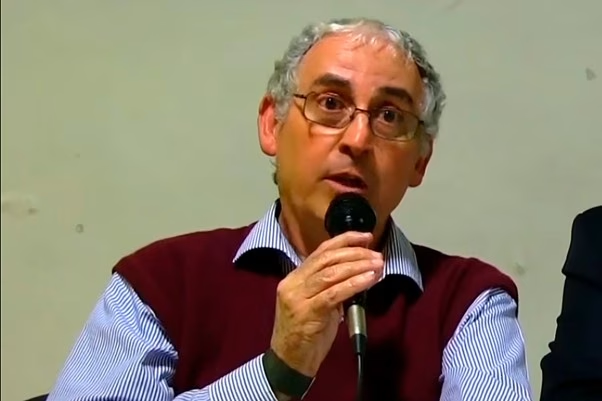
This article reports an interview with Pedro Goldfarb who lived in Kibbutz Nir Itzchak near the border with Gaza. He and his wife survived two waves of attacks on October 7th 2023; attack by Hamas and then civilians, because the door to the safe room was stuck.
His response has been to double down on the call for a peaceful political solution for Israel and Palestine.
He sees Zionist ideology as a root cause of the precarity of Israel’s security and the mass murder, the genocide, of the Palestinians. He calls on Israel to “abandon Zionism”.
Born and schooled in Buenos Aires he was a member of Hashomer Hatzair, for secular socialist Jewish youth. He left the Argentine dictatorship to emigrate to Israel in 1981.
Soon disillusioned with Israeli state racism, he joined the Communist Party. He says that October 7th has made him more left wing and he will stay in Israel and fight for peace “to the end”.
(Translated from the original Spanish article entitled “Tras el 7 de octubre soy más pacifista e izquierdista que antes”)
TB
This article was originally published by Paginal12 on Wed 7 Oct 2026. Read the original here.

"After October 7th I am more pacifist and more left-wing than before"
The attackers didn’t realize that the shelter door opened outward, and he survived. The traumatic experience of three years ago reaffirmed his choice for a peaceful solution and he argues that the root problem is Zionist ideology
Reflection on October 7th 2023: Pedro Goldfarb, Argentine survivor of the Hamas attack on Kibbutz Nir Itxhak
Pedro Goldfarb survived October 7, 2023, in Israel. Pedro Goldfarb attended secondary school in the mid-1970s at the Colegio Nacional Buenos Aires and was part of the political ferment through his activism in the Hashomer Hatzair movement of secular socialist Jews.
But within a few years he abandoned Zionism as an ideology and joined the Communist Party of Israel. In 1981, after graduating as a surveyor from the UBA, he emigrated to Israel to Kibbutz Nir Itzchak, facing the Palestinian cities of Khan Yunis and Rafah—near Egypt—one of those attacked on October 7, 2023 :
He escaped by a miracle and recounts it in an interview in sociologist Guillermo Levy’s book, Sobre los escombros de Gaza (Marea 2025). The account is chilling: “At 6:20 a.m. something unheard-of happened.
We were used to missiles occasionally coming from Gaza; we’d go into the safe room, listen to five minutes of missiles, tanks or Army helicopters, and everything would return to normal. That morning it wasn’t one or two, but twenty. For 15 minutes it was missiles and anti-missiles flying back and forth.
A relative who works in security asked me on WhatsApp: ‘Pedro, what’s happening there? There are rumours that terrorists entered from Gaza and are invading the kibbutzim.’
Nothing had happened at my house yet, but I realized things were getting ugly. Liata Tzili called me, she lived in Kibbutz Nir Oz. We were in contact and, suddenly, we heard no more from her. We learned that she was one of those taken to Gaza and she returned after two months.
We locked ourselves in the internal shelter. At 7:45 I started telling everyone on the phone: ‘I can’t talk because I have terrorists in my house.'”
From inside there, could you hear what was happening in the rest of the house?
For four hours, two different groups of terrorists were inside my house. The first was an armed group that shot up the whole house and destroyed what they could. I had on a nightstand my passport and money for an operation I had to have they stole everything there was.
They were there for an hour and a half and even had time to sit down, open the fridge, eat and drink calmly. I had bottles of wine. Since they are Muslims, they don’t drink. And they devoted themselves to breaking them. My wife is of Iraqi origin; she listened to everything and translated for me what was happening outside.
They burned our car and tried to set fire to my house, but they didn’t find the gas key, which is hidden in a cupboard. They tried to open the safe room and couldn’t. I have problems with my hands; they have no strength, so it was my wife who grabbed the handle, straining to keep them from getting in. And she didn’t let them in.
But wasn’t there a security lock or key?
No. They were only missile shelters. The thing is that, luckily for us, the door of the safe room opens outward. And these guys tried to get in by pushing inward. So, my wife pushed from inside and they also pushed from outside inward: they were helping her.
Half an hour into not being able to open it, they said: ‘There’s nobody here, so there’s nothing to do here.’ In a moment of desperation, I said to my wife: ‘Listen, leave the door aside, get into the bed, I’ll go out and surrender, so they don’t take you.’
She said: ‘We both come out alive or nobody comes out alive. So don’t play the hero.’ Sometime later I realized that in Nir Oz there were similar situations. The husband surrendered and the wife was saved. And he was killed when he was held captive in Gaza. We were in the room until 5:30 in the afternoon: eleven hours. I was in my underwear; my wife was in her nightgown.
It’s strange that they didn’t shoot at the lock. The door is metal, but that’s the weak point.
That’s what I ask myself to this day. My neighbor Moshe Rozen, an Argentine, was shot in the hand, precisely because he was holding the lock.
How did the siege continue?
When the first group left, we thought we had escaped. But half an hour later another one arrived. They were inhabitants of Khan Yunis or Rafah who came to steal. I had some orthopaedic shoes at the entrance of the house and they stole them. They left me their flip-flops. We realized they were ordinary people because we heard the flip-flops. They also tried several times to get into the room and couldn’t.
That second group wasn’t armed?
No. They divided up the rooms to steal. Only at 5:30 did the Israeli soldiers arrive. We heard one saying to the other: ‘Nobody came out alive here.’ They knocked on the door and my wife was afraid: her chest hurt a lot from all the effort she had made.
They told us: ‘We’re from the army.’ We didn’t know whether to answer. Later we learned that there were cases of people who came from the other side of the border dressed as Israeli soldiers and several opened the door: they were killed.
How did we realize they were Israeli soldiers? Because one said: ‘I’m the paramedic.’ I had asked for a paramedic by phone because of my wife’s pains. And Arabs pronounce the P as B. So, I said to my wife: ‘He didn’t say “baramedic”, he said paramedic; he must be one of ours.’ So, we opened.
How many people from Nir Itzhaki died?
Six people: Shajar Iaron, Ofek Arazi, Oren Goldin, Boaz Abraham, Lior Fabian Rudaeff, Tal Haimi, Ela Hamoi and Ofir Melman. They were the members of the Security Force who defended us with the little they had; they died in combat.
My neighbour’s son fell because he was in the group that went out to defend the kibbutz, Ofec Arazi. A very close friend of my daughter died; she was shot at the Nova festival. A soldier died near here.
And there were four kidnapped, neighbours from the house behind mine. Clara, who is a member of the group that emigrated with me in 1981. With her were her sister, her brother and her partner. Clara was released during the first months. And the other two were rescued by the army.
How did Israeli society change after October 7?
It changed tremendously. Tolerance disappeared from the map. Gadi Moses is one of the founders of this kibbutz, who returned from his captivity in the tunnels of Gaza. He was the one responsible for the Rosh Hashanah celebration. As every year, he released doves as a wish to find peace with our neighbours on the other side of the border. When that reached social media, they threatened and cursed him: ‘Why did we do everything possible to save you? You should have stayed in Gaza.’
The same happened with Yohebet Lifshitz, who returned from captivity and when she was interviewed, blamed Netanyahu for being directly responsible for everything that happened on October 7. And again: people without scruples flooded her with messages sending her back to Gaza.
In recent weeks we are seeing that there is almost no official response from the government to Jewish terrorism. I say it with all the words: Jewish terrorism. Jewish terrorists attacking Palestinians in the West Bank, simply for attacking them.
It’s not that the Palestinians did something to them, they just attack out of revenge. They carry out pogroms against innocent people who live in the West Bank and who want to live in peace, like our people who want to live in peace.
I already said this in the article in the book Sobre los escombros de Gaza: that one of the important things that happened to me—and I say it without blushing—was that I arrived in 1981 in Israel with a Zionist youth group and within a few years, I had a tremendous disappointment with the policies of the State, not only against the Palestinians of Gaza and the West Bank, but also against the Arab Israeli inhabitants who live inside Israel.
I abandoned Zionism and joined the Communist Party that is part of the Front for Peace and Equality, Hadash.
The disappointment is tremendous. In that article I say that Israel is on the edge of the precipice, considering the popular responses around the world to what is happening in Gaza.
Do you regret having gone to Israel?
At the time, I didn’t say that the entire Argentine people were in favor of Videla’s civic-military dictatorship. In the same way, I can’t generalize and say that all the inhabitants of Israel are racists, colonialists and fascists. Because it’s not the truth.
My children have been asking me that same thing for three years. After my heart attack following October 7, my history students asked me to come back to school. And they asked me two questions. ‘How do you feel?’ And the second: ‘Did you change your way of thinking?’
And to their surprise, I said: ‘Yes, I changed my way of thinking. Now I’m more left-wing than before.’
About regret, my children asked me the same. And I told them: ‘No, I don’t regret emigrating. I already escaped once. And if I left Argentina in 1981, I won’t escape twice: I stay here and I fight it to the end.'”
We have interviewed the Israeli historian Omer Bartov, who breaks the taboo without shame: he said that the underlying problem is supremacist Zionist ideology.
Israel, in order to improve anything, in order to overcome all this, first of all has to abandon Zionism, nothing less than its foundation.
To be a Zionist and to be progressive is a contradiction. The problems of the State of Israel are two.
The first is Zionism.
The second is that the leaders believe that the U.S. is the solution, when in truth it is the secondary axis of the problem.
Is Zionism racism?
The people who call themselves Zionists and are from the extreme right—the religious fanatics and also part of the liberal right—and who do not treat the neighbours of Gaza and the West Bank equally on the one hand, and the Arab inhabitants of the State of Israel themselves, are xenophobic and feed the internal and external colonialism of the State.
A Meretz leader was asked in the press ‘what is Zionism’ and said: ‘It is loving Israel.’
The Meretz party calls itself social democratic, but in my judgment, it has the same sick foundations as the rest.
The Zionist left in Israel does not exist; there is no Zionist left.
If one says, ‘I love Israel, I’m a Zionist,’ then is the Arab citizen of Nazareth inside Israel who says he loves the State where he lives a Zionist?
Let’s talk from the opposite perspective: that of a Palestinian exiled during the Nakba to Gaza in 1948.
Some still live and their children and grandchildren have been bombed, massacred in the March of Return and blockaded all their lives.
Could a Palestinian militant or an ordinary civilian who crossed into Israel to kill, steal and take revenge, discriminate between pacifist and non-pacifist Israelis?
Someone once taught me that the more aggressively I treat my enemy and do everything possible to dehumanise him and give him no voice or vote, the greater the thirst for revenge will be.
That’s why, when someone asks me how I see the matter, here there are two peoples. And it will take, perhaps one or two generations, to try to carry out a process of base re-education.
Ehud Barak was prime minister of Israel and said: ‘If I were a young Palestinian of the right age, at some point I would have joined one of the terrorist organizations.’
I can’t start blaming people who came to assassinate me; I can’t say, ‘I’m a pacifist, don’t assassinate me.’ Because the matter comes from the base: as I told my students, the problem is that 16- and 17-year-old Israelis see no alternative other than going to the army and killing; the more they can kill, the better.
How many years did it take South Africa to end this? Several generations. And they didn’t reach an extraordinary solution, but at least they are trying to modify the entire apparatus of relations between whites and blacks, after so many years of apartheid.
What can I expect from a 12- or 13-year-old who lives among the rubble of Rafah or Khan Yunis? That he loves me? But everything possible must be done so that this changes. I don’t think I’ll see it, but at least my children will. I have three grandchildren.
What country am I leaving them? What shitty zone am I leaving them when the people who were most identified with a leftist idea tell me, ‘there’s no one to talk to,’ ‘don’t you see they came to kill us?’
The problem is that they don’t conceive of a form of analysis in which they see both sides of the equation.
Here only our side of the equation is seen. The fascist, fanatic and clerical right seeks to annex Gaza and cleanse it of inhabitants.
Then they complain because they are accused of genocides. And most of the parties opposed to the government speak of establishing a military supremacy that gives us a certain pseudo-tranquillity, without giving even a mirage of a political solution.
Guillermo Levy—Sociologist and professor at the UBA and Undav—author of the book Sobre los Escombros de Gaza: del Ataque del Hamás a la Destrucción Planificada: Voces israelíes Contra la Guerra. Marea 2025.
