England’s Covid unlocking is threat to world, say 1,200 scientists
International experts say ‘unethical experiment’ could allow vaccine-resistant variants to develop
Thousands of people marching through London on 27 June calling for all restrictions to be lifted. Photograph: Wiktor Szymanowicz/NurPhoto/Rex/Shutterstock
Boris Johnson’s plan to lift virtually all of England’s pandemic restrictions on Monday is a threat to the world and provides fertile ground for the emergence of vaccine-resistant variants, international experts say.
Britain’s position as a global transport hub would mean any new variant here would rapidly spread around the world, scientists and physicians warned at an emergency summit. They also expressed grave concerns about Downing Street’s plans.
Government advisers in New Zealand, Israel and Italy were among those who sounded alarm bells about the policy, while more than 1,200 scientists backed a letter to the Lancet journal warning the strategy could allow vaccine-resistant variants to develop.
An adviser to New Zealand’s government told the summit he and his colleagues were astounded at the approach being taken in England.
“In New Zealand we have always looked to the UK for leadership when it comes to scientific expertise, which is why it’s so remarkable that it is not following even basic public health principles,” said Michael Baker, a professor of public health at the University of Otago and a member of the New Zealand ministry of health’s Covid-19 technical advisory group.
Also participating was Prof José Martin-Moreno of the University of Valencia, a senior adviser to the World Health Organization (WHO), who said: “We cannot understand why this is happening in spite of the scientific knowledge that you have.”
Others warned the British government’s approach would be imitated, for political expediency, by authorities elsewhere.
“What I fear is that that the some of the worst impulses in many of our states will follow the UK example,” said Dr William Haseltine, a former Harvard Medical School researcher and a pioneering Aids researcher who chairs Access Health International, a New York-based thinktank.
Prof Christina Pagel, the director of University College London’s clinical operational research unit, told the meeting: “Because of our position as a global travel hub, any variant that becomes dominant in the UK will likely spread to the rest of the globe. The UK policy doesn’t just affect us. It affects everybody and everybody has a stake in what we do.”
The letter to the Lancet said: “We believe the government is embarking on a dangerous and unethical experiment, and we call on it to pause plans to abandon mitigations on July 19, 2021.”
“The world is watching the current avoidable crisis unfold in the UK,” said Dr Deepti Gurdasani, a clinical epidemiologist and senior lecturer at Queen Mary University of London, who is taking part in Friday’s summit.
She added on Twitter: “Let’s be under no illusions – we are in a country where our government is taking steps to maximally expose our young to a virus that causes chronic illness in many. Our govt is ending all protections for our children including isolation of contacts of cases in schools & bubbles.”
The concerns expressed in other countries comes after Prof Chris Whitty, the chief medical officer for England, warned on Thursday that the number of people in hospital with Covid-19 could reach “quite scary” levels within weeks, as cases soared caused by the more contagious Delta variant and the lifting of lockdown restrictions.
Whitty said in a webinar late on Thursday, hosted by the Science Museum, that hospital admissions were doubling about every three weeks, and that the current low numbers of Covid admissions could rise to serious levels in the next couple of months.
New coronavirus infections in the UK are at a six-month high, according to government figures, and the number of people in hospital and dying with Covid are at their highest level since March. Thursday’s data showed 3,786 people in hospital with Covid and another 63 virus-related deaths.
Downing Street, which has defended the lifting of all remaining legal restrictions on social gatherings in England on 19 July, is hoping the rapid rollout of vaccines will keep a lid on the number of people becoming seriously ill.
Vladimir Putin personally authorised a secret spy agency operation to support a “mentally unstable” Donald Trump in the 2016 US presidential election during a closed session of Russia’s national security council, according to what are assessed to be leaked Kremlin documents.
The key meeting took place on 22 January 2016, the papers suggest, with the Russian president, his spy chiefs and senior ministers all present.
They agreed a Trump White House would help secure Moscow’s strategic objectives, among them “social turmoil” in the US and a weakening of the American president’s negotiating position.
Russia’s three spy agencies were ordered to find practical ways to support Trump, in a decree appearing to bear Putin’s signature.
Western intelligence agencies are understood to have been aware of the documents for some months and to have carefully examined them. The papers, seen by the Guardian, seem to represent a serious and highly unusual leak from within the Kremlin.
The Guardian has shown the documents to independent experts who say they appear to be genuine. Incidental details come across as accurate. The overall tone and thrust is said to be consistent with Kremlin security thinking.
Vladimir Putin holds a meeting with permanent members of the security council on 22 January 2016 at the Kremlin. Photograph: Alexei Nikolsky/Russian presidential press service/TASS
The Kremlin responded dismissively. Putin’s spokesman Dmitri Peskov said the idea that Russian leaders had met and agreed to support Trump in at the meeting in early 2016 was “a great pulp fiction” when contacted by the Guardian on Thursday morning.
The report – “No 32-04 \ vd” – is classified as secret. It says Trump is the “most promising candidate” from the Kremlin’s point of view. The word in Russian is perspektivny.
There is a brief psychological assessment of Trump, who is described as an “impulsive, mentally unstable and unbalanced individual who suffers from an inferiority complex”.
There is also apparent confirmation that the Kremlin possesses kompromat, or potentially compromising material, on the future president, collected – the document says – from Trump’s earlier “non-official visits to Russian Federation territory”.
The paper refers to “certain events” that happened during Trump’s trips to Moscow. Security council members are invited to find details in appendix five, at paragraph five, the document states. It is unclear what the appendix contains.
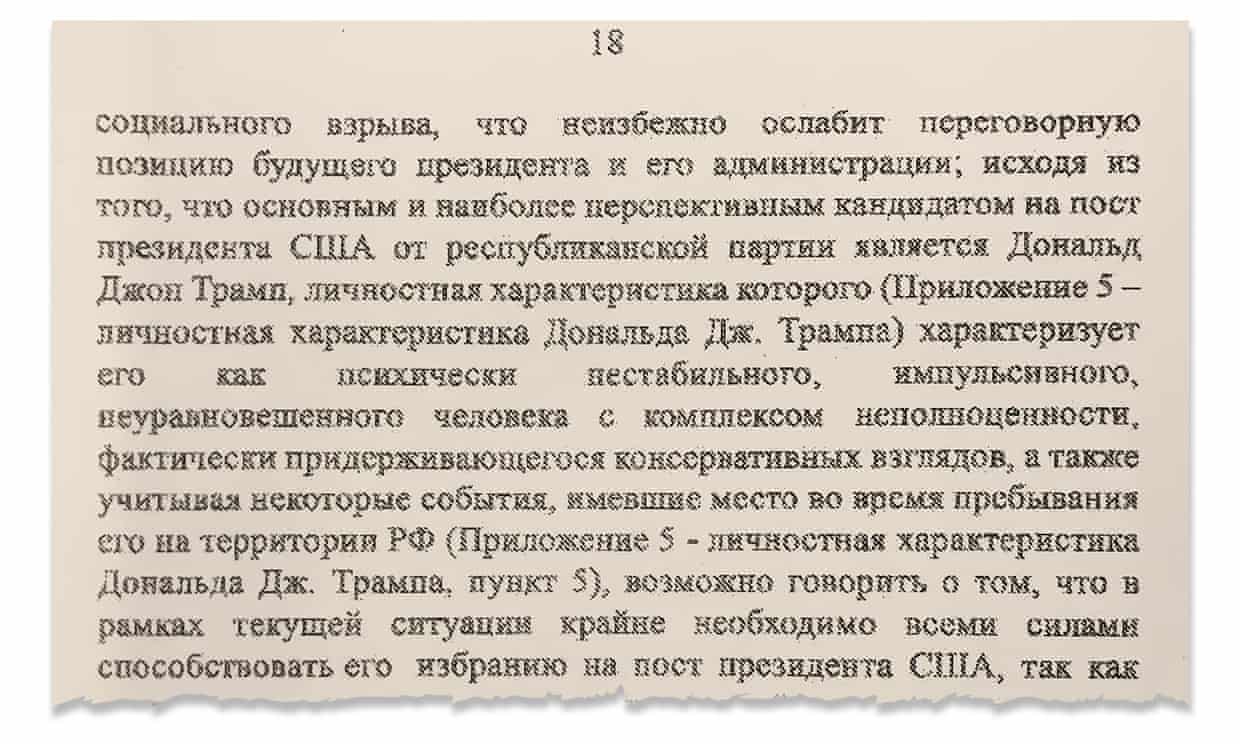
“It is acutely necessary to use all possible force to facilitate his [Trump’s] election to the post of US president,” the paper says.
This extract from a secret Kremlin document gives details of the Russian operation to help an impulsive and ‘mentally unstable’ Donald Trump to become US president
This would help bring about Russia’s favoured “theoretical political scenario”. A Trump win “will definitely lead to the destabilisation of the US’s sociopolitical system” and see hidden discontent burst into the open, it predicts.
The Kremlin summit
There is no doubt that the meeting in January 2016 took place – and that it was convened inside the Kremlin.
An official photo of the occasion shows Putin at the head of the table, seated beneath a Russian Federation flag and a two-headed golden eagle. Russia’s then prime minister, Dmitry Medvedev, attended, together with the veteran foreign minister, Sergei Lavrov.
Also present were Sergei Shoigu, the defence minister in charge of the GRU, Russia’s military intelligence agency; Mikhail Fradkov, the then chief of Russia’s SVR foreign intelligence service; and Alexander Bortnikov, the boss of the FSB spy agency.Nikolai Patrushev, the FSB’s former director, attended too as security council secretary.
According to a press release, the discussion covered the economy and Moldova.
The document seen by the Guardian suggests the security council’s real, covert purpose was to discuss the confidential proposals drawn up by the president’s analytical service in response to US sanctions against Moscow.
Donald Trump after winning the Florida state primary in West Palm Beach, Florida, in March 2016. A report prepared by Putin’s expert department recommended Moscow use ‘all possible force’ to ensure a Trump presidential victory. Photograph: Rhona Wise/AFP/Getty Images
The author appears to be Vladimir Symonenko, the senior official in charge of the Kremlin’s expert department – which provides Putin with analytical material and reports, some of them based on foreign intelligence.
The papers indicate that on 14 January 2016 Symonenko circulated a three-page executive summary of his team’s conclusions and recommendations.
In a signed order two days later, Putin instructed the then chief of his foreign policy directorate, Alexander Manzhosin, to convene a closed briefing of the national security council.
Its purpose was to further study the document, the order says. Manzhosin was given a deadline of five days to make arrangements.
What was said inside the second-floor Kremlin senate building room is unknown. But the president and his intelligence officials appear to have signed off on a multi-agency plan to interfere in US democracy, framed in terms of justified self-defence.
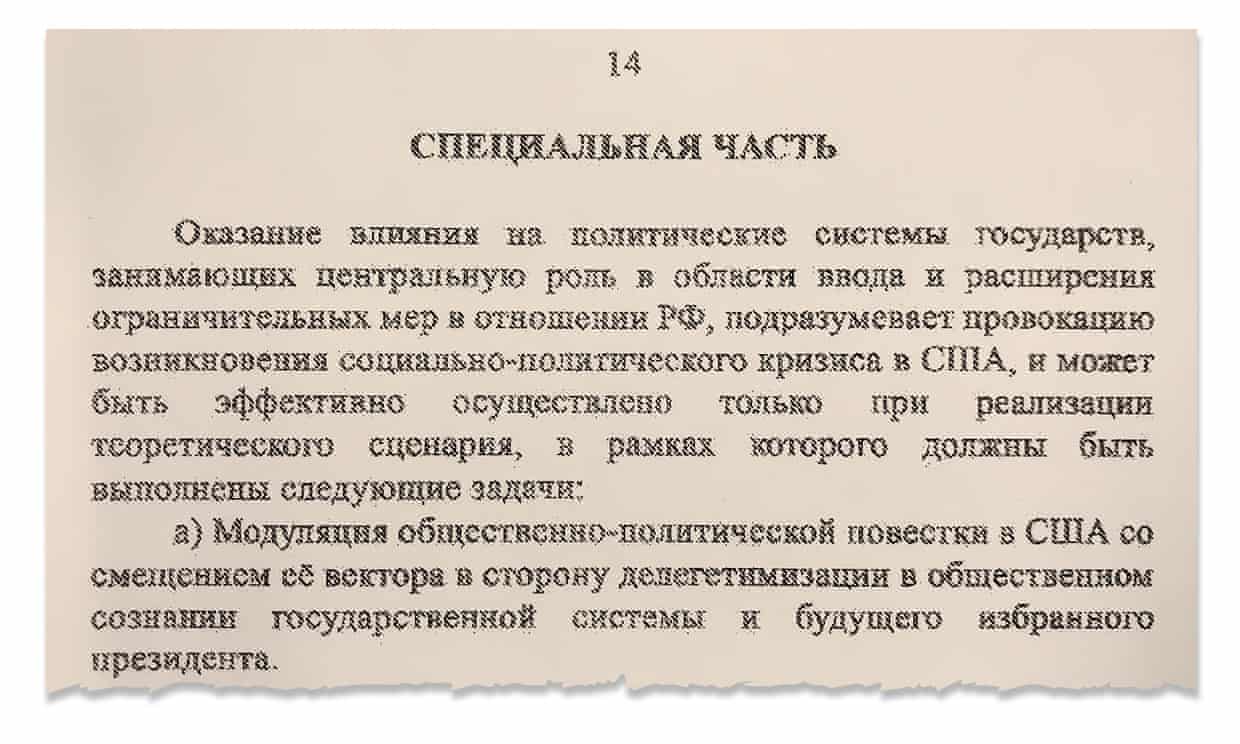
Various measures are cited that the Kremlin might adopt in response to what it sees as hostile acts from Washington. The paper lays out several American weaknesses. These include a “deepening political gulf between left and right”, the US’s “media-information” space, and an anti-establishment mood under President Barack Obama.
The ‘special part’ of a secret Kremlin document setting out measures to cause turmoil and division in America
The paper does not name Hillary Clinton, Trump’s 2016 rival. It does suggest employing media resources to undermine leading US political figures.
There are paragraphs on how Russia might insert “media viruses” into American public life, which could become self-sustaining and self-replicating. These would alter mass consciousness, especially in certain groups, it says.
After the meeting, according to a separate leaked document, Putin issued a decree setting up a new and secret interdepartmental commission. Its urgent task was to realise the goals set out in the “special part” of document No 32-04 \ vd.
Members of the new working body were stated to include Shoigu, Fradkov and Bortnikov. Shoigu was named commission chair. The decree – ukaz in Russian – said the group should take practical steps against the US as soon as possible. These were justified on national security grounds and in accordance with a 2010 federal law, 390-FZ, which allows the council to formulate state policy on security matters.
According to the document, each spy agency was given a role. The defence minister was instructed to coordinate the work of subdivisions and services. Shoigu was also responsible for collecting and systematising necessary information and for “preparing measures to act on the information environment of the object” – a command, it seems, to hack sensitive American cyber-targets identified by the SVR.
Vladimir Putin in 2016. The Russian president has repeatedly denied accusations of interfering in western democracy Photograph: Sputnik/Reuters
The SVR was told to gather additional information to support the commission’s activities. The FSB was assigned counter-intelligence. Putin approved the apparent document, dated 22 January 2016, which his chancellery stamped.
The measures were effective immediately on Putin’s signature, the decree says. The spy chiefs were given just over a week to come back with concrete ideas, to be submitted by 1 February.
Written in bureaucratic language, the papers appear to offer an unprecedented glimpse into the usually hidden world of Russian government decision-making.
Putin has repeatedly denied accusations of interfering in western democracy. The documents seem to contradict this claim. They suggest the president, his spy officers and senior ministers were all intimately involved in one of the most important and audacious espionage operations of the 21st century: a plot to help put the “mentally unstable” Trump in the White House.
The papers appear to set out a route map for what actually happened in 2016.
A matter of weeks after the security council meeting, GRU hackers raided the servers of the Democratic National Committee (DNC) and subsequently released thousands of private emails in an attempt to hurt Clinton’s election campaign.
Hillary Clinton at the Democratic party’s convention in Philadelphia, Pennsylvania, in July 2016. GRU hackers released thousands of private emails in an attempt to hurt Clinton’s election campaign. Photograph: Justin Sullivan/Getty Images
The report seen by the Guardian features details redolent of Russian intelligence work, diplomatic sources say. The thumbnail sketch of Trump’s personality is characteristic of Kremlin spy agency analysis, which places great emphasis on building up a profile of individuals using both real and cod psychology.
Moscow would gain most from a Republican victory, the paper states. This could lead to a “social explosion” that would in turn weaken the US president, it says. There were international benefits from a Trump win, it stresses. Putin would be able in clandestine fashion to dominate any US-Russia bilateral talks, to deconstruct the White House’s negotiating position, and to pursue bold foreign policy initiatives on Russia’s behalf, it says.
Other parts of the multi-page report deal with non-Trump themes. It says sanctions imposed by the US after Russia’s 2014 annexation of Crimea have contributed to domestic tensions. The Kremlin should seek alternative ways of attracting liquidity into the Russian economy, it concludes.
The document recommends the reorientation of trade and hydrocarbon exports towards China. Moscow’s focus should be to influence the US and its satellite countries, it says, so they drop sanctions altogether or soften them.
‘Spell-binding’ documents
Andrei Soldatov, an expert on Russia’s spy agencies and author of The Red Web, said the leaked material “reflects reality”. “It’s consistent with the procedures of the security services and the security council,” he said. “Decisions are always made like that, with advisers providing information to the president and a chain of command.”
He added: “The Kremlin micromanages most of these operations. Putin has made it clear to his spies since at least 2015 that nothing can be done independently from him. There is no room for independent action.” Putin decided to release stolen DNC emails following a security council meeting in April 2016, Soldatov said, citing his own sources.
Sir Andrew Wood, the UK’s former ambassador in Moscow and an associate fellow at the Chatham House thinktank, described the documents as “spell-binding”. “They reflect the sort of discussion and recommendations you would expect. There is a complete misunderstanding of the US and China. They are written for a person [Putin] who can’t believe he got anything wrong.”
Wood added: “There is no sense Russia might have made a mistake by invading Ukraine. The report is fully in line with the sort of thing I would expect in 2016, and even more so now. There is a good deal of paranoia. They believe the US is responsible for everything. This view is deeply dug into the soul of Russia’s leaders.”
Ken Starr helped Jeffrey Epstein with ‘scorched-earth’ campaign, book claims
Book by Miami Herald journalist details extraordinary efforts by special prosecutor who hounded Bill Clinton to aid sex trafficker
Ken Starr was a ‘fixer’ who ‘used his political connections in the White House to get the Justice Department to review Epstein’s case’, according to Perversion of Justice. Photograph: Rex/Shutterstock
Ken Starr, the lawyer who hounded Bill Clinton over his affair with Monica Lewinsky, waged a “scorched-earth” legal campaign to persuade federal prosecutors to drop a sex-trafficking case against the billionaire financier
Jeffrey Epstein relating to the abuse of multiple underaged girls, according to a new book.
In Perversion of Justice the Miami Herald reporter Julie K Brown writes about Starr’s role in securing the secret 2008 sweetheart deal that granted Epstein effective immunity from federal prosecution. The author, who is credited with blowing open the cover-up, calls Starr a “fixer” who “used his political connections in the White House to get the Justice Department to review Epstein’s case”.
The book says that emails and letters sent by Starr and Epstein’s then criminal defense lawyer Jay Lefkowitz show that the duo were “campaigning to pressure the Justice Department to drop the case”. Starr had been brought into “center stage” of Epstein’s legal team because of his connections in Washington to the Bush administration.
Perversion of Justice will be published next week. The Guardian obtained a copy.
When Epstein’s lawyers appeared to be failing in their pressure campaign, with senior DoJ officials concluding that Epstein was ripe for federal prosecution, Starr pulled out the stops. Brown discloses that he wrote an eight-page letter to Mark Filip, who had just been confirmed as deputy US attorney general, the second most powerful prosecutor in the country.
Filip was a former colleague of Starr’s at the law firm Kirkland & Ellis. Brown writes that Starr deployed “dramatic language” in the letter reminiscent of the Starr report, his lurid and salacious case against Clinton that triggered the president’s 1998 impeachment.
In the letter Starr begins affably, invoking the “finest traditions” of fairness and integrity of the DoJ. He then goes on to deliver what Brown calls a “brutal punch”, accusing prosecutors involved in the Epstein case of misconduct in trying to engineer a plea deal with the billionaire that would benefit their friends.
Brown reports that Epstein’s legal team also went after Marie Villafaña, the lead federal prosecutor in the case, accusing her of similarly distorting negotiations to benefit a friend of her boyfriend – an allegation she denied.
Brown cites an unnamed prosecutor linked to the 2008 case who said of the legal campaign in which Starr was central that “it was a scorched-earth defense like I had never seen before. Marie broke her back trying to do the right thing, but someone was always telling her to back off.”
The prosecutor added that someone in Washington – the book does not specify who – was “calling the shots on the case”. Villafaña warned fellow prosecutors at the time that Epstein was probably still abusing underaged girls, but according to the unnamed prosecutor quoted by Brown “it was clear that she had to find a way to strike a deal because a decision had already been made not to prosecute Epstein.”
The outcome of this process was a secret deal that only became public years later, largely through Brown’s own reporting. Given the number of victims and the severity of the allegations, Epstein got off exceptionally lightly with a sentence that saw him serve just 13 months in jail. During his sentence, Epstein was allowed out to work in his private office for 12 hours a day, six days a week, in a breach of jail norms.
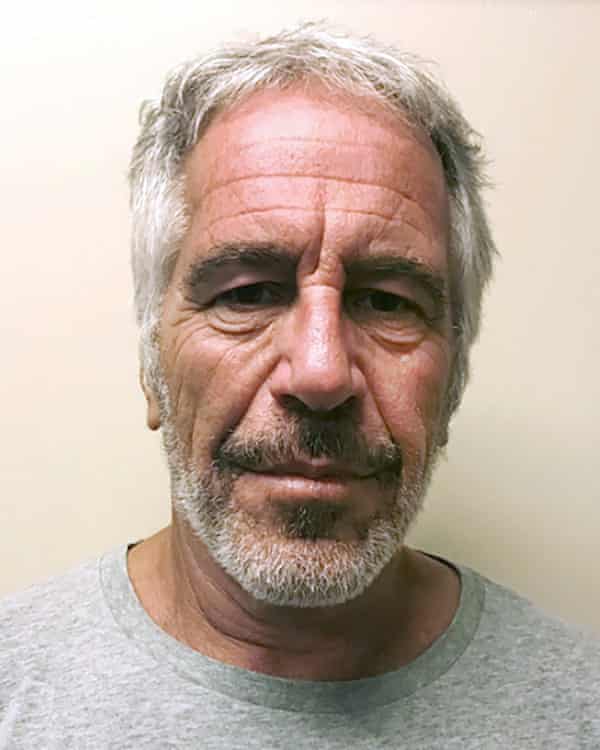
Jeffrey Epstein, in a photo provided by the New York State Sex Offender Registry. Photograph: AP
In 2018 Brown published a three-part exposé in the Miami Herald that lifted the lid on the “non-prosecution agreement” that had been reached covering up Epstein’s sex trafficking operation. The reporter managed to identify 80 potential victims, some as young as 13 and 14.
Following Brown’s exposé, a judge ruled that the secret agreement was illegal, opening up the possibility of a renewed federal prosecution. Epstein was arrested on sex trafficking charges in July 2019 – 11 years after Starr and the rest of his legal team had worked so hard to shield him – and died in jail the following month in what was ruled a suicide.
In the fallout, Alex Acosta, who as Miami’s top federal prosecutor in 2008 had signed off on the Epstein sweetheart deal, was forced to resign as Donald Trump’s labor secretary.
Though Starr’s role in securing the Epstein deal was public knowledge, Brown’s book reveals the lengths that the lawyer was prepared to go to in order to protect from federal justice an accused sexual predator and pedophile. The extent of his involvement is all the more striking given the equally passionate lengths that Starr went to in 1998 to pursue Clinton for perjury and obstruction of justice, given the much less serious sexual activity that sparked that investigation.
Starr’s handling of sexual assault scandals has dogged him during other phases in his career. In 2016 he was stripped of the presidency of Baylor University after the institution under his watch failed to take appropriate action over a sexual assault scandal involving 19 football players and at least 17 women.
Four years later Starr served as a member of Trump’s legal team in the former president’s first impeachment trial over dealings with Ukraine.