donderdag 25 juli 2019

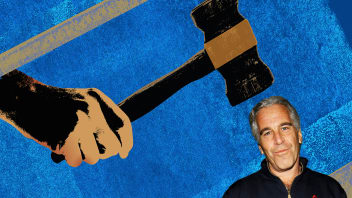
From Jeffrey Epstein to Donald Trump, Deutsche Bank Protected Wealthy Clients


DAILY BEAST


From Jeffrey Epstein to Donald Trump, Deutsche Bank Protected Wealthy Clients

Management at Deutsche Bank ignored internal warnings about high-flying clients, from pedophiles to presidents.

Yesterday, The New York Times reported that Deutsche Bank had reluctantly and belatedly filed a Suspicious Activity Report (SAR) with FinCEN, the Treasury’s Financial Crimes Enforcement Network, on Jeffrey Epstein earlier this year for engaging in suspicious international financial transactions.
Deutsche Bank filed this SAR as it sought to distance itself from the financier—and years after concerns about Epstein’s accounts had been flagged internally, according to the Times. Bank authorities quickly pointed out that the filing of the SAR does not mean that Epstein’s transactions were actually improper. Banks sometimes over-report transactions to the government to be on the safe side. 
That would certainly be a first for Deutsche Bank.
Before we fillet Deutsche’s past spotty history with anti-money laundering compliance, let’s acknowledge the potential significance of the Epstein SAR. 
In an earlier article, we discussed Epstein’s alleged sex trafficking and the mystery surrounding his wealth accumulation. Epstein’s attorney’s filed abare-bones financial statement at his bail hearing outlining approximately $559 million in assets. Federal agents executed a search warrant on Epstein’s mansion, which turned up a safe with thousands of dollars in cash, a dozen loose diamonds and an Austrian passport in a fake name with a Saudi address. 
Epstein had played at being a successful hedge fund manager but few in the industry were aware of any trades that he has made. So how did Epstein accumulate his millions if not billions?
The SDNY has opened up a federal sex-trafficking investigation into Epstein and while the source(s) of Epstein’s wealth piques the curiosity of the masses, SDNY really had little firm basis to open up a criminal financial investigation—until now.
The filing of SARs has proved critical in the past to the successful prosecutions of Paul Manafort and Michael Cohen. They were also the financial enzymes that triggered the successful investigations of ex-Governor Elliot Spitzer and past Speaker of the House Dennis Hastert.
When Deutsche Bank finally bit the bullet and filed a SAR on Epstein, they provided authorities in SDNY with a basis—“reasonable cause”—to file an ex parte request with the IRS for Epstein’s tax returns for the past several years, covering the period immediately proximate to Epstein’s questionable international financial transactions. 
SDNY can now articulate the nexus between Epstein’s tax returns and potential illegal activity with “reasonable cause”—an essential element ofInternal Revenue Code (IRC) Section 6103,  the disclosure section of the IRC that seems to have throttled Robert Mueller and the SDNY in any quest for the returns of President Trump and/or Individual-1.
Once tax returns are secured, Schedule B can be scrutinized and cross-referenced with the required filing of Foreign Bank Account Records (FBARs) by Epstein with FinCEN. Wire transfer records should be readily available from Deutsche Bank and financial investigators can backtrack all the way to the Swiss Bank account apparently opened by Epstein at HSBC Private Bank (Suisse) in 2006.
“The filing of SARs has proved critical in the past to the successful prosecutions of Paul Manafort and Michael Cohen.”
Financial investigators can thoroughly explore all new bank accounts and the likely plethora of financial transactions through analysis of Deutsche Bank records as well as Epstein’s previous account record at JP Morgan Chase, where he was a client from the late 90s until 2013.
Once financial records are fully recorded and analyzed via comprehensive spreadsheets, federal agents can conduct informed interviews of such potentially key witnesses as Epstein’s “tax and accounting expert,” Harry Beller. Once federal investigators have a baseline understanding of Epstein’s finances they can contemplate exploring the tentacles of Epstein’s offshore business dealings, through his company Liquid Funding Ltd, in addition to a number of other shell companies allegedly favored by Epstein and facilitated by his financial enabler Deutsche Bank. 
The International Consortium of Investigative Journalists (ICIJ) has charted out multiple connections, addresses, and officers of this apparent offshore shell company registered in Bermuda that includes well-known business executives in addition to Deloitte and Price Waterhouse accounting firms. Each of these prospective witnesses and business entities will need to be contacted and confronted in light of the Deutsche Bank SAR, which is suggestive of international financial activities by Epstein that may include “illegal activities,” according to the Times report.
Only after the above interviews are conducted should federal authorities contemplate contacting such well-known business luminaries that the media has associated with Epstein, including Leslie Wexner, Leon Black, and Glenn Dubin. A comprehensive financial investigation of Epstein can be conducted parallel to any sex-trafficking investigation by SDNY. It should be noted that inquiries of offshore financial improprieties can be very time-consuming given the difficulties in obtaining documentary evidence pursuant to various international treaties and agreements (MLATs).
While the Epstein investigation takes its course, questions must be asked as to what took Deutsche Bank so long in filing the Epstein SAR.
“This wasn’t the first time Deutsche Bank management overruled their frontline anti-money laundering personnel.”
The Times reports that Epstein was a client of Deutsche’s private-banking division up until earlier this year, when the bank ended its relationship. Sources told the paper that the bank provided Epstein with “loans, wealth-management accounts, and trading services.” Compliance officers reportedly flagged the transactions of Epstein’s company at one point, but bank managers are said to have dismissed their concerns, because “there was nothing illegal about the transactions” and he was a “lucrative client.”
This wasn’t the first time Deutsche Bank management overruled their frontline anti-money laundering (AML) personnel.
The New York Times reported that AML specialists employed at Deutsche Bank identified multiple suspicious financial transactions during 2016 and 2017 entered into by entities connected to Donald Trump and Jared Kushner, and that they reported these transactions to management for the purpose of filing Suspicious Activity Reports with FinCEN.
According to five sources, the Times reported, management declined to process and forward the prepared SARs to the Treasury Department as part of the bank’s anti-money laundering protocol.
This was an AML protocol mandated by the authorities after substantive fines (almost $1 billion) were imposed on Deutsche for their ineffective compliance efforts relative to the so-called “mirror trades,” which laundered $10 billion out of Russia.
While the New York State Department of Financial Services and Britain’s Financial Conduct Authority focused their penalties on the “mirror trades” entered into by Deutsche Bank’s Moscow office during the period between 2010–2014, it is the Federal Reserve’s action that is most germane here. When the Fed imposed the $41 million penalty in May 2017, they also announced a Consent Cease & Desist order against Deutsche Bank to address unsafe and unsound practices in the firm’s domestic banking operations. 
“Deutsche Bank has exhibited a resistance to come clean in the past.”
The Fed identified failures by Deutsche’s U.S. banking operations to maintain an effective program to comply with the Bank Secrecy Act and anti-money laundering laws. The Consent Order required Deutsche Bank to improve its senior management oversight and controls related to compliance with anti-money laundering.
It has been reported that the Federal Reserve has opened up a new inquiry of Deutsche’s AML program.
Perhaps it is this inquiry that compelled Deutsche Bank to finally file the Epstein SAR. The Times further reports that Deutsche is conducting an internal investigation into its relationship with Jeffrey Epstein. “We’re still trying to get our arms around it,” a bank official told the paper.
But Deutsche Bank has exhibited a resistance to come clean in the past. The New York State DFS report stated that the Russian scheme perpetrated by Deutsche “highlights what has been a pervasive culture at Deutsche of skirting regulations to pad profits and personal bonuses.” Subsequent to the “mirror trades” money laundering penalties, and after suffering substantive damage to their reputation, Deutsche Bank started on the path of doing the right thing when it decided to bring in outside financial professionals to dig in and conduct an internal inquiry called Project Square with regard to the “mirror trades.”
George Thoma, a reputable attorney from the tony Shearman & Sterling law firm, was hired to conduct a thorough internal review of the “mirror trade” transactions that caused so much consternation. Thoma analyzed over 2,000 trades before he was cut short and let go a full two years before his contract was up. Thoma reportedly was pushing to investigate Chairman Paul Achleitner and was mounting intensive inquiries into Deutsche Bank executives. Deputy Chairman of Deutsche Bank Alfred Herling criticized Thoma for being “overzealous.”
Not too much should be expected from Deutsche’s internal Epstein review. Perhaps whistleblower Eric Ben-Artzi had it right when he stated that “there was cultural criminality” at Deutsche Bank: “Deutsche was structurally designed by management to allow corrupt individuals to commit fraud.”
Is that why the rich and powerfully connected such as Trump, Kushner and now Epstein were attracted to Deutsche Bank?
Perhaps a zealous criminal financial investigation of Epstein will shed some light on this question where the multitude of previous and currently open investigations of Deutsche Bank have not.
In the immortal words of Yogi Berra—it ain’t over til it's over!


woensdag 24 juli 2019

'No doubt left' about scientific consensus on global warming, say experts


'No doubt left' about scientific consensus on global warming, say experts

Extensive historical data shows recent extreme warming is unprecedented in past 2,000 years


A remote, desert road in Death Valley national park, California. 
A desert road in Death Valley national park, California. Photograph: sara_winter/Getty/iStockphoto


The scientific consensus that humans are causing global warming is likely to have passed 99%, according to the lead author of the most authoritative study on the subject, and could rise further after separate research that clears up some of the remaining doubts.
Three studies published in Nature and Nature Geoscience use extensive historical data to show there has never been a period in the last 2,000 years when temperature changes have been as fast and extensive as in recent decades.
It had previously been thought that similarly dramatic peaks and troughs might have occurred in the past, including in periods dubbed the Little Ice Age and the Medieval Climate Anomaly. But the three studies use reconstructions based on 700 proxy records of temperature change, such as trees, ice and sediment, from all continents that indicate none of these shifts took place in more than half the globe at any one time.
The Little Ice Age, for example, reached its extreme point in the 15th century in the Pacific Ocean, the 17th century in Europe and the 19th century elsewhere, says one of the studies. This localisation is markedly different from the trend since the late 21st century when records are being broken year after year over almost the entire globe, including this summer’s European heatwave.
Major temperature shifts in the distant past are also likely to have been primarily caused by volcanic eruptions, according to another of the studies, which helps to explain the strong global fluctuations in the first half of the 18th century as the world started to move from a volcanically cooled era to a climate warmed by human emissions. This has become particularly pronounced since the late 20th century, when temperature rises over two decades or longer have been the most rapid in the past two millennia, notes the third.
The authors say this highlights how unusual warming has become in recent years as a result of industrial emissions.
“There is no doubt left – as has been shown extensively in many other studies addressing many different aspects of the climate system using different methods and data sets,” said Stefan Brönnimann, from the University of Bern and the Pages 2K consortium of climate scientists.
Commenting on the study, other scientists said it was an important breakthrough in the “fingerprinting” task of proving how human responsibility has changed the climate in ways not seen in the past.
“This paper should finally stop climate change deniers claiming that the recent observed coherent global warming is part of a natural climate cycle. This paper shows the truly stark difference between regional and localised changes in climate of the past and the truly global effect of anthropogenic greenhouse emissions,” said Mark Maslin, professor of climatology at University College London.
Previous studies have shown near unanimity among climate scientists that human factors – car exhausts, factory chimneys, forest clearance and other sources of greenhouse gases – are responsible for the exceptional level of global warming.
A 2013 study in Environmental Research Letters found 97% of climate scientists agreed with this link in 12,000 academic papers that contained the words “global warming” or “global climate change” from 1991 to 2011. Last week, that paper hit 1m downloads, making it the most accessed paper ever among the 80+ journals published by the Institute of Physics, according to the authors.
The pushback has been political rather than scientific. In the US, the rightwing thinktank the Competitive Enterprise Institute (CPI) is reportedly putting pressure on Nasa to remove a reference to the 97% study from its webpage. The CPI has received event funding from the American Fuel and Petrochemical Manufacturers and Charles Koch Institute, which have much to lose from a transition to a low-carbon economy.
But among academics who study the climate, the convergence of opinion is probably strengthening, according to John Cook, the lead author of the original consensus paper and a follow-up study on the “consensus about consensus” that looked at a range of similar estimates by other academics.
He said that at the end of his 20-year study period there was more agreement than at the beginning: “There was 99% scientific consensus in 2011 that humans are causing global warming.” With ever stronger research since then and increasing heatwaves and extreme weather, Cook believes this is likely to have risen further and is now working on an update.
“As expertise in climate science increases, so too does agreement with human-caused global warming,” Cook wrote on the Skeptical Science blog. “The good news is public understanding of the scientific consensus is increasing. The bad news is there is still a lot of work to do yet as climate deniers continue to persistently attack the scientific consensus.”

dinsdag 23 juli 2019

“IT WAS A LOT OF DOUGH”: HOW JEFFREY EPSTEIN, FINANCIAL PASHA, WORKED WALL STREET


The Hive

“IT WAS A LOT OF DOUGH”: HOW JEFFREY EPSTEIN, FINANCIAL PASHA, WORKED WALL STREET


The disgraced financier’s relationship with mega hedge-funder Glenn Dubin and his wife provides a window into how he ran his money.


Glenn and Eva Dubin
Glenn and Eva Dubin

Jeffrey Epstein, the convicted and once-again accused sexual predator, listed $559 million on his audited net worth statement, which was used, unsuccessfully, by his attorneys to try to get him released on bail. But no one on Wall Street can figure out how he made it. There are a number of theories making the rounds. There is the blackmail theory—that his knowledge of the sexual peccadillos of wealthy investors helped make him his money. There is the idea that, like George Soros, he made a killing betting against the British pound once upon a time. There is the theory that he has been providing rich people with tax and estate planning advice—some of which appears to be true, though it’s difficult to see how he could have made a fortune of that size in those businesses. One thing on which most Wall Street people I’ve talked to agree is that they believe he did not make his money trading options or derivatives or from managing other people’s money.
For reasons that are far from obvious, he had a lot of rich friends. Everyone from Prince Andrew to Les Wexner, the billionaire founder of L Brands, makes an appearance in his notorious black book. Leon Black, the billionaire founder of Apollo Management, the private-equity behemoth, is in there too; Black made Epstein a director of his family foundation.
Then there is Glenn Dubin, the billionaire founder of Highbridge Capital Management, a big hedge fund in which Dubin sold a majority interest to JPMorgan Chase in 2004. His relationship with Dubin is a case study in Epstein's complicated, mysterious social life, and how it intersected with his business. The conventional wisdom is that Dubin met Epstein through his wife, Eva Andersson-Dubin, a doctor and former Miss Sweden. Andersson reportedly dated Epstein for years before marrying Dubin. What’s less well-known is that after Andersson married Dubin, Epstein became close to Dubin, too. “Epstein’s the godfather of Glenn’s three children,” says a person who knows Dubin well. “He’s tight, tight, tight with him.” In fact, this person said, when Dubin sold a big chunk of Highbridge to JPMorgan Chase for an undisclosed amount, and then the balance of the business in 2009, it was Epstein who got a big fee for arranging the deal.
Dubin’s familial relationship with Epstein also extended into the financial realm. On two occasions over the years, Dubin arranged for Epstein to invest in Dubin’s professional acolytes, start-up hedge funds with direct ties to Highbridge and Dubin. Dubin declined to comment about his relationship to Epstein. According to a statement released after Epstein’s recent indictment, the Dubins have apparently abandoned him. They “are horrified by the new allegations against Jeffrey Epstein,” they wrote. “Had they been aware of the vile and unspeakable conduct described in these new allegations, they would have cut off all ties and certainly never have allowed their children to be in his presence.”
Things were different 15 years ago, especially when it came to directing Epstein’s money—however he made it—to portfolio managers with ties to Dubin. Joseph C. Kusnan, a former portfolio manager at Highbridge, managed one of the funds spun out of Highbridge; Dubin directed around $75 million of Epstein’s money to Kusnan, a source told me. Daniel B. Zwirn, also a former Highbridge portfolio manager, managed the other fund, the D.B. Zwirn Special Opportunities Fund, in which Highbridge initially owned 47%, the source said. Dubin directed $150 million of Epstein’s money to the Zwirn fund, which was started around 2003. “Dubin prevailed upon Epstein to invest substantially in [Zwirn’s] fund, touting Zwirn’s reliability and business and investment acumen,” Epstein’s lawyers wrote in a 2010 court filing.
Both Zwirn and Kusnan had worked briefly at Lazard, the 171-year-old investment bank, and it was Kusnan who introduced Zwirn to Dubin around 2002. (I know Zwirn from our days together at Lazard and wrote an article about him in Businessweek in 2012, when his hedge fund subsequently ran into trouble with the Securities and Exchange Commission and was later liquidated. I did not know Kusnan.) Zwirn wasn’t allowed to speak with Epstein about Epstein’s large investment in Zwirn’s new fund. “Epstein was Glenn Dubin’s relationship,” someone familiar with them both tells me. “Dubin brought the relationship [to Zwirn] and Dubin maintained the relationship with Epstein.” Epstein made the investment through something called Jeepers, Inc. No one asked any questions about where Epstein got the money to invest in Zwirn’s fund or about Epstein’s sexual proclivities. Epstein was “a known billionaire,” says someone familiar with the Zwirn funds. “We didn’t ask our investors how they got their money. He was a well-known, wealthy guy.” Says the person familiar with both Dubin and Epstein, “It was a lot of dough.” (Zwirn declined to comment for this article.)
On the other hand, Kusnan did have a brief meeting with Epstein at his palatial mansion on East 71st in Manhattan. According to someone who has heard the story, Kusnan went to Epstein’s townhouse and was ushered into a little room by a butler. There, Kusnan saw Epstein sitting atop a “raised platform, like a throne, with two strikingly gorgeous young Eastern European women standing beside the chair.” Epstein asked Kusnan a few questions and then quickly declared that he “was dismissed.” The butler escorted Kusnan out of the mansion. “He walked backed to his office and sitting on the fax machine was the signed paperwork” from Epstein agreeing to make the multi-million-dollar investment in Kusnan’s fund, this person says. It was that simple and quick, thanks to Dubin. Zwirn’s fund also had an investment in Kusnan’s fund and performed “back-office” services for him. Kusnan did not return a call placed to his cell phone for comment about his relationship with Dubin and Epstein.
This curious saga may help to answer other Epstein riddles—including the mystery of his finances. One of the Zwirn fund executives had regular contact with Harry Beller, who worked for Epstein as his tax and accounting expert. This executive tells me that dealing with Beller each quarter was a “completely weird” experience. He said Beller was always fixated about whether any of the annual profits from the Zwirn fund—which averaged returns in excess of 20% a year before it ran into trouble with the SEC—had income sourced from New York State, because Epstein “did not want to pay taxes” in New York State. He says he “never got a single question from [Beller] about the [Zwirn] fund’s strategy or returns. All [Beller] would ask me every quarter was what was the percentage of New York–sourced income. Epstein was legally a U.S. Virgin Islands resident and didn’t want to pay New York State taxes.”
Since February 2014, Beller has worked as a partner at Louis J Septimus & Co, a New York firm offering tax, accounting, and financial planning to corporations, partnerships, trusts, and estates. A person answering his phone said he was not in the office. But there are reasons to believe he might know more than has been revealed about Epstein’s empire. Beller, the Zwirn executive told me, is “the guy people should be trying to track down and interview. He holds the keys to kingdom.”
Like any Wall Street morality play, the story of Daniel Zwirn and Glenn Dubin, and their involvement with Epstein, doesn’t have a simple ending. After four years of stellar returns and a hedge fund with some $12 billion of assets, Zwirn had amassed a personal fortune of some $700 million, as well as a $17 million condominium on Central Park South, a home in Quogue, in the Hamptons, and an $18 million Gulfstream jet. It all began to come crashing down for Zwirn in 2007 when he discovered that the fund’s chief financial officer had moved money around without authorization between his international fund and his domestic fund and had done some unauthorized movement of money in order for Zwirn’s management company to buy the Gulfstream jet. Zwirn reported the infractions voluntarily to the SEC, and both he and his firm were later completely absolved of any wrongdoing by the agency. But that took four years. By then, though the fund was sunk by investor redemptions and an inability to get investors the tax forms they needed to file their tax returns. The remnants of the Zwirn funds were later managed and liquidated by the Fortress Investment Group, another hedge fund.
Jeffrey Epstein sued Zwirn’s fund to get back the money he had invested in it, and prevailed in court, receiving almost all of the $150 million plus what he had made on an annual basis, according to someone familiar with what happened. In 2010 the dispute between Epstein and Zwirn went to private arbitration, which Epstein won.
For his part, Dubin has since left Highbridge. JPMorgan Chase recently announced it was substantially changing the focus of the $2 billion fund, which is part of the bank’s $150 billion portfolio of alternative investments. Dubin now has his own eponymous investment firm, among other investment vehicles, and is focusing on his philanthropy. One of the people who knows him and Epstein well says he doubts Dubin’s reputation as a “philanthropic socialite” will any longer be enhanced by his and his wife’s association with Epstein.

zondag 21 juli 2019

Lawsuit Charges Donald Trump with Raping a 13-Year-Old Girl

\
Snopes.com


Lawsuit Charges Donald Trump with Raping a 13-Year-Old Girl

A civil suit against Donald Trump alleging he raped a 13-year-old girl was dismissed in California in May 2016, refiled in New York in June 2016, and dropped again in November 2016.

  • PUBLISHED 23 JUNE 2016
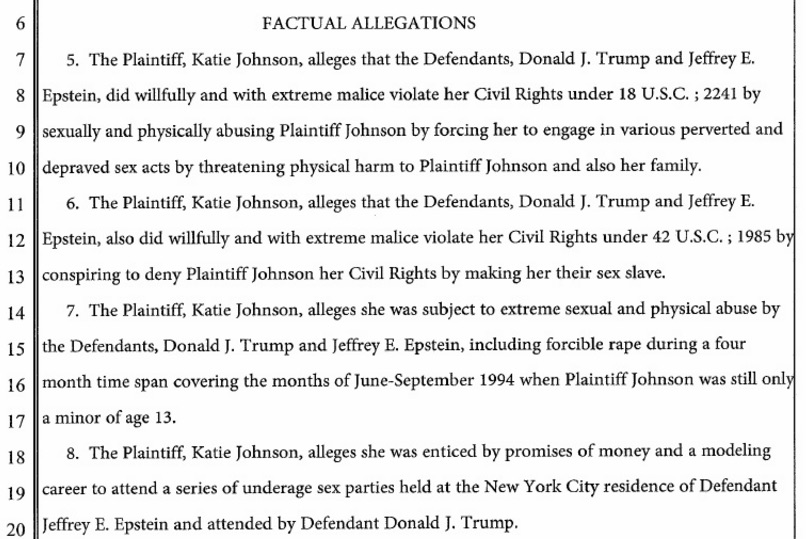
  1. In late April 2016, rumors began to circulate online holding that Republican presidential Donald Trump had either been sued over, or arrested for, raping a teenaged girl. One of the earliest versions of the rumor was published on 2 May 2016 by the Winning Democratsweb site, which reported that woman using the name Katie Johnson had named Trump and billionaire Jeffrey Epstein in a $100 million lawsuit, accusing them of having solicited sex acts from her at sex parties held at the Manhattan homes of Epstein and Trump back in 1994 (when Johnson was just 13 years old):
  2. The first major scandal to hit the Trump campaign besides the typical “what a racist, such a sexist, yada yada yada,” came from a lawsuit stemming from the infamous sex parties held by billionaire and known pedophile Jeffrey Epstein. The woman named in the suit is Katie Johnson, who says Trump took her virginity in 1994 when she was only 13 and being held by Epstein as a slave.
  3. Johnson says in the complaint that Trump and Epstein threatened her and her family with bodily harm if she didn’t comply with all of their disgusting demands. The Trump campaign has been on this immediately, calling it absolute nonsense and not even remotely true or possible.
  4. Many aggregated reports cited a 28 April 2016 article that described the circumstances under which the lawsuit had been filed:
  5. Presidential frontrunner Donald Trump is fighting what could be the biggest election season bombshell yet — explosive court claims that he raped a woman when she was a teen.
  6. The woman — identified as Katie Johnson — filed documents in a California court on April 26, accusing Trump and billionaire pedophile Jeffrey Epstein of “sexual abuse under threat of harm” and “conspiracy to deprive civil rights,” RadarOnline.com has exclusively learned.
  7. She filed the lawsuit herself — without legal representation — and is suing for $100 million.
  8. A copy of the California lawsuit (filed on 26 April 2016) shared via the Scribd web site outlined the allegations, which included the accusation that Trump and Epstein had (over 20 years earlier) “sexually and physically” abused the then 13-year-old plaintiff and forced her “to engage in various perverted and depraved sex acts” — including being “forced to manually stimulate Defendant Trump with the use of her hand upon Defendant Trump’s erect penis until he reached sexual orgasm,” and being “forced to engage in an unnatural lesbian sex act with her fellow minor and sex slave, Maria Doe, age 12, for the sexual enjoyment of Defendant Trump” — after luring her to a “series of underage sex parties” by promising her “money and a modeling career”:
  9. Donald_Trump_Lawsuit_
  10. According to RadarOnline’s initial reporting, the lawsuit filed in California on 26 April 2016 was dismissed over technical filing errors (the address listed in court documents was a foreclosed home that has been vacant since its owner died), with the plaintiff failing in her attempt to avoid incurring the cost of the litigation:
  11. A judge recommended on April 29 that “Katie Johnson” should have to pay her own attorneys’ fees and court costs related to the $100 million lawsuit she brought against Trump and billionaire pedophile Jeffrey Epstein over alleged sexual assault charges. Then on May 2, a U.S. District judge ordered the entire lawsuit thrown out.
  12. “Johnson” had previously filed forms asking to be let off the hook for the costs of the lawsuit, claiming she had only $300 to her name … such an allowance — known as in forma paupers — is only given in civil rights cases in California, and the judge ruled that she “failed to state a claim for relief” on a civil rights basis, even though she “utilized the form provided by the Central District of California for civil actions.”
  13. “Even construing the … pleading liberally, Plaintiff has not alleged any race-based or class-based animus against her, and consequently, her … allegations fail to state a claim upon which relief may be granted,” the judge wrote … the address listed on the paperwork leads to an abandoned property, and the phone number goes straight to voicemail.
  14. For his part, Trump asserted that the charges were “not only categorically false, but disgusting at the highest level and clearly framed to solicit media attention or, perhaps, are simply politically motivated,” adding that “There is absolutely no merit to these allegations. Period.”
  15. On 20 June 2016, New York City-based blog Gothamist reported that the plaintiff had refiled a similar complaint in a New York State federal court:
  16. A federal lawsuit filed in New York accuses Republican presidential candidate Donald Trump of repeatedly raping a 13-year-old girl more than 20 years ago, at several Upper East Side parties hosted by convicted sex offender and notorious billionaire investor Jeffrey Epstein.
  17. The suit, first reported by the Real Deal, accuses Trump and Epstein of luring the anonymous plaintiff and other young women to four parties at Epstein’s so-called Wexner Mansion at 9 East 71st Street. Epstein allegedly lured the plaintiff, identified in the suit only as Jane Doe, with promises of a modeling career and cash.
  18. Another anonymous woman, identified in additional testimony as Tiffany Doe, corroborates Jane’s allegations, testifying that she met Epstein at Port Authority, where he hired her to recruit other young girls for his parties. Trump had known Epstein for seven years in 1994 when he attended the parties at Wexner, according to the suit. He also allegedly knew that the plaintiff was 13 years old.
  19. Jane Doe filed a similar suit in California in April, under the name Katie Johnson, also accusing Trump and Epstein of rape. That suit was dismissed on the grounds of improper paperwork — the address affiliated with her name was found to be abandoned. Today’s suit confirms that the plaintiffs are one and the same.
  20. The online outlet that first reported the second filing in New York explained that the lawsuit might be allowed to proceed even though the statute of limitations for bringing suit has expired, because (according to plaintiff’s lawyer) the plaintiff lacked the “freedom of will to institute suit earlier in time” due to her having been threatened by Trump:
  21. It should be noted that anyone can file a civil complaint in federal court. The statute of limitations in New York for civil rape cases is five years, but [the] complaint argues that the time limit should be waived, noting that the plaintiff was too frightened to report the abuse because Trump had threatened that if she did “her family would be physically harmed if not killed.”
  22. “Both defendants let plaintiff know that each was a very wealthy, powerful man and indicated that they had the power, ability and means to carry out their threats,” the complaint claims.
  23. A copy of the New York-based suit was also uploaded to Scribd, and in the second filing (which asked for no specific amount of monetary damages) the plaintiff was represented by Thomas Francis Meagher, a New Jersey patent lawyer who learned of her allegations via an article published on the GossipExtra web site advertising that she was “shopping for an attorney.” In a statement attached to her filing, the plaintiff (aka “Jane Doe”) asserted:
  24. I traveled by bus to New York City in June 1994 in the hope of starting a modeling career. I went to several modeling agencies but was told that I needed to put together a modeling portfolio before I would be considered. I then went to the Port Authority in New York City to start to make my way back home. There I met a woman who introduced herself to me as Tiffany. She told me about the parties and said that, if I would join her at the parties, I would be introduced to people who could get me into the modeling profession. Tiffany also told me I would be paid for attending.
  25. The parties were held at a New York City residence that was being used by Defendant Jeffrey Epstein. Each of the parties had other minor females and a number of guests of Mr. Epstein, including Defendant Donald Trump at four of the parties I attended. I understood that both Mr. Trump and Mr. Epstein knew I was 13 years old.
  26. Defendant Trump had sexual contact with me at four different parties in the summer of 1994. On the fourth and fnial sexual encounter with Defendant Trump, Defendant Trump tied me to a bed, exposed himself to me, and then proceeded to forcibly rape me. During the course of this savage sexual attack, I loudly pleaded with Defendant Trump to stop but he did not. Defendant Trump responded to my pleas by violently striking me in the face with his open hand and screaming that he would do whatever he wanted,
  27. Immediately following this rape, Defendant Trump threatened me that, were I ever to reveal any of the details of Defendant Trump’s sexual and physical abuse of me, my family and I wold be physically harmed if not killed.
  28. The filing also included a statement from “Tiffany Doe” (i.e., the woman referenced in plaintiff’s statement above who brought her to the parties) attesting that:
  29. I personally witnessed four sexual encounters that the Plaintiff was forced to have with Mr. Trump during this period, including the fourth of these encounters where Mr. Trump forcibly raped her despite her pleas to stop.
  30. I personally witnessed the one occasion where Mr. Trump forced the Plaintiff and a 12-year-old female named Maria [to] perform oral sex on Mr. Trump and witnessed his physical abuse of both minors when they finished the act.
  31. It was my job to personally witness and supervise encounters between the underage girls that Mr. Epstein hired and his guests.
  32. A video reportedly featuring “Katie Johnson” (her identity hidden through the use of facial pixillation, a long blonde wig, and an electronic voice distorter) appeared online, in which she graphically described giving Donald Trump a hand job and being raped by him:
  33. There is little doubt that Donald Trump knows Jeffrey Epstein, as Trump acknowledged in a 2002 New York magazine profile of Epstein:
  34. Epstein likes to tell people that he’s a loner, a man who’s never touched alcohol or drugs, and one whose nightlife is far from energetic. And yet if you talk to Donald Trump, a different Epstein emerges. “I’ve known Jeff for fifteen years. Terrific guy,” Trump booms from a speakerphone. “He’s a lot of fun to be with. It is even said that he likes beautiful women as much as I do, and many of them are on the younger side. No doubt about it — Jeffrey enjoys his social life.”
  35. Epstein has been named in multiple similar lawsuits over the last several years, served 13 months in jail, and is registered as a sex offender for life:
  36. Billionaire sex offender Jeffrey Epstein has paid another accuser.
  37. The 56-year-old money manager has quietly settled with Jane Doe 102, an unnamed woman who alleged in federal court in Florida that Epstein had induced her to “serve his every sexual whim” from the time she was 15 until she was 19. The woman also claimed Epstein had flown her around the world, paying her “to be sexually exploited by [his friends] … including royalty, politicians, academicians [and] businessmen.”
  38. Epstein flatly denied those charges. But a source close to the financier confirms “the matter has been resolved to the satisfaction of both parties.” The woman’s lawyer, Robert Josefsberg, wouldn’t say how much she’s getting. Epstein had in the past offered accusers a minimum of $150,000.
  39. Epstein has settled at least two other civil suits but still faces more than a dozen from women who claim he sexually abused them as minors at his Palm Beach mansion.
  40. As of now, all of the information about this lawsuit comes solely from the complaint filed by “Katie Johnson,” and no one has as yet located, identified, or interviewed her. She was scheduled to appear at a press conference on 2 November 2016 but didn’t show up, claiming that threats to her life kept her away. She reportedly dropped the lawsuit again on 4 November 2016 for the same reason.
  41. A status conference for the lawsuit was scheduled to be held on 16 December 2016.