zondag 21 juli 2019

Why The New Child Rape Case Filed Against Donald Trump Should Not Be Ignored



Afbeeldingsresultaat voor huffington post logo


Why The New Child Rape Case Filed Against Donald Trump Should Not Be Ignored


 Updated Jun 30, 2017

Attorney and bestselling author


An anonymous “Jane Doe” filed a federal lawsuit against GOP presumptive nominee Donald Trump last week, accusing him of raping her in 1994 when she was thirteen years old. The mainstream media ignored the filing.
If the Bill Cosby case has taught us anything, it is to not disregard rape cases against famous men. Serious journalists have publicly apologized for turning a blind eye to the Cosby accusers for over a decade, notwithstanding the large number of women who had come forward with credible claims. And now history is repeating itself.


In covering a story, a media outlet is not finding guilt. It is simply reporting the news that a lawsuit has been filed against Mr. Trump, and ideally putting the complaint in context. Unproven allegations are just that - unproven, and should be identified that way. (Mr. Trump’s lawyer says the charges are “categorically untrue, completely fabricated and politically motivated.”) Proof comes later, at trial. But the November election will come well before any trial. And while Mr. Trump is presumed innocent, we are permitted — no, we are obligated — to analyze the case’s viability now.
No outsider can say whether Mr. Trump is innocent or guilty of these new rape charges. But we can look at his record, analyze the court filings here, and make a determination as to credibility — whether the allegations are believable enough for us to take them seriously and investigate them, keeping in mind his denial and reporting new facts as they develop.
I have done that. And the answer is a clear “yes.” These allegations are credible. They ought not be ignored. Mainstream media, I’m looking at you.
1. Consider the context: Mr. Trump’s overt, even proud misogyny.
The rape case must be viewed through the lens of Mr. Trump’s current, longstanding and well documented contempt for women. Men who objectify women are more likely to become perpetrators of sexual violence, just as one with a long history of overtly racist comments is more likely to commit a hate crime.
Mr. Trump has relished calling women “dogs,” “slobs” and “pigs,” and cyberstalked and derided journalist Megyn Kelly for having the temerity to ask him to defend his own words. He threw out the most misogynist of attacks, attempting to undermine her professionalism by accusing her of menstruating. He’s cruelly ridiculed the appearance of a female opponent (Carly Fiorina) and an opponent’s wife (Heidi Cruz). His campaign even openly acknowledged that it disqualified all women for consideration as his vice-president.
Mr. Trump has a long history of debasing women he’s worked with, crossing the line on a regular basis. He’s taken lifelong joy in objectifying women, including his proclamation: “Women, you have to treat ‘em like shit.”
This cannot be ignored. Decades of abusive language does not make him a rapist. But it does show us who the man is: a callous, meanspirited misogynist who no sane person would leave alone with her daughter. As Dr. Maya Angelou said, “When someone shows you who they really are, believe them.”
2. More context: two prior sexual assault court claims have been made against Mr. Trump.
But Mr. Trump has been accused of worse than just misogynist language. Two prior women have accused Mr. Trump, in court documents, of actual or attempted sexual assault. (Mr. Trump denies all the allegations.)
Under oath, Ivana Trump accused Mr. Trump of a violent rape.
First was Ivana Trump, Donald Trump’s first wife, who said under oath in a 1989 deposition that he had violently attacked her, ripped out her hair and forcibly penetrated her without her consent. According to the Daily Beast, she claims he was wildly angry that she’d referred him to a cosmetic surgeon who had botched a “scalp reduction” job (to cover a bald spot) and caused pain in his scalp - hence the vindictive yanking on her hair. At the time Ms. Trump said she felt “violated” by the alleged “rape.”
A few years later, after their divorce was settled, Ms. Trump claimed that she did not mean the word “rape” in a “literal or criminal” sense.
Note: virtually every settlement of a case involving a high profile person paying money to a former spouse - or anyone - requires the person receiving the money to agree in writing to ironclad nondisparagement and confidentiality. In plain English: you promise to be quiet and not say anything bad about the party paying you money. This has been the case in hundreds of settlement agreements I have worked on over the years. Ms. Trump was almost certainly contractually prohibited after she signed from saying anything negative about Mr. Trump. And it is also common to attempt to “cure” prior negative statements with new agreed-to language - like, I didn’t mean it literally. (You didn’t mean forcible penetration literally?)
A business acquaintance accused Mr. Trump of sexual harassment and “attempted rape.”
A second woman accused Donald Trump of sexual assault, in 1997. According to The Guardian, then 34-year-old Jill Harth alleged in a federal lawsuit that Trump violated her “physical and mental integrity” when he touched her intimately without consent after her husband went into business with him, leaving her “emotionally devastated [and] distraught.” The lawsuit called the multiple acts “attempted rape.” Shortly thereafter she voluntarily withdrew the case when a parallel suit against Mr. Trump brought by her husband was settled. When The Guardian reached the woman in 2016 to ask whether she stood by her sexual assault allegations, she responded, “yes.”
In a court filing, according to a report, Ms. Harth alleged that while she and her husband were trying to do a business deal with Mr. Trump regarding a beauty pageant, he repeatedly propositioned her for sex and groped her, culminating in this frightening alleged incident:
Trump forcefully removed (Harth) from public areas of Mar-A-Lago in Florida and forced (her) into a bedroom belonging to defendant’s daughter Ivanka, wherein (Trump) forcibly kissed, fondled, and restrained (her) from leaving, against (her) will and despite her protests.” In the court document, she said that Trump bragged that he ”would be the best lover you ever have.”
Recently Donald Trump issued a statement that women’s claims of sexual harassment, documented in a lengthy New York Times investigation which included Ms. Harth’s lawsuit, were “made up.”
Jill Harth responded angrily on Twitter last week: “My part was true. I didn’t talk. As usual you opened your big mouth.” 
In other words, she is standing by her story.
3. The new Jane Doe child rape claim against Mr. Trump is consistent with verifiable facts about Mr. Trump and his friend Jeffrey Epstein, and has a powerful witness statement attached to it.
A third woman accused Mr. Trump of rape very recently. According to the Daily Mail, a woman filed an April 2016 lawsuit claiming that when she was thirteen years old she was held as a sex slave to Mr. Trump and his friend Jeffrey Epstein. The woman claimed to have a witness, “Tiffany Doe,” to the incidents. She filed the case in pro per, that is, without the assistance of a lawyer.
The case was dismissed by the court for technical filing errors. She then obtained a lawyer and the case was modified and refiled in New York federal court, against Mr. Trump and Mr. Epstein.
I’ve carefully reviewed this federal complaint. It is now much stronger than the one she filed on her own, which makes sense because she now has an experienced litigator representing her. Jane Doe says that as a 13-year-old, she was enticed to attend parties at the home of Jeffrey Epstein with the promise of money modeling jobs. Mr. Epstein is a notorious “billionaire pedophile” who is now a Level 3 registered sex offender — the most dangerous kind, “a threat to public safety” — after being convicted of misconduct with another underage girl.
Jane Doe says that Mr. Trump “initiated sexual contact” with her on four occasions in 1994. Since she was thirteen at the time, consent is not an issue. If Mr. Trump had any type of sexual contact with her in 1994, it was a crime.
On the fourth incident, she says Mr. Trump tied her to a bed and forcibly raped her, in a “savage sexual attack,” while she pleaded with him to stop. She says Mr. Trump violently struck her in the face. She says that afterward, if she ever revealed what he had done, Mr. Trump threatened that she and her family would be “physically harmed if not killed.” She says she has been in fear of him ever since.
New York’s five year statute of limitations on this claim — the legal deadline for filing — has long since run. However, Jane Doe’s attorney, Thomas Meagher, argues in his court filing that because she was threatened by Mr. Trump, she has been under duress all this time, and therefore she should be permitted additional time to come forward. Legally, this is calling “tolling” — stopping the clock, allowing more time to file the case. As a result, the complaint alleges, Jane Doe did not have “freedom of will to institute suit earlier in time.” He cites two New York cases which I have read and which do support tolling
Two unusual documents are attached to Jane Doe’s complaints — sworn declarations attesting to the facts. The first is from Jane Doe herself, telling her horrific story, including the allegation that Jeffrey Epstein also raped her and threatened her into silence, and this stunner:
Defendant Epstein then attempted to strike me about the head with his closed fists while he angrily screamed at me that he, Defendant Epstein, should have been the one who took my virginity, not Defendant Trump . . .
And this one:
Defendant Trump stated that I shouldn’t ever say anything if I didn’t want to disappear like Maria, a 12-year-old female that was forced to be involved in the third incident with Defendant Trump and that I had not seen since that third incident, and that he was capable of having my whole family killed.
The second declaration is even more astonishing, because it is signed by “Tiffany Doe,” Mr. Epstein’s “party planner” from 1991-2000. Tiffany Doe says that her duties were “to get attractive adolescent women to attend these parties.” (Adolescents are, legally, children.
Tiffany Doe says that she recruited Jane Doe at the Port Authority in New York, persuaded her to attend Mr. Epstein’s parties, and actually witnessed the sexual assaults on Jane Doe:
I personally witnessed the Plaintiff being forced to perform various sexual acts with Donald J. Trump and Mr. Epstein. Both Mr. Trump and Mr. Epstein were advised that she was 13 years old.
It is exceedingly rare for a sexual assault victim to have a witness. But Tiffany Doe says:
I personally witnessed four sexual encounters that the Plaintiff was forced to have with Mr. Trump during this period, including the fourth of these encounters where Mr. Trump forcibly raped her despite her pleas to stop.
Tiffany Doe corroborates, based on her own personal observations, just about everything in Jane Doe’s complaint: that 12-year-old Maria was involved in a sex act with Mr. Trump, that Mr. Trump threatened the life of Jane Doe if she ever revealed what happened, and that she would “disappear” like Maria if she did.
Tiffany Doe herself says that she is in mortal fear of Mr. Trump to this day:


I am coming forward to swear to the truthfulness of the physical and sexual abuse that I personally witnessed of minor females at the hands of Mr. Trump and Mr. Epstein . . . I swear to these facts under the penalty for perjury even though I fully understand that the life of myself and my family is now in grave danger.
Given all this, and based on the record thus far, Jane Doe’s claims appear credible. Mr. Epstein’s own sexual crimes and parties with underage girls are well documented, as is Mr. Trump’s relationship with him two decades ago in New York City. Mr. Trump told a reporter a few years ago: “I’ve known Jeff for 15 years. Terrific guy. He’s a lot of fun to be with. It is even said that he likes beautiful women as much as I do, and many of them are on the younger side. No doubt about it, Jeffrey enjoys his social life.”
Powerfully, Jane Doe appears to have an eyewitness to all aspects of her claim, a witness who appears to have put herself in substantial danger by coming forward, because at a minimum Mr. Epstein knows her true identity.
Jane Doe has not granted any interviews, and we don’t know anything about her background, or Tiffany Doe’s, or the details of their stories. Much information needs to be revealed to fully assess this case. Perhaps they will be discredited on cross-examination. Perhaps they will recant. But if we’re going to speculate in that direction, we should speculate in the other direction as well. Perhaps Jane Doe and her lawyer will have more evidence and witnesses to corroborate her claim. Perhaps witnesses from Mr. Epstein’s notorious parties will come forward. We just can’t know any of that at this point.
But based on what we do know now, Jane Doe’s claims fall squarely into the long, ugly context of Mr. Trump’s life of misogyny, are consistent with prior sexual misconduct claims, are backed up by an eyewitness, and thus should be taken seriously. Her claims merit sober consideration and investigation.
We live in a world where wealthy, powerful men often use and abuse women and girls. While these allegations may shock some, as a lawyer who represents women in sexual abuse cases every day, I can tell you that sadly, they are common, as is an accuser’s desire to remain anonymous, and her terror in coming forward.
What do you call a nation that refuses to even look at sexual assault claims against a man seeking to lead the free world?
Rape culture.

zaterdag 20 juli 2019

“IT’S GOING TO BE STAGGERING, THE AMOUNT OF NAMES”: AS THE JEFFREY EPSTEIN CASE GROWS MORE GROTESQUE, MANHATTAN AND DC BRACE FOR IMPACT


The Hive


“IT’S GOING TO BE STAGGERING, THE AMOUNT OF NAMES”: AS THE JEFFREY EPSTEIN CASE GROWS MORE GROTESQUE, MANHATTAN AND DC BRACE FOR IMPACT


The disgraced financier “collected people,” said a source. Could some of them be implicated in his crimes? Meanwhile, Alan Dershowitz (“He’s a bad person”) and David Boies (“He’s a liar”) are already at war over the case.


The Jeffrey Epstein case is an asteroid poised to strike the elite world in which he moved.  No one can yet say precisely how large it is. But as the number of women who’ve accused the financier (at least, that’s what he claimed to be) of sexual assault grows to grotesque levels—there are said to be more than 50 women who are potential victims—a wave of panic is rippling through Manhattan, DC, and Palm Beach, as Epstein’s former friends and associates rush to distance themselves, while gossiping about who might be ensnared. Donald Trump’s labor secretary, Alexander Acosta, architect of the original 2007 non-prosecution agreement that let Epstein off with a wrist slap, has already been forced to resign.

The questions about Epstein are metastasizing much faster than they can be answered: Who knew what about Epstein’s alleged abuse? How, and from whom, did Epstein get his supposed $500 million fortune? Why did Acosta grant Epstein an outrageously lenient non-prosecution agreement? (And what does it mean that Acosta was reportedly told Epstein “belonged to intelligence”?) But among the most pressing queries is which other famous people might be exposed for committing sex crimes. “There were other business associates of Mr. Epstein’s who engaged in improper sexual misconduct at one or more of his homes. We do know that,” said Brad Edwards, a lawyer for Courtney Wild, one of the Epstein accusers who gave emotional testimony at Epstein’s bail hearing. “In due time the names are going to start coming out.” (Attorneys for Epstein did not respond to a request for comment.)

Likely within days, the U.S. Court of Appeals for the Second Circuit will release almost 2,000 pages of documents that could reveal sexual abuse by “numerous prominent American politicians, powerful business executives, foreign presidents, a well-known prime minister, and other world leaders,” according to the three-judge panel's ruling. The documents were filed during a civil defamation lawsuit brought by Epstein accuser Virginia Roberts Giuffre, a former Mar-a-Lago locker-room attendant, against Epstein’s former girlfriend and alleged madam, Ghislaine Maxwell. “Nobody who was around Epstein a lot is going to have an easy time now. It’s all going to come out,” said Giuffre’s lawyer David Boies. Another person involved with litigation against Epstein told me: “It’s going to be staggering, the amount of names. It’s going to be contagion numbers.”

Epstein remained a fixture in elite circles even after he was a registered sex offender. A few years ago, for example, he was a guest at a dinner in Palo Alto hosted by LinkedIn cofounder Reid Hoffman for the MIT neuroscientist Ed Boyden. At the dinner, Elon Musk introduced Epstein to Mark Zuckerberg.(“Mark met Epstein in passing one time at a dinner honoring scientists that was not organized by Epstein,” Zuckerberg spokesman Ben LaBolt told me. “Mark did not communicate with Epstein again following the dinner.”)

In an email, Elon Musk responded: “I don’t recall introducing Epstein to anyone, as I don’t know the guy well enough to do so, Epstein is obviously a creep and Zuckerberg is not a friend of mine. Several years ago, I was at his house in Manhattan for about 30 minutes in the middle of the afternoon with Talulah [Riley], as she was curious about meeting this strange person for a novel she was writing. We did not see anything inappropriate at all, apart from weird art. He tried repeatedly to get me to visit his island. I declined.” A Musk spokesperson also emailed: “Elon never introduced Jeffrey Epstein to Mark Zuckerberg and does not know either person well enough to do so. They simply happened to be guests at a neuroscience dinner organized by Reid Hoffman.”


One source who’s done business with Epstein told me that Epstein’s 21,000-square-foot townhouse on East 71st Street welcomed a steady stream of the Davos crowd in the past decade. The source said Bill Gates, Larry Summers, and Steve Bannon visited the house, which has been called one of the largest private residences in Manhattan. “Jeffrey collected people. That’s what he did,” the source said. Gates and Summers did not respond to requests for comment.
Thus far, the name most publicly associated with Epstein’s alleged crimes is famed lawyer Alan Dershowitz, who’s been waging a public battle with David Boies for years. In April, Boies’s client Giuffre sued Dershowitz for defamation after Dershowitz called her a liar (a strategy similar to that of seven of Bill Cosby’s accusers). In the days since the FBI arrested Epstein at Teterboro Airport a week and a half ago, Dershowitz has been going on television and dialing up friends and reporters to profess his innocence and label Giuffre and Boies liars. “I want everything to come out! I’m not afraid of anything because I did nothing wrong,” Dershowitz told me on the afternoon of July 15.
He called me a minute after I had emailed him for comment. He said he’d been friends with Epstein since 1996, when they were introduced at a party on Martha’s Vineyard by Lynn Forester de Rothschild. “She begged me to meet him. She told me, ‘here’s this smart academic.’” A few days later, Epstein invited Dershowitz to Les Wexner’s 59th birthday party at Wexner’s mansion in New Albany, Ohio. “It’s a tradition that Jeff invited the smartest person he met that year. He told them I was the smartest.” They remained close for years. Dershowitz strenuously denied ever participating in Epstein’s underage sex ring and said he’d only been in Epstein’s presence with his wife. “I got one massage!” he told me. “It was from a 50-year-old Russian woman named Olga. And I kept my shorts on. I didn’t even like it. I’m not a massage guy.”
Dershowitz said he secretly (and legally) tape-recorded settlement conversations with Boies and that the phone calls capture Boies admitting that Giuffre’s allegations aren’t true. “Boies is a bad person,” he told me.
“I never said that,” Boies responded when I asked about Dershowitz’s version of the phone calls. “What Alan does is he plays a second or two out of context; he never lets anybody listen to the whole thing.” Boies also dismissed Dershowitz’s claim that he never met Giuffre at Epstein’s house. According to Boies, Epstein’s former employees said in sworn depositions that they saw Dershowitz at the house multiple times without his wife. “This Olga woman doesn’t exist. Epstein’s barely kept women around who were over 25. It’s a figment of Alan’s imagination,” Boies said.


On Wall Street, Epstein is a subject of mystery—and fear. “I knew Jeff. He came across as very smart, very sophisticated,” one hedge fund manager told me. “He always had a good read on people. But manipulative people are good at that.” Another person who’s been in meetings with Epstein told me: “He’s very clever.”
How Epstein obtained his fortune is a matter of feverish speculation. His claim to a billionaire-only client list now seems laughable to the bankers I spoke with. One Wall Street source with direct knowledge of Epstein’s business said one source of Epstein’s income was providing “tax advice and estate planning” to rich clients, like Apollo Global Management founder Leon Black, presumably because Epstein had experience with offshore funds after basing his office in the Virgin Islands. In 2015 Black made a $10 million donation to Epstein’s foundation. (Black declined to comment.)
In the absence of much other information, the reigning theory on Wall Street currently is that Epstein’s activities with women and girls were central to the building of his fortune, and his relations with some of his investors essentially amounted to blackmail.

Similarly, DC is on edge. “Epstein bragged about his contacts in Washington,” Boies said. Reporters are likely to dig into why the Justice Department decided not to prosecute Epstein and kept the deal secret from his victims. One theory circulating among prominent Republicans is that Epstein was a Mossad agent. Another is that the George W. Bush White House directed Acosta not to prosecute Epstein to protect Prince Andrew on behalf of the British government, then the U.S.’s closest ally in the Iraq war. “The royal family did everything they could to try and discredit the Prince Andrew stuff,” Boies told me. “When we tried to follow up with anything, we were stonewalled. We wanted to interview him, they were unwilling to do anything.” (Prince Andrew could not be reached for comment).

Of course, the two Epstein friends that people are most curious about are Donald Trump and Bill Clinton, both of whom have denied anything untoward. During the 2016 presidential race, Hillary Clinton’s campaign consulted Bill’s post–White House Secret Service logs because they were worried Trump would bring up Bill’s close association with Epstein and wanted to get ahead of the story, a source told me.

For those in Epstein’s orbit, the stakes of exposure are bound to get higher as more and more women come forward. Every day seems to bring new horrors about Epstein’s alleged depravity. At a press conference on Tuesday, Courtney Wild’s lawyer Brad Edwards said that after interviewing dozens of Epstein’s accusers, it appeared Epstein spent almost all of his time abusing underage girls. “It was his full-time job,” Edwards said. “We have not found anyone who has provided information about a legitimate business he was engaged [in].”

This article has been updated to include a comment from Elon Musk, and to clarify Epstein's relationship to Leon Black.

vrijdag 19 juli 2019

Trump’s Family Fortune Originated in a Canadian Gold-Rush Brothel


Bloomberg

Trump’s Family Fortune Originated in a Canadian Gold-Rush Brothel

Michael Prochazka of Parks Canada
Michael Prochazka of Parks Canada, holds a photograph of Front Street in Bennett, British Columbia from 1900. The town is where Donald Trump's grandfather, Friedrich Trump, opened the Arctic Hotel.
Donald Trump’s grandfather Friedrich Trump ran a restaurant, bar, and brothel in British Columbia.
Buried in a ghost town in Canada’s subarctic are the roots of the family fortune that paved Donald Trump’s path to prominence.
Only shards of glass bottles remain on the lake shore in Bennett, British Columbia—remnants perhaps of the lively establishment operated by Trump’s grandfather that was known for good food, booze and ready women. A church sits further up the slope, its lonely spire peeking out from a thicket of pines.

Friedrich Trump

Friedrich Trump, circa 1918.

Source: Wikipedia

Bennett was once a thriving transit point for prospectors in the Klondike gold rush at the turn of the 20th century, and Friedrich Trump made a killing running a restaurant and bar. The nest egg he generated in just two years grew into the fortune that has supported his grandson’s bid for the U.S. presidency.
“Who else can say that someone running for president of the United States of America owes his fortune to your hometown?,” says Scott Etches, 55, a shop owner hawking Trump t-shirts in Whitehorse, Yukon, about 100 kilometers (62 miles) north of Bennett. “It doesn’t matter whether you support or oppose Trump. It’s actually a great history.”
More than a century after Trump’s grandfather left the Yukon, Canadian developers and entrepreneurs are torn over whether to exploit the connection to one of the most recognized surnames on the planet. A luxury wilderness resort is planned for Bennett, complete with a lodge that would look just like Trump’s watering hole.
“There’s so much history, so many stories around here—Trump is just one of them,” says Nelson Lepine, who runs the development arm of an indigenous group leading the project.
The Trump family’s gold-rush story began when Fred, as he was known, left Germany at the age of 16 with little more than a suitcase. He headed to New York to work as a barber before venturing west in search of riches. Following stints in Seattle and now-defunct Monte Cristo, the gold fever carried him to Bennett, where he and partner Ernest Levin built the Arctic Restaurant, which touted itself as the best-equipped in town.
It was open around the clock with “private boxes for ladies and parties,” according to an advertisement in the Dec. 9, 1899 edition of the Bennett Sun newspaper. The boxes typically included a bed and scale for weighing gold dust used to pay for “services,” according to a three-generational biography by Gwenda Blair, who traced the origins of the Trump family’s wealth. Of course, in the rough-and-tumble frontier towns of that era, the Arctic’s business model built on food, booze and sex was common.

Bennett Lake

The new central guest lodge that will open to the public in Bennett.

Photographer: Ben Nelms/Bloomberg

The Arctic sat a stone’s throw from Bennett Lake in the heart of the township, amid a row of similar establishments and a sea of white canvas tents set up by prospectors. It was constructed of milled lumber and stocked fresh oysters, extravagant luxuries in a place where supplies were brought over arduous overland routes.
“I would advise respectable women travelling alone, or with an escort, to be careful in their selection of hotels at Bennett,” according to a letter penned by “The Pirate” in the Yukon Sun on April 17, 1900. For single men, the Arctic offered excellent accommodations but women should avoid it “as they are liable to hear that which would be repugnant to their feelings and uttered, too, by the depraved of their own sex.”
Trump quickly saw where the real profits lay amid the gold-rush frenzy. An estimated 100,000 prospectors set out for the Klondike, of which only a third actually made it, and a mere 4 percent ever struck gold. Given those odds, Trump’s willingness to lay down his pick was “a shrewd move," according to Blair. “He was mining the miners.”
Bennett was a key hub for prospectors, who trudged from Alaska across frozen mountains and floated rickety rafts down the treacherous rapids of the Yukon River to Dawson City in search of elusive gold. The town lost its allure with the construction of a railway link from Skagway, Alaska to Whitehorse, allowing miners to bypass Bennett.
In response, Trump dismantled the restaurant and its precious lumber and rebuilt it in Whitehorse. A photo in Blair’s book shows a mustachioed Fred Trump in a white apron. He’s standing at the bar near a wall of drapes behind which women, known as “sporting ladies,” entertained miners in privacy.
Trump was a rich man when he left Whitehorse in 1901 to return to his native Kallstadt, Germany, where he later deposited savings of 80,000 marks in the village treasury, Blair recounts. Unable to regain German citizenship, he returned to New York with his riches. That amount—equivalent in purchasing power to about half a million euros in 2014—ended up funding the Trump family’s first residential real estate investments in the New York area, later carried on by his son Fred and grandson Donald.
Trump, who claims in his memoir that his grandfather was Swedish, told the New York Times in August that Blair’s portrayal of Friedrich’s business was “totally false.” Trump’s spokeswoman, Hope Hicks, didn’t reply to two voice mails and an e-mail requesting comment.

Bennett and Whitehorse British Columbia

Clockwise from top left: A float plane in dock at Yukon River south of Whitehorse; St. Andrew's Church built in 1899 stands in the abandoned gold rush town of Bennett; Hiking the Chilkoot Trail in Bennett; Various liquor bottles and glass from the late 1800's lay on the ground in the abandoned gold rush town of Bennett.

Photographer: Ben Nelms/Bloomberg

The Yukon’s rolling hills, cerulean lakes and aurora displays have long been a magnet for intrepid travelers, canoeists and hunters on pricey expeditions. Capitalizing on its indigenous history and links to a business tycoon like Trump could forge a tourist mecca, according to a 2014 plan drafted by the economic development arm of a First Nation community, the Carcross Tagish Management Corp., along with the Parks Canada government agency.
Justin Ferbey, then-chief executive officer of the Carcross group who is now Yukon’s deputy minister of economic development, said he tried to get a resort proposal into Donald Trump’s hands. The plans called for a luxury wilderness camp in Bennett, including a replica of the Arctic Restaurant to serve as the central guest lodge.
Trump either didn’t bite or never saw it, though the project has proceeded without him. Four wooden platforms overlooking the lake are nearly complete and will be fitted with luxury tents housing antique furnishings, wrought-iron bed frames, and high-end mattresses. Guests, limited to eight at a time, will dine at a central guest lodge with a modern kitchen made of old-growth fir reclaimed from a Klondike mine. A four-day, all-inclusive package—including a float plane transfer—is tentatively priced at C$1,675 ($1,250) a person. A soft opening is planned for next summer with full operations by 2018.


A valley near the Chilkoot Trail south of Carcross, Yukon, Canada.

Photographer: Ben Nelms/Bloomberg
“They’ll be wined and dined; we’ll serve top-notch foods. But you’ll still be connected to nature—there’ll only be one piece of canvas between you and the bears,” says Lepine, CEO of Carcross Tagish. “It’s the kind of experience people are really seeking out.”
Lepine and Michael Prochazka, a product development officer at Parks Canada, aren’t as keen as their predecessors to play the Trump card. The central lodge with its arched facade, gabled roof, scrollwork and pine cladding bears a striking resemblance to photos of Trump’s eatery. Prochazka says it’s not a replica of the Arctic, more an archetype of designs common at the time.

Arctic Restaurant

The ‘Arctic Restaurant’ shop in Whitehorse, Yukon, Canada. The shop is in the same location that Donald Trump’s grandfather Friedrich Trump owned and operated a hotel and restaurant under the same name.

Photographer: Ben Nelms/Bloomberg

Meanwhile in Whitehorse, Etches has a different take on the Trump connection potential. In a shopping mall on the site of the former transplanted restaurant, he’s rented a tiny storefront called “The Arctic.” A sign outside notes the birthplace of the Trump family fortune. Inside, he sells T-shirts, black and white prints, and posters like “The Arctic Under New Management. No Liquor, Whores or Gambling Until Further Notice.”
While Etches acknowledges that sales fall “a bit short” of covering his C$200 in monthly rent, he still believes the Trump story is a potential boon for the region.
“We could get every single American tourist on the Alaskan highway pulling over just to see where that fortune was made,” he says. “It doesn’t matter whether they support or oppose Trump. They’d still come off the highway and spend money.”


Afbeeldingsresultaat voor HuffPost

Trump Family History: Donald, Fred, And The Ku Klux Klan


Cashin is a professor at Ohio State University.

 Updated 

Aug 17, 2017


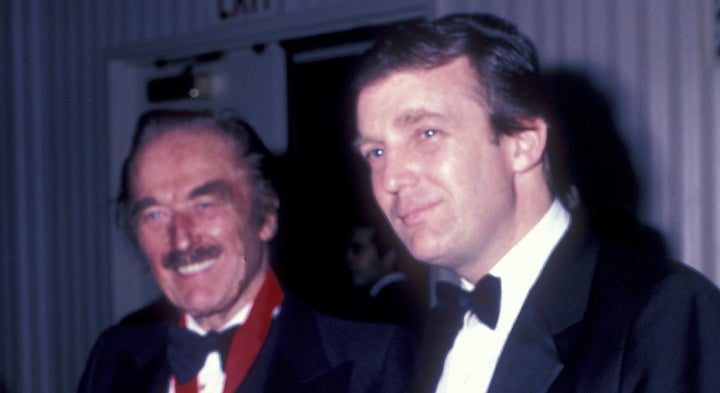
Fred Trump and Donald Trump on May 10, 1985 at the Waldorf Hotel in New York City.ON GALELLA VIA GETTY IMAGES
Fred Trump and Donald Trump on May 10, 1985 at the Waldorf Hotel in New York City.

Donald Trump’s father was arrested at a Klan riot.
Most of the national media studiously avoided printing that simple declarative sentence since Donald Trump decided to run for president. Most of the country’s politicians have remained strangely silent on the topic.
Public commentators did not connect the dots even as President-elect Trump attacked the civil rights hero, John Lewis, when having a Klan sympathizer for a father would seem to be highly pertinent in explaining his behavior.
Yet the factual evidence seems strong. Trump’s father Fred was arrested in New York City in 1927, when a group of Klansmen got into a brawl with police officers during a Memorial Day parade in Queens. There is a document trail, and the names, dates, and addresses match up. The New York Times published a story about the riot and the seven men who were arrested; Fred Trump is mentioned by name. His address is given at 175-24 Devonshire Road, Jamaica, New York City, and the federal census of 1930 shows that Fred Trump resided at that address. The newspaper does not identify him as a Klan member, or clarify whether he was wearing a Klan robe—as were many of the demonstrators―but he did get arrested, and all seven men were represented by the same attorneys. Two days after the brawl, Fred Trump was discharged from custody, with no explanation that can be discovered from public records. The Times further reported that a police commissioner planned to investigate the Klan riot.
After the website Boing Boing reported the story in 2015, Donald Trump denied it, and he has not publicly discussed it since then.
The New York Daily News, the Washington Post, the New York Times and a few other news outlets mentioned the connection briefly in 2016, and then they dropped it. Throughout the campaign, most of the media maintained a deafening silence, as did most of the nation’s politicians in both parties. If Fred Trump was a full-fledged Klansman, no one seemed interested in pursuing the story. A diligent researcher might have at least tried to find the commissioner report in the city archives. Journalists and politicians displayed the most determined zeal in investigating every aspect of Hillary Clinton’s email in 2016, and 20 years ago they showed the same zeal in investigating the Clintons’ investment in Whitewater.
Yet the family history of the Republican Party’s nominee merited nothing close to that scrutiny. And this is the immediate family, the man’s own father, not some distant ancestor from another century, a father with the power to shape the boy’s most profound assumptions about the world. Moreover, Donald Trump has often expressed his admiration for his father. Thoughtful adults can hear the echoes of one hundred years ago in the president’s encouragement of violence at campaign rallies, his prejudices against minorities, and his use of violent language.
Historians know that the Ku Klux Klan, founded in Tennessee in 1866 by ex-Confederate officers, was created to intimidate black Southerners, especially those who wanted to vote, as well as the region’s ethnic and religious minorities. Since the 1860s, the Klan has spread all over the United States, with chapters in every region, and its targets have expanded to include immigrants, gays, and women who work outside the home. In the 1920s, the Klan grew dramatically in the cities of the North, often in response to the arrival of Catholics from Eastern and Central Europe. Accordingly, the Klansmen in Queens protested their presence in 1927 in New York City.
But in the public mind, the organization is still associated largely with the South. Perhaps that is one explanation for the silence on Fred Trump, Donald’s origins in the urban North. Maybe it is still too hard to face up to bigotry and prejudice anywhere outside the South.
We can easily imagine what would have happened if there had been the faintest rumor that Jimmy Carter, Bill Clinton, or Al Gore had a Klan sympathizer in the family—page one stories and protracted coverage in the media, politicians holding forth, bristling with the assumption that the allegation was probably true. Carter, Clinton, and Gore would have been judged unfit for public service, and their careers would have ended long before they reached national office.
Maybe there are other explanations for the silence about Fred Trump, beginning with shame, a deep embarrassment that the Klan has lasted so long and spread throughout the country, including New York. Perhaps it was the hope that the son would turn away from the spectre of a man who had been arrested at a Klan riot. Maybe it was the well-meaning but naïve belief that Donald Trump could not win the election.
Now he inhabits the White House. Let us hope that the country’s media and political leadership recover their usual probing interest in the President’s background, his motives, and his veracity. The future of the Republic may depend on it.