woensdag 10 juli 2019

Global heating: London to have climate similar to Barcelona by 2050


Global heating: London to have climate similar to Barcelona by 2050

Nearly 80% of cities to undergo dramatic and potentially disastrous changes, study finds
Barcelona tram
 Barcelona has previously been affected by extreme drought. London could experience the same problems in the future, say researchers. Photograph: Guy Moberly/Alamy
London will have a similar climate in three decades’ time to that of Barcelonatoday, according to research – but if that seems enticing, a warning: the change could be accompanied by severe drought.
Madrid will feel like present-day Marrakech by 2050, and Stockholm like Budapest, according to a report on the likely impacts of the climate crisis. Around the world, cities that are currently in temperate or cold zones in the northern hemisphere will resemble cities more than 600 miles (1,000km) closer to the equator, with damaging effects on health and infrastructure.
Among other analogues, the study suggests Moscow will resemble Sofia, Seattle will feel like San Francisco and New York will be comparable to Virginia Beach. The researchers have created an interactive map showing hundreds of cities and their 2050 counterparts.
Water shortages will affect scores of cities now in temperate climates as a result of the global heating, which is forecast to be by as much as 3.5C in European cities in summer and 4.7C in winter. Nearly eight in 10 cities will experience dramatic changes, according to the study of 520 major cities published in the journal Plos One.
Barcelona was affected by extreme drought just over 10 years ago, endangering many inhabitants and resulting in tens of millions of euros being spent on importing drinking water. It is becoming more likely that London and cities in similar latitudes will experience the same problems in the future, say the researchers.
Among the most concerning findings is that the residents of about a fifth of cities globally – including Jakarta, Singapore, Yangon and Kuala Lumpur – will experience conditions currently not seen in any major cities in the world. This unprecedented level of change “blew my mind”, said Tom Crowther, founder of the Crowther Lab in Switzerland, which carried out the research.
“These are environmental conditions that are not experienced anywhere on the planet at the moment,” he told the Guardian. “That means there will be new political challenges, new infrastructure challenges, that we have not faced before.”
Rainfall will be a particular problem for such cities, with extreme floodingbecoming more common alongside more frequent and severe droughts.
Crowther said: “We are absolutely not prepared for this. Planning for climate change needs to start yesterday. The sooner it starts, the less the impact will be.”
Richard Betts, a professor of climate impacts at Exeter University and head of the climate impacts strategic area at the Met Office Hadley Centre, who was not involved in the research, said: “Without the benefit of knowing that the new climate conditions are already liveable somewhere in the world, it is harder to know whether people will be able to adapt and stay in these cities, or whether they will eventually look to move elsewhere.”
Concern about the world’s lack of preparedness for the effects of global heating is mounting among experts. Mami Mizutori, the UN secretary general’s special representative on disaster risk reduction, last week told the Guardian that climate crisis disasters were happening at the rate of one a week, but that countries were not investing in making urban infrastructure more resistant.
On Wednesday, the UK’s Committee on Climate Change published a report saying the government was completely unprepared for the likely repercussions of the climate crisis. Its chairman, Lord Deben, compared preparations to the efforts of the ramshackle troops of the classic British comedy Dad’s Army.
The new research took as its baseline one of the central forecasts of the Intergovernmental Panel on Climate Change, for a temperature rise of 2C above pre-industrial levels by 2050, which some regard as optimistic considering the current trajectory of greenhouse gas emissions.
Any London homeowners relishing the prospect of a Catalan climate might need to think again. Mike Lockwood, a professor of space environment physics at Reading University, who was not part of the research team, said: “Bringing Barcelona’s climate to London sounds like it could be a good thing, if you don’t suffer from asthma or have a heart condition – except London clay shrinks and is brittle if it gets too dry, then swells and expands when very wet. The greater swings in ground moisture expected in a warmer world would cause massive subsidence problems.”
One of the purposes of the paper is to illustrate the huge problems the world faces as result of the climate emergency. “History has repeatedly shown that data and facts alone do not inspire humans to change their beliefs or act,” said Jean-François Bastin, the lead author of the paper. “The intangible nature of reporting on climate change fails to adequately convey the urgency. It is hard to envisage how 2C of warming, or changes in average temperature by 2100, might impact on daily life.”
Friederike Otto, the deputy director of the Environmental Change Institute at Oxford University, who was not involved in the research, cautioned that it should be regarded “as an illustration only, not a prediction”, because of the number of variables involved. “It is a useful way to start thinking outside the box, but it does not show London’s future. It could well be that rainfall in winter changes in London in the opposite way to Barcelona.”
Mike Childs, the head of science at Friends of the Earth, said policymakers must take note. “What’s great about this report is that it starkly shows what living in cities will be like if the inertia of governments on climate breakdown continues,” he said. “Young people are taking to the streets to stop their futures being wrecked through inaction on the climate crisis, but this analysis demonstrates that anyone under 50 should be equally concerned that urban living could be intolerable by 2050. Governments have no excuse for further inaction.”

dinsdag 9 juli 2019

Facebook is ripe for exploitation - again - in 2020


Facebook is ripe for exploitation - again - in 2020


Facebook claims to have cleaned up its act. But the platform remains vulnerable to the same sorts of divisive propaganda

Tue 9 Jul 2019 

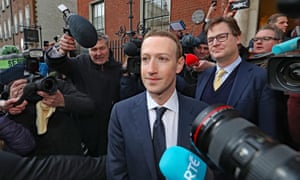
‘Russian propaganda did not inject unfamiliar thought into American politics. It just amplified latent radicalism already flowing at the margins of society.’‘Russian propaganda did not inject unfamiliar thought into American politics. It just amplified latent radicalism already flowing at the margins of society.’ Photograph: Niall Carson/PA


We won’t need Russia in 2020. We will hijack our democracy ourselves. And Facebook is sure to be a major factor in that hijacking – once again.
The platform is ripe for further exploitation by domestic forces bent on distorting the political conversation and stirring up irrational passions in a way sure to benefit Donald Trump’s re-election efforts. The continued proliferation of white supremacists on Facebook, and its refusal to block a heavily doctored video of House speaker Nancy Pelosi, are just the latest demonstrations of Facebook’s cowardice.
Despite scrutiny in the three years since Facebook’s troublesome role in Trump’s 2016 election – embedding Facebook staff in the campaign itself, hosting millions of dollars of targeted ad spending, and distributing false and divisive messages sponsored by Russia and meant to divide the United States and promote Trump – Facebook remains vulnerable to the sorts of divisive propaganda that motivate nationalist and authoritarian movements. This was evident in recent elections in Brazil, Italy, and India, where nationalist forces assumed power with the aid of Facebook-centric election campaigns filled with vitriol and conspiracy theories.
Such propaganda starts with a concerted effort using platforms other than Facebook, such as Reddit, YouTube, state-sponsored systems like Russia’s RT, or private media like Fox News in the US. The messages then migrate to Facebook, with its 220 million American users and 2.4 billion users worldwide. Once there, Facebook’s algorithms take over, amplifying extremist content and connecting susceptible people who might never otherwise find each other. It’s a complex ecosystem that can’t be examined properly by isolating its elements. What happens on Reddit and Fox changes Facebook, and what happens on Facebook changes Reddit and Fox.
US intelligence agencies and the Mueller investigation have extensivelydocumented Russian efforts to spread divisive and pro-Trump propaganda through Facebook. But much of the same sort of content came from domestic sources, such as the National Rifle Association or groups supporting Texas independence. Russian propaganda did not inject unfamiliar thought into American politics. It just amplified and extended latent radicalism already flowing at the margins of society.
Facebook is certainly on guard to limit overt Russian influence in American politics, but it is unable to stem the flow of home-grown white nationalism. It is willing and able to block very specific and literal expressions of white supremacy or white nationalism. But its definitions of both are too narrow, and easily evaded.
Trump himself regularly pumps his white supremacist and anti-democratic agenda into the media ecosystem. More than 25 million people follow and often repost content from Trump’s public figure Facebook page. Whether he calls for violence against people or pushes policies explicitly designed to keep white people in power, Facebook won’t do anything about it.
The locus of much of the most noxious content on Facebook is sure to be large private “Groups”. Mark Zuckerberg has characterized Groups as promoting what he calls (but does not understand) “community”. But radical right-wing content that bubbles up through private groups can easily jump into the newsfeeds of innocent people. We have already seen fringe figures use Groups to sidestep Facebook bans. Journalists recently discovered a secret Facebook group in which members of the US border patrol shared racist and sexist jokes and made jokes about migrants dying.
As with all content on Facebook, the more extreme the message, the farther it will travel. Facebook’s algorithms are designed to amplify items that generate strong emotions. Trump’s messages of nationalism, xenophobia and general resentment provoked his followers to share ads and campaign videos on their own timelines, creating momentum. Hillary Clinton’s plan for universal childcare was always unlikely to invoke such passion, so it sunk on Facebook. The platform is wonderful for motivation but terrible for deliberation.
After the 2016 election, criticism of Facebook came swiftly. Besides transmitting a flood of divisive and misleading propaganda, Facebook political ads offered no accountability. It was impossible for Facebook users to tell if an advertisement came from a political campaign or some individual or group acting independently, like hate groups or a foreign entity. Ads also disappeared almost instantly, never to be seen again or by anyone not in the targeted audience, so it was impossible for candidates to respond to attacks or for journalists to interrogate the ad’s factual claims.
Facebook has made some cosmetic changes for 2020. Now the platform requires all advertisers that invoke political themes to register and disclose their affiliations, lending a bit of transparency to a massive and confusing system. In 2016, Facebook stationed staff inside the Trump campaign, as it had with the campaign of Rodrigo Duterte in the Philippines earlier that year, to help the campaign target ads more effectively. Facebook has promised to stop that practice going forward.
But much has not changed, and some changes at Facebook might make American democracy worse.
In addition to encouraging users to spend more time in Groups, Zuckerberg would like users to make more use of group chats on his encrypted messaging service WhatsApp. As we saw in Brazil and India, this is an invitation to a more chaotic and unstable public sphere, one that amplifies extreme political messages yet removes much of the content even further from public scrutiny. Most significantly, however, the Facebook advertising system, which allows advertisers to target users extraordinarily precisely, is still massive and effective.
Much of this is just Facebook being Facebook. No company would willingly abandon or dismantle such a lucrative advertising system.
But there is one thing Facebook could do to limit its pernicious influence on democracy: restrict targeted advertising for political candidates.
Facebook could change its policies so that, for example, political candidates could limit the audiences of their ads to the geographic area of their constituency, but not target users in smaller segments by gender, income, education, interests, political ideology, race, or any other category.
Under such a system, the entire electorate would be able to see what a candidate has to say about the issues and the other candidates. Opponents and citizens could then respond. Candidates would have to construct messages with broad appeal. Campaigns would have to treat the electorate as an electorate, not as a collection of distinct interests to be manipulated, misled, or pandered to.
Of course, Facebook will probably never do this voluntarily – so the US Congress must. Disclosure is not enough. This would not limit free expression or even total spending. This would merely ensure that ads are more visible and scrutable so that candidates may be held accountable. In fact, far from promoting free political expression, targeted ads constrain the speech of citizens, interest groups, journalists, and opposition candidates by preventing them from being able to respond to claims and accusations.
A healthy democracy is not just one in which nationalist demagogues like Trump lose. A healthy democracy is one in which citizens have access to the best information about candidates and issues; candidates face scrutiny; and the losing side retains trust in the fairness of the system and the expression of the will of the electorate.
It’s unlikely the United States will be such a healthy democracy in 2020. But if the world’s richest, most powerful, and oldest continuous democracy does not take serious steps very soon, it will be no kind of democracy at all.
  • Siva Vaidhyanathan is a professor of Media Studies at the University of Virginia and the author of Antisocial Media: How Facebook Disconnects Us and Undermines Democracy (Oxford University Press)

zaterdag 29 juni 2019

German far-right group 'used police data to compile death list'


German far-right group 'used police data to compile death list'

Activists linked to military and police suspected of preparing terror attack, reports say


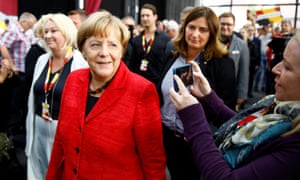
Angela Merkel Party members from the SPD, Greens, Die Linke and Angela Merkel’s CDU were reportedly on the lists. Photograph: Axel Schmidt/Reuters


Fri 28 Jun 2019 


A group of German rightwing extremists compiled a “death list” of leftwing and pro-refugee targets by accessing police records, then stockpiled weapons and ordered body bags and quicklime to kill and dispose of their victims, German media have reported, citing intelligence sources.
Germany’s general prosecutor had been investigating Nordkreuz (Northern Cross) since August 2017 on the suspicion the group was preparing a terrorist attack.
The 30-odd members of the group reportedly had close links to the police and military, and at least one member was still employed in the special commando unit of the state office of criminal investigations.
In the past, Nordkreuz was reported as being part of the “prepper” survivalist movement, whose followers prepare for doomsday scenarios such as the collapse of the prevailing social order.
However, a report by RedaktionsNetzwerk Deutschland, a Hanover-based research agency with links to smaller regional newspapers, suggested the group was actively preparing the ground for a mass attack on political enemies.
Members communicated via the encrypted messenger service Telegram, and accessed police computers to collect almost 25,000 names and addresses of local politicians who had played an active part in civic efforts during the refugee crisis in 2015, the report said.
Party members from the SPD, the Greens, Die Linke and Angela Merkel’s CDU were reportedly on the list, which focused on local politics in the eastern states of Mecklenburg-Vorpommern and Brandenburg.
The group had also allegedly ordered 200 body bags and quicklime, which can be used to speed up the decay of a corpse and cover up its smell.
Three members of Nordkreuz were being separately investigated by a prosecutor in Schwerin for illegal possession of more than 10,000 bullets as well as long- and short-range weapons.
The group is said to deny having planned the murder of the people on the lists.
The report came a few weeks after the murder of a pro-refugee politician by a rightwing extremist, and amid a growing debate about whether Germany’s domestic intelligence agency, the BfV, has underestimated the threat posed by the militant far right.
Thursday’s annual BfV report noted a slight fall in the number of offences by extreme right groups registered in 2018, but also a rise in the number of violent crimes committed by these groups.
Overall numbers of sympathisers for extremist positions on the far right, the far left and in Islamism had all slightly increased over the last year, the report noted.
It made no mention of Nordkreuz, fuelling criticism that the agency had been turning a blind eye to the threat of neo-Nazi terrorism.
Earlier this week, the detained far-right extremist Stephan Ernst confessed to murdering the CDU politician Walter Lübcke. The head of the Kassel regional government was found dead outside his house on 2 June.
Two more men were arrested over the case on Thursday, one for selling the weapon allegedly used in the killing, the other on suspicion of setting up the contact between the gun-seller and Ernst.
Ernst reportedly admitted being incensed by Lübcke’s comments at a town hall meeting he had attended in October 2015. At the meeting, held to discuss a new asylum seeker shelter, Lübcke said: “One has to stand up for values here. And those who don’t do so can leave this country any time if they don’t like it. That’s the freedom of every German.”

donderdag 27 juni 2019

No matter who gets into No 10, their Brexit plans are fantasy


Gina Miller : No matter who gets into No 10, their Brexit plans are fantasy


Boris Johnson and Jeremy Hunt claim the backstop problems can be fixed by 31 October. They are in for a rude awakening


Thu 27 Jun 2019 


This does not appear to be a question 84% of Conservative party membersare remotely bothered with, as they would prefer the fantasy of an immediate “clean Brexit”. They welcome their witching hour of 11pm on 31 October becoming Independence Day, as if it’s some sort of Hollywood blockbuster, with no deal.
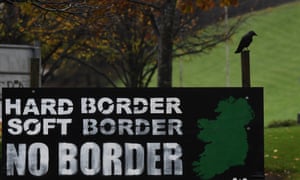
If only will was reality. There is a raft of legislation required even in a no-deal scenario – for example bills on agriculture, fisheries, financial services, trade and immigration. So, too, the vexed question of the Irish border. Boris Johnson, like an overexcited puppy when interviewed by the BBC’s Laura Kuenssberg this week, grabbed this bone and enthused about “abundant, abundant technical fixes that can be introduced to make sure that you don’t have to have checks at the border”. Johnson is not one to worry about details, given the fact that in January Sabine Weyand, the EU’s deputy negotiator, said: “We’ve looked at every border on this Earth, every border the EU has with a third country – there’s simply no way you can do away with checks and controls.”
Then there is the clause in the European Union (Withdrawal) Act 2018. Section 10, on the subject of the Irish border, states that nothing in this act “authorises regulations which … diminish any form of North-South cooperation provided for by the Belfast agreement”. This is likely to mean that the Northern Ireland backstop will stay in place until MPs reach an agreement that honours the UK’s obligations under the Good Friday agreement.
I can hear the naysayers now – we are Great Britain, we can leave with a clean Brexit and a smooth transition to World Trade Organization (WTO) terms under which the rest of the world trades. Yes, Britain is a signatory to the WTO in its own right – but there are no WTO terms that apply specifically to the UK, as we have been operating under the EU’s umbrella for decades.
To deal directly under WTO terms will require us to have something called a schedule of tariffs, which applies tariffs to all imports into a country as well as quotas for a certain amount of tariff-free goods. Brexiteers such as Bernard Jenkin MP say we can simply rely on “default terms” or the EU’s schedule of tariffs. But that suggestion has already, understandably, been blocked by many of the 164 WTO members. Why would they allow the UK to take advantage of the negotiating position of a large global trading bloc such as the EU, when they themselves can’t? Unless Britain can set up emergency cover by using the EU schedule or our own schedule without formal approval, we will enter uncharted territory on the morning of 1 November, as no deal means no transition period. Again, Johnson thinks this is “tosh”. He can magic this, too – an implementation period not attached to a withdrawal agreement, but agreed by the EU anyway – even though he has not spoken to a single person on the EU side about this.


Q&A

What is Gatt XXIV or article 24?


Johnson will say we can be like Australia or New Zealand or Norway, conveniently forgetting that Australia has trade agreements in place with more than 17 countries, including the US, China, Japan, Singapore and Malaysia, and deals with another 20 countries signed and in the pipeline.


I do not doubt that there are many countries that will wish to trade with the UK post-Brexit, but understandably they will wait to see what the UK’s ultimate relationship with Europe will be. WTO members will be watching Britain’s diplomatic behaviour closely. How the new prime minister and his government conduct themselves, especially if they refuse to pay the £39bn bill, will have a serious impact – and possibly make us devoid of international goodwill.
Trade would not stop, but there will be legal uncertainty, tariffs and barriers, and protectionism from other countries. In some sectors, such as meat and dairy, tariffs as high as 97% would result in British farmers who export lamb and beef seeing their prices double to uncompetitive levels. Imports of animal feed and fertilisers could also face tariffs, so farmers’ costs will increase, squeezing margins in the face of falling sales and no subsidies. This would affect chemicals and machinery parts too, which operate on a “just in time” basis, and also labour. A similar story would unfold across other sectors, with everyday imports we depend on – life-saving drugs, radioactive isotopes for MRI scans, medical equipment, epilepsy drugs, contact lenses, electricity, petrol, even milk – being hit.
Most politicians stay quiet on the fact that we are an 80% service economy. The WTO/Gatt regime into which this would fall would mean other countries being able to impose barriers, such as requiring doctors, accountants or architects to requalify. The financial services sector, which has been world-leading, and the UK aviation services sector, the third largest in the world, would be hugely affected: the EU has a competitive single market for air transport.
Meanwhile, though the prime minister will change, the arithmetic in parliament won’t. And there will be just 20 sitting days to the end of October to resolve the hornets’ nest of issues – and no one on the EU side of the table to renegotiate with until mid-November at the earliest.
But let’s not be bothered with mere details. Who needs policies and practical solutions – sheer force of personality will win the day. Why worry that we would be poorer and less safe than we are today?
• Gina Miller is a businesswoman and transparency activist

---------------------------------------------------------------------------------------

1.  Before our brave Gina Miller went all the way to the courts to prepare the road for the UK elected representatives to have a substantial say in the Brexit process, the common opinion had been, that the referendum had given the UK executive the prerogative power on delivering Brexit.
2.  Although this fact is almost too obvious to be overlooked at this point in time, still many people seem to have forgotten, that at the time of the referendum and in the direct aftermath of the referendum, the overriding assumption was, that the new government could practically do as it might wish in this respect.
3.  The total change of perspective, once parliament had been introduced into the entire decision and legislative trajectories, has lead to high levels of frustration and belligerent language under the ruling establishment, and much of the anxiety of today can be explained by the sudden interference of the power of the elected.
4.   A highly complicating factor as well has been the fact, that a substantial part of the Brexit movement had been (and still is been) inspired by a white-supremacist ideology.
5. A strong white supremacist movement has been reappearing - not just in the UK, but - all over the western world recently and its fanatic members are afraid that "the white race" will lose out on its historic hegemony, and eventually will be wiped out.
6.   Within that concept, the white supremacists want a return of the national state, complete with national borders and legislation determined by white politicians, so the survival of "the white race" will be "guaranteed".
7. This geo-political perspective can only be substantiated when non-white people will be deterred from entering the gated community of white supremacists and non-white people that has already been allowed to enter into that gated community, will somehow have to be encouraged to leave the white community.
8. In the UK this agenda has lead to the introduction of the much read and debated about "hostile environment" policy, in the UK designed and delivered by then home secretary Theresa May, who after all does not exactly seem to differ that much from the Boris Johnsons, Rees_Moggs and Farages of this world.
9. International law, based on universal principles like the human rights charter, has been considered incompatible with the alleged superiority of "the white race", so that is the very reason, that the white supremacist part of the pro-Brexit community, does want to severe ties with the EU and wants to by-pass (and undermine) international institutions like the UN.
10. The white supremacist movement has been that much preoccupied with creating an exclusively white society, that it is even prepared, to sacrifice economical advantages, as long as it can preserve the independence of the neo-nationalist UK.
11. Much of the political rhetoric from the extreme-right does resonance the political rhetoric that prevailed in the European interbellum, and much of the rhetoric is about borders and strangers that have to be prevented from entering the sacred homeland.
12. Since White supremacism is all about (perceived) race superiority, racism does form an integral part of the white supremacist political agenda and the importance of national borders (and the subsequent dismantling of international institutions) will bring back border disputes.
13. Border disputes have been a rich source of warfare in the past and do have created wholesale genocidal calamities in our western world only a few decades ago and wholesale carnage in the (today mostly ex-) colonies of the western world.
14. So if one is contemplating to support the Steve Bannon acolytes like Johnson and Farage, one has to be totally aware, that Brexit might highly possibly mean - apart from serious economic decline - the outbreak of old-fashioned war in Europe.
15. Another dire disadvantage of following this ideology, is the fact, that the White supremacist movement has declared itself even independent from regular science and has engulfed itself into pseudo scientific arguments.
16. Pseudo-scientific arguments, that - among other implications - do permit its followers to deny the major human influence on climate change, which opinion only will accelerate the downgrading of our global habitat in general and the downgrading of the UK landscape and nature in particular.
17. Although the latter development seems to be heavily contradicting the ultimate objectives of the ultra-nationalists - such as the to be achieved conservation of the sacred homeland - the hard core ultra-nationalists does not seem to care too much about contradictions within their (mostly conspiracy) theories at all, as one can observe on a daily base when one does register the incoherent rhetoric of Boris Johnson and / or his hero, Donald Trump
18. Do be aware of the fact though, that Johnson and Trump are only useful idiots, that will be ruthlessly replaced by the powerful hyper-manipulative financiers of the global White supremacist movement once their sell-by date will be passed.