zondag 18 maart 2018

The Observer view on how Facebook’s destructive ethos imperils democracy


The Observer view on how Facebook’s destructive ethos imperils democracy


Our revelations about the harvesting of users’ data show that Mark Zuckerberg’s all-powerful company has little sense of responsibility


Sat 17 Mar 2018 

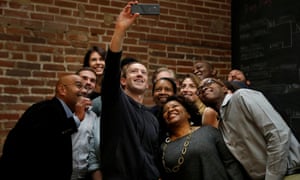
Facebook CEO Mark Zuckerberg poses for a selfie with a group of entrepreneursFacebook CEO Mark Zuckerberg poses for a selfie with a group of entrepreneurs. Photograph: Jeff Roberson/AP


Facebook likes to present itself as a tech company, but often appears more like an advertising corporation that happens to use digital technology in order to conduct its core business. The personal information and data trails left by its 2 billion users to construct detailed profiles allows advertisers to send precisely calibrated advertisements to people who are likely to be susceptible to, or persuaded by, them.
Although the original intention was to build an automated machine for delivering commercial messages, it rapidly became clear that the technology could also be used for delivering targeted political messages to voters, and this appears to be what happened in both the Brexit referendum and the 2016 US presidential election. What this meant was that Facebook acquired both political power and serious responsibilities.
The revelations show that a data analytics firm was able to harvest the Facebook profiles of about a third of all US Facebook users, which were then used to construct psychological models of those individuals for campaign purposes.
The revelations in our lead story today are shocking not just because they reveal the extent to which Facebook’s advertising system was exploited for political purposes in the 2016 election, but also because they demonstrate the company’s inability to comprehend the responsibilities that accompany its newfound power.
This was no run-of-the-mill cybercrime heist that merely stole credit card details. The information that Facebook holds on its users (at least 98 data points per user) is deeply revealing – including of their tastes, preferences, habits, sexuality, politics, hopes and fears. 
Academic research has shown that even knowledge of a few “Likes” can reveal an astonishing amount about an individual Facebook user. For political campaigners, this is the purest gold dust, because it enables messages to be precisely calibrated, and for this to be done at a scale that was unimaginable in the pre-internet era.
In a breathtaking piece of corporate casuistry, Facebook claims that this data harvest was not really a data breach at all, because the researcher who opened the floodgates did so “in a legitimate way and through the proper channels”.
The problem, they say, was that the individual in question didn’t abide by the company’s rules because he passed the information on to third parties. A senior Facebook executive told MPs that while the non-breach might have garnered lots of data, “it is not data that we have provided”.
Our revelations also show that by late 2015 Facebook had found out that information had been harvested on an unprecedented scale but failed to take firm measures to deal with the consequences or to notify the affected users of what had happened. This seemingly cavalier indolence provides an ironic counterpoint to the company’s latest insistence that “protecting people’s information is at the heart of everything we do”.
In a way, this kind of casual indifference to the unintended consequences of digital technology is par for the Silicon Valley course – where the mantra of “creative destruction” has the status of religious dogma. And it appears to have been a particular hallmark of Facebook. 
When suspicions about the exploitation of its systems by political actors (including Russian agencies) first surfaced, the reaction of its founder and CEO, Mark Zuckerberg, was one of hurt denial that his creation could have such malign effects.
Since then, further allegations have been levelled, and he has been obliged to follow in the footsteps of the hero of Mary Shelley’s novel Frankenstein – gradually forced to come to terms with the implications of the monster that he and his employees have created.
The revelations we publish today as part of an award-winning investigation by Carole Cadwalladr should serve as a wake-up call for governments and regulators. Facebook represents a new kind of corporate power, the dimensions of which are only now becoming apparent. 
The automated machine it built, with the capacity to target individuals with commercial messages, turns out to be exceedingly useful for targeting voters with political messages calibrated to produce political effects – to raise anxiety, reinforce prejudices, suppress turnout, amplify partisanship and increase the reach of misinformation and conspiracy theories.
And at the moment, all this can be done under the radar of the institutions that democracies have created to ensure free and fair elections, control campaign funding and maintain transparency about political advertising.
Shortly after Facebook became a public company, its founder famously exhorted his employees to “move fast and break things”. It was, of course, a hacker’s trope and, as such, touchingly innocent. What perhaps never occurred to Zuckerberg is that liberal democracy might be one of the things they break. It’s time for him – and them – to grow up.

----------------------------------------------------------------------------------------


My comments : 

1. As usual the Observer / The Guardian is much too lenient (rather than much too naive, for they are fully aware of the real facts) about the revelation about the real forces behind media such as Facebook.

2. The real forces behind Facebook are secret services and the military and not just the secret services and military of the USA but also their counterparts from the UK and from rogue regimes like those in Tel Aviv.

3. When one does follow the facts in the developments that have been pictured by the Observer and the New York Times this weekend, one simply has to conclude that the election of Trump - and the acquiring of a GOP majority at both Congressional Houses) does indeed mount to a regime change operation by software (rather than the usual method by military hardware such as in the ME region) 

4. In other words : The parties behind the 2016 election - such as the NATO / Pentagon / CIA, but also MI6 and the Mossad) - actually did execute a coup d'état.

5. I do mention the MI6 here because there is also a UK dimension to the political workings of the private defence contractor Cambridge Analytica : Brexit.

6. One of the people behind the shocking revelations did characterise CA and Facebook as companies that have been fully integrated into the political-military-industrial complex and is simply can not be a coincidence that the spiders in the web - Mercer and Zuckerberg - in this respect do share a common ethnic identity 

7. When one subsequently does observe the fact, that Robert Mercer and his daughter Rebekah had demanded a major say in the decisions, of who did get appointed at what position within the White House in general and in the Trump administration in particular, one can impossible escape from the conclusion, that the crucial posts had been reserved for players with an ehtnic-nationalist background.

8. The same does apply for the policies that had been dictated by the Mercer clan : Trumps son in law had been appointed as USA Peace Envoy for the ME, and the main thing he has accomplished until this very day is effectively kill the peace process by acting highly partisan on behalf of one of the parties involved (and at the very heart of the geo-political problems in the region.  

10 It is very simple : As long as the editors in chief of media like the Guardian are not willing to address the ethno-nationalist nature of operations like executed by CA, the problem will never be solved.


N.B. The involvement of USA security agencies in the (USA) election fraud does start from the moment that those very agencies apparently did not entertain into their legal duties to protect the election processes from illegal practices by the different actors involved ()including foreign agencies like the Mossad).

But the total lack of scrutiny from the security services has another dimension then having been "just" passive against election fraud on a massive scale.

After all, the agencies did actively participate into the election process, in order to have the Democrats / Clinton dis-advantaged and the GOP / Trump stimulated at all fronts.

One has to ask the question, of how much agencies like the  FBI might have been involved in to the coup d''etat, because they apparently did not interfere with the election fraud that has been perpetrated by other USA citizens / agencies.

So one has to be highly sceptical (to the degree of being flat-out cynical) about the nature of the Mueller investigation...


Staff claim Cambridge Analytica ignored US ban on foreigners working on elections


The Cambridge Analytica Files

Staff claim Cambridge Analytica ignored US ban on foreigners working on elections

In the 2014 midterm elections and the Trump campaign, firm was staffed mainly by young Britons and Canadians


donald TrumpCambridge Analytica worked on Donald Trump’s election campaign, despite having mainly non-US employees. Photograph: Leah Millis/Reuters


Cambridge Analytica employed non-American citizens to work on US election campaigns in apparent violation of federal law, despite receiving a legal warning about the risks.
The company’s responsibilities under US law were laid out in a lawyer’s memo to the company’s vice-president, Steve Bannon, British CEO Alexander Nix and Rebekah Mercer, daughter of billionaire owner Robert Mercer, in July 2014. It made it clear that most senior and mid-level positions involving strategy, planning, fundraising or campaigning needed to be filled by US citizens.
“Any decision maker must be a US citizen or green card holder,” the memo, seen by the Observer, warned. It also provided a brief legal history of cases involving foreign involvement in election campaigns, drawn up by a lawyer at the firm founded by former New York mayor Rudy Giuliani.
“To the extent you are aware of foreign nationals providing services, including polling and marketing, it would appear that unless it is being done through US citizens, or foreign nationals with green cards, the activity would violate the law.”
Steve Bannon, Cambridge Analytica’s vice-president, in Rome.
Pinterest
 Steve Bannon, Cambridge Analytica’s vice-president, in Rome. Photograph: Tony Gentile/Reuters
It was clear that as a company largely run and staffed by Britons and Canadians, apart from Bannon and Mercer at the top, Cambridge Analytica – which was to go on to work on Donald’s Trump presidential election campaign – had a looming problem.
“The prohibition against foreign nationals managing campaigns, including making direct or indirect decisions regarding the expenditure of campaign dollars, will have a significant impact on how Cambridge hires staff and operates in the short term,” the memo stated.
It specifically called for Nix to step down from work on US elections. “In order for Cambridge to engage in such activities, Mr Nix would first have to be recused from substantive management of any such clients involved in US elections,” it said.“The prohibition against foreign nationals managing campaigns, including making direct or indirect decisions regarding the expenditure of campaign dollars, will have a significant impact on how Cambridge hires staff and operates in the short term,” the memo stated.
Employees working for Cambridge Analytica in the US at the time claimed that rather than tackling the problem, management appeared to ignore it.
“Mercer’s lawyer told a fairly stunned group meeting that it wasn’t allowed,” said one non-American employee who was based in the US at the time. “I’m not sure what, if anything, CA did to act on that knowledge.”
Two employees confirmed that they were still answering ultimately to Nix throughout the mid-term election campaigns that ended in November 2014. In total, more than a dozen foreigners, including Britons and Canadians, filled strategic roles in campaigns across the US.
“We were really speaking directly to the voters in a number of states,” said one former employee, who served on a team with several people who were not US citizens or green card holders.
It is understood that some were working on tourist visas. Another ex-employee claimed that they had been provided with letters to give to US border control officials where needed, stating that they would not be working there.
Robert Mercer, the owner of Cambridge Analytica.
Pinterest
 Robert Mercer, the owner of Cambridge Analytica. Photograph: The Washington Post/Getty Images
“One colleague kept raising these issues, so they gave us a piece of paper to give to immigration to say we weren’t actually working,” the second former employee said. They added that the company appeared to have taken advantage of its mostly young workforce. “It was getting a chance to travel, and to work on campaigns. Having a lot of autonomy, an adventure. When you are young and get that sort of opportunity, you take it rather than thinking about the details or consequences.”
There were no briefings on the kind of work that non-US citizens should avoid, or warnings about the legal risks. “CA was sloppy and didn’t care about its staff,” said the first employee.
Cambridge Analytica said that the company “adheres to FEC [Federal Election Commission] regulations” and that Nix had never been in charge of work on any US election campaigns.
“He has never had a strategic or operational role on any election campaigns undertaken in the US,” a spokesman said, adding that “all CA personnel in strategic roles were US nationals or green card holders and these strategic roles provided all direction to non-strategic personnel”.
The legal memo also warned Cambridge Analytica that it needed to carefully hide behind a firewall any work it did in a single state or election for a particular candidate and for any of the so-called super-PACs (political action committees) supporting the campaign.
These committees can spend unlimited funds but cannot coordinate with individual candidates.
Levy warned that the company would need “to separate working teams that are engaged in substantive work for two or more entities that are not permitted to coordinate their activities”.
The nonpartisan Campaign Legal Center, which represents the public interest, has accused Cambridge Analytica over allegations of illegal coordination of this nature.
It has filed evidence with the FEC alleging that the super-PAC Make America Number 1 made illegal contributions to Trump’s campaign, “engaging in unlawful coordinated spending by using the common vendor Cambridge Analytica”.
Cambridge Analytica denied there had been any illegal coordination, saying it had a firewall policy in place, signed by all staff and strictly enforced.
“Where firewalls exist staff are physically separated; use separate databases and servers; and are prevented from communicating with each other,” a spokesman said.
“The accusations of the Campaign Legal Center are based on conjecture, tabloid stories, and hearsay that attempted to mischaracterise FEC filings where Cambridge Analytica publicly declared our non-coordinated work for different entities.”
Bannon, Mercer and Nix did not respond to requests for comment on the legal memo or their operating structure during the 2016 presidential election.

Data Firm Tied to Trump Campaign Talked Business With Russians


Afbeeldingsresultaat voor logo new york times


Data Firm Tied to Trump Campaign Talked Business With Russians


Alexander Nix, chief executive of the data consulting firm Cambridge Analytica, told the British Parliament last month that his company had no connections to Russia. 
CreditAgence France-Presse — Getty Images
When the Russia question came up during a hearing at the British Parliament last month, Alexander Nix did not hesitate.
“We’ve never worked in Russia,” said Mr. Nix, head of a data consulting firm that advised the Trump campaign on targeting voters.
“As far as I’m aware, we’ve never worked for a Russian company,” Mr. Nix added. “We’ve never worked with a Russian organization in Russia or any other country, and we don’t have any relationship with Russia or Russian individuals.”
But Mr. Nix’s business did have some dealings with Russian interests, according to company documents and interviews.
Mr. Nix is a director of SCL Group, a British political and defense contractor, and chief executive of its American offshoot, Cambridge Analytica, which advised the Trump campaign. The firms’ employees, who often overlap, had contact in 2014 and 2015 with executives from Lukoil, the Russian oil giant.
Continue reading the main story
Lukoil was interested in how data was used to target American voters, according to two former company insiders who said there were at least three meetings with Lukoil executives in London and Turkey. SCL and Lukoil denied that the talks were political in nature, and SCL also said there were no meetings in London.
The contacts took place as Cambridge Analytica was building a roster of Republican political clients in the United States — and harvesting the Facebook profiles of over 50 million users to develop tools it said could analyze voters’ behavior.
Cambridge Analytica also included extensive questions about Russia’s president, Vladimir V. Putin, in surveys it was carrying out in American focus groups in 2014. It is not clear what — or which client — prompted the line of questioning, which asked for views on topics ranging from Mr. Putin’s popularity to Russian expansionism.
On two promotional documents obtained by The New York Times, SCL said it did business in Russia. In both documents, the country is highlighted on world maps that specify the location of SCL clients, with one of the maps noting that the clients were for the firm’s elections division. In a statement, SCL said an employee had done “commercial work” about 25 years ago “for a private company in Russia.”
Photo
President Vladimir V. Putin of Russia, left, meeting with Vagit Alekperov. He is the head of Lukoil, an oil giant that was in talks with Cambridge Analytica employees. CreditMikhail Klimentyev/RIA Novosti/Kremlin, via Reuters
Cambridge Analytica has been a political flash point since its role in the Trump campaign attracted scrutiny after the election. While Mr. Nix’s firm turned over some records to the House Permanent Select Committee on Intelligence during its investigation of Russian interference, Democrats on the committee want a fuller review. “It is imperative to interview a broader range of individuals employed by or linked to Cambridge Analytica,” they said in a report this month.
Asked about the Russian oil company, a spokesman for SCL said that in 2014 the firm’s commercial division “discussed helping Lukoil Turkey better engage with its loyalty-card customers at gas stations.” The spokesman said SCL was not ultimately hired.
Arash Repac, chief executive of Lukoil Eurasia Petrol, offered a different explanation for the talks. He said that a meeting he attended with SCL in Turkey involved a promotional campaign with local soccer teams.
“We needed somebody to guide us with the customer data that we were collecting,” he wrote in response to a question from The Times. “Even though our campaign went ahead, we decided not to cooperate with SCL. No contracts were signed.”
But Christopher Wylie, who helped found Cambridge Analytica and develop the company’s voter-profiling technology, said Lukoil showed interest in how the company used data to tailor messaging to American voters.
“I remember being super confused,” said Mr. Wylie, who took part in one of the Lukoil meetings.
“I kept asking Alexander, ‘Can you explain to me what they want?’” he said, referring to Mr. Nix. “I don’t understand why Lukoil wants to know about political targeting in America.”
“We’re sending them stuff about political targeting — they then come and ask more about political targeting,” Mr. Wylie said, adding that Lukoil “just didn’t seem to be interested” in how the techniques could be used commercially.
Mr. Wylie, a former contractor, left SCL before the talks concluded and could not say what became of the relationship with the oil company. He had a falling out with SCL and tried to set up a rival business. SCL said he had violated a nondisclosure agreement and that his comments were an attempt to hurt the company.
A second person familiar with the discussions backed up Mr. Wylie’s account, but spoke on the condition of anonymity because of a confidentiality agreement.
Though Lukoil is not state-owned, it depends on Kremlin support, and its chief executive, Vagit Alekperov, has met with Mr. Putin on a number of occasions. Reuters reported last year that Lukoil and other companies received instructions from the state energy ministry on providing news stories favorable to Russian leadership.
Mr. Nix, for his part, has long been adamant. “We just don’t have business in Russia,” he told TechCrunch last year. “We have no involvement in Russia, never have done.”
https://www.nytimes.com/2018/03/17/us/politics/cambridge-analytica-russia.html