
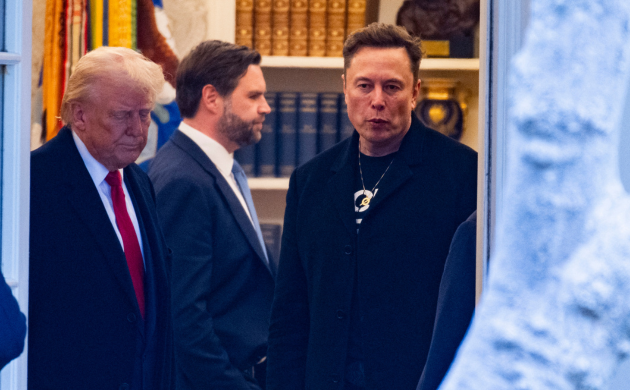

For over half a year now, US-watchers all over the world have been puzzling over the singular nature of Trump’s second term, regularly commenting on extreme differences with his first. It is now a truism that the MAGA movement’s alliance with Big Tech is one of the most startling and momentous political characteristics of this presidency, and perhaps of our age. It is also one which political scientists, and in particular analysts of illiberal political movements should try to understand in more systematic terms. Portmanteau concepts such as "technocaesarism" have indeed become commonplace in political punditry, especially in Europe, seeming to qualify this apparently monolithic fusion between nationalist conservatism and Silicon Valley’s unapologetic accelerationism.
One of the key questions for studying the advent of a new illiberal regime in the United States going forward is to what extent the alliance of Tech, Christian and nationalist-populist strands of the right can succeed in the long term. Having closely followed the American conservative ecosystem during the last election cycle and in the months following Trump’s inauguration, I continued talking to some of the key intellectuals from the postliberal faction of the American right and listening to their utterances, with a particular focus on questioning the ideological and political foundations of this unusual coalition.
After several months in office, the conclusion is a paradoxical one: while the new Trumpian "tent" has never expressed its ideological divisions as starkly, with members of the Christian right expressing near existential dread of Silicon Valley’s techno-political projects, the coalition remains astonishingly solid, even after the spectacular Trump-Musk fallout in June. What is certain, however, is that the coalition is anything but monolithic, as some commentators outside the United States can sometimes suggest. Observers must thus keep an attentive eye on some of the most important pressure points and acknowledge the profound fluidity of American politics.
Fighting Words
One of the most striking facts in current conversations with some of the most influential thinkers in the American conservative movement is their rhetoric virulence against Silicon Valley’s foray into politics. Nowhere was this hostility more on display than during the recent National Conservative conference in Washington, DC. Even more than foreign policy - where the usual conflict between primacists and restrainers came once again to the fore - the dizzying developments of AI and Silicon Valley’s ambitions seemed to be the most contentious issue. As Rachel Bovard, vice-president of the Conservative Partnership Institute, noted during her speech, AI is no less than the "most crucial issue" for the future of the movement. Unsurprisingly, another strident voice against AI was Steve Bannon, whose fiery remarks concluded the event. His very harsh words against the tech elite, whom he paints as nothing less than treacherous in its dealings with the Chinese Communist Part, clearly demonstrated that his political feud with Elon Musk and Silicon Valley’s "broligarchs" goes beyond personal animosity (he is still calling for Musk’s deportation as an illegal immigrant).
Even more than foreign policy - where the usual conflict between primacists and restrainers came once again to the fore - the dizzying developments of AI and Silicon Valley’s ambitions seemed to be the most contentious issue.
Though the strategic motives behind these words are obvious in a hyper-personalized political regime where everyone is vying for the President’s attention, it is important to understand that the differences run on deep political, ideological, even theological grounds.
In fact, two key sources of conservative opposition to AI accelerationism appear today. The first is more political and economic in nature, reflecting the populists’ fear of a takeover by a profoundly elitist and profit-obsessed tech oligarchy. They anxiously point to the unprecedented power that firms like Palantir, OpenAI or Meta have accrued within the administration as a particularly alarming development, which they suspect will skew the coalition in favor of the tech agenda. Philosopher Patrick Deneen, one of the key intellectual figures in the postliberal right who identifies with its "populist" wing, is for instance very explicit in his fears a takeover by a techno-utopian cast after several months of Trumpian rule, thus echoing Bannon’s much more sanguine assaults.
The second is more spiritual and profound in nature, amounting to an almost existential opposition between Christian values and the transhumanist agenda carried by some Silicon Valley luminaries. Rod Dreher, a close friend of JD Vance and a central figure of the Christian Right, goes further than his friend Patrick Deneen by offering what amounts to a theological refutation of the Tech Right. For this reactionary mystic, figures like Thiel, Andreessen, Sacks, and Karp are nothing more than Renaissance occultists, Faustian alchemists intent on reviving the dream of turning men into gods. "AI is demonic," he recently declared in an interview, viewing it as the main gateway to the fusion of humanity and machine - nothing short of transhumanism. Asked about whether he agreed with Peter Thiel’s extraordinary defense of the transhumanist agenda on biblical grounds, Dreher could not state it more plainly: his "friend" Thiel is profoundly mistaken, even though they belong to the same political coalition.
Existential Disagreements
A deep dive into the more developed intellectual formulations by either side of the spectrum - Christian conservatives versus Tech Right - shows the extent of the chasm, and reminds one of how unnatural this alliance remains. In his works,Patrick Deneen dreams of a return to a stable, pre-modern caste society, where a virtuous aristocracy leads a people rooted in tradition and faith. Alongside fellow post-liberals like Adrian Vermeule, Gladden Pappin, and Rod Dreher, all steeped in classical and medieval European thought, he explicitly celebrates the return of limits in the name of a Christian ideal of "common good." Dreher, citing Ellul and his friend Paul Kingsnorth (who is about to publish a pamphlet against "the Machine"), is even more explicit in his nostalgia for pre-industrial stability.
These postliberal conservatives moreover all express the hope that the Vatican, under the leonine influence of Catholic social teaching, will prioritize defending human integrity in the age of AI. Cognitive dissonance reaches thus a form of culmination, as these thinkers seem to hope for nothing less than a clash between a foreign religious authority and the very capitalists whom they have struck a durable alliance with.
Indeed, the political assessment of technology on the Christian new Right side of the spectrum could not be more distant from some of the ideological formulations emanating from Silicon Valley. On this point, one must distinguish between the nationalist yet rather apolitical accelerationism embodied by the likes of Mark Andreessen, David Sacks or Alex Karp (and joined by opportunists like Sam Altman and Mark Zuckerberg) and the much more elaboratetechno-monarchism of Curtis Yarvin and Nick Land, well described by Arnaud Miranda. The neo-reactionary movement, as Land puts it, is an ideology "devoid of any Rousseauistic enthusiasm for popular expression", and therefore profoundly anti-populist in nature and profoundly atheistic. The Dark Enlightenment thinkers share the Christian Right’s contempt for liberalism, but their alternative is overtly Darwinian and Hobbesian, leading straight toward techno-authoritarianism as a logical solution. If Deneen’s ideal polis looks like a harmonious medieval city, Yarvin dreams of Dubai, Singapore, or even Beijing - i.e. rule by the ultra-technological Leviathan. Though softer and less political, Marc Andreessen’s Nietzschean enthusiasm for the "techno-capitalist machine" and the "technological superman" seems no less incompatible with the Christian conservative creed. As a critical republican commentator recently noted of this atheistic and amoral Tech Right: "They burn with the desire to see the ‘Strong Gods’ return, but have no idea which gods to call upon… A vague appeal to national interest or progress will not suffice."
The coalition’s profound dichotomies-political, theological, even anthropological-are thus beginning to come into the open.
With the concrete experience of governing together and a proliferation of ideological formulations emanating from each faction, the coalition’s profound dichotomies-political, theological, even anthropological-are thus beginning to come into the open.
It is more obvious than ever that this administration has to balance schizophrenically between opposite ethoi: innovation versus tradition, individualism versus community, science versus faith, endless exploration versus rootedness, meritocracy versus aristocracy, social Darwinism versus populism.
The Common Agenda of Destruction
One must be cautious, of course, not to carve overly rigid conceptual dichotomies where reality is more fluid. As Marlène Laruelle has noted about illiberal political thought, we live in the age of "liquid ideologies"-opportunistic and ready to bend to the imperatives of power. Thus, between the two poles represented by, say, Patrick Deneen and Mark Andreessen, one finds a spectrum of reactionary right-wing tribes, comfortably oscillating between nationalism, libertarianism, and Christianity. Trump himself is strikingly devoid of any doctrinal framework, which has allowed every faction to project onto him its deepest desires. And many official ideologues still seem willing to walk this very delicate tightrope. In the intellectual sphere, Kevin Roberts, the Heritage Foundation’s president, exemplifies this willful balancing act in his recent book Dawn’s Early Light. In it, he manages to both condemn Silicon Valley’s totalitarian tendencies and celebrate figures such as Palmer Luckey, the CEO of defense startup Anduril, as the embodiment of America’s eternal entrepreneurial genius.
On a more strategic level, key points of convergence still hold the coalition in Washington together. The two poles of the reactionary continuum-Christian or national-populist conservatives on one side, the Tech Right on the other-are still unified around a shared agenda of destruction. Their hostility toward universities perfectly exemplifies the nature of their alliance forged against elite institutions, which they claim have been overtaken by woke. Yet the motives differ: for the Tech Right, the battle is about restoring a genuinely meritocratic order, indispensable to a dynamic, innovation-driven, capitalist society. For the national conservatives, the struggle is primarily cultural and spiritual in nature. In line with this revolt against the "woke elite," all factions can still rally around dismantling the deep state-the protean enemy that alternately designates federal bureaucrats, journalists, NGO staff, or the expert class writ large. As long as this work of demolishing or subordinating Washington’s institutions remains unfinished, one can wager that the coalition’s momentum will remain.
Money, too, is a binding agent unlikely to disappear, whether the Christian right’s intellectual class likes it or not. The 2024 election confirmed more than ever that money is the blood coursing through the veins of the American body politic. For conservatives, an alliance with Silicon Valley great fortunes, Musk’s included, remains a key lever of medium- and long-term electoral strategy. For the Tech barons, the partnership with Trump’s regime has thus far proved profitable-as shown by the AI Action Plan crafted in large part by David Sacks and the president’s tech advisor, Michael Kratsios. The incorporation of AI into America’s strategic military priorities has opened historic opportunities for companies like Palantir, Anduril, and ScaleAI to displace the industrial behemoths of the old military-industrial complex. The new class of "patriotic engineers" - Alex Karp, Palmer Luckey and Shyam Sankar - know they now have an historic chance to capture the largest public contracts in the world and build the army of the future. Their time horizons stretch well beyond electoral cycles, as they already live in a future where Trump is long dead but will have served them well.
Trump himself is strikingly devoid of any doctrinal framework, which has allowed every faction to project onto him its deepest desires.
Opposition to China as a conveniently designated civilizational enemy represents a third piece of glue that holds the coalition together. Much as the Cold War once held together the "fusionist" alliance of libertarians and evangelical Christians, competition with Beijing remains a key North star for the current administration-even if it has yet to cohere into a clear strategy.
For the tech accelerationists, China provides the perfect pretext to cloak their technological frenzy in patriotic colors. This is, in essence, the argument that one finds in Alex Karp’s book The Technological Republic. At the other end of the spectrum, Christian conservatives invoke China to justify technological escalation, even at the ultimate price, i.e. losing our humanity. Rod Dreher is most explicit about this self-conscious tradeoff, and frames the dilemma starkly: "China places no restrictions whatsoever in these matters-if we do not do the same, it will end up dominating us. It is a very difficult position to hold, but that is where we are." If anything this sentence is revealing of an American Right riven by dilemmas, acutely aware of the contradictions eating away at its core.
Growing Cracks in the Wall
Still, concrete disagreements are multiplying, and it is likely they will only grow. The hardest task will be agreeing on what kind of world to build once the work of destruction is complete. This is especially true if the accelerationists’ scenarios materialize as they hope. How, for instance, can a political movement built on defending workers displaced by deindustrialization in the Rust Belt, the kind that Bannon has dedicated his life to, coexist in the long run with the ultimate prophets of creative destruction? Immigration promises to become another explosive fault lineif the major tech firms wish to maintain their edge in the race against China. Suffice to point out that more than half of all PhD-level AI researchers in the United States are foreign-born, and nearly two-thirds of leading AI companies were founded by immigrants. The administration’s recent decision to impose a yearly 100 000 fee on H1-B visas, the most common type of visa for highly skilled immigrant labor in tech firms, is an extremely hard pill to swallow for the sector. Energy policy, too, could spark conflict: Trump’s dogmatic stance against renewables cannot help but frustrate an industry that is desperate for new energy solutions.
If the AI Action Plan demonstrates the Tech faction’s influence within Trumpism, one must remain alert to subtle warning signs. In a political episode barely noticed outside of the United States, a fleeting "AI-skeptic" coalition emerged when lawmakers discovered that the One Big Beautiful Bill had quietly inserted a moratorium on state-level AI regulations. Marjorie Taylor Greene, a historic MAGA firebrand, vocally opposed it, joining forces with Bannon and sparking a chain reaction that rallied colleagues-including Democrats-to strip the provision from the bill. Even the Heritage Foundation voiced its opposition, citing religious and moral grounds and advocating for a federal approach to AI regulation. Meanwhile Josh Hawley, still harboring his own presidential ambitions as an embodiment of Christian nationalist populism, has launched his own investigations into Meta, sensing that this alliance with accelerationist billionaires could jeopardize his credentials with the base.
The truth is that the Trump era is fated to slide ever further into political entropy. Having made the strategic "blunder" (according to Bannon) of renouncing the idea of a third Trump term, the movement’s tempo has slowed, and the coalition’s factions are inevitably beginning to think about the aftermath-even as they scramble to maximize immediate gains. Even Trump’s closest allies do not want their own futures compromised by his missteps; they prefer to bask in his achievements while hedging against his decline.
And yes, the dramatic rupture with Musk-buried since beneath the ceaseless churn of news cycles-must be read for what it was: a major political event, exposing genuine tensions. Beyond depriving the GOP of his immense financial firepower, Musk’s virulent break with Trump, coupled with his flirtation with creating a third party, has embarrassed his PayPal Mafia peers, Sacks and Andreessen, by breaking some of the coalition’s deepest taboos.
It is the classic "lame duck" syndrome that comes with a second and term. Curtis Yarvin’s recent blogpost in which he calls for nothing less than an authoritarian acceleration shows that the risk of disintegration is perceived from within the coalition, and could well explain the attempts at using tragedies like Charlie Kirk’s assassination as motives for further authoritarian lurches.
The Uncertain Future of a Coalition
Vance is a profoundly ambiguous and protean figure who strikingly inspires equal hope across the factions: for the Christian and populist Right, he is the Augustinian statesman they long for; for the Tech barons, he is the potential techno-monarch.
For now, the coalition’s future hinges on a single man tasked with holding it together: JD Vance, the regime’s now-official successor. Emanating from Trump’s organic social base yet forged by his experience among the tech elite, Vance is a profoundly ambiguous and protean figure who strikingly inspires equal hope across the factions: for the Christian and populist Right, he is the Augustinian statesman they long for; for the Tech barons, he is the potential techno-monarch.
Crucially, Musk has signaled his willingness to back Vance despite his falling-out with Trump. The paradoxes and ambiguities that define the young vice president are in fact his greatest political asset: his dual identity as both child of the dispossessed and member of the meritocratic elite; his Christian nationalism coupled with a multicultural family life; his visceral MAGA-style populism paired with curated intellectualism.
Yet whether he can save his political family from divorce remains an open question. His work will undoubtedly be far harder, not only because he lacks Trump’s singular charisma, but because it would likely fall to him, should he win in 2028, to erect a new order from the rubble of Trump’s destructive enterprise. That reality may explain why he is still reluctant to express himself in positive terms and relies on the unifying power of the Left to corral disparate tribes: crusading against the woke enemy and blaming Joe Biden are still as central to his rhetoric as before the election.
Vance’s job of managing the coalition will only get harder as the Tech Right becomes increasingly confident and powerful, and secret hopes of a third party-one capable of representing a pro-technology coalition, open to material progress and immigration-become less secret. Influential blogger Richard Hanania is among those who openly call for it. Publicly repentant of his vote for Trump, he is convinced the MAGA movement is dragging the United States into "kakistocracy"-government by the worst. For now, Musk’s unpopularity seems to doom his vision of a third party, but the appetite for an alternative to Democrats and Republicans has never been stronger.
These hopes of a tech-friendly coalition are moreover fueled by the curious similarities on the left wing of the spectrum. The lively debate around a new "abundance agenda", recently popularized by Ezra Klein and Derek Thompson, similarly pits the democrats’ tech donors such as Dustin Moskovitz, Eric Schmidt, and Reid Hoffman against the populist faction embodied by Alexandria Ocasio-Cortez and Bernie Sanders. A strategic paper from the Niskanen Center, incubator of this agenda, makes clear that while they currently invest in the Democratic Party, their real preference lies in a centrist third force. The unspoken truth in America’s current political landscape is that the techno-utopianism of Andreessen or Altman-who dreams of a "Moore’s Law for everything"-is far closer to this emergent left-wing faction than to the conservatism of the New Right.
The extraordinary political involvement of the tech lords in right-wing politics is a source of unprecedented political volatility in the United States.
It is far too early to herald yet another realignment of America’s political chessboard. But in a post-Trump future, as the consequences of AI become tangible, today’s equilibria will only grow more unstable. What must be kept in mind is that the extraordinary political involvement of the tech lords in right-wing politics is a source of unprecedented political volatility in the United States.
Observers and policymakers worldwide would do well to anticipate these dynamics and take them into consideration when analyzing contemporary American politics. In the months ahead, events will offer many precious clues about the future of this great, unnatural alliance.


/s3/static.nrc.nl/wp-content/uploads/2026/02/03153105/030226OND_2031303670_1.jpg)
/s3/static.nrc.nl/wp-content/uploads/2026/02/03153257/030226OND_2031303670_4.jpg)
/s3/static.nrc.nl/wp-content/uploads/2026/02/03153129/030226OND_2031303670_3.jpg)
/s3/static.nrc.nl/wp-content/uploads/2026/02/03153130/030226OND_2031303670_2.jpg)