vrijdag 1 oktober 2021

LEAKED GRANT PROPOSAL DETAILS HIGH-RISK CORONAVIRUS RESEARCH


LEAKED GRANT PROPOSAL DETAILS HIGH-RISK CORONAVIRUS RESEARCH

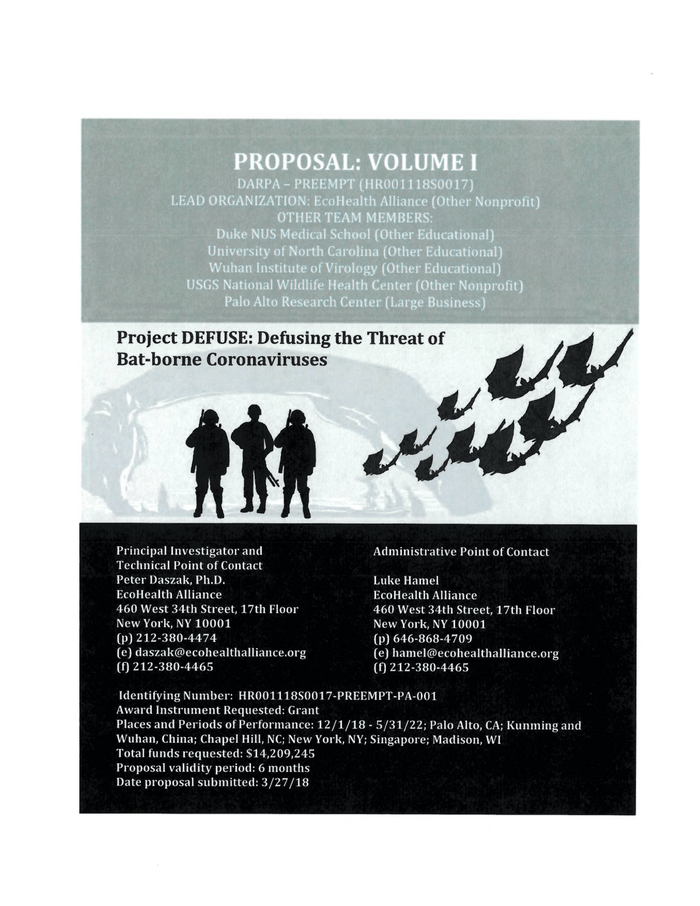
The proposal, rejected by U.S. military research agency DARPA, describes the insertion of human-specific cleavage sites into SARS-related bat coronaviruses.


A GRANT PROPOSAL written by the U.S.-based nonprofit the EcoHealth Alliance and submitted in 2018 to the Defense Advanced Research Projects Agency, or DARPA, provides evidence that the group was working — or at least planning to work — on several risky areas of research. Among the scientific tasks the group described in its proposal, which was rejected by DARPA, was the creation of full-length infectious clones of bat SARS-related coronaviruses and the insertion of a tiny part of the virus known as a “proteolytic cleavage site” into bat coronaviruses. Of particular interest was a type of cleavage site able to interact with furin, an enzyme expressed in human cells.

The EcoHealth Alliance did not respond to inquiries about the document, despite having answered previous queries from The Intercept about the group’s government-funded coronavirus research. The group’s president, Peter Daszak, acknowledged the public discussion of an unfunded EcoHealth proposal in a tweet on Saturday. He did not dispute its authenticity.

Since the genetic code of the coronavirus that caused the pandemic was first sequenced, scientists have puzzled over the “furin cleavage site.” This strange feature on the spike protein of the virus had never been seen in SARS-related betacoronaviruses, the class to which SARS-CoV-2, the coronavirus that causes the respiratory illness Covid-19, belongs.

The furin cleavage site enables the virus to more efficiently bind to and release its genetic material into a human cell and is one of the reasons that the virus is so easily transmissible and harmful. But scientists are divided over how this particular site wound up in the virus, and the cleavage site became a major focus of the heated debate over the origins of the pandemic.

Many who believe that the virus that caused the pandemic emerged from a laboratory have pointed out that it is unlikely that the particular sequence of amino acids that make up the furin cleavage site would have occurred naturally.

Adherents of the idea that SARS-CoV-2 emerged from a natural spillover from animal hosts have argued that it could have evolved naturally from an as-yet undiscovered virus. Further, they argued, scientists were unlikely to have engineered the feature.

“There is no logical reason why an engineered virus would utilize such a suboptimal furin cleavage site, which would entail such an unusual and needlessly complex feat of genetic engineering,” 23 scientists wrote earlier this month in an article in the journal Cell. “There is no evidence of prior research at the [Wuhan Institute of Virology] involving the artificial insertion of complete furin cleavage sites into coronaviruses.”

But the proposal describes the process of looking for novel furin cleavage sites in bat coronaviruses the scientists had sampled and inserting them into the spikes of SARS-related viruses in the laboratory.

“We will introduce appropriate human-specific cleavage sites and evaluate growth potential in [a type of mammalian cell commonly used in microbiology] and HAE cultures,” referring to cells found in the lining of the human airway, the proposal states.

The new proposal, which also described a plan to mass vaccinate bats in caves, does not provide conclusive evidence that the virus that caused the pandemic emerged from a lab. And virus experts remain sharply divided over its origins. But several scientists who work with coronaviruses told The Intercept that they felt that the proposal shifted the terrain of the debate.

Tipping the Scales

“Some kind of threshold has been crossed,” said Alina Chan, a Boston-based scientist and co-author of the upcoming book “Viral: The Search for the Origin of Covid-19.” Chan has been vocal about the need to thoroughly investigate the possibility that SARS-CoV-2 emerged from a lab while remaining open to both possible theories of its development. For Chan, the revelation from the proposal was the description of the insertion of a novel furin cleavage site into bat coronaviruses — something people previously speculated, but had no evidence, may have happened.

“Let’s look at the big picture: A novel SARS coronavirus emerges in Wuhan with a novel cleavage site in it. We now have evidence that, in early 2018, they had pitched inserting novel cleavage sites into novel SARS-related viruses in their lab,” said Chan. “This definitely tips the scales for me. And I think it should do that for many other scientists too.”

Richard Ebright, a molecular biologist at Rutgers University who has espoused the possibility that SARS-CoV-2 may have originated in a lab, agreed. “The relevance of this is that SARS Cov-2, the pandemic virus, is the only virus in its entire genus of SARS-related coronaviruses that contains a fully functional cleavage site at the S1, S2 junction,” said Ebright, referring to the place where two subunits of the spike protein meet. “And here is a proposal from the beginning of 2018, proposing explicitly to engineer that sequence at that position in chimeric lab-generated coronaviruses.”

“A possible transmission chain is now logically consistent — which it was not before I read the proposal.”

Martin Wikelski, a director at the Max Planck Institute of Animal Behavior in Germany, whose work tracking bats and other animals was referenced in the grant application without his knowledge, also said it made him more open to the idea that the pandemic may have its roots in a lab. “The information in the proposal certainly changes my thoughts about a possible origin of SARS-CoV-2,” Wikelski told The Intercept. “In fact, a possible transmission chain is now logically consistent — which it was not before I read the proposal.”

But others insisted that the research posed little or no threat and pointed out that the proposal called for most of the genetic engineering work to be done in North Carolina rather than China. “Given that the work wasn’t funded and wasn’t proposed to take place in Wuhan anyway it’s hard to assess any bearing on the origin of SARS-CoV-2,” Stephen Goldstein, a scientist who studies the evolution of viral genes at the University of Utah, and an author of the recent Cell article, wrote in an email to The Intercept.

Other scientists contacted by The Intercept noted that there is published evidence that the Wuhan Institute of Virology was already engaged in some of the genetic engineering work described in the proposal and that viruses designed in North Carolina could easily be used in China. “The mail is filled with little envelopes with plasmid dried on to filter paper that scientists routinely send each other,” said Jack Nunberg, director of the Montana Biotechnology Center at the University of Montana.

Vincent Racaniello, a professor of microbiology and immunology at Columbia University, was adamant that the proposal did not change his opinion that the pandemic was caused by a natural spillover from animals to humans. “There are zero data to support a lab origin ‘notion,’” Racaniello wrote in an email. He said he believed that the research being proposed had the potential to fall in the category of gain-of-function research of concern, as did an experiment that was detailed in another grant proposal recently obtained by The Intercept. The government funds such research, in which scientists intentionally make viruses more pathogenic or transmissible in order to study them, only in a narrow range of circumstances. And DARPA rejected the proposal at least in part because of concerns that it involved such research.

While Racaniello acknowledged that the research in the DARPA proposal entailed some danger, he said “the benefits far, far outweigh the risk.” He also said the fact that the viruses described in the proposal were not known pathogens mitigated the concern. “This is not SARS,” he said, referring to SARS-CoV-1, the virus that caused a 2003 outbreak. “It’s SARS-related.”

But SARS-CoV-2 is not a direct descendant of that virus — it’s a relative.

In fact, the viruses described in the grant proposal, which was first posted online by the research group DRASTIC, were not known pathogens. And the authors of the grant proposal make the case that because the scientists would be using SARS-related bat viruses, as opposed to the SARS virus that was known to infect humans, the research was exempt from “gain-of-function concerns.” But according to several scientists interviewed by The Intercept, the viruses presented a threat nevertheless.

“The work describes generating full-length bat SARS-related coronaviruses that are thought to pose a risk of human spillover. And that’s the type of work that people could plausibly postulate could have led to a lab-associated origin of SARS-CoV-2,” said Jesse Bloom, a professor at Fred Hutchinson Cancer Research Center and director of the Bloom Lab, which studies the evolution of viruses. Bloom pointed out that the scientists acknowledge the risk to humans in their proposal. “It’s an explicit goal of the grant to identify the bat SARS-related coronaviruses that they think pose the highest risk.”

Stuart Newman, a professor of cell biology who directs the developmental biology laboratory at New York Medical College, also said the fact that the viruses weren’t known to be dangerous didn’t preclude the possibility that they might become so. “That’s really disingenuous,” Newman said of the argument. “The people that are claiming natural emergence say that it begins with a bat virus that evolved to be compatible with humans. If you use that logic, then this virus could be a threat because it could also make that transition.” Newman, a longtime critic of gain-of-function research and founder of the Council for Responsible Genetics, said that the proposal confirmed some of his worst fears. “This is not like slightly stepping over the line,” said Newman. “This is doing everything that people say is going to cause a pandemic if you do it.”

While the grant proposal does not provide the smoking gun that SARS-CoV-2 escaped from a lab, for some scientists it adds to the evidence that it might have. “Whether that particular study did or didn’t [lead to the pandemic], it certainly could have,” said Nunberg, of Montana Biotechnology Center. “Once you make an unnatural virus, you’re basically setting it up in an unstable evolutionary place. The virus is going to undergo a whole bunch of changes to try and cope with its imperfections. So who knows what will come of it.” The risks of such research are profound and irreversible, he said. “You can’t call back the virus once you release it into the environment.”

DARPA, a division of the Department of Defense, said regulations prevented it from confirming that it had reviewed the proposal. “Since EcoHealth Alliance may or may not be the direct source of the material in question, and we are precluded by Federal Acquisition Regulations from divulging bidders or any associated proposal details, we recommend that you reach out to them to confirm the document’s authenticity,” a DARPA spokesperson wrote in an email to The Intercept. The British Daily Telegraph reported that it had confirmed the document’s legitimacy with a former member of the Trump administration.

The Telegraph story erroneously reported that the scientists proposed to inoculate bats with live viruses. In fact, they hoped to inoculate them with chimeric S proteins, which were proposed to be developed through a subcontract in the grant in Ralph Baric’s lab at the University of North Carolina at Chapel Hill, not in Wuhan. Baric did not respond to The Intercept’s request for comment.

Conflict of Interest

Many questions remain about the proposal, including whether any of the research described in it was completed. Even without the DARPA funding, there were many other potential ways to pay for the experiments. And scientists interviewed for this article agreed that often researchers do some of the science they describe in proposals before or after they submit them.

“This was a highly funded group of researchers that wouldn’t let one rejection halt their work,” said Chan, the “Viral” author.

Perhaps the most troubling question about the proposal is why, within the small group of scientists who have been searching for information that could shed light on the origins of the pandemic, there has apparently been so little awareness of the planned work until now. Peter Daszak and Linfa Wang, two of the researchers who submitted the proposal, did not previously acknowledge it.

Daszak, the EcoHealth Alliance president, has actively sought to quash interest in the idea that the novel coronavirus originated in a lab. In February 2020, as the pandemic began to grip major cities in the U.S., he began organizing scientists to write an open letter that was published in the Lancet addressing the origins of the virus. “The rapid, open, and transparent sharing of data on this outbreak is now being threatened by rumours and misinformation around its origins,” read the statement signed by Daszak and 26 co-authors. “We stand together to strongly condemn conspiracy theories suggesting that COVID-19 does not have a natural origin.”

Daszak directed and gathered signatures for the letter, all the while suggesting that he and his collaborators on the proposed DARPA project, Baric and Wang, distance themselves from the effort.

“I spoke with Linfa [Wang] last night about the statement we sent round. He thinks, and I agree with him, that you, me and him should not sign this statement, so it has some distance from us and therefore doesn’t work in a counterproductive way,” Daszak wrote to Baric in February 2020, just weeks before it appeared in the journal, according to an email surfaced a year later by public health investigative research group U.S. Right to Know. “We’ll then put it out in a way that doesn’t link it back to our collaboration so we maximize an independent voice.” Ultimately, Daszak did sign the letter.

“I also think this is a good decision,” Baric replied. “Otherwise it looks self-serving and we lose impact.”

Baric and Wang — a professor in the emerging infectious diseases program at Duke-NUS Medical School, Singapore — did not respond to inquiries from The Intercept about their decision not to sign the letter in the Lancet.

Daszak was also a member of the joint team the World Health Organization sent to China in February 2020 to investigate the origins of the pandemic, which concluded that it was “extremely unlikely” that the virus had been released from a laboratory. (In March, WHO called for further investigation of the origins of the virus and stated that “all hypotheses remain open.”)

“I find it really disappointing that one of the members of the joint WHO-China team, which is essentially the group of scientists that were tasked as representatives of both the scientific community and the World Health Organization of investigating this, are actually on this proposal, knew that this line of research was at least under consideration, and didn’t mention it all,” said Bloom, of Fred Hutch. “Whatever information that relates to help people think about this just needs to be made transparently available and explained.”

Correction: September 24, 2021

A previous version of this article stated incorrectly that the EcoHealth Alliance proposal had been featured on Sky News Australia.

Correction: September 23, 2021, 3:30 p.m.

A previous version of this article stated incorrectly that Linfa Wang was a member of the WHO-China team.

https://theintercept.com/2021/09/23/coronavirus-research-grant-darpa/

woensdag 8 september 2021

Mogelijk honderden kinderen uit gezinnen die de dupe waren van toeslagenaffaire, zijn uit huis geplaatst

 HARRIËT DUURVOORT

Mogelijk honderden kinderen uit gezinnen die de dupe waren van toeslagenaffaire, zijn uit huis geplaatst

null Beeld

Het toeslagenschandaal lijkt voor velen naar de achtergrond verdrongen. De eerste gedupeerden kregen 30 duizend euro van de overheid, 70 duizend kinderen kregen een schadevergoeding. Maar van eind goed, al goed is helaas geen sprake.

Toen het boegbeeld van de toeslagenslachtoffers Kristie Rongen, bekend van haar indrukwekkende optreden in het verkiezingsdebat tegen Rutte, onlangs ontsteld twitterde dat de dochter van een ­toeslagenslachtoffer al sinds mei in een isoleercel in een Jeugdzorginstelling zit opgesloten, was mijn belangstelling gewekt.

Volgens Rongen en andere gedupeerden speelt ook Jeugdzorg een omstreden rol in de zogenaamde ‘toeslagengezinnen’. Terwijl juist deze hulpverleners naast ouders hadden moeten gaan staan.

Ik sprak de moeder van het meisje dat op dit moment in een isoleercel zit, Karin van Opstal. Ze is moeder van vier kinderen en student rechten (hbo) als ze in 2006 plotseling door de Belastingdienst op een fraudelijst blijkt te zijn gezet.

Ze heeft geen flauw benul waarom, ze heeft als student gewoon recht op kinderopvangtoeslag. Maar ze moet 56 duizend euro terugbetalen. Door het hardvochtige inningsbeleid van de Belastingdienst (men vordert 990 euro per maand) raakt ze haar huis kwijt.

In 2009, hoogzwanger, wordt ze uit haar huis gezet en zwerft vervolgens van adres naar adres, verblijft en slaapt bij vrienden en kennissen. Als ze is bevallen en haar baby tien dagen oud, wordt het kindje door ­Jeugdzorg bij haar weggehaald. In de weken erna gebeurt dat ook met haar andere kinderen. Omdat ze geen eigen onderkomen heeft, met dank aan de Belastingdienst. Het is een traumatische ervaring.

Je zou verwachten dat hulpverleners die kinderen in zo’n kwetsbaar gezin moeten helpen, náást een moeder gaan staan, en naar de oorzaken van haar armoede gaan vorsen en vervolgens hun pijlen richten op de Belastingdienst. Wat waren veel gezinnen daarmee geholpen geweest.

In plaats daarvan wordt Karins gezin uit ­elkaar gerukt. De kinderen komen in verschillende pleeggezinnen en instellingen terecht. Karin mag ze aanvankelijk 1 uur per drie maanden zien, een regeling die een ­aantal jaar geleden wordt opgeschort. Zelfs haar verjaardagskaarten worden niet ­bezorgd.

Haar dochter Michelle, nu 17 jaar, is sinds haar uithuisplaatsing, zoals dat zo vaak gaat, van pleeggezin naar pleeggezin naar instelling gestuurd, en komt uiteindelijk terecht in de Jeugdzorginstelling Midgaard. Daar wordt ze slachtoffer van seksueel misbruik door een medewerker. De zaak is landelijk nieuws.

Nadat ze een aantal zelfmoordpogingen heeft ondernomen, is ze nu opgesloten in een isoleercel bij Jeugdzorginstelling Pluryn. Ze heeft reuma, maar ligt op een dun matrasje en heeft het vaak koud. Maar vooral de eenzame opsluiting is gekmakend. De bedoeling was dat de isoleercel in de Jeugdzorg al eerder zou worden afgeschaft, maar vanwege de personeelstekorten is dat niet haalbaar.

Karins verhaal is niet uniek. Toeslagenslachtoffers verenigen zich steeds meer en zowel Rongen als Van Opstal vermoeden dat honderden kinderen uit huis geplaatst zijn. Dat is op zichzelf geen gekke gedachte, omdat kinderen die in extreme armoede terecht komen niet in een veilig geachte omgeving opgroeien.

Het is een cynisch besef dat de kosten van pleeg- en instellingszorg alleen al voor Karins vijf, meer dan tien jaar uit huis geplaatste, kinderen in de miljoenen lopen. De kosten voor verblijf en behandeling in een instelling bedragen jaarlijks tussen één en anderhalve ton euro, becijferde NRC Handelsblad.

Voor kinderen van de slachtoffers van de toeslagenaffaire die nog steeds niet thuis ­wonen, duurt deze hel onverminderd voort. Zij verdienen niet alleen geld, maar vooral ook hulp bij het vinden van hun weg in de maatschappij en hulp bij het terugkeren in hun gezin. Deze kinderen werden bij hun ouders, broertjes en zusjes weggerukt, terwijl hun ouders hen niet hebben mishandeld. Alleen de overheid heeft dat gedaan.

Michelles naam is om privacyredenen gefingeerd


https://www.volkskrant.nl/columns-opinie/mogelijk-honderden-kinderen-uit-gezinnen-die-de-dupe-waren-van-toeslagenaffaire-zijn-uit-huis-geplaatst~bc426792/

donderdag 2 september 2021

Sackler family set to pay $4.5bn to settle opioid claims after judge approves plan

 Sackler family set to pay $4.5bn to settle opioid claims after judge approves plan

Conditional approval for plan to organize drugmaker into new company with board appointed by public officials

Wed 1 Sep 2021 22.33 BST

The settlement sets up a compensation fund that will pay some victims of drug addiction an expected $3,500 to $48,000 each. Photograph: Douglas Healey/A

A US federal bankruptcy judge on Wednesday conditionally approved a sweeping, potentially $10bn plan submitted by the OxyContin maker Purdue Pharma to settle a mountain of lawsuits over its role in the opioid crisis that has killed a half-million Americans over the past two decades.

Under the settlement reached with creditors including individual victims and thousands of state and local governments, the Sackler family will give up ownership of the company and contribute $4.5bn but will be freed from any future lawsuits over opioids.

The drugmaker will be reorganized into a new company with a board appointed by public officials and will funnel its profits into government-led efforts to prevent and treat opioid addiction.

Also, the settlement sets up a compensation fund that will pay some victims of drug addiction an expected $3,500 to $48,000 each.

US bankruptcy judge Robert Drain said on Wednesday he would approve the plan as long as two technical changes were made.

If so, he said, he will formally enter the decision on Thursday.

He said before his ruling that while he does not have “fondness for the Sacklers or sympathy for them”, collecting money from them through litigation would be complicated.

The settlement comes nearly two years after the Stamford, Connecticut-based company filed for bankruptcy under the weight of about 3,000 lawsuits from states, local governments, Native American tribes, hospitals, unions and other entities. They accuse Purdue Pharma of fueling the crisis by aggressively pushing sales of its bestselling prescription painkiller.

The Sacklers were not given immunity from criminal charges, though there have been no indications they will face any.

State and local governments came to support the plan overwhelmingly, though many did so grudgingly, as did groups representing those harmed by prescription opioids.

Nine states, Washington DC, Seattle and the US bankruptcy trustee, which seeks to protect the nation’s bankruptcy system, opposed the settlement, largely because of the protections granted to the Sackler family.

At least some of them were expected to appeal and the Washington state attorney general, Bob Ferguson, quickly announced he would appeal against the plan, calling it inadequate.

The bankruptcy judge, based in White Plains, New York, had urged the holdouts to negotiate an agreement, warning that drawn-out litigation would delay getting settlement money to victims and the programs needed to address the epidemic.

“Bitterness over the outcome of this case is completely understandable,” Drain said. “But one also has to look at the process and the issues and risks and rewards and alternatives of continued litigation versus the settlement laid out in the plan.”

He noted that the payout issue was mediated by Kenneth Feinberg, who oversaw the government’s September 11 Victim Compensation Fund.

Most states have sued Purdue, claiming it aggressively marketed OxyContin, contributing to an opioid overdose and addiction epidemic that has been linked to more than 500,000 deaths in the US.

Some of the deaths have been attributed to OxyContin and other prescription opioids, but most are from illicit forms of opioids such as heroin and illegally produced fentanyl. Opioid-linked deaths in the US continued at a record pace last year, hitting 70,000.

The crisis crushed the reputation of the Sackler family, major philanthropists whose name was once emblazoned on the walls of museums and universities around the world. With the settlement, family members who have owned the company will still be worth billions.

Whether the deal provides enough accountability for the Sacklers was the most contentious question through the proceedings. Many state attorneys general and advocacy groups working on behalf of opioid victims pushed for the family members to pay more and initially fought against the liability waiver.

They succeeded in boosting the amount the Sacklers would pay from a likely $3bn to a guaranteed $4.5bn over a decade.

David Sackler, a former Purdue board member, had testified that family members would not accept the agreement unless it protected them from lawsuits.

Otherwise, he said, the family would defend itself in litigation that could drag on for years, with the company’s and the family’s assets eaten up by lawyers’ fees rather than used to help address the crisis.

His father, Richard Sackler, a former Purdue president and board chairman, said under questioning that he, his family and the company did not bear responsibility for the opioid crisis.

Drain noted that none of the four Sacklers who testified offered an explicit apology. “A forced apology is not really an apology, so we will have to live without one,” he said.

The settlement also requires members of the Sackler family, who are scattered across the US, Britain and elsewhere in Europe, to get out of the opioid business worldwide.

Several attorneys general won another provision that will create a massive public repository of company documents, including communications with lawyers that normally would be protected by attorney-client privilege.

Purdue’s bankruptcy has been the highest-profile case in a complicated universe of opioid litigation.

Drugmaker Johnson & Johnson and the three largest US drug distribution companies recently announced a settlement that could be worth up to $26bn if state and local governments agree.

Individual trials also remain, including one scheduled to start in October in Cleveland over the role pharmacies played in the crisis. Other trials have been held this year in California, New York and West Virginia, though verdicts have not yet been reached.

https://www.theguardian.com/us-news/2021/sep/01/purdue-pharma-sackler-family-settlement-judge-approves-opioid-crisis

zondag 29 augustus 2021

‘People wanted to believe’: reporter who exposed Theranos on Elizabeth Holmes’ trial


Elizabeth Holmes in 2015. Her company, Theranos, rose during the ‘unicorn boom’ of the time, John Carreyrou said. Photograph: CNBC/NBCU Photo Bank via Getty Images


As blood testing startup founder’s fraud trial looms, John Carreyrou says hero worship is still a problem in Silicon Valley

 in San Francisco

The unraveling of Theranos began with a 2015 article in the Wall Street Journal that revealed how the revolutionary technology promoted by the blood testing startup wasn’t exactly what it seemed.

Over the proceeding months, the reporter John Carreyrou exposed how the testing devices the Silicon Valley darling said could perform a variety of medical tests with just a drop of blood were not actually being used to perform most of the analyses. Investors and consumers, Carreyrou found, were being fooled.

Theranos dissolved in 2018 and its star founder, Elizabeth Holmes, will face trial in a San Jose courtroom next week.

Carreyrou’s book about the rise and fall of Theranos, meanwhile, became a bestseller and the author is hosting a new podcast, Bad Blood: the Final Chapter, as the trial begins.

He spoke with the Guardian about the lies Holmes pulled off and the larger questions about Silicon Valley culture that Theranos raised.

What do readers need to know about the particular moment in Silicon Valley culture when Theranos rose to prominence?

Theranos rose to prominence between 2013 and 2015, during the beginning of what I call the “unicorn boom” – Silicon Valley’s second enormous boom after the dotcom boom of the late 90s.

This boom started with the emergence of Facebook and Twitter and then metastasized with the appearance of these other big unicorns like Uber and Airbnb. Theranos at one point was worth even more and was the most valuable private startup in Silicon Valley back in 2014.

This was all before the backlash against big tech. People did not come down hard on Facebook until the 2016 election, when they realized the roles that Facebook and Twitter had played and the way those platforms were manipulated by Russian hackers. The disposition of the country and of the press towards Silicon Valley was still positive. When I broke the Theranos scandal, in a small way, it contributed to the backlash against tech that began to transpire.

Why do you think it was able to go unchecked for so long?

As Holmes herself has said, Theranos was in stealth mode in its first 10 years, so the company was not on anyone’s radar. It was really only in the limelight for two years before I wrote my first story on the scandal. You could argue that even that was too long because these unreliable and inaccurate blood tests were already available in Walgreens.

Sunny [Ramesh Balwani, former president of Theranos, who was also charged with fraud] and Elizabeth were very secretive – they managed that company like it was the CIA. The threat of litigation was always in the air, so employees were worried about speaking out.

It seems like the collection of high-profile people on the board, many of whom did not actually have scientific expertise, played into the hype. How was Holmes able to secure such supporters?

She very much did that in a calculated way. Early on, she started associating with these older men who could give her more credibility. It started out with Channing Robertson, the well-regarded Stanford engineering professor who would join her board, encouraging her and putting her in touch with people he knew around the Valley.

Then George Schultz was key in terms of being able to put together the last iteration of the board. He introduced her to all those luminaries; many of them were fellows at the Hoover Institution. And so she milked it. She was able to meet Gen Mattis, ex-cabinet members like Kissinger, and on and on.

The [Securities and Exchange Commission] has a term for this, and it’s affinity fraud. It’s associating yourself with people who are credible and well regarded by society to give yourself credibility. And that is a big part of the Theranos story.

Could you talk a little bit about the mythos surrounding Elizabeth Holmes and why people were attracted to that?

There are two parts to it. One is a myth that survives to this day, popularized by the incredible success of Steve Jobs, that Silicon Valley every few years can produce these young genius startup founders and that they can do no wrong.

[Holmes] served that myth, but there was also a gender component to it. She was going to be the first woman who reached billionaire status and join the pantheon of these tech leaders. People were really rooting for her – young girls were writing her letters.

A lot of people wanted to believe this fairytale, because it would have represented real progress in this very male-dominated world of Silicon Valley. Unfortunately, it was a fairytale that wasn’t true.

Ramesh ‘Sunny’ Balwani leaves court in San Jose, California, in 2019.
Ramesh ‘Sunny’ Balwani leaves court in San Jose, California, in 2019. Photograph: Justin Sullivan/Getty Images

Do you think that those myths around people or those personas still play a big role and who gets funding in Silicon Valley?

Yes, absolutely. To this day there is a willingness to worship geniuses in Silicon Valley. It is a very American phenomenon – I am half French and I think Europeans tend to be a little bit more cynical, but Americans are eternally optimistic, eternally willing to worship new heroes.

That is especially true in Silicon Valley, where there’s this magical thinking that some people are geniuses and just can’t be wrong. It may have been tempered in the past years because of Theranos, but I believe it still very much exists.

When you broke the story you were also based on the east coast – do you think coming from outside the bubble of Silicon Valley helped in your reporting?

That is part of it, but it’s also the fact that I’d been doing investigative reporting about healthcare for a decade before I stumbled on Theranos. Holmes framed herself as being part of a tech lineage when in fact her company was a healthcare company. So I had just the right background to see through it.

Given that the media played such a large role in building up the company, do you think tech media is doing any better now?

Especially after we learned the way Facebook and Twitter were exploited during the 2016 election and how these companies have become virtual monopolies, there’s a lot more skeptical and critical coverage nowadays than there was back then.

In terms of the culture of Silicon Valley itself changing, I still think it’s going to take a guilty verdict.

How do you think the outcome of the case will impact Silicon Valley and startup culture more broadly?

If she’s convicted and does significant prison time, it’s going to be a shot across the bow to venture capitalists and startup founders in the Valley that there are limits to how much bullshitting you can do, to how much exaggerating and hyping you can do and how many rules you can break.

There has long been a culture of faking it until you make it in Silicon Valley, and she is a product of that culture. To reform that, it is going to take a conviction and people realizing if you cross too many lines, you will end up in prison.

The flip side of that is that if she’s acquitted you’ll have young entrepreneurs running around Silicon Valley saying: “Yeah, I push the envelope but look at what Elizabeth Holmes got away with – she did worse than what I am doing and didn’t do a day in prison.”

Do you think she will testify?

If I had to bet, I think she will testify. Not just because of what I have said about her tolerance for risk and her confidence, but because it looks like her strategy is going to be to blame Sunny and say he was abusive.

If that is the strategy, I don’t think it will be enough to put psychologists on the stand. To convince the jurors, they will want to hear from her how Sunny abused her, what effect that had on her, and how it affected her judgment.

Maybe I will be proven wrong. In most criminal cases defense lawyers advise their clients not to testify because it is a huge gamble. It opens you up to cross-examination from the prosecution, which can backfire in a huge way. If she does testify, it will certainly go against the grain of what usually happens.

Given the defense that we’re kind of anticipating , what is your take on her relationship with Balwani?

He definitely was a bad influence - but the notion that he controlled her, to me, is laughable. They were in this together in a partnership of equals. If anything, when they disagreed, she had the final say.

I know this not only from the six years of reporting I have done on this, and all the people I have interviewed who saw them operate together up close, but I have perused five years of text messages between them that were exhibits in the SEC case [against Theranos].

You also have to remember the fact that she had 99.7% of the voting rights of this company. She was in full control. Was she living with him and were they consulting each other all the time? Yes. But I do not buy this notion that he was the puppeteer and she was the puppet.

This story has inspired a lot of movies, books and other media. Why do you think that it’s so compelling to people?

Scams are compelling in general, and US capitalism is really good at producing them.

In this case, people are fascinated with the psychology of Holmes. How did she rationalize behaving the way she did? How was she able to pull off these lies for so long? How was she able to manipulate people for so long? The way she deepened her voice at times, the clothes she wore – she is a real chameleon.

She’s also got this extraordinary tolerance for risk, because to pull off what she pulled off – going live with a blood testing device that didn’t work – that takes chutzpah. Even how she is handling the case now – most people would have pled out four years ago. She has chosen to take this trial to court, to roll the dice.

https://www.theguardian.com/technology/2021/aug/28/elizabeth-holmes-theranos-trial-john-carreyrou