woensdag 26 augustus 2020

Population panic lets rich people off the hook for the climate crisis they are fuelling
 e


Opinion

Population panic lets rich people off the hook for the climate crisis they are fuelling

George Monbiot

Rising consumption by the affluent has a far greater environmental impact than the birth rate in poorer nations
sebastien thibault200826-opinion web
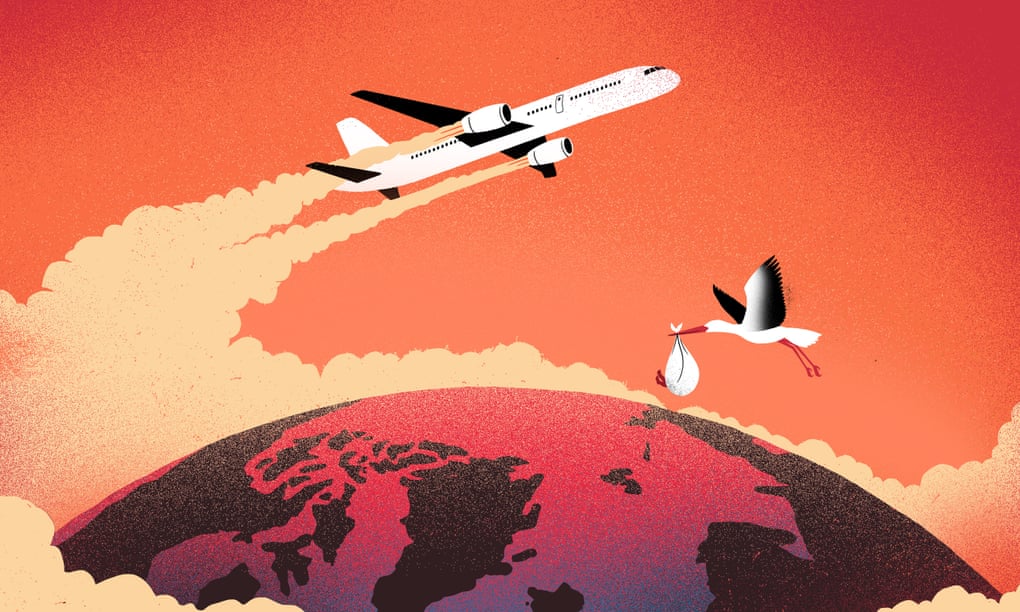
 Illustration: Sébastien Thibault/The Guardian

W

hen a major study was published last month, showing that the global population is likely to peak then crash much sooner than most scientists had assumed, I naively imagined that people in rich nations would at last stop blaming all the world’s environmental problems on population growth. I was wrong. If anything, it appears to have got worse.

Next week the BirthStrike movement – founded by women who, by announcing their decision not to have children, seek to focus our minds on the horror of environmental collapse – will dissolve itself, because its cause has been hijacked so virulently and persistently by population obsessives. The founders explain that they had “underestimated the power of ‘overpopulation’ as a growing form of climate breakdown denial”.

It is true that, in some parts of the world, population growth is a major driver of particular kinds of ecological damage, such as the expansion of small-scale agriculture into rainforests, the bushmeat trade and local pressure on water and land for housing. But its global impact is much smaller than many people claim.

The formula for calculating people’s environmental footprint is simple, but widely misunderstood: Impact = Population x Affluence x Technology (I = PAT). The global rate of consumption growth, before the pandemic, was 3% a year. Population growth is 1%. Some people assume this means that the rise in population bears one-third of the responsibility for increased consumption. But population growth is overwhelmingly concentrated among the world’s poorest people, who have scarcely any A or T to multiply their P. The extra resource use and greenhouse gas emissions caused by a rising human population are a tiny fraction of the impact of consumption growth.

Yet it is widely used as a blanket explanation of environmental breakdown. Panic about population growth enables the people most responsible for the impacts of rising consumption (the affluent) to blame those who are least responsible.

At this year’s World Economic Forum in Davos, the primatologist Dame Jane Goodall, who is a patron of the charity Population Matters, told the assembled pollutocrats, some of whom have ecological footprints thousands of times greater than the global average: “All these things we talk about wouldn’t be a problem if there was the size of population that there was 500 years ago.” I doubt that any of those who nodded and clapped were thinking, “yes, I urgently need to disappear”.

In 2019, Goodall appeared in an advertisement for British Airways, whose customers produce more greenhouse gas emissions on one flight than many of the world’s people generate in a year. If we had the global population of 500 years ago (around 500 million), and if it were composed of average UK plane passengers, our environmental impact would probably be greater than that of the 7.8 billion alive today.

She proposed no mechanism by which her dream might come true. This could be the attraction. The very impotence of her call is reassuring to those who don’t want change. If the answer to environmental crisis is to wish other people away, we might as well give up and carry on consuming.

The excessive emphasis on population growth has a grim history. Since the clergymen Joseph Townsend and Thomas Malthus wrote their tracts in the 18th century, poverty and hunger have been blamed not on starvation wages, war, misrule and wealth extraction by the rich, but on the reproduction rates of the poor. Winston Churchill blamed the Bengal famine of 1943, that he helped to cause through the mass export of India’s rice, on the Indians “breeding like rabbits”. In 2013 Sir David Attenborough, also a patron of Population Matters, wrongly blamed famines in Ethiopia on “too many people for too little land”, and suggested that sending food aid was counter-productive.

Another of the charity’s patrons, Paul Ehrlich, whose incorrect predictions about mass famine helped to provoke the current population panic, once argued that the US should “coerce” India into “sterilising all Indian males with three or more children”, by making food aid conditional on this policy. This proposal was similar to the brutal programme that Indira Gandhi later introduced, with financial support from the UN and the World Bank. Foreign aid from the UK was funding crude and dangerous sterilisation in India as recently as 2011, on the grounds that this policy was helping to “fight climate change”. Some of the victims of this programme allege that they were forced to participate. At the same time, the UK government was pouring billions of pounds of aid into developing coal, gas and oil plants, in India and other nations. It blamed the poor for the crisis it was helping to cause.

Malthusianism slides easily into racism. Most of the world’s population growth is happening in the poorest countries, where most people are black or brown. The colonial powers justified their atrocities by fomenting a moral panic about “barbaric”, “degenerate” people “outbreeding” the “superior races”. These claims have been revived today by the far right, who promote conspiracy theories about “white replacement” and “white genocide”. When affluent white people wrongly transfer the blame for their environmental impacts on to the birthrate of much poorer brown and black people, their finger-pointing reinforces these narratives. It is inherently racist.

The far right now uses the population argument to contest immigration into the US and the UK. This too has a grisly heritage: the pioneering conservationist Madison Grant promoted, alongside his environmental work, the idea that the “Nordic master race” was being “overtaken” in the US by “worthless race types”. As president of the Immigration Restriction League, he helped to engineer the vicious 1924 Immigration Act.

But, as there are some genuine ecological impacts of population growth, how do we distinguish proportionate concerns about these harms from deflection and racism? Well, we know that the strongest determinant of falling birth rates is female emancipation and education. The major obstacle to female empowerment is extreme poverty. Its effect is felt disproportionately by women.

So a good way of deciding whether someone’s population concerns are genuine is to look at their record of campaigning against structural poverty. Have they contested the impossible debts poor nations are required to pay? Have they argued against corporate tax avoidance, or extractive industries that drain wealth from poorer countries, leaving almost nothing behind, or the financial sector in Britain’s processing of money stolen abroad? Or have they simply sat and watched as people remain locked in poverty, then complained about their fertility?

Before long, this reproductive panic will disappear. Nations will soon be fighting over immigrants: not to exclude them, but to attract them, as the demographic transition leaves their ageing populations with a shrinking tax base and a dearth of key workers. Until then, we should resist attempts by the rich to demonise the poor.

• George Monbiot is a Guardian columnist

https://www.theguardian.com/commentisfree/2020/aug/26/panic-overpopulation-climate-crisis-consumption-environment

dinsdag 25 augustus 2020

QAnon explained: the antisemitic conspiracy theory gaining traction around the world

e

QAnon explained: the antisemitic conspiracy theory gaining traction around the world

The visibility of the online movement has surged as a supporter appears headed to Congress and Trump fails to debunk claims

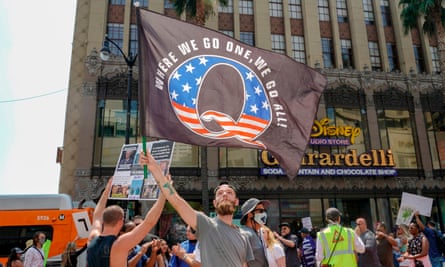
Conspiracy theorist QAnon demonstrators protest child trafficking on Hollywood Boulevard in Los Angeles, California, on 22 August.

Conspiracy theorist QAnon demonstrators on Hollywood Boulevard in Los Angeles, California, on 22 August. Photograph: Kyle Grillot/AFP/Getty Images

 in San Francisco


To Donald Trump, it’s “people who love our country”. To the FBI, it’s a potential domestic terror threat. And to you or anyone else who has logged on to Facebook in recent months, it may just be a friend or family member who has started to show an alarming interest in child trafficking, the “cabal”, or conspiracy theories about Bill Gates and the coronavirus.

This is QAnon, a wide-ranging and baseless internet conspiracy theory that reached the American mainstream in August. The movement has been festering on the fringes of rightwing internet communities for years, but its visibility has exploded in recent months amid the social unrest and uncertainty of the coronavirus pandemic.

Now, a QAnon supporter is probably heading to the US Congress, the president (who plays a crucial role in QAnon’s false narrative) has refused to debunk and disavow it, and the successful hijacking of the #SaveTheChildren hashtag has provided the movement a more palatable banner under which to stage real-life recruiting events and manipulate local news coverage.

Here’s our guide to what you need to know about QAnon.

So what is QAnon?

“QAnon” is a baseless internet conspiracy theory whose followers believe that a cabal of Satan-worshipping Democrats, Hollywood celebrities and billionaires runs the world while engaging in pedophilia, human trafficking and the harvesting of a supposedly life-extending chemical from the blood of abused children. QAnon followers believe that Donald Trump is waging a secret battle against this cabal and its “deep state” collaborators to expose the malefactors and send them all to Guantánamo Bay.

A man holds a sign condemning supposed pedophilia in the film industry, in Hollywood on 22 August.
A man holds a sign condemning supposed pedophilia in the film industry, in Hollywood on 22 August. Photograph: Christian Monterrosa/EPA

There are many, many threads of the QAnon narrative, all as far-fetched and evidence-free as the rest, including subplots that focus on John F Kennedy Jr being alive (he isn’t), the Rothschild family controlling all the banks (they don’t) and children being sold through the website of the furniture retailer Wayfair (they aren’t). Hillary Clinton, Barack Obama, George Soros, Bill Gates, Tom Hanks, Oprah Winfrey, Chrissy Teigen and Pope Francis are just some of the people whom QAnon followers have cast as villains in their alternative reality.

This all sounds familiar. Haven’t we seen this before?

Yes. QAnon has its roots in previously established conspiracy theories, some relatively new and some a millennium old.

The contemporary antecedent is Pizzagate, the conspiracy theory that went viral during the 2016 presidential campaign when rightwing news outlets and influencers promoted the baseless idea that references to food and a popular Washington DC pizza restaurant in the stolen emails of Clinton campaign manager John Podesta were actually a secret code for a child trafficking ring. The theory touched off serious harassment of the restaurant and its employees, culminating in a December 2016 shooting by a man who had travelled to the restaurant believing there were children there in need of rescue.

QAnon evolved out of Pizzagate and includes many of the same basic characters and plotlines without the easily disprovable specifics. But QAnon also has its roots in much older antisemitic conspiracy theories. The idea of the all-powerful, world-ruling cabal comes straight out of the Protocols of the Elders of Zion, a fake document purporting to expose a Jewish plot to control the world that was used throughout the 20th century to justify antisemitism. Another QAnon canard – the idea that members of the cabal extract the chemical adrenochrome from the blood of their child victims and ingest it to extend their lives – is a modern remix of the age-old antisemitic blood libel.

How did QAnon start?

On 28 October 2017, “Q” emerged from the primordial swamp of the internet on the message board 4chan with a post in which he confidently asserted that Hillary Clinton’s “extradition” was “already in motion” and her arrest imminent. In subsequent posts – there have been more than 4,000 so far – Q established his legend as a government insider with top security clearance who knew the truth about the secret struggle for power between Trump and the “deep state”.

Though posting anonymously, Q uses a “trip code” that allows followers to distinguish his posts from those of other anonymous users (known as “anons”). Q switched from posting on 4chan to posting on 8chan in November 2017, went silent for several months after 8chan shut down in August 2019, and eventually re-emerged on a new website established by 8chan’s owner, 8kun.

Q’s posts are cryptic and elliptical. They often consist of a long string of leading questions designed to guide readers toward discovering the “truth” for themselves through “research”. As with Clinton’s supposed “extradition”, Q has consistently made predictions that failed to come to pass, but true believers tend to simply adapt their narratives to account for inconsistencies.

For close followers of QAnon, the posts (or “drops”) contain “crumbs” of intelligence that they “bake” into “proofs”. For “bakers”, QAnon is both a fun hobby and a deadly serious calling. It’s a kind of participatory internet scavenger hunt with incredibly high stakes and a ready-made community of fellow adherents.

How do you go from anonymous posts on 4chan to a full-fledged conspiracy movement?

Not by accident, that’s for sure. Anonymous internet posters who claim to have access to secret information are fairly common, and they usually disappear once people lose interest or realize they are being fooled. (Liberal versions of this phenomenon were rampant during the early months of the Trump administration when dozens of Twitter accounts claiming to be controlled by “rogue” employees of federal agencies went viral.)

QAnon supporters await the arrival of Donald Trump for a rally at Mohegan Sun Arena in Wilkes-Barre, Pennsylvania, in 2018.
QAnon supporters await the arrival of Donald Trump for a rally at Mohegan Sun Arena in Wilkes-Barre, Pennsylvania, in 2018. Photograph: Mandel Ngan/AFP/Getty Images

QAnon might have faded away as well, were it not for the dedicated work of three conspiracy theorists who latched on to it at the very beginning and translated it into a digestible narrative for mainstream social media networks. A 2018 investigation by NBC News uncovered how this trio worked together to promote and profit off QAnon, turning it into the broad, multi-platform internet phenomenon that it is today. There now exists an entire QAnon media ecosystem, with enormous amounts of video content, memes, e-books, chatrooms, and more, all designed to snare the interest of potential recruits, then draw them “down the rabbit hole” and into QAnon’s alternate reality.

How many people believe in QAnon? And who are they?

Nobody knows, but we think it’s fair to say at least 100,000 people.

Experts in conspiracy theories point out that belief in QAnon is far from common. While at one point, 80% of Americans believed a conspiracy theory about the Kennedy assassination, a poll by Pew Research in March found that 76% of Americans had never heard of QAnon and just 3% knew “a lot” about it.

The largest Facebook groups dedicated to QAnon had approximately 200,000 members in them before Facebook banned them in mid-August. When Twitter took similar action against QAnon accounts in July, it limited features for approximately 150,000 accounts. In June, a Q drop that contained a link to a year-old Guardian article resulted in approximately 150,000 page views over the next 24 hours.

These are rough figures to draw a conclusion from, but in the absence of better data, they hint at the scale of the online movement.

In general, QAnon appears to be most popular among older Republicans and evangelical Christians. There are subcultures within QAnon for people who approach studying Q drops in a manner similar to Bible study. Other followers appear to have come to QAnon from New Age spiritual movements, from more traditional conspiracy theory communities, or from the far right. Since adulation for Trump is a prerequisite, it is almost exclusively a conservative movement, though the #SaveTheChildren campaign is helping it make inroads among non-Trump supporters (see below).

QAnon has spread to Latin America and Europe, where it appears to be catching on among certain far-right movements.

Why does QAnon matter?

First, there’s the threat of violence. For those who truly believe that powerful figures are holding children hostage in order to exploit them sexually or for their blood, taking action to stop the abuse can seem like a moral imperative. While most QAnon followers will not engage in violence, many already have, or have attempted to, which is why the FBI has identified the movement as a potential domestic terror threat. Participation in QAnon also often involves vicious online harassment campaigns against perceived enemies, which can have serious consequences for the targets.

QAnon is also gaining traction as a political force in the Republican party, which could have real and damaging effects on American democracy. Media Matters has compiled a list of 77 candidates for congressional seats who have indicated support for QAnon and at least one of them, Georgia’s Marjorie Taylor Greene, will in all likelihood be elected in November.

People march during a ‘Save the Children’ rally outside the Capitol building on 22 August in St Paul, Minnesota.
People march during a ‘Save the Children’ rally outside the Capitol building on 22 August in St Paul, Minnesota. Photograph: Stephen Maturen/Getty Images

As the hero of the overall narrative, Trump has the unique ability to influence QAnon believers. On 19 August, at a White House press briefing, he was given the opportunity to debunk the theory once and for all. Instead, he praised QAnon followers as patriots and appeared to affirm the central premise of the belief, saying: “If I can help save the world from problems, I’m willing to do it; I’m willing to put myself out there, and we are, actually. We’re saving the world from a radical left philosophy that will destroy this country and, when this country is gone, the rest of the world will follow.”

QAnon believers were jubilant.

Didn’t you mention #SaveTheChildren? What’s that all about?

Participating in QAnon is largely made up of “research” – ie learning more about the byzantine theories or decoding Q drops – and evangelism. Most of the proselytization relies on media manipulation tactics designed to catch users’ attention and send them into a controlled online media environment where they will become “redpilled” through consuming pro-QAnon content.

QAnon followers have for years used a wide range of online tactics to achieve virality and garner mainstream media coverage, including making “documentaries” full of misinformation, hijacking trending hashtags with QAnon messaging, showing up at Trump rallies with Q signs, or running for elected office.

A very potent iteration of this tactic emerged this summer with the #SaveTheChildren or #SaveOurChildren campaign. The innocuous sounding hashtag, which had previously been used by anti-child-trafficking NGOs, has been flooded with emotive content by QAnon adherents hinting at the broader QAnon narrative. (It doesn’t help that the debate around human trafficking is already full of bogus statistics.)

On Facebook, anxiety over children due to the coronavirus pandemic, a resurgent anti-vaxx movement, and QAnon-fueled scaremongering about child trafficking have all combined to inspire a modern-day moral panic, somewhat akin to the “Satanic Panic” of the 1980s.

Hundreds of real-life “Save Our Children” protests have been organized on Facebook in communities across the US (and around the world). These small rallies are in turn driving local news coverage by outlets who don’t realize that by publishing news designed to “raise awareness” about child trafficking, they are encouraging their readers or viewers to head to the internet, where a search for “save our children” could send them straight down the QAnon rabbit hole.

https://www.theguardian.com/us-news/2020/aug/25/qanon-conspiracy-theory-explained-trump-what-is