dinsdag 3 maart 2020

Human rights and Greta on Hungarian state media watch list

POLITICO EUROPE


Afbeeldingsresultaat voor POLITICO EUROPE


Human rights and Greta on Hungarian state media watch list

Activists condemn ‘censorship’ revealed in leaked emails.
 
Updated 


Hungarian state media bosses told staff they need permission to report on Greta Thunberg and EU politics, and banned coverage of reports from leading human rights organizations, according to internal emails obtained by POLITICO.
Editors working in state media are provided with lists of sensitive topics, and any coverage related to the issues mentioned requires staff to send draft content for approval from higher up, the internal correspondence shows. In the case of Thunberg, the Swedish climate activist, journalists were told they need permission before they even start writing, according to one email.
Journalists do not know who ultimately green-lights the articles whose subject matter is on the list, said one state media employee, who spoke on condition of anonymity due to fear of reprisal. When something gets rejected by the unknown decision-makers, senior editors sometimes euphemistically refer to it as reporting that "fell in battle," the employee said.
Hungary is currently subject to the EU's Article 7 censure procedure, triggered when the bloc's fundamental values are considered at risk in a member country. The European Parliament launched the procedure in 2018, citing media freedom as one of many issues that gave cause for alarm. Prime Minister Viktor Orbán's government has dismissed such concerns.
Screenshots of the internal emails detailing instructions to state media staff, all dating from the second half of 2019, were sent anonymously to POLITICO. The state media employee confirmed their authenticity.
Hungarian journalists have long raised concerns that some politically sensitive issues are absent from the news coverage of state-owned television channels.
The emails come from senior editors who work for an organization with responsibility for state media outlets such as the state news agency MTI and multiple television and radio stations. The emails appear to focus particularly on the news wire's coverage.
A list of political issues requiring special consent ahead of publication includes “migration, European terror, Brussels, church issues” and parliamentary, presidential and local elections in the “EU+” — a category covering European and some neighboring countries — according to an October email signed by senior editor Sándor Végh.
Ad-hoc instructions are also sometimes emailed to staffers. Last summer, Sándor Ráthy, another senior editor, circulated a short email with the simple subject line of "greta."
"Before writing the Greta Thunberg materials," staffers need to seek consent from the editor-in-chief's office, he wrote. The email was sent on August 14, the day the teen activist set sail from the U.K. to New York to speak at the United Nations. The wire ultimately did not publish news of Thunberg's trip, according to its articles database.
An explicit order was issued preventing state media employees from mentioning reports by Amnesty International and Human Rights Watch | Geoffroy Van Der Hasselt/AFP via Getty Images
The emails also confirm that, as reported previously by Hungarian daily Népszava, an explicit order was issued preventing state media employees from mentioning reports by Amnesty International and Human Rights Watch in their coverage.
“I have been informed by [state television foreign desk lead staffer] Balázs Bende that we do not publish Human Rights Watch and Amnesty International’s materials,” senior editor Tamás Pintér wrote in a November 8 email to his colleagues.
A day earlier, Amnesty International's Hungarian chapter organized a demonstration against Turkish President Recep Tayyip Erdoğan, who was visiting Hungary. Hours before the email was sent, Human Rights Watch published a video of its Budapest-based senior researcher Lydia Gall presenting footage of what the organization described as illegal pushbacks of migrants from Croatia to Bosnia. Pushbacks are a sensitive topic in Hungary: Watchdogs have raised concerns about reports of Hungarian police illegally and at times violently moving migrants across borders. The Hungarian authorities have denied any wrongdoing.
Civil society groups expressed outrage at the state media restrictions.
"This is another example of the Hungarian government undermining media freedom and attempting to silence and interfere with the vital work of civil society organizations," said Gall.
State-owned entities play a big role in the Hungarian media scene, but critics say their structure and governance is opaque.
Hungarian journalists have long raised concerns that some politically sensitive issues are absent from the news coverage of state-owned television channels and wire reports.
"This is censorship — pure and simple," Julie Majerczak, head of the Brussels office of media freedom NGO Reporters Without Borders, said in reaction to the leaked emails. "It is unacceptable and very worrying. Public media are not the spokespersons of the government, they should be neutral and independent."
State-owned entities play a big role in the Hungarian media scene, but critics say their structure and governance is opaque.
Editorial responsibility for state media formally rests with an organization called the Duna Media Service Provider, said Ágnes Urbán, an expert at Mérték Media Monitor, a Hungarian NGO that campaigns for media freedom.
But, Urbán noted, that body has "minimal" budget and staff. It is overseen by another organization, the Public Service Foundation, whose board consists of three members delegated by the ruling Fidesz party in parliament, three by opposition parties and one by the Media Council — a body dominated by allies of Fidesz. The Media Council also appoints the board's president.
MTVA did not respond to questions submitted to them for this article| Attila Kisbenedek/AFP via Getty Images

In practice, yet another body, the Media Service Support and Asset Management Fund (MTVA), wields significant influence over media content — under a structure that international media watchdogs have criticized as lacking in transparency.
Neither Duna nor MTVA responded to questions submitted to them for this article several days before publication. The editors who sent the emails did not respond to requests for comment or referred questions to MTVA.
After this article was published, MTVA portrayed state media’s decisions on coverage as part of a normal editorial process.
The question of "which issue, in which form, on what scale and in which area of the state media" is published is a matter of editorial decision-making, "just like every other editorial office in the world,” a statement said.
It described questions submitted by independent Hungarian media outlets as a result of POLITICO’s reporting as “coordinated attacks” intended to exact “revenge” on state media.
MTVA also said that Hungarian state media follows the standards of the BBC.
Radio Free Europe plans to resume its Hungarian-language service later this year in an effort to boost independent reporting and fight disinformation.
In late 2018, thousands of anti-government protesters rallied outside MTVA's headquarters calling for objective public media.
This article has been updated to add reaction from the Media Service Support and Asset Management Fund.
-----------------------------------------------
    My Comments : 
1. Lectoring extreme right populists from the eastern side of the EU on possible censorship on Greta Thunberg / XR  might be right (and highly satisfactory) within itself, but at the same time this seems to be rather hypocritical.
2. Hypocritical given for example the shameful fact, that a number of those very moral high-ground lectorers (escpacially) from the western po;itical hemishere had been caught red handed lately by notably having Thunberg / XR labelled by their police in the same category of violent extremists as neo-nazi  and Islamist terrorgroups.
3. Apart from the fact of course that knowingly destroying the human habitat most definitively should be labelled terrorism from the ultimate category and should be punished likewise.

maandag 24 februari 2020

Harvey Weinstein found guilty at rape trial


Harvey Weinstein found guilty at rape trial

Film mogul faces prison time, as verdict may encourage more women to come forward after abuse and change the way crimes are prosecuted


 in New York


Mon 24 Feb 2020 


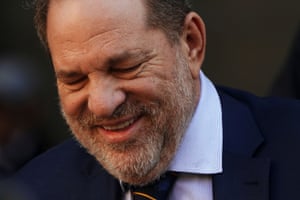
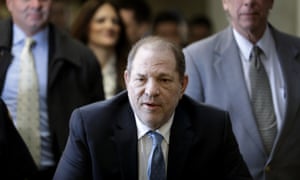
Harvey Weinstein arrives at a Manhattan courthouse for his rape trial on Monday, February 24, 2020, in New York. Harvey Weinstein arrives at a Manhattan courthouse for his rape trial on Monday, February 24, 2020, in New York. Photograph: Seth Wenig/AP

Harvey Weinstein, the fallen titan of Hollywood whose sexual abuse of aspiring young female actors sparked the #MeToo movement, has finally been brought to justice after a New York jury found him guilty.
The movie mogul’s epic fall from grace is now complete, toppled from the pinnacle of independent cinema where he helmed films such as Pulp Fiction and Shakespeare in Love, amassing a total of 81 Oscars. The glamorous Manhattan and Los Angeles lifestyle he once enjoyed will soon be replaced by a New York state prison cell as he faces jail time.
The jury of seven men and five women at the New York supreme court took five days to reach their verdict.
The conviction marks the final comeuppance for a towering figure who wielded his power in the movie industry – as well as his commanding physical presence – over vulnerable young women seeking his help.

Though Judge James Burke cautioned the jury not to see the case as a referendum on #MeToo, Weinstein’s conviction is certain to have far-reaching consequences for gender relations in the workplace, in Hollywood and far beyond. The world of powerful men who deploy their seniority as tools of sexual control is much less secure in its wake.
Michelle Simpson Tuegel, an attorney representing victims of sexual assault, said she expected to see a wave of women coming forward with complaints against other sexual abusers. “No matter how powerful a person is, no matter how much mud or dirt may be flung at those who have the courage to come forward, we are in a new time. The #MeToo era has thankfully started to unmask these systems of abuse of power, and now women can be heard and believed.”
The guilty verdict could also have a profound impact on the way sex crimes are prosecuted. The New York district attorney’s office took an enormous gamble in how they set up the trial.
Prosecutors chose as main accusers two women, both of whom continued to have close – and at times sexual – contact with Weinstein after they were attacked. In the past, prosecutors have almost always balked at such cases where coerced and consensual sex exists side-by-side, considering them too messy to secure guilty verdicts.
The fact that the tactic succeeded with the jury is a sign of the shifting sands of #MeToo. It suggests that prosecutors might have far more leeway in future to take on cases where victims continue to be in the thrall of their attackers after sexual assaults – a scenario which sex crimes experts say is all too common and yet up til now has been almost entirely neglected by the criminal courts.
As psychiatrist Barbara Ziv told the jury in expert testimony, “it is the norm to have contact with the assailant.”
Such a striking victory can be credited to the two intrepid prosecutors, Joan Illuzzi-Orbon and Meghan Hast, who meticulously laid out the defendant’s culpability. They did so against the headwinds generated by Weinstein’s lawyers led by the Chicago-based sex crimes defender Donna Rotunno who was so aggressive towards witnesses that she induced in one of the two main accusers a fully fledged panic attack.

‘His reputation will never recover’: the rape trial that took down Harvey Weinstein


‘His reputation will never recover’: the rape trial that took down Harvey Weinstein


Mon 24 Feb 2020 


Film producer Harvey Weinstein departs New York criminal court during his ongoing sexual assault trial on 14 February. Film producer Harvey Weinstein departs New York criminal court during his ongoing sexual assault trial on 14 February. Photograph: Carlo Allegri/Reuters


One of the most powerful men in Hollywood is unlikely to return to the top after reporting exposed decades of sexual harassment and assault allegations


Harvey Weinstein’s career in the movie business has risen and fallen as markedly as his famous temper.
Long before he faced harassment and assault charges from scores of women he worked with over the years, and before he was the symbolic villain of the #MeToo movement paying top-dollar to fend off rape charges, Weinstein was busy defending himself from something much more ordinarily Hollywood: the notion he was a gigantic jerk.
Matt Damon once compared him to a scorpion, saying “it’s his nature” to sting people. Meryl Streep, accepting an award for best actress in 2012, thanked, “God, Harvey Weinstein, the punisher, Old Testament, I guess.”

Streep’s metaphor was apt.
At the time he was one of the most powerful men in Hollywood as co-founder of Miramax and the Weinstein Company, and as producer of some of the previous decades’ top movies. He was a kingmaker helping to shape the careers of top directors like Quentin Tarantino and A-listers like Gwyneth Paltrow. He could make careers, and he could break them.
But Pulitzer prize-winning reporting from the New York Times and the New Yorker that exposed decades of sexual harassment and assault allegations against him, and culminated this year in a criminal trial in New York, saw Weinstein become a virtual untouchable – toxic to most of those who formerly feted him with a surname that has become a byword for abuse, not Oscars.
Weinstein is unlikely to ever return to the top. That’s according even to people whose job it is to redeem the reputation of the seemingly irredeemable. “His reputation will never recover,” said Shannon Wilkinson, a New York-based reputation management consultant.
Ken Auletta, an early profiler of Weinstein now at work on a biography of the mogul that is due out in 2021, agreed. “Who’s going to want to act in a Harvey movie? What studio is going to recruit him?”

American film producers Harvey Weinstein and his brother Bob Weinstein, left, of Miramax Films at their offices in New York City, in 1989.
Pinterest
 American film producers Harvey Weinstein and his brother Bob Weinstein, left, of Miramax Films at their offices in New York City, in 1989. Photograph: Barbara Alper/Getty Images

The early years

Weinstein grew up in Queens and from a young age his father Max would take him and his brother Bob to the movies every Saturday. They went to see foreign films, dramas, everything – and though his father would sometimes fall asleep, the boys relished the outings and promptly became cinephiles.
Weinstein took readily to the role of movie historian, incorporating things he learned in his weekend movie sojourns to what he was learning in school. An old classmate, Jeff Malek told the Hollywood Reporter that Weinstein “knew the entire cast of every movie” and that when he tested him with questions about The Wizard of Oz, Weinstein “proceeded to list the cast and crew, including gaffers, wardrobe, etc, by memory”.
Not everything the Weinsteins learned at home was so helpful. In a 2011 tribute piece to his dad, Bob Weinstein recalled how once after his mom received an unflattering haircut at the beauty salon, she demanded her husband seek revenge. “‘Have the hairstylist fired and sue the beauty parlor for everything they’ve got,’” Bob recalled his mother saying in the piece he penned in Vanity Fair.
Bob meant to relay it as a playful anecdote, writing: “Max and his sons learned a valuable lesson that day. No matter what, the hair always looks great.” But looking back at Weinstein’s career, and the long list of claims that he was explosive and abusive to underlings, it’s hard not to wonder if he didn’t have a different takeaway.
Weinstein first started to leverage his bold personality into a career while attending school at the Buffalo branch of the State University of New York, where he founded a concert promotion business, Harvey & Corky Presents, with his friend Corky Burger, and quickly made a name for himself by bringing big names like the Rolling Stones, Frank Sinatra and Bob Dylan up to Buffalo.
By 1973 he had dropped out of school, and was running a local theater where he showed three movies for the price of one on Saturday nights, according to Auletta’s New Yorker profile in 2002.
He and Bob wanted to get into the movie business though, so in 1979 he used the proceeds made from Harvey & Corky Presents to, along with his brother, found Miramax, an independent film distribution and production company named for their parents, Miriam and Max.
“It wasn’t very expensive to do that,” Auletta said. “Distribution was really cheap to do, and they had a good eye and they spotted movies like Sex, Lies and Videotape, which was their first major hit.”
Other successes followed and in June of 1993, Miramax was bought by The Walt Disney Company for $80m in a deal that allowed the brothers to stay on creatively. Director Quentin Tarantino’s cult classic movie Pulp Fiction, which was backed by Miramax, came out a year later and was awarded the Palme d’Or award at the Cannes Film Festival. In 1997, The English Patient landed Miramax its first Academy Award for best picture. And in 1999, Shakespeare in Love won seven Oscars, including a best actress award for Gwyneth Paltrow.

‘Shakespeare in Love’ Best Actress winner Gwyneth Paltrow (center) is joined by Harvey Weinstein (center left) backstage as they celebrated their win of Best Picture at the 1999 Academy Awards.
Pinterest
 ‘Shakespeare in Love’ Best Actress winner Gwyneth Paltrow (center) is joined by Harvey Weinstein (center left) backstage as they celebrated their win of Best Picture at the 1999 Academy Awards. Photograph: Bob Riha Jr/Getty Images

The setback

But even in his heyday, Weinstein was developing a reputation as difficult to work with, even against the high bar of Hollywood where dictatorial directors and arrogant studio heads are the norm.
After a string of successes, he hit a rough patch in 2005. Disney divorced the Weinstein brothers that year following disputes about budget and creative control.
The brothers launched their own independent studio, the Weinstein Company, the same year. But they struggled initially to repeat earlier successes. Films released in the first few years included a number of duds, and rumors about his temper were starting to catch up with him in the insular circles in which he moved.
As early as the 1990s, the New York Times was reporting settlements he had made with various women – among them Rose McGowan in 1997 and numerous assistants.
“It’s a recurring theme with him,” said Auletta, who wrote the groundbreaking New Yorker profile of Weinstein in 2002 highlighting his abusive behavior and hinting at his sexual malfeasance, though Auletta was not able to confirm it with women going on the record at the time. “He apologizes and says, I want to change,” Auletta continued. “He’s done that all through his adult life. But in my experience, he hasn’t changed. He couldn’t control his temper.”

The comeback and the fall

But by 2011, Weinstein was back on top again, as changing audience tastes caught up with his aesthetic. That year The King’s Speech was nominated for a dozen Oscars and awarded best picture. The following year he racked up a pile of Golden Globe awards for films including My Week with Marilyn, Iron Lady, and The Artist – an ode to the golden era of silent films which would go on to win best picture at the Academy Awards.
A spate of glowing profiles portrayed Weinstein as the quintessential “comeback kid” of Hollywood, including one by the New York Times media writer David Carr entitled A Mistake to Write Off the Weinsteins. Another piece in Gawker described him as rising from the grave to “feast on the bones of his enemies”.
Weinstein was back near the height of his powers when he heard that reporters were snooping around allegations of rape and sexual assault that had long been simmering.

Actresses who have accused Harvey Weinstein of assault. (Top L-R) Léa Seydoux, Emma de Caunes, Gwyneth Paltrow, Asia Argento, Ashley Judd (bottom L-R) Cara Delevingne, Rosanna Arquette, Judith Godrèche, Angelina Jolie and Rose McGowan.
Pinterest
 Actresses who have accused Harvey Weinstein of assault. (Top L-R) Léa Seydoux, Emma de Caunes, Gwyneth Paltrow, Asia Argento, Ashley Judd (bottom L-R) Cara Delevingne, Rosanna Arquette, Judith Godrèche, Angelina Jolie and Rose McGowan. Photograph: N Prommer/G Horcahuelo/S Nogier/ A Gombert/Peter Fole/EPA

In response he used the full breadth of his connections, money and ruthless self-interest, to try to quash them. He hired lawyers, private investigators and even an intelligence firm founded by ex-Israeli spies called Black Cube, which counter-investigated the reporters who were investigating him.
He also leaned on longstanding relationships at NBC News and tapped relationships at other media outlets, including David Pecker, the now notorious head of the National Enquirer who also kept secrets and killed stories for Donald Trump.
But Weinstein couldn’t hold back the tide.
In the fall of 2017, the New York Times and the New Yorker published stories documenting years of alleged abuse and kicking off what would become the #MeToo movement, a worldwide reckoning around sexual harassment and assault by powerful men in countless industries. Weinstein ended up in court, a powerful symbol for women worldwide of powerful men abusing their position for sex.
Civil attorney Ari Wilkenfeld, a partner at the DC-based firm Wilkenfeld, Herendeen & Atkinson, who specializes in discrimination, said Weinstein’s trial has triggered important changes.
For one thing, Wilkenfeld – who has represented female clients in a number of high-profile #MeToo cases, including Brooke Nevils when she accused Matt Lauer of rape and Linda Vester when she accused Tom Brokaw of sexual harassment – has seen a renaissance in people caring about sexual harassment law.
“We’re finally getting somewhere,” he said.
He also noted the Weinstein trial has been important in highlighting the defense’s line of argument that if women had really been raped or assaulted they wouldn’t continue to have any kind of relationship with their abuser.
Wilkenfeld said that’s not the case. “People behave in ways that seem antithetical to members of the jury. They might delay in reporting; they might deny that the rape occurred. They might have a romantic relationship with the person after the assault or rape; they might do any number of things that, to an ordinary person, don’t make sense. And the challenge is to explain the psychology of what a victim and survivor goes through and how there’s no straight line and no one way a person reacts,” he said.
Similar legal defenses were mounted on behalf of rapist college football coach Jerry Sandusky, Wilkenfeld noted, and the prosecution was ultimately able to overcome predictable skepticism.
Sarah Ann Masse, a Weinstein accuser involved in the class-action lawsuit against him, sees justice in Weinstein’s position in the dock.
“I think losing his job and the fact that he’s on criminal trial are exceptionally important,” she said, adding of powerful male abusers that “we have to hold them accountable”.
“I’m hoping what this will do regardless of the outcome is help educate the public about what it’s really like to be a survivor of sexual violence,” she said.