dinsdag 30 juli 2019

What’s in Boris Johnson’s £100m no-deal preparation leaflets? Here’s a taster


What’s in Boris Johnson’s £100m no-deal preparation leaflets? Here’s a taster


From eating pets and warming up kippers to embracing martial law, this advice could help us survive a no-deal Brexit
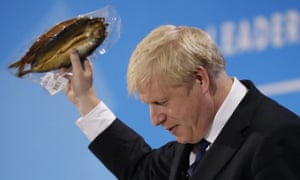

Boris Johnson at the final Conservative leadership hustings in London, 17 July 2019


Tue 30 Jul 2019 

At this news the pound fell at an alarming rate, pretty much acting in the opposite manner to Johnson on a zipline, and hit a new 28-month low. On the bright side, we will soon hit parity with the euro, essentially finally joining to the currency by the back door, and it’s all thanks to Brexiteers.
So how has the emergency committee decided to prepare us for something pretty much unprecedented in British history in three months’ time? While sitting around in the Cobra briefing room – normally reserved for national emergencies that we haven’t brought upon ourselves – Johnson and his team decided to talk about leafleting. The government will launch a new campaign to inform the whole country about no-deal preparations, with costs expected to run into nine figures.
A few years after Theresa May looked a nurse dead in the eye and said“There’s no magic money tree”, here they are spending £100m on a leaflet explaining how best to eat your dog. These leaflets will have the difficult job of assuring everyone that everything is going to be fine while also containing enough information to convince the EU that we’re taking it seriously and are prepared to go through with it. They have to tell people “This is what you wanted, isn’t it great” but also “Here are some steps you can take so you don’t die in November”.
It’s a tough balancing act, but I have decided to offer my copywriting services, as a patriotic duty:

Section 1: The following pets are now food


A dog at a People’s Vote march in London, March 2019
Pinterest
 ‘There’s no problem here that can’t be solved by reclassifying Mr Biggles as food.’ A dog at a People’s Vote march in London, March 2019. Photograph: Kirsty Wigglesworth/AP

Remainers and people that ship food in and out of the country on a regular basis (eg major supermarkets) would have you believe that there will be shortages in parts of the country on 1 November, as 30% of our supplies come from the EU.
Where’s their blitz spirit? Did you know (true story) that we massacred over 750,000 of our own dogs and cats at the beginning of the second world war? OK, that wasn’t about serving them up for Sunday lunch, but making sure we didn’t have to worry about keeping them fed. I say kill two birds with one stone: there’s surely no problem here that can’t be solved by reclassifying Mr Biggles as food. Recipes on page nine.

Section 2: Blackouts are nature’s way of telling you to go to bed

Everybody loves camping off-grid, seeing the stars come out and hearing the wildlife emerge from the woods. When the blackouts come, try to think of Birmingham as your tent.

Section 3: Have you considered not having diabetes?

The remoaner elite – in these specific circumstances comprised of our own ministers, advisers and facts – say that no deal could disrupt supply lines through ports, with longer checks on goods causing a backlog of medicines trapped at borders and eventually going to waste. To this, and without any real reason or proof, we say nah, that won’t happen, probably.
I ask you this: if we’re going to deny these realities – which it’s very much clear we are – would it really kill you to pretend you don’t have diabetes for a bit? Hmm? Have a little try for me, there’s a good chap.

Section 4: Fill your bathtub with water if you want to live


Rubber duck
Pinterest
 ‘Keep water in your bathtub in case you need to drink it for a month.’ Photograph: Michele Adamson/Getty Images/EyeEm

Chemicals to clean water might not make it into the UK, so please keep water in your bathtub in case you need to drink it for a month. I know this sounds bad, but honestly who actually enjoys washing anyway?

Section 5: Keep your spirits up

The tough bit is nearly over. Keep your spirits up by doing stuff the EU wouldn’t let us do: you don’t have bananas, but if you did they’d sure as hell have a bend in them, enjoy that thought.
Take your kippers off their ice pillows. No pillows for kippers! Rip your shirt off and scream “FREEDOM”, like in Braveheart. OK, so that turned out to be a British law, and all you’re really doing is inviting food poisoning and diarrhoea because fish needs to be kept cool, but at least diarrhoea was your choice. Which – to be absolutely clear – it already was.

Section 6: Embrace martial law


Members of the British armed forces marching in Salisbury, June 2019
Pinterest
 ‘Everyone loved playing army as a kid.’ Members of the British armed forces marching in Salisbury, June 2019. Photograph: Corporal Ben Beale/British Army/PA

Everybody loved playing army as a kid, and in the end isn’t Brexit really about wanting your childhood back? Voila, we give you martial law. Keep your head down and nobody dies. What fun!

Section 7: Congratulations, we Brexited ourselves

We did it. We’re finally free from the shackles of the EU and its laws and its medicine and the tyranny of its [squints] food. We survived! And, as we all know, that was the prize of Brexit promised in the 2016 referendum campaign: vote leave and we’ll scrape through with our lives. Just.
• James Felton is a TV and radio comedy writer

https://www.theguardian.com/commentisfree/2019/jul/30/boris-johnson-no-deal-preparation-leaflets-advice-brexit#comment-131558566


----------------------------------------------------------------------------------------------------------------


01
What’s in Boris Johnson’s £100m no-deal preparation leaflets?
1. As I did mention in an earlier Guardian comment on this very subject, I did consider the fact that Johnson did visit the UK police force as one of his first (PR) duties in the country, as a dire sign of things to come, once a no-deal Brexit will have been realised : Johnson and his team do anticipate at present already, that once the no-Deal Rubicon will have been crossed, large protests and massive popular resistance will be organised.
2. These Large Protests might easily escalate into major riots, including looting and street-fights between extreme-right gangs and anxious Remainers / soft Brexiteers : Explosive scenery as a sort of announcement / forbode of a civil war in the UK (*).
3. Under those circumstances the UK police most certainly will be ordered on the streets to 'restore order' - so to take sides - and they might obey only to that order, if and when they on forehand will have been assured of additional / extra police officers and better equipment.
4. Next stop will be the appeasement by Johnson and Co, of the military, which will be badly needed, when the state of emergency will be declared and nightly curfews will have to be upheld.
5. You might think that I do overestimate the urge for drama by the Johnson government, but I can assure you, that not only will people be highly frustrated, when post-Brexit austerity will have set in, after a steep cliff-edge Brexit, the Johnson cabinet will also act according to its apparent preference for a fascist-like approach to government.
6. Think in this respect about the Tory extreme-right tendency (not necessarily exclusively represented by by the ERG alone) for chauvinist neo-nationalism, anti-democratic (for mainly populist and charisma based) leadership, anti-international governing bodies, white supremacism and a firm anti-scientific stance, that for example has to address the AGW climate-disaster that is rapidly unfolding over our global habitat at the moment.
7. So there is no such thing as coincidence in the frenetic way, that Johnson and his ultra-right fellow-plotters are behaving politically and socially at this point in time, for they already know what mischief might be in store for the UK population, once the 31th of October Brexit-threshold will have been passed.
8.   Although I do appreciate a bit of comedy (or black humour) every now and then on whatever subject, one can not simply avoid the observation, that things in the UK might indeed quickly change for the worse after a no-Deal Brexit in (only) a few months time.... 
(*) Not to speak of the highly realistic possibility of the restart of the Troubles in Northern Ireland, soon spilling over to England and/or the start of the war of Independence by Scottish nationalists.

Cambridge Analytica did work for Leave. EU, emails confirm


Cambridge Analytica did work for Leave. EU, emails confirm

Government committee told work went beyond exploring potential future collaboration
Julian Wheatland, the then chief operating officer of Cambridge Analytica
 Julian Wheatland, the then chief operating officer, told Cambridge Analytica staff the relationship with Leave.EU was to be formalised. Photograph: Screengrab/Netflix

Cambridge Analytica did work for Leave.EU on the EU referendum, according to emails published by a House of Commons committee, even though the company never received payment for it.
Brittany Kaiser, the former director of business development at the shuttered political consultancy, supplied the emails to the digital, culture, media and sport committee. She argued that they showed that, despite claims to the contrary, the partnership between the two organisations went beyond exploring the potential for future collaboration.
“Chargeable work was completed for Ukip and Leave.EU, and I have strong reasons to believe that those data sets and analysed data processed by Cambridge Analytica … were later used by the Leave.EU campaign without Cambridge Analytica’s further assistance,” Kaiser wrote in a letter to Damian Collins, the committee chair.


The emails show Cambridge Analytica staff, including Julian Wheatland, the company’s chief operating officer, discussing with Leave.EU staff whether or not to share the results of analysis performed on Ukip data. “We have generated some interesting findings that we can share in the presentation, but we are certain to be asked where the data came from. Can we declare that we have analysed Ukip membership and survey data,” Wheatland asked Leave.EU’s Andy Wigmore and Ukip’s then general secretary, Matthew Richardson. He was rebuffed.
Wheatland also told Cambridge Analytica staff that the relationship was intended to be formalised. “I had a call with Andy Wigmore today (Arron [Banks, founder of Leave.EU]’s right-hand man) and he confirmed that, even though we haven’t got the contract with the Leave written up, it’s all under control and it will happen just as soon as Matthew Richardson has finished working out the correct contract structure between Ukip, CA and Leave,” Wheatland said in an email to Cambridge Analytica staff.
In fact, Cambridge Analytica was never paid for the work it carried out. In her letter to Collins, Kaiser said: “Despite having no signed contract, the invoice was still paid, not to Cambridge Analytica but instead paid by Arron Banks to Ukip directly. This payment was then not passed on to Cambridge Analytica for the work completed, as an internal decision in Ukip, as their party was not the beneficiary of the work, but Leave.EU was.”
A Ukip spokesman disputed that any money paid by Banks to Ukip was intended to be passed on to Cambridge Analytica, and said Kaiser’s allegations against the party had already been investigated by the Information Commissioner’s Office in 2018. “We took the data to Cambridge Analytica, who looked at the data, and then we took the data away,” the spokesman said. “We refused the service, frankly because it was too expensive, and we didn’t want to engage with what they were doing.”
Cambridge Analytica and Leave.EU have long maintained that the analysis was only carried out for the purposes of pitching for a more permanent arrangement. Richard Tice, a co-founder of Leave.EU, said in 2018 that Cambridge Analytica “received no data or undertook any modelling for Leave.EU”.
At the time, Banks said: “Leave.EU did not receive any data or work from Cambridge Analytica. Ukip did give Cambridge Analytica some of its data and Cambridge Analytica did some analysis of this. But it was not used in the Brexit campaign. Cambridge Analytica tried to make me pay for that work but I refused. It had nothing to do with us.”
In response to the release, the DCMS committee member Ian Lucas called on the Electoral Commission to reopen its investigation into Leave.EU “in view of the additional evidence from Brittany Kaiser”.
Collins said: “There are important questions to follow up, in particular whether the data sets created by Cambridge Analytica were used in the referendum or other campaigns and if they were, whether or not it was a breach of data protection law for Ukip voter data to be used in this way – that certainly seems to be something that they themselves were concerned about.”
-----------------------------------------------------------------------
My Comments :
MI5 should be urgently and intensively investigated by an independent entity on this subject, for the UK (and USA) security services have been informed at that time on (possible) illegal interference by foreign nations - such as Russia (but possibly Tel Aviv and Peking as well) - that tried to seriously influence the outcome of the EU-UK referendum, but did refuse to inform the electorate on electioneering firms as Cambridge Analytica etc..   

Secret texts cast light on UK's early role in Trump-Russia inquiry


Secret texts cast light on UK's early role in Trump-Russia inquiry

Senior MI5 and FBI officials shared concerns about ‘our strange situation’ in 2016


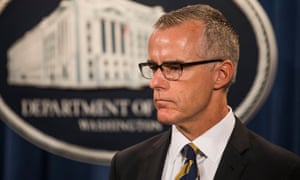
Andrew McCabehttps://www.amazon.co.uk/Lone-Gladio-Ms-Sibel-Edmonds/dp/0692213295


Two of the most senior intelligence officials in the US and UK privately shared concerns about “our strange situation” as the FBI launched its 2016 investigation into whether Donald Trump’s campaign was colluding with Russia, the Guardian has learned.

Text messages between Andrew McCabe, the deputy director of the FBI at the time, and Jeremy Fleming, his then counterpart at MI5, now the head of GCHQ, also reveal their mutual surprise at the result of the EU referendum, which some US officials regarded as a “wake-up call”, according to a person familiar with the matter.
While Russia had previously been viewed as a country that would seek to interfere in western elections, the Brexit vote was viewed by some within the FBI as a sign that Russian activities had possibly been successful, the person said.
Their exchanges offer new insights into the start of the FBI’s Russia investigation, and how British intelligence appears to have played a key role in the early stages.
In one exchange in August 2016, Fleming noted that members of the FBI and MI5 had “met on our strange situation”, a veiled reference to discussions about Russian activities, according to the source.
Jeremy Fleming with Prince Charles at GCHQFacebookTwittPinterest
 Jeremy Fleming (right) with Prince Charles at GCHQ this month. Photograph: Robert Weideman/EPA
The text messages between the two men were infrequent and cryptic and did not contain specific or sensitive materials, but occurred with some regularity after the referendum in June 2016.
A spokesperson for McCabe declined to comment.
The exchanges underscore a sensitive issue in the US – namely the role foreign intelligence services played in the FBI’s decision to initiate an investigation into the Trump campaign.
On 31 July 2016, the FBI opened a covert counterintelligence investigation codenamed “Crossfire Hurricane” into the then presidential candidate’s possible collusion with Russia.
The investigation was eventually taken over by the special counsel Robert Mueller, who has said there were “multiple, systematic efforts to interfere in our election” by Russia.
Mueller’s 448-page report did not establish a criminal conspiracy between the Trump campaign and Russia, but it did identify incidents in which Trump attempted to obstruct justice in the investigation, and did not clear the president of wrongdoing.
US and UK intelligence agencies frequently share information, but the exchanges between McCabe and Fleming appear to reflect a desire for a direct line of communication given what was seen as a developing problem on both sides of the Atlantic.
In his text message about the August 2016 meeting, Fleming appeared to be making a reference to Peter Strzok, a senior FBI official who travelled to London that month to meet the Australian diplomat Alexander Downer. Downer had agreed to speak with the FBI about a Trump campaign adviser, George Papadopoulos, who had told him that Russia had dirt on Hillary Clinton, the Democratic nominee in the race. The meeting was first reportedby the New York Times.
When Boris Johnson, the UK foreign secretary at the time, was asked in November 2017 whether Russia had played any role in British elections, he told MPs in a select committee that he had not seen any evidence of such an occurrence.
When asked in a follow-up if Russia had sought to play a role, Johnson said: “I don’t know about sought to play, but as far as I know they played no role.”
The new revelation comes as authorities in the UK are investigating the funding behind a pro-Brexit campaign, and whether it might have included illegal foreign donations. The National Crime Agency (NCA) is investigating the insurance executive and political donor Arron Banks, who was suspected by the UK’s Electoral Commission of not being the “true source” of £8m in funding to the Leave.EU campaign. The matter was referred to the NCA by the commission after it said it had “reasonable grounds” to suspect a number of criminal offences.
Banks has said there was “no Russian money, no interference” behind the £8m he gave to the unofficial Brexit campaign.
The Guardian reported in 2017 that Britain’s spy agencies played a crucial role in alerting their counterparts in Washington to contacts between members of Trump’s campaign team and Russian intelligence operatives. GCHQ became aware in late 2015 of suspicious “interactions” between figures connected to Trump and known or suspected Russian agents, a source close to UK intelligence said. This intelligence was passed to the US as part of a routine exchange of information, they said.
Strzok and almost every senior FBI official who was involved in the initial Trump investigation has since left the FBI, including McCabe. In many cases, they were dismissed by Trump officials, ostensibly for unrelated reasons. Fleming was elevated to head GCHQ in 2017.
During his period as a senior official at MI5, Fleming served as director for intelligence collection and led MI5’s preparations for the 2012 Olympics. He was appointed deputy director of MI5 in 2013.

-------------------------------------------------------------
     My Comments :
1.  A bit peculiar and rich (to say the least) to read this text and absorb the apparent suspicion of the then MI5 and FBI chiefs about the suspected interference of Russian security forces into the UK - EU referendum, and at the same time those very western agencies would not be alarmed by the secret use of stealthy electioneering firms, used by both the pro-Leave campaign and by the Trump campaign.
2.  Electioneering firms - like Cambridge Analytica and AggregateIQ - that do have a relatively long history as (stealthy) election manipulation tools, also used by NATO and the CIA in order to achieve Regime Change by Software (in stead of by - military - hardware) in third world countries/
3.   From the very same odd perspective I can not but wonder how the former FBI director Mueller (and his predecessor Comey), could accept the task of investigating foreign influence on the 2016 congressional and presidential election campaigns and not touching on the (CIA - NATO certified) brainwashing tools used by the very Trump campaign, in order to distort the democratic election processes.
4.  Not to speak in this context of foul play, of the many highly manipulative GOP (Mitch McConnell and others)  efforts to influence the very outcome of  those elections by gerrymandering.