dinsdag 23 april 2019

It's time for nations to unite around an International Green New Deal


It's time for nations to unite around an International Green New Deal

Several countries have proposed their own versions of a Green New Deal, but climate change knows no borders. We need a global response

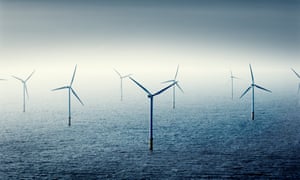
Wind farm at sea<br>GettyImages-1133007846 Wind Farm ‘The stakes of the international Green New Deal are not merely environmental.’ Photograph: Craig Easton/Getty Images/Cultura RF


I
n times of crisis and catastrophe, children are often forced to grow up quickly. We are now witnessing this premature call to action on a planetary scale. As the adults in government accelerate their consumption of fossil fuels, children are leading the campaign against our species’ looming extinction. Our survival now depends on the prospects for a global movement to follow their lead and demand an International Green New Deal.
Several countries have proposed their own versions of a Green New Deal. Here in Europe, DiEM25 and our European Spring coalition are campaigning under the banner of a detailed Green New Deal agenda. In the UK, a new campaign is pushing similar legislation with MPs such as Caroline Lucas and Clive Lewis. And in the US, dogged activists in the Sunrise Movement are working with representatives such as Alexandria Ocasio-Cortez to push their proposal to the front of the political agenda.
But these campaigns have largely remained siloed. Their advisers may exchange notes and ideas, but no strategy has emerged to coordinate these campaigns in a broader, global framework.
Unfortunately, climate change knows no borders. The US may be the second-largest polluter in the world, but it makes up less than 15% of global greenhouse emissions. Leading by example is simply not enough.
Instead, we need an International Green New Deal: a pragmatic plan to raise $8tn – 5% of global GDP – each year, coordinate its investment in the transition to renewable energy and commit to providing climate protections on the basis of countries’ needs, rather than their means.
Call it the Organization for Emergency Environmental Cooperation – the namesake of the original OEEC 75 years ago. While many US activists find inspiration in a “second world war-style mobilization”, the International Green New Deal is better modeled by the Marshall plan that followed it. With financial assistance from the US government, 16 countries formed the Organization for European Economic Cooperation (OEEC), dedicated to rebuilding the infrastructure of a devastated continent and coordinating its supply of energy.
But if the original OEEC entrenched an extractive capitalism at Europe’s core –protecting the steel and coal cartel – the new organization for an International Green New Deal can empower communities around the world in a single transformational project.
The transnational scope of this mobilization is crucial for three main reasons.
The first is production. Recent studies show that, as long as countries cooperate, all continents have the wind, solar and hydropower resources they need in a zero-emissions world. Northern countries and mountainous regions have better access to wind power, while southern lands are better suited to exploiting the sun. An International Green New Deal could exploit these differences and ensure that renewable energy is available to all of them year-round.


The second is innovation. Confronting the climate crisis will require more than keeping fossil fuels in the ground. We will also need major scientific breakthroughs to develop renewable sources of energy, adapt existing infrastructure, detoxify our oceans and decarbonize the atmosphere. No country alone can fund the research and development necessary to meet these challenges. The OEEC would pool the brainpower of the global scientific community: a Green Manhattan Project.
The third is reparation. For centuries, countries such as the US and the UK have plundered natural resources from around the world and polluted them back out. Less developed nations have been doubly dispossessed: first, of their resource wealth, and second, of their right to a sustainable life – and in the case of many small island developing states, of their very right to exist. An International Green New Deal would redistribute resources to rehabilitate overexploited regions, protect against rising sea levels, and guarantee a decent standard of living to all climate refugees.
The UN climate change conferences will not save us from extinction – the demise of the Paris agreement should be evidence enough. These frameworks lock us into prisoners’ dilemmas, in which every country has an incentive to defect on their climate commitments, even if cooperation between them would yield a greater collective good. As long as climate cooperation is framed around sacrifice, it is vulnerable to strongmen like Donald Trump who vow to buck international rules in the name of national interests.
The International Green New Deal changes the frame. Rather than pleading for restraint, it sets out a positive-sum vision of international investment, in which the gains from joining in outweigh those to going it alone.
This is the strategy that won Franklin D Roosevelt the original New Deal. His plan addressed people who had given up hope and inspired in them the idea that there is an alternative. That there are ways of pressing idle resources into public service. It made sense to the disheartened and offered opportunity to the entrepreneurial.
The same is true of the International Green New Deal, which mobilizes public finance to crowd in private investments that, together, fund the $8tn transition. Just like in the original New Deal, public financing will involve a mix of taxes and bond instruments. On the former, we can introduce a global minimum corporate tax rate that is then redistributed on the basis of their sales. On the latter, public investment banks – including the European Investment Bank, the World Bank and the KfW, Germany’s state-owned development bank – can coordinate the issue of green bonds that the major central banks agree collectively to support in the secondary markets.
Suddenly, countries with large trade surpluses will realize they are better able to invest their excess capital if green investments in deficit countries are coordinated under the auspices of an international plan. The positive-sum dynamic will prevail.
In this sense, the stakes of the International Green New Deal are not merely environmental. By uniting countries in the project of bottom-up economic transformation – and coercing multinationals to fund their fair share of it – it will also stem the tide of bigotry and xenophobia engulfing the world.
“Advanced” capitalist countries today are literally falling apart. In the US, net public investment has fallen below half of one per cent of GDP. Across the eurozone, net public investment has remained below zero for nearly a decade. It is little wonder that political monsters are rising again: just as in the 1930s, the grapes of wrath are ripening and “growing heavy for the vintage”.
To revive the liberal democratic project, some pundits have suggested making China into a bogeyman. But the real bogeyman is of our creation: a climate crisis wrought by decades of inaction and underinvestment. To address the true existential threat that we face today, we must reverse the economic policies that brought us to this brink. Austerity means extinction.
The promise of an International Green New Deal to is to avoid the pitfalls of cold war politics and unite humanity in the only project capable of preserving a habitable planet. To do this, however, we need a powerful progressive international movement to demand that our leaders begin to act beyond their own borders. Let’s start building it. The children are watching.

vrijdag 19 april 2019

Climate Change: The Facts review – our greatest threat, laid bare


Climate Change: The Facts review – our greatest threat, laid bare


Maybe the message will filter through … David Attenborough in Climate Change – The Facts. Maybe the message will filter through … David Attenborough in Climate Change – The Facts. Photograph: Polly Alderton/BBC


David Attenborough’s rousing, horrifying call to arms should do for climate change denial what Blue Planet did for plastic


O
nce, a night in with David Attenborough promised the TV equivalent of a warm blanket. It was a chance to watch spectacular creatures revelling in the beauty of their natural habitats, as the man with a voice as soothing as ice-cream described what we could see, from the violent to the serene. 

Those days are gone. Attenborough’s recent move to Netflix, for Our Planet, was deceptive: a seemingly gorgeous nature documentary that doubled up as animal kingdom snuff movies in which the beauty of those natural habitats was revealed as a crumbling paradise, ruined by people and particularly by greed. One of the main points of praise for Our Planet, which was well received, suggested that Attenborough was no longer tiptoeing around the issue of climate change, the implication being that he had done so before.


You sense that Our Planet was unfortunately timed for the BBC. In Climate Change: The Facts, the gloves are now not so much off as thrown to the floor in a certain rage. It’s right there in the title, bold and stark. This hour-long documentary, part of the Our Planet Matters season, is wide-ranging yet concise, easy to understand, not blighted by the ego of, say, An Inconvenient Truth, and it is designed to do for climate change denial what 2017’s Blue Planet did for single-use plastic.
That’s not to say it should be Attenborough’s responsibility to get the wider public to pay attention, nor that it is down to the BBC. It isn’t. But Climate Change: The Facts is a rousing call to arms. It is an alarm clock set at a horrifying volume. The first 40 minutes are given over to what Attenborough calls, without hyperbole, “our greatest threat in thousands of years”. Expert after expert explains the consequences of rising CO2 levels, on the ice caps, on coastal regions, on weather and wildlife and society itself. 
The most powerful moments are in footage shot not by expert crews who have spent years on location, but on shaky cameras, capturing the very moment at which the reality of our warming planet struck the person holding the phone. In Cairns, Australia, flying foxes are unable to survive the extreme temperatures; rescuers survey the terrible massacre, and we learn that while 350 were saved, 11,000 died. A man and his son talk through their escape from raging wildfires, over the film they took while attempting to drive through a cavern of blazing red trees. These are horror movies playing out in miniature. It is difficult to watch even five minutes of this and remain somehow neutral, or unconvinced.
Yet as I kept on, scribbling down an increasingly grim list of statistics, most of which I knew, vaguely, though compiled like this they finally sound as dreadful as they truly are – 20 of the warmest years on record happened in the last 22 years; Greenland’s ice sheet is melting five times faster than it was 25 years ago – I started to wonder about responsibility, and if and where it would be placed. This would be a toothless film, in the end, if it were hamstrung by political neutrality, and if its inevitable “it’s not too late” message rested solely on individuals and what relatively little tweaks we might make as consumers. What about corporations? What about governments?
Then, at that exact moment, having played the despair through to its crescendo, the experts served up unvarnished honesty. They lined up to lay out the facts, plain and simple. 
Fossil fuel companies are the most profitable businesses man has ever known, and they engage in PR offensives, using the same consultants as tobacco companies, and the resulting uncertainty and denial, designed to safeguard profits, has narrowed our window for action. 
It is unforgivable. I find it hard to believe that anyone, regardless of political affiliation, can watch footage of Trump calling climate change “a hoax ... a money-making industry” and not be left winded by such staggering ignorance or astonishing deceit, though it is, more likely, more bleakly, a catastrophic combination of the two. At least Nigel Lawson only appears here in archive footage, and his argument sounds limp, to put it kindly.
Climate Change: The Facts should not have to change minds, but perhaps it will change them anyway, or at least make this seem as pressing as it needs to be. With the Extinction Rebellion protests across London this week, disrupting day-to-day business, and this, on primetime BBC One, maybe the message will filter through. At the very least, it should incite indignation that more was not done, sooner, and then urgency and a decision to both change and push for change at a much higher level. Because there is, for a brief moment, just possibly, still time.

dinsdag 9 april 2019


Antisemitic criticism of Israel is NOT widespread in the Labour Party

08 Apr 2019

JVL Introduction
There has been a lot said recently about contemporary or ‘new antisemitism’ expressed as criticism of Israel.
In order to advance our appreciation of its prevalence, Alan Maddison has explored this topic with a  particular focus on the influence of political affiliations, using  relevant data drawn from L Daniel Staetsky’s important recent study for the Institute for Jewish Policy Research, Antisemitism in contemporary Great Britain.
Among the interesting findings presented here, we discover that the risk for a critic of Israel being antisemitic increases as we move from left to right across the political spectrum.
The implications of this analysis for the Labour Party include responding vigorously to any victim complaints, but having appropriate actions based on differentiating between legitimate criticism of Israeli policies, a minority motivated by antisemitism, and those where antisemitic comments may be made out of ignorance rather than any hostility towards Jews.


Antisemitic criticism of Israel is NOT

widespread in the Labour Party


Dr Alan Maddison
Jewish Voice for Labour
7 April 2019


Antisemitism takes different forms in different ages, writes Rabbi Jonathan Sacks… “Today [Jews] are hated because of their nation state, the state of Israel.”[1]This is, supposedly, the ‘new antisemitism’.
There are clearly many valid reasons for criticising Israel – its occupation, its treatment of Palestinians, its violation of international law and more. Such criticism  can also  sometimes be motivated by antisemitism. To differentiate between the two we have to look at whether such criticism is associated with antisemitism, defined independently of Israel.
We have recently challenged misleading reports that critics of Israeli policies are ‘highly likely” to reflect expressions of this ‘new antisemitism’, when evidence suggests the very opposite. [2]
In this article we explore the patterns of strong anti-Israel attitudes and any associated strong antisemitic attitudes, or ‘new antisemitism’, in British society. In particular we analyse the variations across political groups, and ask if there is any justification for the relentless McCarthy-like focus on the Labour Party?

Exploring the prevalence of ‘new antisemitism’ expressed as criticism of Israel
Our best guide comes from the biggest survey ever undertaken into antisemitism by the Institute of Jewish Policy Research. Its results were published in 2017 under the title Antisemitism in contemporary Great Britain. A study of attitudes towards Jews and Israel.[3]
The author, L Daniel Staetsky, offered a number of ‘anti-Israel’ statements to some 4,005 responders, representative of the British population. These ranged from ‘Israel is committing mass murder in Palestine’ or ‘Israel has too much control over global affairs’ to ‘People should boycott Israeli goods and products’.
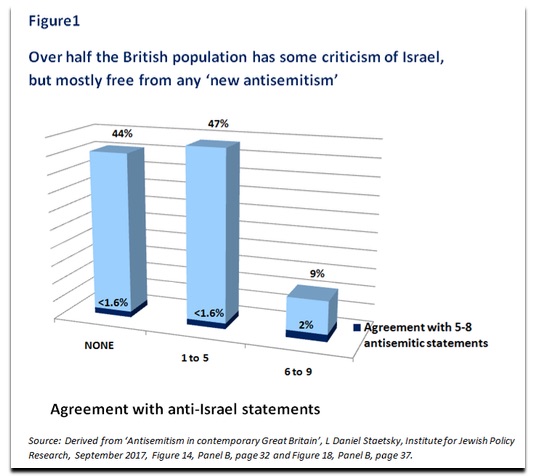
He found that 47% of responders had an unfavourable opinion about Israel and/or endorsed 1-5 of the statements presented to them while a further 9% agreed with 6 or more statements. The latter group  were defined by Staetsky as having ‘strong anti-Israel attitudes’.
The responses illustrated below, derived from from Staetsky’s data, show that critics of Israeli policies are very prevalent in our society, but only rarely seem associated with antisemitism.
It is disingenuous to frame debates about the Israel-Palestine conflict primarily around ‘new antisemitism’ when most critics of Israel are clearly motivated by other factors, such as advocating social justice and equal rights for Palestinians, or respect for international law.
Recognising that “antisemitism at the individual level is a state of mind and emotions” and that these are complex, the survey “undertook a detailed study of the spread and intensity of various antisemitic ideas and attitudes, and developed what we subsequently called an ‘elastic view’ of antisemitism – i.e. multiple ways of measuring the extent to which antisemitic attitudes permeate society”.(p.12)
So here a range of statements about Jews, positive and negative, were used: A British Jew is just as British as any other British person, British Jews make a positive contribution to British society, Jews think they are better than other people/Jews have too much power in Britain, Jews exploit Holocaust victimhood for their own purposes, down to Holocaust denial
The survey found that 30% of responders endorsed at least one statement considered to be ‘antisemitic’ but most were not considered to be antisemitic as they had also agreed with at least one positive statement about Jews.nHowever, 3.6% of responders agreed with 5 or more ‘antisemitic statements’ and were considered by Staetsky as probably ‘antisemitic’ in terms of having a dislike or hostility towards Jews for being Jews.
If we focus on the 9% of responders in Figure 1 above, those who were considered strongly anti-Israel, we see only 2% had strong antisemitic attitudes (shown in deep blue).
So, of the total 3.6% responders overall with strong antisemitic attitudes, little more than half (2/3.6 or 56%) of them also shared strong anti-Israel attitudes. The remaining 1.6% were distributed among the 91% of the population not having any strong anti-Israel attitudes.
The fact that the remaining 44% (1.6/3.6%) of the ‘antisemites’ were not strong critics of Israel is hardly a surprise. Some on the extreme right are both very pro-Israel and aggressively antisemitic. Others may be ignorant about Israel, or even be motivated not to criticise Israel by a prejudice of Islamophobia against Palestinians outweighing their antisemitism.
If we return to the 9% of the British population with ‘strong anti-Israel attitudes shown above, then antisemites were 22% of them (2/9%). It is this group we might choose to refer to as probably being “new antisemites”
We do not, however, know how many of this group were driven by pre-existing antisemitism to criticise certain acts of the “Jewish” State of Israel, and how many developed a generalised dislike for Jews because they were witness to those acts and reacted against them by blaming “the Jews”.
However, we can investigate how this average 22% antisemitism overlap varies across the political spectrum.

‘New antisemitism’ and political affiliation
To illustrate the relationship between strong anti-Israel attitudes and ‘new antisemites’ by political groups, we have applied the general 56% (2/3.6%) overlap of antisemitism mentioned earlier, and combined and simplified the graphs provided by Staetsky.

In Figure 2 we see strong anti-Israel attitudes occur across the whole political spectrum, but with greater prevalence on the left (13% to 22.5%) than right ( 8.5% to 19%).
‘New antisemitism’ (shown as deep blue from the baseline) is also apparent in all political groups, but this time is more prevalent on the right (2% to 7.3%) than the left (1.4% to 2.3%) of politics
Staetsky himself commented on the fact that the low prevalence of strong antisemitic attitudes for the ‘very left-wing’ were indistinguishable from other groups apart from the ‘very right-wing’. This is important, for it exposes as a myth the idea of a greater prevalence of antisemitism on the far left, or the unfounded claim that the Labour Party has become more antisemitic due to an alleged influx of ‘very left-wing’ members.
It is also clear that if we are looking for ‘new antisemitism’ at the political extremes, attention should focus on the ‘very right-wing’, where 40% (7.6/19) of this group of individuals are ‘new antisemites’ and not the ‘very left-wing’ where we find only 10% (2.3/22.5).
Strong anti-Israel attitudes on the left and far left (illustrated by the pale blue surface area) are more often free from ‘new antisemitism’ than those on the right, and therefore more likely to be motivated by previously mentioned values of social justice and equal rights for Palestinians. From the data in Figure 2, it would be tempting to conclude that although ‘new antisemitism’ is found across the whole political spectrum, in order to tackle it effectively we should focus more on the ‘very right-wing’. But…..

Factoring in the size of each political group
In this survey the ‘very right-wing’ group only represents 1.4% of the population, so even if they are almost four times more likely to be ‘new antisemites’ than the average strong critic of Israel, we can estimate that this group only provides around 5% of the new antisemitism found in society.
The ‘very right wing’ may merit special attention but we obviously need to consider the other 95%.  What are their political affiliations?
To answer that question we need to factor in the population sizes for each political group. Figure 3 below shows how participants in Staetsky’s survey responded when asked where they would place themselves on the political spectrum.
The largest group was the ‘centre’ with 36.5% of responders, the smallest groups were at the extremes.
In total there were more people identifying themselves as ‘left-wing’ (27.8%) than ‘right-wing’ (23.5%), and a significant 15.2% did not know how to position themselves.

‘New antisemitism’ by political group
If we combine the prevalence of ‘new antisemitism’ for each group with its population size, we can then estimate the contribution of each to the 2% prevalence of ‘new antisemitism’ we find in society, as shown in Figure 4 below.

Even though the population of the combined right-wing groups (23.5%) was smaller than that for the left-wing groups (27.8%), the right-wingers provided slightly more of the ‘new antisemites’ (25%) than the left-wingers (23%). This was largely, but not solely, down to the ‘very right-wing’ group, which from only 1.4% of the population provided 5% of ‘new antisemites’.
We can see that the 39% share of the ‘centre’ group was slightly higher than their population share of 36.5%, also reflecting a slightly greater than average prevalence of ‘new antisemitism’ among that group.
Participants in the Staetsky survey were then asked for which political party they would vote or would favour (Figure 23 page 44). We find some voters from all political parties in this large ‘centre’ group but in particular 34% voted Labour and 42% Conservative. In fact, based upon the responses given for the voting preferences for all these political groups we can also build a rough estimate of the distribution of all ‘new antisemites‘ by political party.
As expected, this confirms a slightly higher prevalence of ‘new antisemites’ in Conservative than Labour voters.
It has to be said that these are very approximate estimates as they are based on just 80 ‘new antisemites’ (2%) found in the initial group of 4005 respondents.
We can say that the ‘new antisemites’ seem fairly evenly distributed, and of low prevalence, across all political parties, and is probably slightly lower in left-wingers and Labour than right-wingers and Conservative voters.

The implications
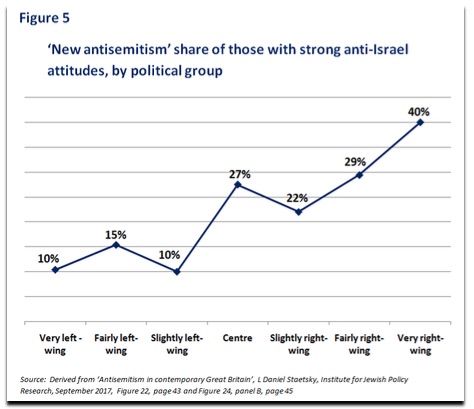
In this analysis we see that over half (56%) of the British population, across the whole political spectrum, has some criticism of the way Israel is treating Palestinians. For the vast majority of the population such criticism is free from any antisemitism. The prevalence of those with strong anti-Israel attitudes is also found across the political spectrum, but as shown in Figure 1, it is higher in ‘left-wing’ groups (pooled mean of 15%) than ‘right-wing’ groups (pooled mean of 10%).  However, the variation in prevalence of associated ‘new antisemitism’ is far more marked, as shown in Figure 5 below

We see that as we move from left to right on the political spectrum then the trend is for more ‘new antisemitism’ to be associated with strong criticism of Israel, rising from only 10% of the ‘very left-wing’ group to 40% of the ‘very right-wing’ group.
This pattern is determined both by increases in antisemitism and decreases in strong anti-Israel sentiment as we move from the left to right of politics.
Lately, in claimed searches for ‘new antisemitism’, there has been a particular scrutiny of ‘left-wing’ groups and the Labour Party. This campaign has been linked to high levels of media and political focus on the inevitable cases of alleged ‘new antisemitism’ discovered.
Not only is this selective scrutiny and publicity unjustified, but based on the available evidence presented here, it will provide a very distorted view of the relative threats of antisemitism in wider British society, playing down those from the political centre and right but especially the growing far right movements.
So the exceptionally high volume of attacks concentrated on the Labour Party and left-wingers seems, as some suggest, not to be about antisemitism, but about undermining Jeremy Corbyn and stifling necessary debate on Israel.
A similar process is happening in the USA too. Jewish Senator Bernie Sanders recently defended Muslim Representative Ilhan Omar against violent accusations of antisemitism, [4] saying:
Campaigns to stifle such useful debate have also been criticised by Kenneth Stern, one of the original drafters of what became the IHRA definition on antisemitism.[5] He condemned its misuse, and says that “outside groups will try and suppress – rather than answer – political speech they don’t like” with a “chilling McCarthy-like exercise”. This is precisely what has happened in the UK, including use of serious intimidation.[6,7]
So a distinction has to be made between activities that are part of the genuine fight against antisemitism and those dishonestly employed for factional advantage or political gain, including the suppression of legitimate debate on the ongoing Israel-Palestine conflict.
The former needs to be energetically supported, but the latter vigorously challenged for the widespread damage it inflicts.

What should the Labour Party do?
Labour must continue to fight antisemitism and other forms of racial and religious prejudices in society and to deal with them all within its own ranks in the same way. It may be that prevalences are much lower than mainstream media and opponents of Corbyn claim but nonetheless Labour must respond seriously and wholeheartedly to all genuine victim complaints.
It should resist the politically motivated McCarthy-like witch hunt attempts to destroy our movement, even from within.
Grossly exaggerated and misleading claims of antisemitism in the Labour Party have already been exposed.[8,9,10] But Labour also needs to publicly challenge pro-Israel groups and others who selectively scour social media solely to undermine Labour’s electoral prospects and deprive its members of their precious freedom of speech.
Labour must leave no victim group behind, and must ask all members to unite, to continue to stand alongside all our ethnic minority communities including our Jewish neighbours, to challenge the Tory’s “hostile environment” and the growing threat from the growing far right and fascist movements.
While being relentless in our opposition to hard-core antisemitism, we need to remember that many offensive comments and attitudes are born out of ignorance rather than hostility. So an education programme would seem appropriate – and urgent. But as the late A Sivanandan, from the Institute of Race Relations recommended [11], this should not be a community-specific exercise but an inclusive one. Such education should also cover all forms of far more prevalent racial and religious prejudices, including Islamophobia. They all share a similar pathway of stereotypes adoption against “the other”, and subsequent exploitation towards discrimination, blame, scapegoating and abuse.
In this way Labour members can work with all minority groups to share experiences and unite in a sincere attempt to combat all the ignorance or hatred in our society that affects us all.

References

  1. Rabbi Jonathan Sacks, The Mutating Virus: Understanding Antisemitism, 27th September 2016 in Brussels.
  2. The New-Antisemitism: Proof At Last? Jamie Stern-Weiner and Alan Maddison, for JVL, 24th February 2019
  3. Antisemitism in contemporary Great Britain, L Daniel Staetsky, Institute for Jewish Policy Research, September 2017
  4. Sanders defends Omar: Can’t equate anti-Semitism with ‘legitimate criticism’ of Israel, Tal Axelrod, The Hill, 6th Mrch 2019
  5. Extracts of written testimony of Kenneth S Stern, Before the US House of Representatives Committee on the Judiciary, November 7, 2017
  6. “Jewish event at Labour conference abandoned after bomb scare”. Kevin Rawlinson, The Guardian, 25 September 2018.
  7. Listen: Horrific antisemitic voice message sent to left-wing Jewish Labour activist, The Skwawkbox, 15th March 2019.
  8. Antisemitism: no justification for singling out Labour, Dr Alan Maddison, Jewish Voice for Labour, 16 February 2019
  9. Searching for the truth about on-line abuse allegations, Dr Alan Maddison, Jewish Voice for Labour, 28th February 2018
  10. Has the Labour left subjected Luciana Berger to hate speak and death threats? Bob Pitt, Medium, 20th March 2019
  11. Submission from the IRR to the Labour Party Inquiry into anti-Semitism and other forms of racism, A. Sivanandan, Liz Fekete and Jenny Bourne, Institute of race relations, 23rd June 2016.
maandag 8 april 2019

Populists are whipping up a storm as Europe faces lurch to the right


Populists are whipping up a storm as Europe faces lurch to the right


Nationalist groups across the continent are stoking anti-immigrant and Islamophobic sentiment to win seats in next month’s EU elections


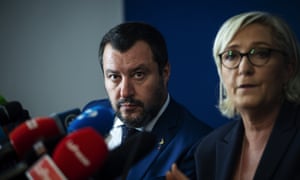
The far-right stuff … Matteo Salvini of Italy’s League and Marine Le Pen of France’s National Rally.  The far-right stuff … Matteo Salvini of Italy’s League and Marine Le Pen of France’s National Rally. Photograph: Antonio Masiello/Getty


T
he battle for Europe is coming to a head – but, surprise, surprise, the main focus is not Brexit. Across the continent, far-right populist and nationalist parties are mobilising ahead of next month’s EU parliamentary elections. Polls show their support growing. For Europe’s newly energised hard right, Brexit is both a spur and a sideshow.

Whipping up anti-immigrant, Islamophobic and anti-semitic sentiment, and exploiting public anger over austerity and the perceived arrogance of the Brussels political class, the populists aim to reassert the pre-eminence of national identity, narrowly defined, and halt the European project in its integrationist tracks.
It is, as yet, a rag-tag army with myriad rivalrous leaders and policy differences. Some prominent figures, such as Matteo Salvini, leader of Italy’s far-right League, occupy senior government positions. Others, such as Thierry Baudet, who leads the insurgent Dutch populist Forum for Democracy and likes to quote Cicero (in dog Latin), are eccentrics whingeing on the fringe. But Europe’s multi-party mainstream coalitions, which currently dominate the EU parliament, and the grand panjandrums of the EU Commission, where top jobs depend on the election outcome, have been put on notice. The days of comfortable centrist majorities are coming to an end. The far-right is knocking at the door.

The parliament’s own polling confirms this trend. The biggest groupings, the centre-right European People’s party and the centre-left Socialists & Democrats, are each expected to lose dozens of seats, the latest survey suggests. If Britain does not participate, about 150 MEPs out of a total of 705 will represent Eurosceptic parties.
The Europe of Nations and Freedom bloc, which includes Salvini’s League and Marie Le Pen’s French National Rally (formerly the National Front), could swell to more than 60 MEPs. Separate polling by the Politico website predicts that mainstream parties, including the Liberal group allied to French president Emmanuel Macron’s En Marche, may fare even worse.
Far-right populists are not about to take control of the EU. But their enhanced sway will intensify tensions over EU integration, increase disruption and deadlock, and complicate the process of appointing a new commission. As Salvini and his supporters tell it, the evolving realignments could end Franco-German “hegemony” over the EU.
Across the continent, signs of approaching upheaval are unmistakable. An early augury may come this month in Spain’s general election, where Vox is set to become the first far-right party to win seats in parliamentary since the close of the Franco era.
Social media form part of the electoral battlefield. According to research by Alto Analytics, online supporters of far-right populist and nationalist parties are disproportionately deluging platforms such as Facebook and Twitter with anti-immigration, Eurosceptic posts.
Attempts to organise Europe’s far-right into a united, cohesive force are continuing apace, though with mixed success. Following previous meetings with like-minded politicians in Austria, Hungary and Poland, Salvini plans to host a rally involving up to 20 countries in Milan next month. On Monday he will hold talks with German, Finnish and Danish right-wingers. He wants a joint electoral platform akin to the League’s manifesto, which pledges to “underline and reaffirm common Christian roots, defend national identity and the supremacy of [national laws] over European laws and directives”. The manifesto also trumpets opposition to immigration, austerity and integration.
It’s unclear at this point whether leading lights on Europe’s populist right such as Le Pen, Hungary’s prime minister, Viktor Orbán, and Poland’s ruling party leader, Jarosław Kaczyński, will attend next month. This uncertainty reflects personal jealousies and policy differences, for example over engagement with Russia (which the Poles oppose and Salvini and Le Pen favour).
It’s plain that, like Europe’s mainstream parties, the populist-nationalist camp will struggle to unite around a shared vision. Speaking last week, the chief election candidate for Germany’s anti-Islam, anti-immigrant Alternative for Germany, Jörg Meuthen, said personality clashes would probably prevent the creation of a pan-European “patriotic alliance”. But he predicted big gains for the hard right and urged parties to work together.
That’s a lesson the pro-European mainstream also needs to heed. It, too, has an opportunity if it can be grasped. A Eurobarometer survey, published last year, found the highest level of support for the EU in 35 years, with two-thirds of Europeans believing their country had benefited from membership. Last month’s million-strong Remain march in London was “the greatest public outpouring of pro-EU sentiment that Europe has witnessed in years”, wrote analyst Mark Leonard. Yet at the same time, there appears little doubt eurosceptic forces have electoral momentum behind them.
Among Europe’s leaders, only Macron is actively making the case across national borders for a more deeply integrated, tolerant and reformed EU. He recently appealed directly to Europe’s citizens to reject the “anger-mongers” of the right and embrace “renewal”. Salvini and Orban, promoting a sinister-sounding new “European spring”, view Macron as opponent-in-chief.
If the far-right surge is to be repelled, Macron needs help. But strong leadership is lacking. Angela Merkel, Germany’s chancellor and a natural ally, is on her way out. Other pro-EU governments and parties are struggling with multiple policy splits of their own. An ugly brawl is in prospect over who will replace Jean-Claude Juncker as commission president.
And then there is Brexit, distracting attention from the main battlefront at a vital juncture. As Europe prepares for an imminent showdown with the forces of reaction, Britain’s dishonourable retreat from the fray might never be forgiven.