vrijdag 9 oktober 2015

Review: Israeli Exceptionalism – The Destabilizing Logic of Zionism


Review: Israeli Exceptionalism – The Destabilizing Logic of Zionism
by Stephen J. Sniegoski
June 26, 2010 

M. Shahid Alam, Israeli Exceptionalism: The Destabilizing Logic of Zionism, New York: Palgrave MacMillan, 2009

This is an excellent book that dares to transgress the regnant taboos and myths in the American mainstream on the issue of Israel. The author, M. Shahid Alam, a professor of economics at Northeastern University of Pakistani nationality, is a published writer on contemporary social and political topics that far transcend his academic field. Due to his proclivity to write on controversial and taboo topics, he has attained a place in ultra-Zionist David Horowitz’s book, “The Professors: The One Hundred and One Most Dangerous Academics in America (2006).”

Israeli Exceptionalism lucidly encapsulates in its relatively short 220-page narrative the essential aspects of the Zionist movement, showing how it has been able to rapidly advance from its birth to regional dominance, and how, concomitantly, its amazing success has brought the United States, its powerful patron, into the cauldron of never-ending Middle East wars. While undoubtedly hostile toward Zionism, Alam manages to write rather dispassionate prose. And it is difficult to take issue with the validity of his arguments.

The author states that book’s “primary theme” is to “focus on the germ of the Zionist idea, its core ambition—clearly discernible at its launching—to create a Jewish state in the Middle East by displacing the natives. This exclusionary colonialism would unleash a deeply destabilizing logic, if it were to succeed. It could advance only by creating and promoting conflicts between the West and the Islamicate [the social and cultural complex historically associated with Islam]. Since its creation, this primordial logic has driven the Jewish state to deepen this conflict. Overweening ambition launched Zionism, but the destabilizing logic of this idea has advanced and sustained it.” (p. 3) Because of Zionism’s unparalleled influence over American policymakers, this “destabilizing logic” has mired the United States in a Middle East morass from which it is now politically unable to extricate itself.

Interwoven in the narrative is the theme of Israeli and Jewish exceptionalism, which provides the title of the book. The Jews have historically seen themselves as an exceptional people—“God’s chosen people”—and the Zionists expanded on this religious theme to make it serve as the intellectual basis for the modern state of Israel’s existence and defense. Moreover, this exceptionalism is recognized, at least tacitly, by Western countries, and, consequently, Israel is able to ignore the norms and rules usually applied to other countries. Most significantly, Alam notes that Israel stands alone as the only European settler colonial state that was created and continues to exist in an era of anti-colonialism.

Alam emphasizes that Zionism originated as a very ambitious project that had to overcome a number of formidable hurdles. The Jews were a people without a homeland and without much of a national feeling, but the Zionists intended to establish a Jewish homeland on land fully inhabited by another people and, in the process, mold a national identity. Moreover, unlike other European colonizers, the Jews did not have a motherland to support their colonial venture, which required them to find one.

Unlike what many pro-Israel mythologists imagine to be the case, Zionism did not have a morally pure beginning—at least by the standards of modern international morality. From the outset, the Zionists intended to occupy land inhabited by others, bringing about the latter’s displacement. The early Zionists did not give much consideration to the native Palestinians and thus did not dwell on the need to forcibly expel them from the land. It was the revisionist Zionist, Ze’ev Jabotinsky, who in the 1920s brought out into the open the inevitable need for violence against the Palestinians in order to achieve the Zionist goals. Alam remarks, however, that the Zionist leaders had “always known what Jabotinsky now challenged them to acknowledge and confront openly” (p. 27).

The Zionists’ choice of Palestine, a settled land, for a homeland guaranteed conflict. What was the reason for choosing Palestine? And why did the Zionists seek a homeland at all? A conventional argument, disputed by Alam, is that the Zionists sought a homeland abroad because hostility to Jews in Europe necessitated moving elsewhere. To falsify the idea that finding a safe haven was the fundamental motive, Alam reviews the suggested alternative homelands for Jews, which were very sparsely inhabited and whose native occupants thus did not face displacement by Jewish emigrants. In short, Jews could have emigrated to areas where the likelihood of conflict was much less than in Palestine. Since the Zionists did not show much interest in these much safer, alternative homelands, it would seem apparent that finding a haven for Jews was not their overarching goal.

Orthodox Jews, of course, had prayed about returning to Jerusalem, but Alam points out that very few actually tried to live there prior to the advent of Zionism. And even the Zionists found it difficult to attract Jewish settlers to Palestine before the era of Nazi persecution. Alam, in short, maintains that the choice of Israel did not reflect the historical longing of the Jewish people but rather the ideological needs of modern Zionism.

Alam contends that Zionism was essentially a 19th century nationalist movement, similar to other forms of European ethnic nationalism, and was not simply a defensive reaction to the threat of anti-Semitic persecution. In fact, the condition of European Jews had actually improved significantly in the 19th century, as they prospered economically and could assimilate into the higher echelons of gentile society, which had become available to them as Western society had become more open and free. For numerous Jews, however, this move toward assimilation caused considerable angst as they lost their Jewish religious distinctiveness. To compensate for this psychological loss, Jewish thinkers started to emphasize Jewish racial identity as a group unifier.

Other European nationalist movements could rely on a home territory, inhabited by their nationality, as a magnet to provide group unity and a sense of nationhood. For the Jews, in contrast, territory would need to be taken in order to forge this sense of unity and nationhood among a congeries of disparate people alien from one another in language and culture, and linked together only by a religion and its customs. With this arduous task at hand, the choice could not be any available territory. To provide the necessary social and cultural binding for nationhood, the territory chosen would have to have a strong connection to a Jewish nation that had existed in the past—thus the only choice was Palestine.

In trying to get hold of a foreign land, the Zionists were quite like other Western settler colonial enterprises, but were radically different from other colonial ventures in that they did not have a mother country to facilitate their enterprise. They would have to find a surrogate mother country. Zionists were able to turn what would seem to have been a weakness into a strength, since they were in a position to choose their mother country and thus could select the one best suited to their needs. Prior to gaining independence, the Zionists would rely on England, which was critical since it held the League of Nations Mandate over Palestine; after the Israeli state came into being in 1948, they would gradually switch to the United States, which, as England’s military capability waned, had become the mightiest country in the world and was assuming burgeoning global responsibilities in its Cold War with the Soviet Union.

It was also of crucial importance that Jews were very influential in the West because of their wealth and dominant positions in key sectors of society, such as the media. To influence the foreign powers and their populations, the Jewish Zionists would have to present a rationale for their takeover of already-inhabited Palestinian land. Alam observes that the Zionists essentially provided a number of fundamental arguments to justify their endeavor.

* First, they argued that the land did not really belong to the native inhabitants but was, instead, the Jewish homeland by historical right, and that it had been given to them by God and later usurped by invaders. This argument has especially appealed to Protestants with their special affinity for the Old Testament.

* Next, they claimed that they were more progressive, both socially and economically, than the native Arab inhabitants, and thus appealed to both the socialist Left and the capitalist Right.

* And what has especially become a key argument since the Holocaust has been the claim that Jews have suffered more than all other peoples and thus deserve recompense. This claim of being the ultimate victim not only served to morally justify the Zionists’ take-over of Palestine but also has shielded them from criticism for their mistreatment of the Palestinians, since any suffering experienced by the Palestinians could not compare with the infinite suffering endured by Jews in the Holocaust.

* Finally, for individuals motivated less by moral empathy than by national self-interest, the Zionists have claimed that the Jewish state serves as a strategic asset to Western interests in the Middle East.

http://www.foreignpolicyjournal.com/2010/06/26/review-israeli-exceptionalism-the-destabilizing-logic-of-zionism/

vrijdag 2 oktober 2015

Netanyahu's Cabinet Proves Abbas Was Right : The smoking gun is the prime minister's plan to legalize four more outposts in the West Bank.


Netanyahu's Cabinet Proves Abbas Was Right : The smoking gun is the prime minister's plan to legalize four more outposts in the West Bank.

Haaretz Editorial 
Oct 02, 2015 6:38 AM
Israel intends to authorize West Bank outpost bloc containing hundreds of illegal buildings.

How Israel keeps Palestinians off a third of all West Bank land Israel clamping down on Jewish terror - but not tightly enough.

Palestinian President Mahmoud Abbas, in a desperate speech at the United Nations, accused Israel of a systematic violation of the Oslo Accords and a stubborn attempt to finally do away with the two-state solution. By coincidence, Israel’s response came the same day: authorization for illegal outposts in the West Bank, which proves the justice of Abbas’ claims.

The message from a government that whitewashes additional outposts is unambiguous: yes to continued occupation, no to a two-state solution. There’s no other way to interpret it.

In responding to a petition by rights group Yesh Din, the state said it intended to legalize all the outposts in the Shiloh area. This region amounts to six square kilometers and four outposts – Adei Ad, Kida, Esh Kodesh and Ahiya.

The area contains hundreds of unlawfully built houses, some of which were put up on private Palestinian land. No fewer than 150 files relating to illegal construction have been opened against the residents of Adei Ad alone, but over 16 years only five enforcement measures have been taken. Now the government intends to reward these lawbreakers and encourage others.

The message is clear: more land robbing and more construction with abandon. No one will enforce the law in this unruly land beyond the Green Line, an area that has spawned violent settlers against whom dozens of investigations have been opened on suspicions of assault on their Palestinian neighbors and their property.

Beyond the issue of the fate of these outposts, which should never have been built and which any law-abiding country would have removed long ago, stark questions arise about the government’s image and true intentions.

There is no more doubt regarding the ambition driving this government: to completely thwart a two-state solution, to further entrench the occupation until it becomes irreversible — assuming that’s not already the case — and to prevent any possibility of a deal with the Palestinians based on a partition of the land. This is exactly what Abbas said at the United Nations.


woensdag 23 september 2015

Video: Palestinian woman shot, left to bleed by Israeli soldiers

Afbeeldingsresultaat voor logo the electronic intifada

Video: Palestinian woman shot, left to bleed by Israeli soldiers


This video posted by the news agency PalMedia shows a young Palestinian woman left to bleed on a sidewalk in the occupied West Bank city of Hebron after she was shot by Israeli soldiers on Tuesday morning.
By evening, Palestinian media reported that the woman, 18-year-old Hadil Salah Hashlamoun, had died of her injuries.
Instead of being given immediate medical treatment, the video shows her being pulled roughly out of the frame of the camera, her scarf coming off as her head drags on the ground.
Israeli settlers and soldiers can be seen standing around, and in some cases smiling and laughing in the background.
Wattan TV reported that the young woman was left to bleed for more than 30 minutes.
In a separate incident, a Palestinian man was also killed overnight by Israeli forces near Hebron.
Local sources told Ma’an News Agency that Diyaa Abdulhalim Talahmah, 21, was killed by the army during a raid in the village of Khursa.
Israel has claimed he tried to throw a Molotov cocktail at its soldiers.
These shootings come just days after Israel loosened even further its already lax permission to its forces to use live ammunition against Palestinians.

Checkpoint shooting

Wattan TV named the young woman in the video as 18-year-old Hadil Hashlamoun.
The Israeli army claimed that she was shot after she tried to stab a soldier, the Tel Aviv newspaper Haaretzreported. But photos and eyewitnesses contradic this account.
An Israeli army spokesperson said that the incident had occurred around 8am at the so-called Container Checkpoint near Shuhada Street, Ma’an News Agency reported.
The spokesperson said the woman approached the checkpoint in order to carry out the attack and Israeli forces responded with gunfire.
The army said that the young woman was treated on site by Israeli medics and then taken to hospital.
Her father, Saleh Hashlamoun, told Wattan TV earlier on Tuesday that his daughter had been hit in the abdomen several times and was in serious but stable condition at Shaare Tzedek hospital in Jerusalem.
By evening she had died.

No weapon

The Hebron-based group Youth Against Settlements published several photos on its Facebook page that it says show the young woman immediately before and after the shooting.
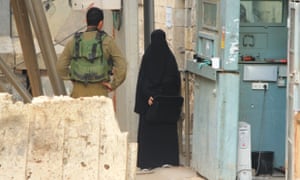
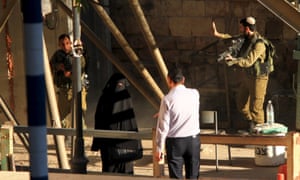
An image published by Youth Against Settlements shows Hadil Hashlamoun surrounded by Israeli soldiers at a checkpoint in Hebron.
The photos show a person dressed in a long black dress and headcovering, carrying a briefcase. In none of the images is she holding any sort of weapon.
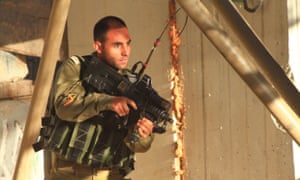
Several Israeli personnel are pointing weapons at her.
Youth Against Settlements suggests the photo sequence shows that Hashlamoun tried to leave the checkpoint before she was shot.
An image published by Youth Against Settlements shows Hadil Hashlamoun lying injured.
Other photos show the person lying on the ground with at least one bullet wound, the same briefcase visible near her.
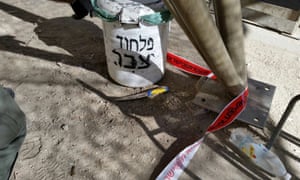
Additional photos show the scene of the shooting, including blood on the ground and bullet holes in a metal door, after the victim was removed.

Eyewitnesses

One eyewitness, a European activist, told The New York Times that Hashlamoun had simply opened her purse to allow it to be inspected, at the request of a soldier.
“When she was opening at her bag, he began shouting: ‘Stop! Stop! Stop! Don’t move! Don’t move!’” the activist said. “She was trying to show him what was inside her bag, but the soldier shot her once, and then shot her again.” Several more soldiers raced over and also fired at her.
A second witness, 34-year-old Fawaz Abu Aisheh, told the Times that Hashlamoun appeared “frozen” and in shock. Abu Aisheh said he had opened a gate inside the checkpoint so that Hashlamoun could back away from the soldiers. She tried to do so.
“Even if she had a knife, she would have to leap over a barrier about a meter high to reach a soldier,” Abu Aisheh added. “There were six or seven soldiers with heavy weapons. There was no need for that assassination.”
The Times said it had seen photos corroborating these accounts. Abu Aisheh appears in some of the images.
Abu Aisheh has also given a detailed account to Ma’an News Agency refuting the Israeli claims.

Unverified claims

While Palestinians undoubtedly have an internationally recognized right to resist Israeli military occupation, the unverified claims of the army should never be taken for granted as accurate.
Similar claims have habitually turned out to be false when independent evidence has been available.
In July, a video revealed that 17-year-old Muhammad Ali al-Kasbeh was shot dead by Israeli colonel Yisrael Shomer as he ran away, near Ramallah.
This falsified the army’s version that the Israeli had been in imminent danger when he fired.
Israeli human rights group B’Tselem warned that the high-level backing Shomer received would only reinforce an “unlawful message” to occupation soldiers that they are “allowed and even encouraged to shoot to kill a Palestinian stonethrower, even if he’s running away and does not constitute a danger.”
In December 2012, Israeli Border Police officer Nofar Mizrahi claimed she shot dead 17-year-old Muhammad al-Salaymeh at a checkpoint in Hebron as the teen held a pistol to another soldier’s temple.
In May 2014, video caught Israeli soldiers shooting dead two teens in the West Bank village of Beitunia at long distance and in cold blood.
In July 2014, Israeli police spread false rumors that 16-year-old Muhammad Abu Khudair had been murdered by his family in an “honor killing” for being gay.
Police later arrested several Israeli Jews in the abduction and burning to death of the youth, which occurred at a time of intense anti-Palestinian incitement in Jerusalem.


The systematic impunity Israel affords its occupation personnel and settlers means that Israeli claims are almost never seriously investigated and Palestinians have no recourse for protection or justice.
https://electronicintifada.net/blogs/ali-abunimah/video-palestinian-woman-shot-left-bleed-israeli-soldiers


Dispute arises over circumstances of death of [Palestinian] woman at Israeli checkpoint..

Afbeeldingsresultaat voor logo the guardian

Dispute arises over circumstances of death of [Palestinian] woman at Israeli checkpoint..

Israeli forces say 18-year-old Hadeel al-Hashlamon was shot dead after pulling out a knife at a checkpoint in Hebron, but eyewitnesses dispute this account

Hadeel al-Hashlamon at a checkpoint in Hebron


Contradictory accounts have emerged over the fatal shooting of an 18-year-old Palestinian student, Hadeel al-Hashlamon, by Israeli forces at a checkpoint in the West Bank city of Hebron on Tuesday morning, after she allegedly pulled a knife on the soldiers.
Questions over the precise circumstances have been raised by a series of images depicting much of the lethal encounter, including whether a group of heavily armed soldiers wearing body armour acted appropriately in shooting the young woman several times.
She died later from injuries, which family members say included gunshot wounds to her abdomen, despite initial claims by the Israeli military that she was shot in the legs.
According to the Israeli military, Hashlamon was shot after pulling a knife on the soldiers at around 8am at the so-called Container checkpoint near the flashpoint of Shuhada Street in Hebron.
“From the preliminary review regarding this morning’s incident in Hebron, the perpetrator approached the checkpoint and the metal detector was activated, alerting the troops’ suspicion,” the Israel defence forces said in a statement.
“Forces at the scene asked the perpetrator to stop, at which point she approached the forces, disregarding the instructions and raising further suspicion. Forces called for her to halt, which she ignored, and she continued moving while also pulling out a knife.
“At this point, forces fired at the ground, then at her lower extremities in attempts to stop her advancement. The perpetrator continued and at this point, recognising a clear and present danger to their safety, the forces fired towards her.”
However, Palestinian eyewitnesses and foreign activists from a local group called Youth Against Settlements have contradicted that story.
Issa Amro, one of the activists who took some of the pictures told the Guardian that a soldier appeared to ask Hashlamon something as she held her bag out from under her hijab.
“She had just come through the metal detector at the checkpoint,” Amro said. “The soldier asked to search her. She didn’t want to be searched by a male soldier and went back to exit from the checkpoint.”
Hashlamon then attempted to walk back out of the exit, said Amro, as one soldier in a kippa covered her with his rifle while another – with a radio on his back – moved towards her.
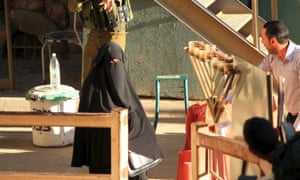
At one point a Palestinian man in a striped shirt – who Amro said he spoke to after the event – is visible in the pictures trying to speak to the young woman, whose arms, in all the images, are not raised.
“The man was speaking to her, encouraging her to go back. He told me afterwards she seemed frozen with fear,” continued Amro. “You see the soldier wearing the kippa hold up his hand. He is telling others at the checkpoint not to enter.”
The images suggest Hashlamon turned to face a soldier with a radio – who according to eyewitnesses was a commander – who approached from the left from the photographer’s point of view. Hashlamon is seen both facing the Palestinian man, who has spoken to her, and turning to face the soldier with the radio.
It is what happened next that is one of several disputed points. 
The Israeli military said the images did not include the moment when they say Hashlamon pulled out a knife. They did not supply images of her with the knife when asked.
“The attacker attempted to stab a soldier,” an Israeli army spokeswoman told al-Jazeera, explaining that the unidentified soldier – who was not injured – then opened fire.
According to Amro it was the soldier with the radio who fired first, followed by others. The next images show Hashlamon on the ground, her jeans visible and a blood stain on one hip. No images have been released showing the moment of the shooting.
Another point at which the two accounts diverge is in the claim that Hashlamon was given immediate medical treatment. Instead video that appears to have been taken at the scene shows what seems to be the injured student being pulled roughly by her legs by a soldier from under the barrier where she had fallen.
“We took footage of her bag afterwards,” said Amro, claiming its only contents were two mobile phones and two books. A photograph supplied by a press spokesman of the Israel defence forces however showed a knife on the ground with a blue and yellow handle.
"From the preliminary review regarding this morning's incident in Hebron, the perpetrator approached the checkpoint and the metal detector was activated, alerting the troops suspicion. Forces at the scene asked the perpetrator to stop, at which point she approached the forces, disregarding the instructions and raising further suspicion. Forces called for her to halt, which she ignored, and she continued moving while also pulling out a knife (see enclosed picture). At this point, forces fired at the ground, then at her lower extremities in attempts to stop her advancement. The perpetrator continued and at this point, recognizing a clear and present danger to their safety, the forces fired towards her."
Pinterest
 Picture of the knife the Israel defence forces say Hadeel al-Hashlamon was carrying when killed. Photograph: IDF
A European pro-Palestinian activist also present at the shooting gave a similar account to Amro in an interview with the New York Times.
The activist – who asked not to be identified – said a soldier had asked Hashlamoun to open her bag for inspection.
“When she was opening at her bag, he began shouting: ‘Stop! Stop! Stop! Don’t move! Don’t move!’” the activist told the paper. “She was trying to show him what was inside her bag, but the soldier shot her once, and then shot her again.”

Images released by Youth Against Settlements


Hadeel al-Hashlamon stands next to a checkpoint in Hebron while a soldier allegedly asks to search her.
 Hadeel al-Hashlamon stands next to a checkpoint in Hebron while a soldier allegedly asks to search her. Photograph: Youth Against Settlements
Palestinian student Hadeel al-Hashlamon, before she was shot and by Israeli troops
Pinterest
 Hashlamon, before she was shot by Israeli troops Photograph: Reuters/Youth Against Settlements
An Israeli soldier - reportedly an officer - approaches Hadeel from the left as she is speaking to a Palestinian man in a striped shirt who had apparently attempted to intervene to help her.
 An Israeli soldier – reportedly an officer – approaches Hashlamon from the left as she was speaking to a Palestinian man in a striped shirt who had apparently attempted to intervene to help her. Photograph: Youth Against Settlements
Israeli soldiers aim their rifles at Hashlamon.
Pinterest
 Israeli soldiers aim their rifles at Hashlamon. Photograph: Youth Against Settlements/Reuters
The body of Hadeek al-Hashlamon lies on the ground after being fatally wounded by gunfire by Israeli soldiers who initially said she had been shot in the legs.
 The body of Hashlamon lies on the ground after being fatally wounded by gunfire by Israeli soldiers who said she had been shot in the legs. Photograph: Youth Against Settlements

http://www.theguardian.com/world/2015/sep/23/dispute-arises-over-circumstances-of-death-of-woman-at-israeli-checkpoint-hadeel-al-hashlamon