dinsdag 12 december 2023

Failures Leading Up to the Hamas Attack That Changed Israel Forever


Analysis | 

Failures Leading Up to the Hamas Attack That Changed Israel Forever

Security establishment became enamored in the notion that the enemy is deterred ■ Netanyahu nurtured Hamas, and Israelis looked away ■ The years of ignoring the ramifications of the Israeli-Palestinian conflict exacted a heavy, sudden price

The Coordination and Liaison Office at Erez, on Israel’s border with the Gaza Strip, looked quite drowsy on the morning of August 25. It was a Friday, six weeks and a day before Hamas’ murderous surprise attack, which ignited the war. The sentry opened the gate slowly; not many soldiers were visible on the base. But the commander of the Gaza Division, Brig. Gen. Avi Rosenfeld, looked and sounded as though a cloud of concern loomed overhead. Asked what lay ahead for Gaza, Rosenfeld, a former commander of Shaldag, an Israel Air Force reconnaissance unit, replied laconically: Things won’t get better, at some point they’ll get worse.


The meeting and tour of the area were part of the preparation for an article that appeared in Haaretz on the eve of the Sukkot holiday, based on interviews with five territorial division commanders in the Israel Defense Forces, in the territories and along the country’s borders. The tour of the Gaza border was like the dozens of visits I’d paid there, and to other areas, over the past 25 years. High fences, outposts, observation means, plenty of technological systems – but not many forces on the ground. In the absence of a specific intelligence warning, the level of preparedness and vigilance also didn’t appear to be high.

In a similar visit to the 91st Division on Israel’s border with Lebanon three weeks later, the commander, Brig. Gen. Shay Klapper, noted that Radwan, Hezbollah’s elite unit, had more troops along the border than were present in the IDF’s routine-operation battalions deployed on the other side. When we ascended to the observation post of the Tzivoni outpost, next to Kibbutz Manara, we saw the outpost that Hezbollah had established across the border, adjacent to a battalion HQ of UNIFIL, the United Nations peacekeeping force. A few dozen meters separated the Hezbollah personnel from the Israeli outpost.

The soldier who was with us in the observation facility related that he had seen Iranian commanders there recently. A Farsi speaker, he had held a conversation of shouts with them. The outpost was manned by a Golani infantry brigade auxiliary force, but the initials EAC appeared on the signs: At the instruction of the previous chief of staff, Aviv Kochavi, the name of the veteran auxiliary units had been changed to exposure-assault companies. On a tour of the outpost I was taken aback by the amount of garbage in the corridors. I thought of mentioning this in the article, but decided to drop the idea – no one wants combat personnel to have to spend the weekend on the base because of a nasty comment.


The Coordination and Liaison Office was attacked on October 7 together with all the outposts along the division’s line. A large Hamas force seized the adjacent Erez Crossing, which was closed for the Simhat Torah holiday. From there, within minutes and with no resistance they advanced into the military base, killing and kidnapping the soldiers of the Civil Administration, though a few of them managed to return fire before being hit. A similar raid took place in the nearby moshav of Netiv Ha’asara, where there were serious losses, even though the inhabitants of the village fought heroically against superior forces.

Brig. Gen. Rosenfeld entrenched himself in the division’s subterranean war room together with a handful of male and female soldiers, trying desperately to rescue and organize the sector under attack. Many of the soldiers, most of them not combat personnel, were killed or wounded outside. The division was compelled to request an aerial strike against the base itself in order to repulse the terrorists.

Ahead of breaching the fence, Hamas incapacitated observation means and disabled various command and control systems. The division was effectively blindsided and the warnings did not reach the bases in time, with the result that in some of them, many soldiers were attacked in their beds that Shabbat morning. The precious hours that were lost enabled many hundreds of terrorists to infiltrate the local communities with rampages of massacres and brutalization. Many hours would pass before the IDF recovered and responded. Some of the communities that were captured were not liberated until the next day.

The situation in the northern division is better at the moment. Almost immediately, the IDF mobilized reservists on a huge scale and sent a good many of them to the Lebanon border, to thwart any another surprise attack and to deter Hezbollah from joining the fighting. This activity was bolstered by the direct threat issued by U.S. President Joe Biden, who ordered an aircraft carrier to the region and warned Iran and Hezbollah not to intervene.

But Hezbollah is far from being completely deterred. For more than a week, intensive “days of battle” have been taking place along the border, with the Shi’ite organization firing antitank missiles, launching rockets and dispatching squads to attack the border. The IDF is responding by bombing Hezbollah positions along the line, but is trying to avoid a flare-up that will ignite a second front and a regional war.

False sense of security

It wasn’t only the defensive conception and the intelligence deterrence that collapsed on October 7 in the Gaza Division. Something far more extensive occurred, which dragged Israel into a war it didn’t expect, one that will have profound implications for life here in the decades ahead. The drowsy base on the border, like Kibbutz Nahal Oz, whose western homes were built a few hundred meters from the border fence, was living with a false sense of relative security. Despite the overwhelming hatred from the Palestinians in the Gaza Strip, despite the vast disparities in the living conditions on the two sides, and even though Gaza has been ruled since 2007 by a murderous terrorist organization that is bent entirely on the destruction of Israel, we told ourselves a story we would be able to live with.

Even more than behind penetrable fences, Israel lived with high walls of repression around it. We talked about “the villa in the jungle” and took pride in being the only democracy in the Middle East, but we didn’t grasp the meaning of the powder keg whose fuse was lit here. The Arab world spiraled into total chaos as a result of the events of the Arab Spring in 2010. This period allowed Israel to occupy itself with its own affairs for some years and to persuade itself that all was well. But in this period, borders were erased, regimes were supplanted by force, millions of people became refugees and hundreds of thousands were murdered with appalling cruelty.

Organizations such as the Islamic State and al-Qaida won over tens of thousands of active participants and millions of admirers. The few regional taboos, if any such existed, were smashed to smithereens. Israel was relatively protected from the lethal chaos as long as it was perceived to be strong in the regional arena. That image, too, was undermined in Hamas’ attack on October 7.

What we are seeing is the fusion of an old, bloody conflict with the Palestinians, in which the two populations are today almost inextricably intertwined, deep and violent religious fanaticism, and incessant meddling by Iran. The Tehran regime discerned a way to wear down Israel by arming and training armed militias that seek to place the Jewish state in a stranglehold – and all of it without Iran paying a direct price itself. In fact, these forces are far more than militias: in their size, weaponry and combat training, Hezbollah and Hamas have become akin to terror armies. They don’t need warplanes and tanks to inflict serious military harm here, on a scale that undermines Israelis’ feeling of personal security. Rockets, drones and more traditional means of combat used by guerrilla organizations are enough.

As for the terrorists themselves, a dangerous mixture has been created here, because a jihadist fighter is a rather new combination: a professional soldier who is eager to die. The assault from the Gaza Strip was an operation of self-sacrifice. Hamas was not perturbed by the scale of its losses, and is certainly not wasting its time with concern for the rabble that raided the communities after the assault, murdering, raping and looting until they were shot and killed by the IDF.

In the face of this threat, Israel – on the right and on the left – fell asleep at the wheel. Israeli society repressed the ramifications of the Palestinian conflict, persuaded itself that it could go on rolling the problem forward without looking for a solution, and sought lucrative real estate and cheap vacations abroad. The Iranian threat sounded like an abstract story, something the security establishment likes to talk about to get priority for additional funds for their budget. Hezbollah, we thought, is still deterred and cautious. Israel abjectly failed in the previous confrontation with the organization, in 2006, which ended in a gloomy stalemate. But over the years, an alternative narrative took shape: The mistakes were corrected, the IDF returned to its former self and Hezbollah’s secretary general, Hassan Nasrallah, took care to avoid another round because he feared that Israel would again destroy Dahieh, the Shi’ite neighborhood in south Beirut.

The IDF, in the meantime, again inflated its command posts, grew slack in its organizational culture and cultivated the service conditions of its personnel. At the same time, the army became enamored of technological solutions and sanctified them at the expense of polishing operational capabilities. The attacks mounted during the period of the “campaign between the wars” in Syria were presented as a dramatic military development, without anyone explaining what Iran was nevertheless able to transfer to Hezbollah by indirect routes. The IDF’s chiefs of staff found themselves being dragged into dealing with dozens of issues that were tearing Israeli society apart – from women’s combat service (a dispute that the heroism shown by women in the October 7 assault and afterward should put to an end) to promoting equal opportunities for soldiers from the periphery.

The icing on this lethal cake was provided by the prime minister, Benjamin Netanyahu. Years of corrupting the civil service, advancing cronies and ignoring conflicts of interest, all the while sowing hatred and a schism in the nation, reached their peak when Netanyahu became entangled in criminal matters. From that moment, every means justified the end: to extricate him. That included the encouragement of a cold civil war between the contentious camps, an attempt to enact legislation for a regime coup, and readiness to tear apart the IDF after the chief of staff refused to punish reservists who ceased to volunteer in an attempt to halt the coup.

President Joe Biden meets with victims' relatives and first responders who were directly affected by the Hamas attacks on Wednesday.Credit: Evan Vucci /AP

From a sea of warning signs during the first nine crazy months of this year, two should be singled out. The Bibi-ists’ systematic social media attacks, with the government’s encouragement, on U.S. President Joe Biden; and Netanyahu’s remark to the newspaper Yedioth Ahronoth that the country could get along without two air force squadrons, but not with pilots’ and navigators’ “refusal [to serve].” Where would we be now without the backing of the United States and without the air force – two of the foundational pillars of Israel’s security conception?

The far-right government, which fuses Likud, hardalim, or nationalist ultra-Orthodox, and Haredim, knew what the stakes were. As early as last February, all the intelligence organizations warned that Israel’s enemies were detecting internal weakness that stemmed from the huge political crisis, and were considering the possibility of exploiting it. That does not diminish the severity of the sweeping failure of the intelligence community to discern Hamas’ operative plan and the fact that it would be implemented in the immediate future. With all that Hamas achieved – and part of the plan was even more ambitious, but was blocked – it could have been stopped in advance if only the pieces of information had been analyzed correctly and if the intelligence and defensive deployment had been more serious and more thorough.

But this was compounded by the horrendous failure of the political decision-makers. Over a decade, Netanyahu consistently cultivated Hamas’ rule in the Gaza Strip to slough off international pressure to renew the diplomatic process with the competing Palestinian camp, that of the Palestinian Authority in the West Bank. He ignored a strategic warning issued by the research division of Military Intelligence six years ago, about an explosion that would occur in the Palestinian arena. The prime minister advocated a policy of rounds of fighting, and stopped every significant military operation in Gaza before it got to the ground maneuver stage. To be fair, it has to be noted that all the sides, from both the right and the left (as well as we in the media), played down the scale of the military threat posed by Hamas while fearing a casualty-fraught ground operation.

Palestinians receiving cash as the United Nations begins distributing cash aid, funded by Qatar, to poor families in Khan Yunis in Gaza, 2021.Credit: Ibraheem Abu Mustafa/Reuters

Upon returning to power last December, Netanyahu adopted the policy of Naftali Bennett’s, Yair Lapid’s and Benny Gantz’s “government of change” and allowed 17,000 Gazan workers to enter Israel, along with the continuing infusion of Qatari money into Gaza, which had begun under his premiership. The money helped Hamas prepare the war, while the workers photographed the communities around the Gaza Strip and provided the organization with effective operational intelligence ahead of the assault. A detailed diagram of Netiv Ha’asara was found on the body of a terrorist who was killed there. It showed every house in a neighborhood of the village, along with the number of children living there and whether there was a dog in the house. Hamas launched a deliberate operation to annihilate civilians, and tragically, did so successfully.

The total unfitness of the government for its missions, certainly during an unprecedented emergency, is now being revealed in all its severity in the handling of the civilian rear. The southern residents who were evacuated from their homes and the families of the kidnapped and the missing are falling between the cracks and having a hard time getting initial help. In the Knesset, the Haredim are waging a rearguard battle to ensure that the corrupt flow of funds to their voters will not be frozen, despite the fact that the economy is headed for a years-long recession in the wake of the war. This week, Justice Minister Yariv Levin continued to battle by every means against the appointment of new judges. A coalition of thieves and vested interest groups continues to operate here, which is also entangled in endless bureaucracy introduced by a weary and battered civil service, with most of the departments having been purged of their professional directors general in favor of hangers-on and cronies.

Some ministers, who until October 7 wanted to be interviewed in every possible studio, have totally disappeared from the public eye. It’s completely unclear what their role is in the campaign and what they are doing. That vacuum is being filled by civil society organizations, some of which are connected with the protest movement. That is moving and heartwarming, but it’s not how a country is supposed to function. It appears that after the war, it will be necessary to rebuild the state.

Some articles in Haaretz in the past two weeks have expressed hope for change. Wars – and the one we are caught up in is liable to escalate seriously – foment tectonic changes. It’s possible that at the end of the war, a sobering approach will prevail, and will underscore the unifying and shared traits of the squabbling Israeli tribes. The scale of the disaster is also honing the public’s broad understanding of the nullity of the government and is advancing Netanyahu’s fall when the shooting ends.

Palestinian Hamas terrorists leave Kibbutz Kfar Azza, Israel, following the massacre of the Jewish community there on October 7, 2023.Credit: Hassan Eslaiah/AP

All of this is probably correct. But we must not underestimate the importance of other developments. The Islamic State-style barbarism displayed by the Hamas terrorists in the homes of the kibbutzim and at the site of the Nova music festival, has seriously scarred the Israeli psyche. The unmediated encounter with that experience will seriously damage an entire generation and could cause a sharp rightward shift politically. This involves not just disillusionment about the hope of peace with the Palestinians, but also hatred and a desire for revenge. As time passes, we will see more such phenomena in the far-right and in ordinary thugs.

The fear of Arabs, and the appraisals that there are squads that infiltrated from Gaza and are hiding in the center of the country, are engendering a wave of hysterical rumors. On Wednesday, there were rumors that Arabs were photographing buildings in the center of the country, supposedly in preparation for a terrorist assault. There are also acts of revenge against Palestinians by the so-called hilltop youth in the West Bank, increasing severity from the police toward manifestations of protest among Israeli Arabs, and the contribution of National Security Minister Itamar Ben-Gvir, who launched a campaign to distribute a firearm to all comers, with no practical criteria.


We must not ignore the potential danger that lies here on the domestic front, both in a flare-up from the Arab side and in terms of acts of violence by Jewish civilians or army and police forces on the backdrop of the general paranoia.

Grounding the decision

The end of the airlift of Western leaders to Israel, and in particular the conclusion of Biden’s brief visit on Wednesday, mark the onset of the next stage of the war, which will enter its third week on Saturday. Israel is still reeling from the brutal shock of the events of October 7, but in practice, not much has happened militarily since then. After regaining control of the south, the number of incidents with Hamas along the fence declined. The regular army and the reservists who are stationed in the Southern Command are undergoing training and preparations ahead of a ground move.

According to all the declarations by the political decision-makers and by the IDF, the intention is to launch such an operation. This also involves the understanding that the declared goal of the operation – the total annihilation of the Hamas regime – cannot be achieved without a ground maneuver. But the government and the army are not telling the public whether there is consistency between the goal and the means and capabilities, apart from a warning that the operation will have to take months.

Israeli soldiers are silhouetted as they sit astride an Israeli tank near Israel's border with the Gaza Strip, in southern Israel, Thursday.Credit: AMIR COHEN/ REUTERS

Biden’s visit really tightened the security and diplomatic coordination with Israel, but also imposed limitations on Israel. The president promised a continuing presence of the aircraft carriers, security supplies to renew stocks and diplomatic support for Israel’s stance. It’s likely that an American green light, which for the first time is required in the circumstances, was given for a ground operation in Gaza as well. But the United States does not want Israel to occupy the Strip, is warning that a humanitarian disaster could ensue, and is trying with all its might to prevent a war between Israel and Iran and Hezbollah.

Some of the appraisals being voiced in Israel – as if it’s clear that American aircraft will strike in Lebanon if Hezbollah attacks Israel – are overly categorical. And Iran is already making moves to deter the United States, including two drone attacks on American bases in Syria and Iraq in the past two days.

As far as is known, the security cabinet hasn’t yet decided on the scale of the ground operation in Gaza. In the corps below, and in the General Staff as well, there is support for a broad maneuver. The prevailing argument in the army is that Hamas has dented the Israeli iron wall, the concept of defense and deterrence that was developed and rehabilitated here for years, after the shock of the Egyptian and Syrian assault in 1973 (whose impact was dulled because of the IDF’s recovery during the war). This approach holds that there is no alternative to inflicting a staggering blow on Hamas, despite the danger of large-scale casualties on the Israeli side, because any further weakness will tempt Iran to initiate another offensive in the future and will stir the appetite of additional rivals, to the point of causing unquiet on the domestic front.

A shell from Israeli artillery explodes over Dahaira, a Lebanese border village with Israel, south Lebanon, on Monday.Credit: Hussein Malla /AP

The advocates of a broad ground maneuver admit that multiple losses are anticipated but believe that the public is less sensitive to this in light of the total undermining of the sense of security in the wake of the Hamas assault. They are also presenting the ground operation as a jolting move, which will enable the army to score achievements (although much time for activity will be required afterward, at very high cost).

In contrast, others – in the army as well – are recommending that Israel make do with a more limited move. They believe that reasonable achievements can be attained within an allotted timeframe. At the same time, they are worried about the possibility of a trap in Gaza that will lead to an Israeli failure and could also induce Hezbollah to take advantage of the opportunity and join the campaign. The final decision will be made by the war cabinet, but the true influencers in this regard will be Netanyahu, and in large measure, also Biden.


CNN report claiming sexual violence on October 7, relied on non-credible witnesses, some with undisclosed ties to Israeli govt


 MEDIA ANALYSIS

CNN report claiming sexual violence on October 7, relied on non-credible witnesses, some with undisclosed ties to Israeli govt

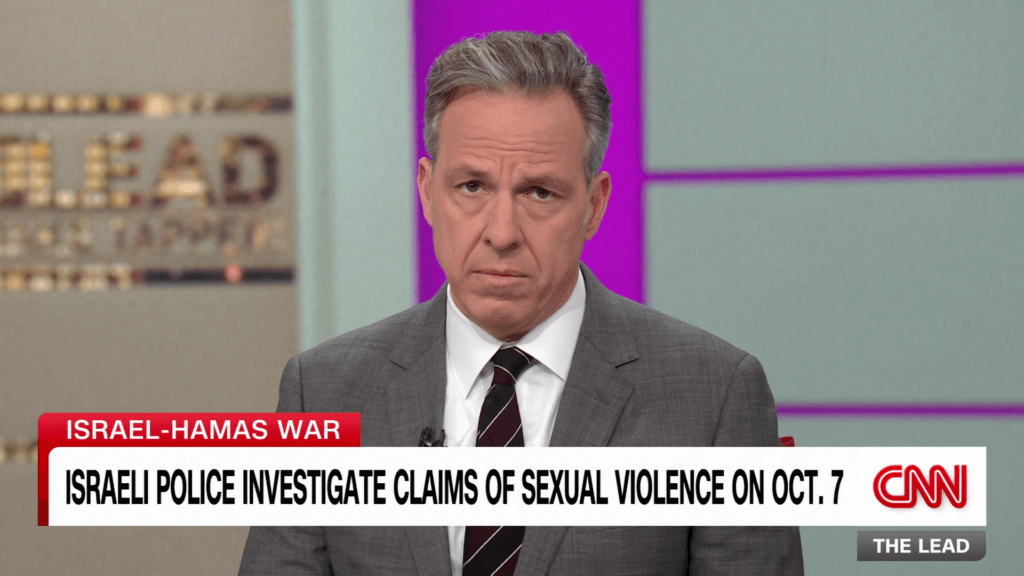
CNN’s Jake Tapper failed to adhere to professional and ethical journalism standards in a story claiming to offer proof of sexual violence by Palestinian fighters on October 7.

Editor’s Note: The authors of this report are based in Palestine and have requested anonymity in the face of the persecution, violence, and threats from Israeli authorities, which would put them in severe danger.

On November 18, 2023, CNN aired a report by journalist Jake Tapper. The report claims to provide testimonies on “rape crimes” against Israeli women that allegedly took place on October 7, 2023. Within a few hours of the publication of the CNN report, an international media campaign by Israel and pro-Israeli groups was launched. Other media outlets, including The Washington Post, based their reporting on CNN’s report. Feminist activists and groups who have been calling for a ceasefire in Gaza were also targeted as part of this campaign. Samantha Pearson, the director of the Sexual Assault Centre at the University of Alberta in Canada, was fired from her job a few hours after the airing of the report. She had signed a letter on October 25 that stated that the accusation that Palestinians were guilty of sexual violence remains “unverified.” The letter did not say that sexual violence did not occur but that there was no sufficient evidence yet to support these accusations. 

The CNN report represents a serious breach of professional conduct, which we detail in this piece. The most concerning aspect of the report is the fact that every single witness and “expert” in the CNN report proves to either be lacking in credibility or have ties to Israeli government officials and institutions. A deeper examination of the CNN report shows a series of manipulations and professional failures, including the fact that all witnesses that CNN claims to have “found” were featured in previous reports pitched and coordinated by the Israeli government, calling into question how much original reporting or fact-finding went into the CNN report. CNN’s failure to adhere to professional and ethical standards of responsible journalism also raises questions regarding CNN’s possible complicity with a political campaign orchestrated by the Israeli Prime Minister’s office to perpetuate unverified claims of mass rape, and a larger effort to dehumanize Palestinians in order to justify the ongoing genocidal campaign in Gaza.


Civil human rights expert or National Security Advisor?

The CNN report begins with an interview with Cochav Elkayam-Levy. She is identified as an “expert in human rights law who organized a civil committee to document evidence.” The speaker is indeed an expert, but not of human rights law. In her former positions, including a post for the Israeli government’s Attorney General’s Office in the International Law Department, she provided the legal justification for Israeli officials committing human rights violations against Palestinians. She had previously published a “guidance for policymaking, government officials and legal advisors in the management of hunger strikes.” There, she provided a detailed legal manual to “standardization through legislation and regulation” for forced feeding – a brutal act of torture used to break political prisoners. In the same year, Israel legalized and regulated the “forced feeding” law to oppress and torture Palestinian prisoners protesting their administrative detentions through hunger strikes. 

Yet, CNN considered it appropriate to bring her as a human rights expert. In her interview, which opens the CNN report, Elkayam-Levy presents nothing but justifications for the absence of evidence and facts. While Elkayam-Levy claims to speak under the auspice of the “civil committee,” CNN hides the tight connections between her and the National Security Council for the Israeli Prime Minister. Elkayam-Levy is also the founder and director of the “Dvora Institute,” which works as a close advisory body to the Israeli prime minister’s “National Security Council.” The advisory committee for the Dvora Institute includes a former director of the Israeli Prime Minister’s Office, and three former officials in the National Security Council.

Soldier testimony doesn’t match up

The report then claims that CNN “found witnesses to the atrocities.” The report then presented a video of an Israeli soldier, showing his back only, identified by the letter “G,” claiming to be a paramedic of unit “669” – the Israeli Air Force Special Tactics rescue unit. 

In his testimony, the soldier says that during a search in the houses of “Kibbutz Be’eri,” during combat, he opened a door of a bedroom to find the bodies of two girls aged between 13 and 15, both killed, one of them naked with semen remains on her lower back.

Upon examining the names of all the girls killed in Kibbutz Be’eri on October 71 to match the facts, no pair of Israeli teenagers meeting that description were found dead together.

For instance, the closest possibility to what the paramedic describes are the two sisters (“Y” – 13 years old) and (“N” – 16 years old). The two, however, were not found together, as claimed by “G.” According to the Israeli reports, the body of one of them was found with her dead mother at home, while the other sister and her father went missing for a few days. According to Ynet, “the family wished that the girl was kidnapped to Gaza, but a few days after the attack they found her body.”  

Surprisingly, very similar testimony was given on Republic, a right-wing conservative Indian TV channel, on October 25. Back then, a soldier of the same unit, 669, appeared in an interview with no name initials. Weirdly, the interview was widely ignored by Israeli media. This interview was arranged by Eylon Levy, the foreign media spokesperson for the Israeli Prime Minister’s Office. At that time, Eylon Levy posted the interview on X/Twitter, claiming it was testimony from “Be’eri,” although the soldier of the first interview referred to another settlement, “Nahal Oz.”

Furthermore, according to an interview with Channel 13, the leader of the Kibutz Be’eri battle, Brigadier General Barak Hiram, counted 13 different military units that formed the combat force that were there – Unit 669 was not among them.

Everyone can become a forensic pathologist

The CNN report then brings two witnesses to talk about the conditions of the dead bodies they have seen. The first appears under a pseudonym for an unknown reason, despite showing her face and wearing civilian clothes from a private house. 

The report identified her as a “volunteer” at the morgue of the Shura military base, where many bodies were brought for identification and preparation for burial. The witness previously appeared in a written report (including a photo of her in military uniform) where she was identified as a reservist corporal in the Israeli army who works as an architect in her daily life. In the written report in Ynet, published on October 31, 2023, she did not mention any claims of sexual violence. 

The second witness is Rami Shmuel, who Jake Tapper identifies as one of the organizers of the “Nova” festival. In fact, he is an organizer of the “UNITY” festival – another electronic music festival, held the day before the “Nova” in the same location. The two festivals are not connected.

CNN fails to mention the fact that Rami Shmuel was not present at the festival location during the attack. According to Shmuel’s Facebook post, published on the afternoon of October 7, he was “safe” in a villa in Netivot settlement.

Shmuel claims the next day that he joined efforts to search for bodies and survivors in the area in a personal, unofficial capacity. What Shmuel told his followers on the evening of October 8 did not have any hint of sexual violence: “An hour ago, I left the area, and the scenes are very, very difficult and (…) A war zone in every sense of the word. Hundreds of abandoned bullet-riddled cars, fires still burning in some open areas.”

The witness who ‘saw them’

The CNN report then continues, “On Tuesday, the police held a press briefing in which a witness said…” then the reporter moves to read a written quote shown on the screen. The quote suggests that the witness- a woman with no further information about her at all- saw while hiding with another paramedic that “They bent someone over and I understood he was raping her and then he was passing her on to someone else (…) I saw him chop off her breast and then he was throwing it towards the road, and they started playing with it.”

The report, here, hides many important facts that were reported in a detailed report in the Israeli media of the briefing that points to the following inconsistencies: 

1.) The woman was not present in the briefing, the police officers played a recording by her without further details. 

2.) The witness escaped from the music festival, what she describes was seen while hiding. 

3.) She was accompanied by a paramedic who said he didn’t see what she mentioned. 

4.) Both CNN and different media outlets who published this testimony purposely omitted the last part of the testimony: “I saw one of them carrying a naked girl on his shoulder, while the others were raising decapitated heads like in a kind demonstration of power.” 

This final claim has not been shared by any Israeli officials and raises serious questions as to the overall reliability of the witness.

Israeli campaign to promote the issue 

The CNN story ends with Tapper and Elkayam-Levy castigating the international community for ignoring these acts of violence against women. It is difficult to separate this framing from the very framing the Israeli government itself was also promoting at this time.

On November 13, the Israeli police conducted a briefing for journalists that, according to reports, promised new evidence regarding sexual violence on October 7. This is the briefing referred to in the CNN report. However, not reported by CNN was the apparent tension between journalists and police officers at the briefing over the absence of new information and clear evidence. The Police Chief refused to answer any questions, and the police media officer, Merit Ben Meir, engaged in a heated discussion with journalists where they made the intended message of the briefing clear, stating: “Based on the circumstances of the bodies, rape occurred, and there’s no room for questioning these events.”

A few days later, on November 17, more than twenty days after the Canadian activists’ letter was published, a tweet was posted by a Canadian Zionist organization attacking Samantha Pearson. 

A day after, on November 18, CNN published its report, and within a couple of hours, a media campaign against Pearson and other feminist groups began, leading immediately to her firing. 

On the morning of November 19, the Israeli press announced that the Foreign Ministry was intensifying its efforts to influence “global feminist organizations” and leveraging the International Day for the Elimination of Violence against Women on November 25 to highlight Israeli allegations regarding sexual assaults. In the evening of the same day, an advertising campaign was released featuring Israeli actresses and models repeating literally the same slogan that Jake Tapper ends his CNN report with: “If the rape of Israeli women doesn’t count as rape.”

Accountability 

History has taught us that genocide always requires the dehumanization and demonization of the annihilated people as human animals and savages. The CNN report is part of this dehumanization. The analysis presented here is not meant to deny the possibility that sexual violence against women may have occurred on October 7. It is about fair reporting and about ensuring that there is sufficient and reliable evidence to support these serious allegations. If sexual violence did occur, perpetrators must face severe punishment. This should be the responsibility of the Palestinians above all else. 

This is about seeking justice for the victims of these crimes and about the integrity of the Palestinian struggle for liberation, which rejects sexual violence. Individual perpetrators ought to be held accountable for their actions. This must be achieved through a fair criminal process based on facts and evidence. Fair criminal process, we maintain, cannot be achieved in illegal Israeli military courts, in which conviction rates are over 99%.

Rather, we believe Israel’s goal is not to seek justice but to create pressure that silences the world and persecutes anyone calling for a ceasefire and an end to the war. The next step in this campaign is to escalate a witch hunt against every person who supports the rights of Palestinians. This is exercised with one single goal: the annihilation of the people of Palestine in Gaza. 

Notes

  1. You can search for בארי and you’ll get the list. There is (as detailed in the longer report) another girl (12 years old) who had no other female teenagers with her. Another pair of sisters, 15 and 22, were missing for more than two weeks, and their family thought they were abducted. Which leaves us with the case in the report. ↩︎

maandag 11 december 2023

Israel Cannot Blame Antisemitism Alone for Global Condemnation


Haaretz


Nov 28, 2023


In recent weeks, Israel and Israelis have had new, serious enemies competing with their longtime strategic foe, Iran. These aren’t Hamas or Islamic Jihad, but rather demonstrators in the streets, on campuses, and opposite Israeli embassies in Europe and the United States. They have one particularly hated slogan: “Free Palestine,” or in its longer version: “From the river to the sea, Palestine will be free.”

If you thought this was only driving Israeli right-wingers crazy, you’re wrong. It’s also riling leading left-wingers and people who, until the October 7 Hamas attack on Israeli border communities, were stalwart advocates for human rights. Israelis claim that the slogan is a clear call for the destruction of the State of Israel – pure antisemitism.

There has been a range of Israeli reactions to the pro-Palestinian tide: online public diplomacy, amused newspaper articles, sketches on the satirical TV show “Eretz Nehederet,” and political cartoons. There are jokes about bored, privileged Europeans or Americans who feel they’re at the forefront of a fight they don’t understand and ultimately damage the Palestinians.

Israelis argue that they even know which river or sea is being referred to and that Islam will soon take control of their own countries and destroy them, just as Hamas took control in the Gaza Strip and has tried to destroy Israel. These Israelis call on the demonstrators to come to their senses and realize that Israel is the good guy and Hamas and Islam are the bad guys.


Students participate in a protest in support of Palestine and for free speech outside the Columbia University campus in New York, earlier this month.Credit: Spencer Platt - Getty Images via AFP

Frankly, I don’t know whether all the pro-Palestinian demonstrators have a coherent ideology, whether they support a two-state solution or one state. Maybe they’re just antisemites, and I don’t intend to be their advocate.

But instead of being concerned with all this Judith Butler, Greta Thunberg, and Angelina Jolie, Jewish Voice for Peace, the international left wing, and everything else in existence, Israelis need to ask themselves how things got to this point.

A quick tour of social media will suffice. You can easily get an unfortunate impression of the state of affairs from Israeli public officials’ video translated by Google Translate. Danny Danon, Israel’s former UN ambassador, is suggesting that Gaza’s residents agree to voluntary expulsion.


Protesters show placards during a pro-Palestinian protest in London, last month.Credit: Alberto Pezzali /AP

Ayelet Shaked, the former justice minister, is looking forward to the day when Israel turns the city of Khan Yunis in Gaza into a soccer field. Amichai Eliyahu, the heritage minister, thinks an atomic bomb on Gaza is an option, while Otzma Yehudit Knesset member Limor Son Har-Melech is praying for the reoccupation of Gaza.

Then there are the TikTok videos of Israeli soldiers in Gaza laughing about the hunger of residents there and troops filming themselves blowing up houses, as a soldiers stands at a DJ control board in the background timing the blasts to the beat. But most importantly, people are seeing the horrific scenes from Gaza that aren’t shown on Israeli channels.

And it’s not just the events of the past month or so. It’s more and more settlement construction, the occupation, the blockade on and bombardment of Gaza, the IDF spokesman lying, the IDF spokesman lying again, etc.


A protester waves a flag at a rally held in support of Palestinians at Columbia University in New York earlier this month.Credit: EDUARDO MUNOZ/ REUTERS

Over the past decade and a half, the world has marched toward a conversation about occupation, colonialism, and human rights, while in Israel, the common, mainstream discourse has stalled over whether or not there’s such a thing as a Palestinian people.

Young people around the world are opposed to militarism and the military, while their Israeli counterparts have been shifting to the right, becoming more racist and ignorant. That’s the image that Israel projects to the liberal world – a racist, occupying country that has been systematically killing Palestinians for years.

You can condescendingly laugh about the “snowflake” protesters all you want, but they’re not going anywhere. Because they represent the future, while Israel has, it has to be admitted, been stuck in the past for too long.


zondag 10 december 2023

Journalist Gideon Levy heeft weinig hoop voor Israël: ‘We zitten vast in onze slachtofferrol’


Journalist Gideon Levy heeft weinig hoop voor Israël: ‘We zitten vast in onze slachtofferrol’

Journalist Gideon Levy (70) in zijn tuin in Tel Aviv. Beeld Kobi Wolf voor de Volkskrant
Journalist Gideon Levy (70) in zijn tuin in Tel Aviv.Beeld Kobi Wolf voor de Volkskrant

De Israëlische journalist Gideon Levy bereikte al weinig landgenoten met zijn berichtgeving over Palestijnen, maar sinds de Hamas-aanval is er helemaal geen ruimte meer voor empathie. ‘Waarschijnlijk weten jullie in Nederland beter wat inwoners van Gaza meemaken.’

Sacha Kester

Hij wordt gehaat, de vriendelijke man die op dit moment in korte broek koffie en thee zet voor zijn gasten. Het Israëlische leger heeft hem meerdere malen beschoten, een woedende meute heeft gedreigd hem in elkaar te slaan, en verschillende ministers hebben geëist dat hij zorgvuldig in de gaten wordt gehouden omdat hij een veiligheidsrisico vormt.

Wat Gideon Levy, die in de keuken liefdevol over zijn drie katten praat, zo gevaarlijk maakt? Decennialang probeert hij als journalist al te vertellen over de mensen met wie Israëliërs dit land delen. De Palestijnen. Niet over de ‘beesten’, zoals zij tegenwoordig in Israël worden genoemd, maar over doodnormale gezinnen die onder gruwelijke omstandigheden proberen te overleven. En over hoe Israël de rechten van deze mensen vertrapt.

Het was altijd al lastig om voor deze boodschap een luisterend oor te vinden, maar op dit moment, nu heel het land in shock verkeert vanwege de aanval van Hamas, wil eigenlijk niemand zijn verhaal nog horen. Toch blijft Levy (70) onvermoeibaar zijn vinger op de zere plek leggen en schrijft hij over de moorden op de Westelijke Jordaanoever (in zeven weken tijd 42 Palestijnse doden in één dorp), hekelt hij oud-generaals die schaamteloos suggereren dat er eens een flinke epidemie zou moeten woeden onder de vluchtelingen in Gaza, en vraagt hij zichzelf af waarom je een verrader zou zijn als je ook empathie voelt voor de kinderen in Gaza.

Over de auteur

Sacha Kester schrijft voor de Volkskrant over België, Israël en het Midden-Oosten. Eerder was ze correspondent in India, Pakistan en Libanon.

U schrijft voor de linkse krant Haaretz. Is dit geluid ook in andere Israëlische media te vinden?

‘Nee, daar is momenteel geen ruimte voor empathie. Palestijnen zijn voor heel veel Israëliërs geen mensen meer, maar ‘terroristen’ of zelfs ‘beesten’. Onze media laten niet eens zien wat er in Gaza gebeurt. Waarschijnlijk weten jullie in Nederland beter wat de inwoners daar meemaken dan Israëliërs die er een halfuurtje vandaan wonen. Je kunt in dit land urenlang naar de tv kijken en dan gaat het continu over de oorlog, maar de gevolgen van de bombardementen – de slachtoffers, de vernietiging en de wanhoop – blijven buiten beeld.’

Dit is geen Rusland: Israël is een democratie waar de pers in vrijheid verslag mag doen. Dit is dus niet van bovenaf opgelegd.

‘Dat is misschien nog het ergste: niemand vertelt de media dat ze deze beelden moeten achterhouden. Ze kiezen er zelf voor omdat ze weten dat hun kijkers ze niet willen zien, en dus omdat het slecht zou zijn voor de kijkcijfers.’

U schrijft het wel op. Maakt dat enig verschil?

‘Helaas niet, maar het is wel terug te vinden in de archieven, en later zal niemand kunnen zeggen: ‘O, dat was vreselijk, maar ik wist dat niet.’ Mensen kiezen ervoor om het niet te weten, en de media helpen hen daarbij.’

Terwijl de gelauwerde Levy op internationale podia wordt geroemd om zijn columns en analyses, wordt het hem in Israël zelf niet in dank afgenomen dat hij over de slachtoffers in Gaza schrijft. Toch voelt hij zich niet onveilig en heeft hij geen doodsbedreigingen gekregen.

‘Wellicht hebben ze mij gewoon opgegeven’, zegt hij lachend.

Want dat is weleens anders geweest. Tijdens de oorlog tussen Israël en Hamas in 2014 kwam Levy de straat niet meer op: hij was het zat om constant bespuugd te worden of te zien dat mensen in restaurants van hun tafeltje wegliepen omdat ze niet bij hem in de buurt wilden zitten. Hij had het bovendien gehad met zijn bodyguards die hem om veiligheidsredenen buitenshuis moesten vergezellen, en dan ook steeds begonnen over zijn politieke mening.

Bodyguards, ja. Een dag nadat Levy in zijn column niet alleen politici, maar ook piloten die bommen op Gaza lieten vallen de maat had genomen, stormde op straat een meute op hem af. ‘Ik moest rennen!’, vertelt hij. Zelfs in tijden van vrede mag er geen kwaad worden gesproken over de jongens en meisjes die het land verdedigen, en in tijden van oorlog was dit heiligschennis.

‘Maar het is nu eenzamer dan toen’, vertelt hij in zijn achtertuin in Tel Aviv, waar het warme ochtendlicht schijnt op een jonge citroenboom. ‘Bijna iedereen, ook in mijn omgeving, is veranderd. Mensen die zogenaamd een links hart hadden, zeggen plotseling ook dat er geen kans meer is op vrede omdat Arabieren nu eenmaal moordenaars zijn. Dat is uitermate deprimerend. Wat er is gebeurd, ligt helemaal niet automatisch in de aard van Palestijnen of Arabieren. Het was barbaars, maar de woede heeft wortels. Het is onvergeeflijk, maar het betekent niet dat heel Palestina zo in elkaar zit.’

Hoe verklaart u dat zelfs Israëliërs die de situatie in Gaza en op de Westelijke Jordaanoever persoonlijk kennen, die weten hoe de bezetting daar aan mensenlevens vreet, nu geen ruimte hebben voor dit perspectief?

‘Vergeet niet dat de aanval toevallig plaatsvond bij de ruggegraat van het Israëlische vredeskamp. De kibboetsen waar Hamas al die burgers en kinderen heeft vermoord, vormen het hart van de vredesbeweging. Mensen zien dat als verraad, voelen zich persoonlijk vernederd en verraden. Tegelijkertijd laat het zien dat zionistisch links niet heel erg solide is. Eén aanval en er vindt een aardverschuiving plaats.’

Kun je stellen dat Israël door deze aanval is veranderd?

‘We moeten wachten tot de oorlog voorbij is om dat te beoordelen, want op dit moment bevinden we ons nog midden in de storm. Mensen zijn geschokt en voelen zich vernederd. We kunnen niet geloven dat een stel jongemannen met geweren en motoren het zuiden van ons land kon overnemen en zoveel mensen kon vermoorden. In Israël! Met ons superieure leger, en onze superieure veiligheidsdiensten!

‘Ook ik geloof na deze gruwelijke aanval dat we tegen Hamas moeten strijden. Maar we moeten onszelf tegelijkertijd afvragen hoe we hier zijn terechtgekomen, want het conflict is niet op 7 oktober begonnen. Hamas kon zo sterk worden doordat mensen zestien jaar lang in armoede, onder vreselijke omstandigheden en zonder enig perspectief, in een kooi hebben geleefd.’

U zegt dat er tegen Hamas moet worden gestreden, maar deze organisatie zit diep ingegraven in overbevolkt gebied en gebruikt burgers als menselijk schild. Hoe kan een democratie daartegen vechten?

‘Het is onmogelijk om dat te doen zonder dat het burgerlevens kost, maar het moet wel proportioneel blijven, ook in ons eigen belang. Stel dat het wél moreel verantwoord zou zijn om al deze onschuldige mensen te doden, en dat we daadwerkelijk het recht hebben onszelf op deze manier te verdedigen, wat komt er dan daarna? Want we moeten, zelfs los van enige morele afweging, ook aan de consequenties denken. Wat denk je dat er gaat gebeuren? Gaan deze mensen Israël in hun harten sluiten omdat we Hamas hebben verjaagd? Gaat dit in Gaza tot een vredesbeweging leiden? Natuurlijk niet! Dit genereert een nieuwe generatie die ons diep zal haten en ons met geweld zal willen bestrijden.’

Wordt dit gesprek, dat gaat over de veiligheid van Israël, wel gevoerd?

‘Alleen in heel kleine bubbels, en nu helaas minder dan ooit. Deze samenleving leeft met een olifant die midden in onze levens staat, maar we spreken niet over de bezetting en dus bestaat die niet. Helaas is geweld het enige signaal dat we krijgen, dat mensen wakker schudt en laat zien dat er ook nog Palestijnen zijn. Het is een erg deprimerende conclusie, maar het is wel waar. Als ze netjes achter hun muur blijven, en wij niets van hen horen, geeft niemand hier in Israël iets om Gaza.’

Maar legt u dit alstublieft uit: ik ken Israëliërs als uitermate warme en genereuze mensen die het leven omarmen, de democratie een warm hart toedragen en anderen over de hele wereld willen helpen waar ze kunnen.

‘Het is helaas niets nieuws. Dezelfde Israëlische soldaten die na de aardbeving naar Turkije gaan om een kind te redden, kunnen een dag later een kind doodschieten op de Westelijke Jordaanoever zonder zich daar schuldig over te voelen. Als je een bezetting wilt volhouden, moet het bezette volk gedehumaniseerd worden, anders word je gek. Wij ontmenselijken de Palestijnen al decennialang, want als we hen niet meer zien als mensen zoals jij en ik, wordt alles veel simpeler. Dan hoeven we geen rekening te houden met mensenrechten of internationale wetgeving. Als je na de overstromingen op de Filipijnen een kind redt, heb je een mensenleven gered. Een Palestijns kind is geen mens.’

Als je in Israël met mensen praat, zijn ze oprecht bang: alsof ook hier in Tel Aviv elk moment een Hamasstrijder uit een tunnel kan stappen om hen te vermoorden en hun kinderen te kidnappen. Hoe legt u die angst uit?

‘Die wordt ons bijna met de melk van onze moeders bijgebracht. De Holocaust is veel meer in deze samenleving aanwezig dan buitenstaanders beseffen, en we vertellen elkaar altijd dat we in gevaar zijn. Dat we klein en zwak zijn, zoals David, en dat we tegenover een Goliath staan. Terwijl dat in de meeste gevallen helemaal niet waar is. Als het gaat om de Palestijnen, zijn zij de kleine zwakke David en wij zelf de Goliath.

‘Natuurlijk is een deel van die angst terecht. Ook ik was de eerste dagen na de aanval bang dat het tot een regionale oorlog, of misschien zelfs een wereldoorlog zou leiden. De realiteit kan in deze regio erg beangstigend zijn. Maar een ander deel van de angst is gemanipuleerd. Angst kan heel goed zijn voor regeringen, voor totalitaire leiders. Angst verenigt mensen tenslotte enorm. En dus zeggen wij nu in koor dat de hele wereld tegen ons is, dat de hele wereld antisemitisch is. Er is alleen maar angst, angst, angst.

‘Terwijl de wereld juist belachelijk welwillend tegenover Israël staat. Toen Rusland de Krim binnenviel, werden er binnen een week sancties opgelegd. Israël bezet sinds 1967 al Palestijns land, en zelfs het noemen van sancties is ongehoord.’

Palestijnse ­kinderen lopen donderdag door het puin na een aanval van het Israë­lische leger op de grootste stad in Zuid-­Gaza. Beeld Getty Images
Palestijnse ­kinderen lopen donderdag door het puin na een aanval van het Israë­lische leger op de grootste stad in Zuid-­Gaza.Beeld Getty Images

Zo heeft Levy niet altijd naar de situatie gekeken. In 1974 werd hij als jongeman opgeroepen voor het Israëlische leger, waar hij als verslaggever diende bij Israel Army Radio. Van 1978 tot 1982 werkte Levy als assistent voor Shimon Peres, op dat moment de leider van de Israëlische Arbeiderspartij, en daarna begon hij te schrijven voor Haaretz. Toen hij als verslaggever naar de Westelijke Jordaanoever ging en zag hoe kolonisten olijfbomen van Palestijnse boeren omhakten, en hoe Palestijnse vrouwen bij checkpoints werden mishandeld door Israëlische soldaten, dacht hij nog dat het om de rotte appels, de uitzonderingen ging. ‘Ik was jong en gehersenspoeld’, zei Levy in een eerder interview. ‘Het duurde heel lang voordat ik begreep dat dit bewust beleid van de overheid was.’

Na de aanval van Hamas werd er buiten Israël, ook door bondgenoten als de Verenigde Staten, wel gesproken over het belang van een vredesproces. Gelooft u dat deze ramp na de oorlog kan leiden tot een dialoog?

‘In Israël zie ik dat niet gebeuren. Ik hoop het, maar al mijn hoop ligt bij de internationale gemeenschap, want in Israël is een groot gebrek aan rationeel denken. We zijn te emotioneel, te nationalistisch en we zitten vast in onze slachtofferrol.’

Ook niet als premier Netanyahu vertrekt en er een minder rechtse regering zou worden gekozen?

‘Het spijt me, nee, maar Netanyahu is niet het probleem. Dat zit veel dieper. Ook mensen uit de oppositie, zoals Yair Lapid of Benny Gantz, willen de bezetting laten voortduren. Er is helaas geen leiderschap dat het voortouw kan nemen. Een dappere leider, die het volk kan vertellen: ‘Genoeg is genoeg, we hebben al zoveel geprobeerd, en dat heeft nooit gewerkt, we kunnen niet meer op ons leger vertrouwen en ook de Verenigde Staten zullen ons niet eeuwig beschermen. We hebben geen andere keuze dan met de Palestijnen om de tafel gaan zitten.’

‘Maar dergelijk leiderschap zie ik niet. Niet bij ons, in Israël, en ook niet bij de Palestijnen. Zeker niet degenen die op het podium staan, maar helaas ook niet achter de coulissen.’

Dat klinkt uitermate deprimerend. U heeft echt geen sprankje hoop?

‘Natuurlijk blijf ik hopen, maar ik zie niet waar het vandaan kan komen, behalve uit de internationale gemeenschap. En natuurlijk moet je in deze regio, in het Midden-Oosten, altijd realistisch genoeg zijn om in wonderen te geloven.’

https://www.volkskrant.nl/buitenland/journalist-gideon-levy-heeft-weinig-hoop-voor-israel-we-zitten-vast-in-onze-slachtofferrol~b6f60939/#:~:text='In%20Isra%C3%ABl%20zie%20ik%20dat,zitten%20vast%20in%20onze%20slachtofferrol.'