donderdag 18 november 2021

The forgotten oil ads that told us climate change was nothing

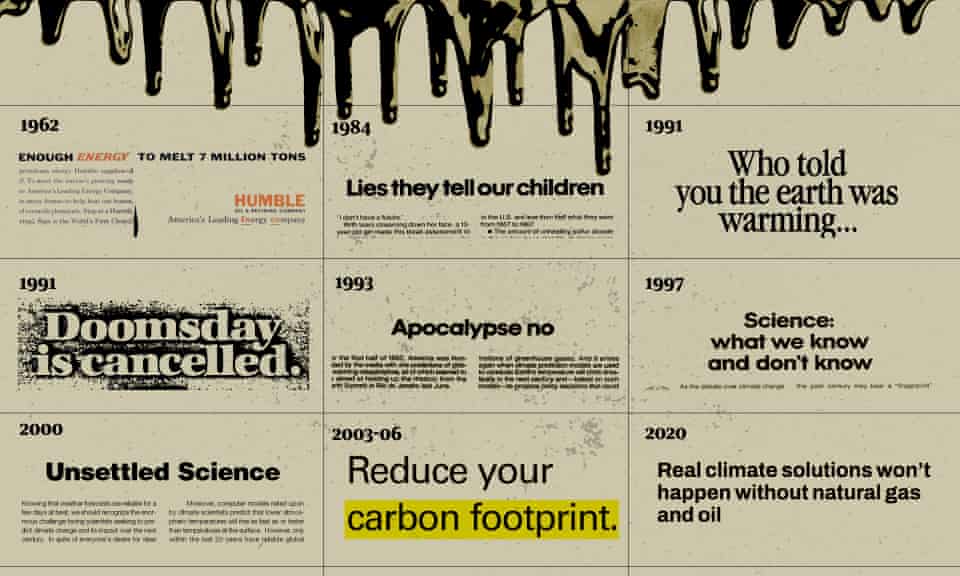
 Composite illustration of oil ads from 1962 to 2020

Illustration: Guardian Design

The forgotten oil ads that told us climate change was nothing

Since the 1980s, fossil fuel firms have run ads touting climate denial messages – many of which they’d now like us to forget. Here’s our visual guide

Why is meaningful action to avert the climate crisis proving so difficult? It is, at least in part, because of ads.

The fossil fuel industry has perpetrated a multi-decade, multibillion dollar disinformation, propaganda and lobbying campaign to delay climate action by confusing the public and policymakers about the climate crisis and its solutions. This has involved a remarkable array of advertisements – with headlines ranging from “Lies they tell our children” to “Oil pumps life” – seeking to convince the public that the climate crisis is not real, not human-made, not serious and not solvable. The campaign continues to this day.

As recently as last month, six big oil CEOs were summoned to US Congress to answer for the industry’s history of discrediting climate science – yet they lied under oath about it. In other words, the fossil fuel industry is now misleading the public about its history of misleading the public.

We are experts in the history of climate disinformation, and we want to set the record straight. So here, in black and white (and color), is a selection of big oil’s thousands of deceptive climate ads from 1984 to 2021. This isn’t an exhaustive analysis, of which we have published several, but a brief, illustrated history – like the ‘sizzle reels’ that creatives use to highlight their best work – of the 30-plus year evolution of fossil fuel industry propaganda. This is big oil’s PR sizzle reel.


Early days: Learning to spin

Humble Oil (now ExxonMobil) was not self-conscious about the potential environmental impacts of its products in this 1962 advertisement touting “Each day Humble supplies enough energy to melt 7 million tons of glacier!”

Life Magazine, 1962
  • Life Magazine, 1962

The truth behind the ad: Three years earlier, in 1959, America’s oil bosses had been warned that burning fossil fuels could lead to global heating “sufficient to melt the icecap and submerge New York”.

Their knowledge only grew. A 1979 internal Exxon study warned of “dramatic environmental effects” before 2050. “By the late 1970s”, a former Exxon scientist recently recalled, “global warming was no longer speculative”.


“Reposition global warming as theory (not fact)”

In 1991, Informed Citizens for the Environment, a front group of coal and utility companies announced that “Doomsday is cancelled” and asked, “Who told you the earth was warming … Chicken Little?” They complained about “weak” evidence, “non-existent” proof, inaccurate climate models and asserted that the physics was “open to debate”.

Informed Citizens for the Environment, 1991: "Who told you the earth was warming... Chicken Little?"
Informed Citizens for the Environment, 1991: "Doomsday is cancelled. Again."
  • Both ads from the Informed Citizens for the Environment, 1991

The truth behind the ads: Instead of warning the public about global heating or taking action, fossil fuel companies stayed silent as long as they could. In the late 1980s, however, the world woke up to the climate crisis, marking what Exxon called a “critical event”. The fossil fuel industry’s PR apparatus swung into action, implementing a strategy straight out of big tobacco’s playbook: to weaponize science against itself.

A 1991 memo by Informed Citizens for the Environment made that strategy explicit: “Reposition global warming as theory (not fact).”


“Emphasize the uncertainty”

Mobil and ExxonMobil ran one of the most comprehensive climate denial campaigns of all time, with a foray in the 1980s, a blitz in the 1990s and continued messaging through the late 2000s. Their climate ‘advertorials’ – advertisements disguised as editorials – appeared in the op-ed page of the New York Times and other newspapers and were part of what scholars have called “the longest, regular (weekly) use of media to influence public and elite opinion in contemporary America”.

New York Times, 1984: "Lies they tell our children"
New York Times, 1993: "Apocalypse no"
  • Left: New York Times, 1984. Right: New York Times, 1993

Between 1996 and 1998, for instance, Mobil ran 12 advertorials timed with the 1997 UN Kyoto negotiations that questioned whether the climate crisis is real and human-made and 10 that downplayed its seriousness. “Reset the alarm,” one ad suggested. “Let’s not rush to a decision at Kyoto … We still don’t know what role man-made greenhouse gases might play in warming the planet.”

New York Times 1997 ad from Mobil: "What we don't know"
New York Times, Wall Street Journal and other publications, 2000, from Mobil: "Unsettled Science"
  • Left: New York Times, 1997. Right: New York Times, Wall Street Journal and other publications, 2000

The truth behind the ads: “Exxon’s position”, instructed internal strategy memos from 1988-89, was to “extend the science” and “emphasize the uncertainty in scientific conclusions” about the climate crisis. Or as a 1998 “Action Plan” by Exxon, Chevron, API, utilities companies and others declared: “Victory will be achieved when average citizens” and the “media ‘understands’ (recognizes) uncertainties in climate science.”

ExxonMobil continued to fund climate denial through at least 2018. One of their 2004 advertorials claimed “scientific uncertainties” precluded “determinations regarding the human role in recent climate change”. That was untrue. Nine years earlier, the UN’s Intergovernmental Panel on Climate Change had concluded a “discernible human influence on global climate”. ExxonMobil’s chief climate scientist was a contributing author to the report.


Economic scaremongering

“Don’t risk our economic future,” implored the Global Climate Coalition, a front group for utility, oil, coal, mining, railroad and car companies. This 1997 ad also targeted the Kyoto negotiations and was part of a $13m campaign that was so successful that the White House told GCC: President Bush “rejected Kyoto, in part, based on input from you”.

Global Climate Coalition, 1997 ad: "Americans work hard for what we have, Mr. President. Don't risk our economic future."
  • Global Climate Coalition, 1997

The truth behind the ad: Put “emphasis on costs/political realities”, instructed a 1989 Exxon strategy memo. Just as the fossil fuel industry funded contrarian scientists to deny climate science, it also touted the flawed economic analyses of industry-funded economists.

The best predictors of fossil fuel industry ad spending are media scrutiny and political activity. Today, economic scaremongering has gone digital, with huge spikes in television and social media ad spending by oil lobbies each time climate regulations loom. In the run-up to the 2018-20 US midterm and presidential elections, ExxonMobil spent more on political advertising on Facebook and Instagram than any other company in the world (except Facebook itself).


It’s not our fault, it’s yours

From 2004-06, a $100m-plus per year BP marketing campaign “introduced the idea of a ‘carbon footprint’ before it was a common buzzword”, according to the PR agent in charge of the campaign. The targets of this campaign were the “routine human activities” and “lifestyle choices” of “individuals” and the “average American household”. In 2019, BP ran a new “Know your carbon footprint” campaign on social media.

BP ad in various publications, 2003 to 2006: "What on earth is a carbon footprint?"
BP ad in various publications, 2003 to 2006: "Reduce your carbon footprint. But first, find out what it is."
  • Both ads were published in various publications from 2004 to 2006.

The truth behind the ads: Big oil’s rhetoric has evolved from outright denial to more subtle forms of propaganda, including shifting responsibility away from companies and on to consumers. This mimics big tobacco’s effort to combat criticism and defend against litigation and regulation by “casting itself as a kind of neutral innocent, buffeted by the forces of consumer demand”.


Greenwashing: talk clean, act dirty

“We’re partnering with major universities to develop the next generation of biofuels,” said Chevron in 2007. This is also a top talking point of BPExxonMobil and others.

The New Yorker, 2007, Chevron ad: "We're partnering with major universities to develop the next generation of biofuels."
  • The New Yorker, 2007

ExxonMobil has been trumpeting its research into algae biofuels for more than a decade – from black-and-white print ads (2009) to digital commercials (2018-21).

New York Times, 2009 ad from Exxon Mobil on algae biofuels
  • New York Times, 2009

New York Times 2018 algae ad
  • New York Times, 2018

The truth behind the ads: Greenwashing confers companies with an aura of environmental credibility while distracting from their anti-science, anti-clean energy disinformation, lobbying and investments. The goal is to defend what BP calls a company’s “social license to operate”.

One way fossil fuel companies give themselves a green sheen is to establish – then boast about – what a 1998 API strategy memo termed “cooperative relationships” with reputable academic institutions. Big oil’s colonization of academia is pervasive. Shell’s ongoing sponsorship of the London Science Museum’s climate exhibition comes with a gagging clause prohibiting the museum from discrediting the company’s reputation.

As for algae: America’s five largest oil and gas companies spent $3.6bn on corporate reputation advertising between 1986 and 2015. ExxonMobil has spent more on advertising than on algae research.


“We’re part of the solution!”

BP “developed an ‘all of the above’ strategy” for marketing energy from 2006-08, “before any presidential candidates spoke of the same”, according to BP’s PR lead.

Big oil continues to push this narrative of ‘fossil fuel solution-ism’, including its “all of the above” language on social media, in Congress and in paid-for, pretend editorials in the Washington Post. To make this spin stick, fossil fuel companies have been calling methane “clean” since at least the 1980s. “Natural gas is already clean,” said API Facebook ads and billboards last year.

BP’s ‘all of the above’ ad
  • One of BP’s many ‘all of the above’ ads grouping oil and natural gas with renewable sources

American Petroleum Institute native advertising in the Washington Post, 2021
  • American Petroleum Institute native advertising in the Washington Post, 2021

The truth behind the ads: In contradiction to the science of stopping global heating, big oil asserts that fossil fuels will be essential for the foreseeable future. The “all of the above” energy mantra was – as BP’s advertising creative put it – “co-opted by politicians in 2008” and became a centerpiece of the Obama administration’s energy policies. The campaign also positioned methane as a “clean bridge” fuel.

Like “clean coal”, calling methane “clean”, “cleanest” or “low-carbon” has been deemed false advertising by regulators.


Distorting reality in the 2020s and beyond

A Shell TV ad last year featured birds in the sky, fields of wind and solar farms, the CEO of a Shell renewables subsidiary saying she’s “made the future far cleaner and far better for our children”, and not one reference to fossil fuels.

The truth behind the adBetween 2010 and 2018, 98.7% of Shell’s investments were in oil and gas. Such misrepresentations are industry-wide.

Today, we’re all inundated with ads that leverage a combination of narratives, including those illustrated above, to present fossil fuel companies as climate saviors. It’s way past time we called their bluff.

The narratives highlighted here are a selection of ‘discourses of climate denial and delay’ previously identified by the authors and other researchers. The advertisements selected to illustrate these discourses were identified by the authors based on a review of dozens of peer-reviewed studies, journalistic investigations, white papers, ad libraries, newspaper archives, social media reports and lawsuits.

https://www.theguardian.com/environment/2021/nov/18/the-forgotten-oil-ads-that-told-us-climate-change-was-nothing

donderdag 11 november 2021

“I was Fired from the University of Bristol Despite Being Cleared of Anti-Semitism” - An Interview with David Miller


Jewish Voice for Labour

An interview with David Miller

David Miller, former professor at the University of Bristol. (CAGE/YouTube)

JVL Introduction

David Miller has gone on the record, giving his account of the events at Bristol University which culminated in his recent dismissal in an interview published by Politics Today.

His reflections towards the end of the wider implications of this case are particularly interesting, for instance his suggestion that the growth of pro-Israel organizations in recent years is not because there has been an upswing of support for Israeli, but precisely becuse of its decline.

As is the issue he raises of how very difficult it is for institutions that have to deal with the question of antisemitism and inequalities, to even contemplate the possibility that some of the allegations might be made in bad faith…

This article was originally published by Politics Today on 

Mon 8 Nov 2021. 

Read the original here.

“I was Fired from the University of Bristol Despite Being Cleared of Anti-Semitism” - An Interview with David Miller


David Miller was a professor of political sociology at the University of Bristol in the UK, but he was fired following a campaign by the Israel lobby over his criticism of Israel. No complaint was ever made to the University by a student of Professor Miller’s. A Queens Counsel (QC) cleared him of accusations of anti-Semitism, however, the university still decided to fire him because it was claimed that his comments ‘annoyed’ or ‘upset’ a small number of pro-Israel students, none of which he had ever taught. Politics Today spoke to Miller about what happened with him and academic freedom in the UK in the context of the Palestine/Israel issue.

Q. Could you please introduce yourself and, academic background and your area of expertise and research to our readership?

My name is David Miller. Until four weeks ago, I was a professor of political sociology at the University of Bristol, in the UK, and I’ve been involved as a sociologist in academic jobs, since the late 1980s. My first research project for my PhD back in the early 1990s was on the conflict in the north of Ireland, in particular, the question of propaganda in the conflict in the north of Ireland, and as a result of doing that work, I became very interested especially in state organizations and their involvement in propaganda.

I was particularly interested in propaganda and propaganda of state organizations, especially the army, the police, but also for the Foreign Office of the Ministry of Defence and the Northern Ireland Office, and as a result I’ve had an abiding interest in propaganda and public relations activities.

My career since then, I’ve come again and again to the question of conflict and propaganda. That’s what partly is taking me towards the question of Palestine, of Zionism, but also, I’ve been interested in propaganda more widely in society. So, I got interested in corporate public relations and spin. But partly as a result of that, I got interested in lobbying and the exertion of direct power on decision making, as opposed to the indirect exertion of power through propaganda and media. So that also has been something I’ve drawn on in my research in the last 10 years or so on Zionism.

I’ve become very interested in Zionism as a political philosophy and as an actually existing social movement, and I’ve become interested in studying that directly in the way that not that many people have been doing. Also, I have been interested in Zionism in the context of the question of Islamophobia, racism against Muslims and the wider context of anti-Arab racism and anti-Palestinian racism. I’ve connected the two of those issues together, and that’s one of the things which has proven, I think, controversial, about my activities.

Q. I would like to learn more about your version of events of what happened that pushed the University of Bristol to fire you from the University.

I arrived at University of Bristol in September 2018. And around six months later, I was giving a lecture on Islamophobia on one of my modules. What appears to have happened is that two of my students in the class  contacted the Community Security Trust (CST), which is a pro-Israel organization, that claims that it is only an organization set up to combat anti-Semitism. Of course, the problem with it is that it fails to, or finds it difficult, or deliberately doesn’t want to, distinguish between anti-Semitism and criticism of Israel. Of course, those are two separate things.

The CST complained to the University of Bristol, the University rejected their complaint because they weren’t students. The students themselves were able to complain anonymously if they wanted to, but they didn’t want to. So, the CST went to an organization that it is very closely connected to the Union of Jewish Students, which is a British national organization, the umbrella group for all Jewish student societies across the whole of the UK. And they put in a complaint together with the local society, the Bristol Jewish Society, that complained about some of my statements over the previous six years, including only one which I’ve made since I have been in post at the University of Bristol.

The Union of Jewish Students is not just an organization which represents Jews, nor does it represent all Jews on campus. It’s constitutionally a pro-Israel organization. It is not, it doesn’t represent, for example, anti-Zionist or non-Zionist Jews. And in fact, many of them may find it very difficult to be part of such an organization. So, the UJS put in a complaint to the University.

The University thought that the complaint should be accepted because one of the people who signed the letter was a current student at the University of Bristol. She was not my student, and had never been to any of my lectures, but was the president of the local JSoc. The University accepted the complaint.  Later  they rejected it because it was determined that there was no evidence in any of the things I’ve said or in my teaching of anti-Semitism.

The complaint was ridiculous, essentially. But the students’ society appealed that decision. The University then suggested to the students that the appeal process might be paused, while the university decided whether it was going to adopt the International Holocaust Remembrance Association’s working definition of anti-Semitism, and the student agreed to pause the complaint. She then led the campaign on campus for the introduction of the IHRA, which was then introduced in December 2019.

The complaint was then reactivated under the new rules, in a complete breach of natural justice. But even under the new rules, after they appointed a Queen’s Counsel (QC) to investigate me, for most of the year of 2020, it was determined that I have not been in any way anti-Semitic, not a single thing I had said was in any way anti-Semitic and the complaint was entirely rejected.

But the university would not publish that finding, or the report. It was confidential. I wasn’t allowed to mention that I had been entirely cleared of complaints of anti-Semitism. But the student societies were still complaining that the University of Bristol had done nothing because the university had not said that I’ve been found to have no case to answer at all. Then what happened was that the university was considering the possibility of publishing a version of the report, but eventually decided not to.

I then gave a talk on the 13th of February this year, in which I referred to the complaints taken by the JSoc and the Union of Jewish Students, where I said: “I’ve been attacked and complained about by the head of the JSoc, and the President of Union of Jewish Students.” Now, that was a statement, which was factual, which was also in the public domain. They – both of the complainants, the president of the national organization, and the president of the local organization, publicly stated that they were behind the complaints. So, although I didn’t name them, it was already a matter of public record, that they made the complaint. So, I was simply reporting what happened to me and that was part of what then made the university to investigate me.

So, they investigated me for that, for my statement at that meeting, for a couple of other statements I made to the press, and for an article that I wrote, in the Electronic Intifada. None of the complaints was the result of students making a complaint through the university formal complaints process. And none of the complaints was about anything I’ve done on campus, or anything to do with teaching. It’s all to do with the statements I made off campus outside of my teaching.

Q. What was the content of these statements and the article you wrote for the Electronic Intifada?

I said things about being attacked and complained about. I also referred to Zionism as a racist ideology that should be ended; It has always been a racist ideology. The difficulty in this case was that students were potentially in danger,  there was a question of students being put in danger by being used as pawns by a violent, racist foreign regime, the State of Israel. I went on to talk in my Electronic Intifada article about campaigns originating from the State of Israel, which had been targeting, in the UK for example, the leader of the Labour Party, Jeremy Corbyn, academics and others who dare to criticize either the actions of the State of Israel or indeed the whole concept of the ideology of Zionism.

So, the investigation started six months ago, and the QC determined that none of my statements, were anti-Semitism. Nevertheless, they decided to fire me on the grounds that some students were upset with what I had said; that somehow, my words have been spoken in a manner which was not correct. I am still not entirely clear what that meant.

Q. So, the university said that your statements were not anti-Semitic, but it still fired you because some students were upset. Did the university say this to you?

Yes.

Q. Considering this, how do you see academic freedom at UK campuses, when it comes to Palestine and Israel?

Well, it’s a very difficult area. I mean, my case is not the first, there were attacks in the UK in previous times against other academicians. There have been previous cases of people being attacked and actions taken against them. And at present, there are a large number of complaints throughout the UK, which probably people don’t really know about, at universities such as Glasgow, Warwick, Leeds, Birmingham. There are a lot of different complaints from especially the local affiliates of the Union of Jewish Students who make complaints about comments about Israel-Palestine.

These are always, almost always, against pro-Palestine people, or people on the left. There’s no actual fascists or actual anti-Semites being criticized in these cases. This is an attack on academic freedom. Like it was an attack on the leadership of the Labour Party. It’s a strategy which the Government of Israel has been developing for some years, in particular, through the Global Forum for Countering Antisemitism where they want to target the left, and they want to target Muslims. So, they want to try and intervene in the possibility that Muslims might work together with people on the left to show solidarity for Palestine, and that’s why they want to attack people like that, because they threaten the interests of the Israeli state.

Q. There are accusations of anti-Semitism against you, but you have also received support from the local community, including from Jewish students, tell us about this.

Well, this is a strategic use of anti-Semitism allegations. This strategy has been developed by the Israeli state, through the Global Forum for Combating Antisemitism since the year 2000. The adoption of the IHRA definition, is part of that strategy which blurs together anti-Semitism and criticism of Israel. But they don’t just need that because it doesn’t go far enough. They have to be able to criticize anybody who criticizes Israel’s policies, or indeed, the ideology of Zionism itself. That’s what they’re doing. They have this definition, which helps them as well, and they use it as a weapon, to bludgeon anyone who opposes them, but they also have invested significant amounts of organizational capacity and money in a myriad of local pro-Israel groups up and down the country.

Some of them are long standing and go back to the foundations of the Zionist movement. However, many of these groups have been created in the last eight or nine years, especially since 2014 when the Israeli 51-day attack on Gaza took place, where many more pro-Israel organizations were founded in this country than previously. The reason for this is not because there’s an upswing of support for Israel, it’s just the opposite.

There is increasing hostility towards Israel, amongst the public, but there’s been also investment of money and in organizational capacity to set up new organizations, the function of which is to troll, to bludgeon, to complain, to make up stuff, to dredge up facts or seeming facts from the past, and to use these to target people in local councils and schools and trade unions and the universities, to remove a whole cadre of people who will stand up for Palestinians. They are very concerned about the fact that public opinion opposes them. So nevertheless, public opinion and support for Israel starts to fade away, as a result of intensify their efforts, there’s more and more heat and light about this alleged crisis of anti-Semitism, something which was entirely invented.

Q. Some might think that, since the public opinion in the West, including in the UK, is turning in favor of the Palestinians, the opposite should happen, that you also have received support from the local community, different groups, different people from different backgrounds and political affiliations that should have supported you. Despite this, the Israeli lobby is still able to deliver its version of the story and have the upper hand or the final say, when it comes to criticism against Israel.

Yes, that’s because this is a strategy of intimidation, and bullying, and public institutions in this country, and many other countries, try and operate on the basis that people are operating in good faith. When they’re faced with an orchestrated campaign of bullying, they don’t know what to do, especially when an orchestrated campaign can present itself as a victim of the situation, especially as a victim of racism. So, the idea here is to present yourself as being a victim of anti-Semitism.

And that makes it very difficult for institutions that have to deal with the question of anti-Semitism and inequalities, because they don’t know how to deal with or they cannot even comprehend in some ways, the possibility that some of these are allegations in bad faith. Of course, they are. This is a strategy dreamt up in Israel, and deployed in France and in Germany, and in the UK and elsewhere.

VIDEO: Zionism, Israel & The Firing Of UK University of Bristol Sociologist David Miller

Q. There have been complaints against academicians, students, different universities in the UK, because of their views on Israel. How do you see the future of academicians who are supportive of Palestinian rights, students who are supportive of human rights, in light of what happened with you? What happened with you was unprecedented in many different ways. How do you see the future of academic debate of Palestine and Israel?

They’ve had a victory. And they’ve had other victories too, and this is frightening people and intimidating them. The price of that is that more and more people see through that strategy and more and more people will come to understand this strategy and will drift the other way towards the Palestinians. Israel is in a crisis of declining support amongst the public in general, it has a declining support amongst the Jewish community too, which is moving towards the Palestinians, perhaps not as fast as some would like it, but it is moving towards the Palestinians, and they have declining support in their own movement.

If you look at the membership figures of the Zionist movement in the UK, or the U.S. and other places 20 years ago, they are declining really quite rapidly. They recognize that, and that’s why they put all this money into these new fake grassroots groups, which are called ‘friends of Israel’. They have to try and shore that up because they recognize that their membership base is declining and ready to collapse. It will be a sudden thing and we’re approaching that time. I wish it was going to come sooner than it might be, but it will be coming soon.

https://www.jewishvoiceforlabour.org.uk/article/an-iinterview-with-david-miller/

zaterdag 16 oktober 2021

Tweets Sywert van Lienden waren vooropgezet plan om VWS tot miljoenendeal te bewegen

 Sywert van Lienden spoedt zich naar binnen voor een opname van Buitenhof.

CORONACRISIS

Sywert van Lienden spoedt zich naar binnen voor een opname van Buitenhof. © ANP/Robin Utrecht

Tweets Sywert van Lienden waren vooropgezet plan om VWS tot miljoenendeal te bewegen

Sywert van Lienden plaatste op 10 april vorig jaar een reeks kritische tweets met het doel binnen te komen bij het ministerie van Volksgezondheid. Dat werkte: zijn tirade was de directe aanleiding voor de beruchte mondkapjesdeal van 100 miljoen euro. Een dag daarvoor registreerde Van Liendens zakenpartner de domeinnamen van de commerciële bv waarin de miljoenenwinst terechtkwam. Dit blijkt uit onderzoek van Follow the Money.
'Waar verhaal: we geven grote thuiszorgorganisatie beschermende mondkapjes van niveau (je kan er duizenden werknemers wekenlang mee beschermen). Belletje van inspectie: of ze daarmee willen stoppen qua inkopen en spullen van lagere kwaliteit willen gebruiken.’Bron: Twitteraccount @Sywert 10-04-20 17.05
'Geloof mij: binnen 1-2 weken kan íedereen in Nederland goed beschermd werken in de zorg. [..] En als dat gebeurt, dan zal ik met plezier de afgelopen weken vergeten. Als het niet gebeurt, dan ben ik benieuwd naar de parlementaire nabeschouwing van de afgelopen periode.’Bron: Twitteraccount @Sywert 10-04-20 17.40

Bovenstaande tweets – inmiddels verwijderd – verstuurde Sywert van Lienden op vrijdag 10 april 2020. Hij plaatste de tirade met het doel om in Den Haag een doorbraak te forceren, zo blijkt uit een WhatsAppbericht dat Follow the Money heeft ingezien: 'Heb even een noodkreet op twitter geslingerd om politiek deurtje te openen. Assistent minister is inmiddels in de app.' 

'Heb even een noodkreet op twitter geslingerd om politiek deurtje te openen. Assistent minister is inmiddels in de app.'Bron: WhatsApp Sywert van Lienden april 2020

De publicitaire druk van Van Lienden was voor het ministerie van Volksgezondheid, Welzijn en Sport (VWS) de directe aanleiding om zijn stichting Hulptroepen Alliantie – opgericht om de zorg ‘tegen kostprijs’ van mondkapjes te voorzien – binnen te halen. Dat bevestigen bronnen binnen het ministerie tegenover Follow the Money. Ruim een week later mondden de gesprekken uit in een deal van 100 miljoen euro.

De dag voor Van Liendens tweets, op donderdag 9 april, liet zijn zakenpartner Bernd Damme de domeinnamen reliefgoodsalliance.nl en reliefgoodsalliance.com vastleggen. Relief Goods Alliance is de commerciële bv waarmee de deal met de overheid werd uitgevoerd, en waarin de miljoenenwinst van de drie oprichters terechtkwam. Van Lienden hield aan de transactie ruim 9 miljoen euro over, zijn zakenpartners Damme en Camille van Gestel ieder ruim 5 miljoen.


Bron: sidn.nl

Tegenover de Volkskrant verklaarde Van Lienden eerder dat de transactie op ‘initiatief’ van het ministerie via een commerciële bv ging, in plaats van via de non-profitorganisatie Hulptroepen. Later zei hij dat de constructie tot stand kwam ‘in samenspraak’ met VWS. 

Volgens VWS kwam de bv pas op 13 april voor het eerst ter sprake, op voorstel van Van Lienden. Op 14 april werd de vennootschap opgericht bij de notaris. Een bv binnen één dag oprichten is buitengewoon snel, zeggen geraadpleegde advocaten en notarissen. De gebruikelijke termijn is één tot twee weken.

Van Lienden, Damme en Van Gestel willen niet reageren op vragen van Follow the Money. Het drietal wacht naar eigen zeggen het onderzoek af dat accountantsbureau Deloitte uitvoert naar de overeenkomst.

Assistent De Jonge in actie

Na Van Liendens tweets van 10 april nam Bart van den Brink (CDA), de politiek adviseur van minister van Volksgezondheid Hugo de Jonge (CDA), nog diezelfde dag via WhatsApp contact op met Van Lienden. Van Lienden antwoordde hem miljoenen mondkapjes te kunnen leveren.

Van den Brink stuurde dat aanbod door aan de verantwoordelijke minister, Martin van Rijn van Medische Zorg. Vervolgens nam Bas van den Dungen –  secretaris-generaal van het ministerie van Financiën en vanwege de coronacrisis tijdelijk actief bij VWS – op 12 april 2020 telefonisch contact op met Van Lienden, om het aanbod te bespreken. 

De volgende dag was er opnieuw overleg, dit keer ook met minister Van Rijn. Op 19 april werd de overeenkomst voor de levering van 40 miljoen mondkapjes getekend. Van Lienden en zijn partners werden multimiljonair omdat de deal liep via hun eigen commerciële bv Relief Goods Alliance, en niet via de non-profitstichting Hulptroepen.

Of Bart van den Brink contact opnam met Van Lienden op verzoek van zijn baas Hugo de Jonge wil VWS niet ophelderen. Ook Van den Brink zelf weigert hier desgevraagd antwoord op te geven. Voormalig minister van Medische Zorg Tamara van Ark (VVD) zei in juni tegen de Kamer: ‘Ik sluit niet uit dat het feit dat iemand zoveel publiciteit zocht en op zoveel plekken liet weten dat hij het zelf beter kon, een rol heeft gespeeld.’ 

Een bron bij VWS bevestigt dat het ministerie zich zeer bewust was van de invloed van opiniemaker Van Lienden. ‘Hij was zeer aanwezig in het publieke debat hierover, zowel online als op tv.’ VWS was in deze fase van de coronacrisis zeer beducht voor verwijten over tekortschietende inkoop van persoonlijke beschermingsmiddelen, waaronder mondkapjes. ‘Aanbiedingen die niet opgepakt werden, zouden potentieel terug kunnen komen in debatten,’ aldus de bron. 

Minister Hugo de Jonge voerde in deze periode de Kamerdebatten over de inkoop van mondkapjes.

TWEETS VAN SYWERT VAN LIENDEN OP 10 APRIL 2020

'Waar verhaal: we geven grote thuiszorgorganisatie beschermende mondkapjes van niveau (je kan er duizenden werknemers wekenlang mee beschermen). Belletje van inspectie: of ze daarmee willen stoppen qua inkopen en spullen van lagere kwaliteit willen gebruiken.

‘Ben echt stil van wat we tegenkomen afgelopen drie weken.'

'Voor mensen het weer beter weten: privaat gefinancierd, aangeboden aan overheid (nooit gereageerd), werkgever die om z’n mensen geeft en toonaangevend is in de sector.’ 

'Geloof mij: binnen 1-2 weken kan íedereen in Nederland goed beschermd werken in de zorg. Alles is getest en in kaart gebracht. Met mondmaskers, schorten, handschoenen, gels, brillen etc.’ 

‘En als dat gebeurt, dan zal ik met plezier de afgelopen weken vergeten. Als het niet gebeurt, dan ben ik benieuwd naar de parlementaire nabeschouwing van de afgelopen periode.’

Met zijn deal maakte Van Lienden een succesvolle comeback. Tot zijn frustratie had hij bij het Landelijk Consortium Hulpmiddelen (LCH) – de inkooporganisatie voor de overheid – geen voet aan de grond. Eind maart zette de bewaking hem zelfs het pand uit, volgens het consortium omdat hij met plannen rondliep voor een webshop. Na dat voorval dacht hij ‘nooit meer’ aan de overheid te zullen leveren, zei Van Lienden begin deze maand tegen Follow the Money. ‘Die [toenadering door VWS op] 10 april is voor mij ook een verrassing geweest.’

‘Die [toenadering door VWS op] 10 april is voor mij ook een verrassing geweest’

Volgens het ministerie van VWS was de overeenkomst met Relief Goods Alliance bv een deal als alle andere. Of de mondkapjes geleverd werden door een stichting of een commerciële bv maakte het ministerie niets uit, schreef voormalig minister Van Ark dit voorjaar over de order in haar antwoord op Kamervragen. Het doel van de transactie was het oplossen van de vermeende schaarste.

Maar anders dan de minister deed voorkomen, achtte het LCH Van Lienden en zijn twee partners geen betrouwbare partij – de leveringszekerheid van de mondkapjes werd betwijfeld, onthulde Follow the Money. Bovendien lagen er al betere aanbiedingen van betrouwbaar geachte partijen én waren er volgens de inkopers van het LHC al meer dan genoeg mondkapjes besteld. 

Het ministerie drukte de deal toch door, waarna het consortium bij de top van VWS tot viermaal toe formeel protest aantekende tegen dit besluit.

https://www.ftm.nl/artikelen/sywert-van-lienden-hoe-hulptroepen-bij-vws-binnenkwam?&utm_source=nieuwsbrief&utm_medium=persbericht&utm_campaign=SywertVWS

vrijdag 15 oktober 2021

Hoe pro-Palestijns activisme in Nederland structureel wordt ondermijnd


Onderzoek

Hoe pro-Palestijns activisme in Nederland structureel wordt ondermijnd


Maatschappelijke organisaties en personen die zich inzetten voor de rechten van de Palestijnen worden in Nederland structureel tegengewerkt, belasterd en zelfs bedreigd. Dat blijkt uit een vandaag verschenen rapport van het European Legal Support Center.

Omslag van het ELSC-rapport. 

Een cultureel festival dat halverwege moet worden afgelast omdat de organisatoren haat en bedreigingen over zich krijgen uitgestort. Een activiste wier accounts worden gehackt met de mededeling dat zij zal worden ‘gescalpeerd’. Een doorgesneden remkabel van een auto, die een gezin het leven had kunnen kosten. Het zijn voorbeelden van methodes waarmee personen en organisaties in Nederland te maken krijgen die aandacht vragen voor de rechten van de Palestijnen en hun onderdrukking door Israël. Een vandaag verschenen rapport biedt inzicht in die methodes.

Actieve tegenwerking

Dat pro-Palestijns activisme kan rekenen op actieve tegenwerking is bekend. Talloze organisaties, media en personen in binnen- en buitenland kregen ermee te maken, zoals door ons frequent beschreven. Het rapport geeft voor het eerst een indruk van de schaal waarop die tegenwerking in Nederland plaatsvindt.

De bevindingen van het rapport zijn gebaseerd op onderzoek naar 76 incidenten tussen 2015 en 2020 waarbij pro-Palestijns activisme werd tegengewerkt. Het werd uitgevoerd door het European Legal Support Center (ELSC), een in Amsterdam gevestigde organisatie die deze trend in een aantal Europese landen monitort en slachtoffers bijstaat met juridische hulp.

Het werkelijke aantal incidenten ligt hoger dan 76. ELSC documenteert uitsluitend incidenten die door benadeelde organisaties of personen worden gemeld. Die procedure bestaat pas ruim een jaar en is nog niet algemeen bekend. Daarnaast werd ELSC geconfronteerd met incidenten die onvoldoende konden worden gedocumenteerd, en daarom niet in de cijfers zijn opgenomen.

Maatschappij-breed effect

De onderzochte incidenten betreffen onder meer het ontzeggen van toegang tot debatruimtes, het inperken van academische vrijheid, het aanvechten van subsidies en fondsen, maar ook de genoemde cyberaanvallen en (doods)bedreigingen. Een ander fenomeen waarmee organisaties en personen te maken krijgen zijn lastercampagnes, waarbij solidariteit met de Palestijnen en legitieme kritiek op Israël verdacht worden gemaakt als uiting van antisemitisme of steun voor terrorisme.

Het rapport toont aan dat sprake is van een patroon waarbij elke vorm van aandacht voor de Palestijnen kan rekenen op tegenwerking en intimidatie. Zowel maatschappelijke organisaties als individuele activisten, medewerkers van ngo’s, journalisten, wetenschappers, studenten en politici worden ernstig belemmerd in hun activiteiten, frequent ten koste van hun reputatie, middelen of zelfs gezondheid. Die dreigende realiteit leidt op termijn tot vermijding of zelfcensuur, en tot een krimpende ruimte voor maatschappelijk debat over Israël/Palestina.

Pro-Israël-organisaties

Het rapport legt een direct verband met de campagne die de Israëlische regering sinds 2015 voert om de wereldwijd toenemende kritiek op haar Palestina-politiek te smoren, en de succesvolle pro-Palestijnse beweging voor Boycot, Desinvestering en Sancties (BDS) te bestrijden. Sindsdien zetten Israël en zijn bondgenoten in de Verenigde Staten en Europa – zoals belangenorganisaties, denktanks, PR-bureaus en juristen – zich in om onwelgevallige stemmen overal het zwijgen op te leggen. Het ELSC-onderzoek geeft een indruk van de vorm die dat in Nederland heeft aangenomen.

Het onderzoek wijst uit dat de meeste incidenten op naam komen van pro-Israëlorganisaties. Zo blijken medewerkers van het Centrum Informatie en Documentatie Israël (CIDI) betrokken bij 46 van de 76 onderzochte incidenten. Andere betrokken organisaties zijn onder meer Christenen voor IsraëlLikoed Nederland en het Centraal Joods Overleg (CJO). Zij worden in hun missie gesteund door de rechtse en christelijke partijen PVV en FvD, CU en SGP, en door rechtse media als de TelegraafElsevier WeekbladGeenStijlOpinieZ en het Nieuw Israëlietisch Weekblad (NIW).

IHRA-definitie en NCAB

In het rapport worden ook middelen beschreven die de genoemde actoren ten dienste staan om hun agenda te realiseren. Het belangrijkste daarvan is de uiterst controversiële ‘IHRA-werkdefinitie van antisemitisme’, die vergezeld gaat van een aantal voorbeelden waarin kritiek op Israël wordt gekoppeld aan antisemitisme. Hoewel de IHRA-definitie in Nederland geen officiële status heeft – het kabinet aanvaardde alleen de definitie, zonder de kwalijke voorbeelden – en bovendien juridisch niet bindend is, blijkt die op grote schaal te worden ingeroepen om pro-Palestijns activisme te belasteren en zo mogelijk te laten verbieden.

Een andere potentieel zorgwekkende ontwikkeling is de aanstelling van een Nationaal Coördinator Antisemitismebestrijding (NCAB) per 1 april 2021. Die functie wordt bekleed door Eddo Verdoner, voormalig bestuurslid van het CIDI en CJO, en pleitbezorger van de IHRA-definitie. De vrees is gerechtvaardigd dat Verdoner zich naar voorbeeld van zijn Duitse en Amerikaanse collega’s zal gedragen als een instrument in de bestrijding van pro-Palestijns activisme.

Vrijheid van meningsuiting

Het ELSC concludeert op grond van het onderzoek dat de gedocumenteerde incidenten een verstikkend effect hebben op de vrijheid van meningsuiting over Israël en Palestina. De organisatie roept de Tweede Kamer, overheden, media, universiteitsbesturen en andere instellingen op te waken voor een (on)bedoelde bijdrage aan die verstikking, door zich bewust te zijn van de door ELSC gedocumenteerde realiteit, in te grijpen wanneer de vrijheid van meningsuiting onder vuur komt, de verspreiding van desinformatie tegen te gaan, en af te zien van het aannemen van de IHRA-definitie.

Het Nederlandse ELSC-rapport staat niet op zichzelf, maar zal worden gevolgd door rapporten over andere Europese landen. Het belang daarvan bleek deze week in het Verenigd Koninkrijk, waar de pro-Israëlische lobbyorganisatie UK Lawyers for Israel (UKLFI) in het ongelijk werd gesteld na een aanklacht tegen PricewaterhouseCoopers Palestine (PwC Palestine) met betrekking tot zijn werkzaamheden voor twee Palestijnse organisaties (UAWC en DCI-P). Eerder analyseerden wij de rol van UKLFI in een poging om de Nederlandse subsidie van UAWC te beëindigen.

https://rightsforum.org/nieuws/hoe-pro-palestijns-activisme-in-nederland-structureel-wordt-ondermijnd/?fbclid=IwAR05z1LUBP2k-DZwsZU9r1p4vk8nqTjoL8g2wkNaGiqMuDbo1FaBVsG_3c8