woensdag 3 juni 2020

Governments and WHO changed Covid-19 policy based on suspect data from tiny US company


Governments and WHO changed Covid-19 policy based on suspect data from tiny US company
Surgisphere, whose employees appear to include a sci-fi writer and adult content model, provided database behind Lancet and New England Journal of Medicine hydroxychloroquine studies
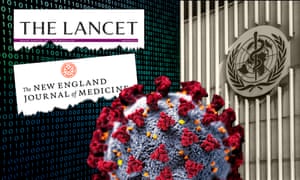
 A tiny US company, Surgisphere, is behind flawed data which led to governments and the world health organisation changing health policyA tiny US company, Surgisphere, is behind flawed data which led to governments and the world health organisation changing health policy Photograph: Anthony Brown/Alamy Stock Photo
 in Sydney and  in Washington

The World Health Organization and a number of national governments have changed their Covid-19 policies and treatments on the basis of flawed data from a little-known US healthcare analytics company, also calling into question the integrity of key studies published in some of the world’s most prestigious medical journals.
A Guardian investigation can reveal the US-based company Surgisphere, whose handful of employees appear to include a science fiction writer and an adult-content model, has provided data for multiple studies on Covid-19 co-authored by its chief executive, but has so far failed to adequately explain its data or methodology.
Data it claims to have legitimately obtained from more than a thousand hospitals worldwide formed the basis of scientific articles that have led to changes in Covid-19 treatment policies in Latin American countries. It was also behind a decision by the WHO and research institutes around the world to halt trials of the controversial drug hydroxychloroquine.
Two of the world’s leading medical journals – the Lancet and the New England Journal of Medicine – published studies based on Surgisphere data. The studies were co-authored by the firm’s chief executive, Sapan Desai.
Late on Tuesday, after being approached by the Guardian, the Lancet released an “expression of concern” about its published study. The New England Journal of Medicine has also issued a similar notice.
An independent audit of the provenance and validity of the data has now been commissioned by the authors not affiliated with Surgisphere because of “concerns that have been raised about the reliability of the database”.
The Guardian’s investigation has found:
  • 1. A search of publicly available material suggests several of Surgisphere’s employees have little or no data or scientific background. An employee listed as a science editor appears to be a science fiction author and fantasy artist. Another employee listed as a marketing executive is an adult model and events hostess.
  • 2. The company’s LinkedIn page has fewer than 100 followers and last week listed just six employees. This was changed to three employees as of Wednesday.
  • 3. While Surgisphere claims to run one of the largest and fastest growing hospital databases in the world, it has almost no online presence. Its Twitter handle has fewer than 170 followers, with no posts between October 2017 and March 2020.
  • 4. Until Monday, the get in touch” link on Surgisphere’s homepage redirected to a WordPress template for a cryptocurrency website, raising questions about how hospitals could easily contact the company to join its database.
  • 5. Desai has been named in three medical malpractice suits, unrelated to the Surgisphere database. In an interview with the Scientist, Desai previously described the allegations as “unfounded”.
  • 6. In 2008, Desai launched a crowdfunding campaign on the website indiegogo promoting a wearable “next generation human augmentation device that can help you achieve what you never thought was possible”. The device never came to fruition.
  • 7. Desai’s Wikipedia page has been deleted following questions about Surgisphere and his history.
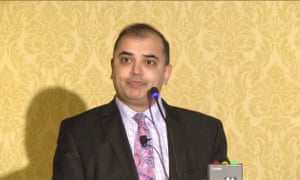

Sapan Desai Sapan Desai, the chief executive of Surgisphere. Photograph: Gore Medical

over Lancet study


Questions surrounding Surgisphere have been growing in the medical community for the past few weeks.
On 22 May the Lancet published a blockbuster peer-reviewed study which found the antimalarial drug hydroxychloroquine, which has been promoted by Donald Trump, was associated with a higher mortality rate in Covid-19 patients and increased heart problems.
Trump, much to the dismay of the scientific community, had publicly touted hydroxychloroquine as a “wonder drug” despite no evidence of its efficacy for treating Covid-19.
The Lancet study, which listed Desai as one of the co-authors, claimed to have analysed Surgisphere data collected from nearly 15,000 patients with Covid-19, admitted to 1,200 hospitals around the world, who received hydroxychloroquine alone or in combination with antibiotics.
The negative findings made global news and prompted the WHO to halt the hydroxychloroquine arm of its global trials.


But only days later Guardian Australia revealed glaring errors in the Australian data included in the study. The study said researchers gained access to data through Surgisphere from five hospitals, recording 600 Australian Covid-19 patients and 73 Australian deaths as of 21 April.
But data from Johns Hopkins University shows only 67 deaths from Covid-19 had been recorded in Australia by 21 April. The number did not rise to 73 until 23 April. Desai said one Asian hospital had accidentally been included in the Australian data, leading to an overestimate of cases there. The Lancet published a small retraction related to the Australian findings after the Guardian’s story, its only amendment to the study so far.
The Guardian has since contacted five hospitals in Melbourne and two in Sydney, whose cooperation would have been essential for the Australian patient numbers in the database to be reached. All denied any role in such a database, and said they had never heard of Surgisphere. Desai did not respond to requests to comment on their statements.
Another study using the Surgisphere database, again co-authored by Desai, found the anti-parasite drug ivermectin reduced death rates in severely ill Covid-19 patients. It was published online in the Social Science Research Network e-library, before peer-review or publication in a medical journal, and prompted the Peruvian government to add ivermectin to its national Covid-19 therapeutic guidelines.


Richard Horton
Pinterest
 Richard Horton, the editor of the Lancet. Photograph: Richard Saker/The Observer

The New England Journal of Medicine also published a peer-reviewed Desai study based on Surgisphere data, which included data from Covid-19 patients from 169 hospitals in 11 countries in Asia, Europe and North America. It found common heart medications known as angiotensin-converting–enzyme inhibitors and angiotensin-receptor blockers were not associated with a higher risk of harm in Covid-19 patients.
On Wednesday, the NEJM and the Lancet published an expression of concern about the hydroxychloroquine study, which listed respected vascular surgeon Mandeep Mehra as the lead author and Desai as co-author.
Lancet editor Richard Horton told the Guardian: “Given the questions raised about the reliability of the data gathered by Surgisphere, we have today issued an Expression of Concern, pending further investigation.
“An independent data audit is currently underway and we trust that this review, which should be completed within the next week, will tell us more about the status of the findings reported in the paper by Mandeep Mehra and colleagues.”

Surgisphere ‘came out of nowhere’

One of the questions that has most baffled the scientific community is how Surgisphere, established by Desai in 2008 as a medical education company that published textbooks, became the owner of a powerful international database. That database, despite only being announced by Surgisphere recently, boasts access to data from 96,000 patients in 1,200 hospitals around the world.


When contacted by the Guardian, Desai said his company employed just 11 people. The employees listed on LinkedIn were recorded on the site as having joined Surgisphere only two months ago. Several did not appear to have a scientific or statistical background, but mention expertise in strategy, copywriting, leadership and acquisition.
Dr James Todaro, who runs MedicineUncensored, a website that publishes the results of hydroxychloroquine studies, said: “Surgisphere came out of nowhere to conduct perhaps the most influential global study in this pandemic in the matter of a few weeks.
“It doesn’t make sense,” he said. “It would require many more researchers than it claims to have for this expedient and [size] of multinational study to be possible.”
Desai told the Guardian: “Surgisphere has been in business since 2008. Our healthcare data analytics services started about the same time and have continued to grow since that time. We use a great deal of artificial intelligence and machine learning to automate this process as much as possible, which is the only way a task like this is even possible.”
It is not clear from the methodology in the studies that used Surgisphere data, or from the Surgisphere website itself, how the company was able to put in place data-sharing agreements from so many hospitals worldwide, including those with limited technology, and to reconcile different languages and coding systems, all while staying within the regulatory, data-protection and ethical rules of each country.
Desai said Surgisphere and its QuartzClinical content management system was part of a research collaboration initiated “several years ago”, though he did not specify when.
“Surgisphere serves as a data aggregator and performs data analysis on this data,” he said. “We are not responsible for the source data, thus the labor intensive task required for exporting the data from an Electronic Health Records, converting it into the format required by our data dictionary, and fully deidentifying the data is done by the healthcare partner.”
This appears to contradict the claim on the QuartzClinical website that it does all the work, and “successfully integrates your electronic health record, financial system, supply chain, and quality programs into one platform”. Desai did not explain this apparent contradiction when the Guardian put it to him.
Desai said the way Surgisphere obtained data was “always done in compliance with local laws and regulations. We never receive any protected health information or individually identifiable information.”
Peter Ellis, the chief data scientist of Nous Group, an international management consultancy that does data integration projects for government departments, expressed concern that Surgisphere database was “almost certainly a scam”.
“It is not something that any hospital could realistically do,” he said. “De-identifying is not just a matter of knocking off the patients’ names, it is a big and difficult process. I doubt hospitals even have capability to do it appropriately. It is the sort of thing national statistics agencies have whole teams working on, for years.”
“There’s no evidence online of [Surgisphere] having any analytical software earlier than a year ago. It takes months to get people to even look into joining these databases, it involves network review boards, security people, and management. It just doesn’t happen with a sign-up form and a conversation.”


None of the information from Desai’s database has yet been made public, including the names of any of the hospitals, despite the Lancet being among the many signatories to a statement on data-sharing for Covid-19 studies. The Lancet study is now disputed by 120 doctors.
When the Guardian put a detailed list of concerns to Desai about the database, the study findings and his background, he responded: “There continues to be a fundamental misunderstanding about what our system is and how it works”.
“There are also a number of inaccuracies and unrelated connections that you are trying to make with a clear bias toward attempting to discredit who we are and what we do,” he said. “We do not agree with your premise or the nature of what you have put together, and I am sad to see that what should have been a scientific discussion has been denigrated into this sort of discussion.”

‘The peak of human evolution’

An examination of Desai’s background found that the vascular surgeon has been named in three medical malpractice suits in the US, two of them filed in November 2019. In one case, a lawsuit filed by a patient, Joseph Vitagliano, accused Desai and Northwest Community Hospital in Illinois, where he worked until recently, of being “careless and negligent”, leading to permanent damage following surgery. 
Northwest Community Hospital confirmed that Desai had been employed there since June 2016 but had voluntarily resigned on 10 February 2020 “for personal reasons”.
“Dr Desai’s clinical privileges with NCH were not suspended, revoked or otherwise limited by NCH,” a spokeswoman said. The hospital declined to comment on the malpractice suits. Desai said in the interview with the Scientist that he deemed any lawsuit against him to be “unfounded”.
Brigham and Women’s Hospital, the institution affiliated with the hydroxychloroquine study and its lead author, Mandeep Mehra, said in a statement: “Independent of Surgisphere, the remaining co-authors of the recent studies published in The Lancet and the New England Journal of Medicine have initiated independent reviews of the data used in both papers after learning of the concerns that have been raised about the reliability of the database”. 
Mehra said he had routinely underscored the importance and value of randomised, clinical trials and that such trials were necessary before any conclusions could be reached. “I eagerly await word from the independent audits, the results of which will inform any further action,” he said.
Desai’s now-deleted Wikipedia page said he held a doctorate in law and a PhD in anatomy and cell biology, as well as his medical qualifications. A biography of Desai on a brochure for an international medical conference says he has held multiple physician leadership roles in clinical practice, and that he is “a certified lean six sigma master black belt”.
It is not the first time Desai has launched projects with ambitious claims. In 2008, he launched a crowdfunding campaign on the website indiegogo promoting a “next generation human augmentation device” called Neurodynamics Flow, which he said “can help you achieve what you never thought was possible”.
“With its sophisticated programming, optimal neural induction points, and tried and true results, Neurodynamics Flow allows you to rise to the peak of human evolution,” the description said. The device raised a few hundred dollars, and never eventuated.
Ellis, the chief data scientist of Nous Group, said it was unclear why Desai made such bold claims about his products given how likely it was that the global research community would scrutinise them.
“My first reaction is it was to draw attention to his firm, Ellis said. “But it seems really obvious that this would backfire.”
Today Prof Peter Horby, Professor of Emerging Infectious Diseases and Global Health in the Nuffield Department of Medicine, University of Oxford, said: “I welcome the statement from the Lancet, which follows a similar statement by the NEJM regarding a study by the same group on cardiovascular drugs and COVID-19. 
“The very serious concerns being raised about the validity of the papers by Mehra et al need to be recognised and actioned urgently, and ought to bring about serious reflection on whether the quality of editorial and peer review during the pandemic has been adequate. Scientific publication must above all be rigorous and honest. In an emergency, these values are needed more than ever.”
https://www.theguardian.com/world/2020/jun/03/covid-19-surgisphere-who-world-health-organization-hydroxychloroquine
---------------------------------------------

My Comments :

1. The supposedly valid CV of the - potentially - apparently highly fraudulent medical scientist Sapan Desai :

https://provider.kareo.com/sapan-desai

2.  If the findings of the Guardian et al. will appear to be true, the bigger part of the scandal undoubtely will be reserved for procedures applied to by the Lancet,  the New Enland Journal of Medicin (on the cardiovascular madicine against Covid-19) and possible other well-respected medical publications.

3. In relation to the very subject - of people erroneously referring for years to Lancet peer-reviewed studies, and developing a desastrous attitude to vaccination as a whole, as a consequence - I might remind the public of the fraudulent Wakeman study on the (totally wrongfully) assumed relation between MMR vaccines and autism, that had been retracted only after 12 years of grave controversy about its validity.

4. When academic quality papers like the Lancet could be accused of a breach of scientific integrity - if only by a small number of cases already - it might have grave and even fatal repercussions on a large scale, for example, because of the stimulus it might contribute to quackery.   

dinsdag 2 juni 2020

Erik Prince Recruits Ex-Spies to Help Infiltrate Liberal Groups


Erik Prince Recruits Ex-Spies to Help Infiltrate Liberal Groups

Mr. Prince, a contractor close to the Trump administration, contacted veteran spies for operations by Project Veritas, the conservative group known for conducting stings on news organizations and other groups.

Erik Prince, the former head of Blackwater Worldwide and the brother of Education Secretary Betsy DeVos, has at times served as an informal adviser to Trump administration officials.  Credit...Jeenah Moon/Reuters


By Mark Mazzetti and Adam Goldman
Published March 7, 2020

Updated March 9, 2020
WASHINGTON — Erik Prince, the security contractor with close ties to the Trump administration, has in recent years helped recruit former American and British spies for secretive intelligence-gathering operations that included infiltrating Democratic congressional campaigns, labor organizations and other groups considered hostile to the Trump agenda, according to interviews and documents.

One of the former spies, an ex-MI6 officer named Richard Seddon, helped run a 2017 operation to copy files and record conversations in a Michigan office of the American Federation of Teachers, one of the largest teachers’ unions in the nation. Mr. Seddon directed an undercover operative to secretly tape the union’s local leaders and try to gather information that could be made public to damage the organization, documents show.

Using a different alias the next year, the same undercover operative infiltrated the congressional campaign of Abigail Spanberger, then a former C.I.A. officer who went on to win an important House seat in Virginia as a Democrat. The campaign discovered the operative and fired her.

Both operations were run by Project Veritas, a conservative group that has gained attention using hidden cameras and microphones for sting operations on news organizations, Democratic politicians and liberal advocacy groups. Mr. Seddon’s role in the teachers’ union operation — detailed in internal Project Veritas emails that have emerged from the discovery process of a court battle between the group and the union — has not previously been reported, nor has Mr. Prince’s role in recruiting Mr. Seddon for the group’s activities.

Both Project Veritas and Mr. Prince have ties to President Trump’s aides and family. Whether any Trump administration officials or advisers to the president were involved in the operations, even tacitly, is unclear. But the effort is a glimpse of a vigorous private campaign to try to undermine political groups or individuals perceived to be in opposition to Mr. Trump’s agenda.

Mr. Prince, the former head of Blackwater Worldwide and the brother of Education Secretary Betsy DeVos, has at times served as an informal adviser to Trump administration officials. He worked with the former national security adviser Michael T. Flynn during the presidential transition. In 2017, he met with White House and Pentagon officials to pitch a plan to privatize the Afghan war using contractors in lieu of American troops. Jim Mattis, then the defense secretary, rejected the idea.

Mr. Prince appears to have become interested in using former spies to train Project Veritas operatives in espionage tactics sometime during the 2016 presidential campaign. Reaching out to several intelligence veterans — and occasionally using Mr. Seddon to make the pitch — Mr. Prince said he wanted the Project Veritas employees to learn skills like how to recruit sources and how to conduct clandestine recordings, among other surveillance techniques.

James O’Keefe, the head of Project Veritas, declined to answer detailed questions about Mr. Prince, Mr. Seddon and other topics, but he called his group a “proud independent news organization” that is involved in dozens of investigations. He said that numerous sources were coming to the group “providing confidential documents, insights into internal processes and wearing hidden cameras to expose corruption and misconduct.”

“No one tells Project Veritas who or what to investigate,” he said.

James O’Keefe, the head of Project Veritas, last year at a White House social media summit. Credit...Carlos Barria/Reuters
A spokesman for Mr. Prince declined to comment. Emails sent to Mr. Seddon went unanswered.

Mr. Prince is under investigation by the Justice Department over whether he lied to a congressional committee examining Russian interference in the 2016 election, and for possible violations of American export laws. Last year, the House Intelligence Committee made a criminal referral to the Justice Department about Mr. Prince, saying he lied about the circumstances of his meeting with a Russian banker in the Seychelles in January 2017.

Once a small operation running on a shoestring budget, Project Veritas in recent years has had a surge in donations from both private donors and conservative foundations. According to its latest publicly available tax filing, Project Veritas received $8.6 million in contributions and grants in 2018. Mr. O’Keefe earned about $387,000.

Last year, the group received a $1 million contribution made through the law firm Alston & Bird, a financial document obtained by The New York Times showed. A spokesman for the firm said that Alston & Bird “has never contributed to Project Veritas on its own behalf, nor is it a client of ours.” The spokesman declined to say on whose behalf the contribution was made.

The financial document also listed the names of others who gave much smaller amounts to Project Veritas last year. Several of them confirmed their donations.

The group has also become intertwined with the political activities of Mr. Trump and his family. The Trump Foundation gave $20,000 to Project Veritas in 2015, the year that Mr. Trump began his bid for the presidency. The next year, during a presidential debate with Hillary Clinton, Mr. Trump claimed without substantiation that videos released by Mr. O’Keefe showed that Mrs. Clinton and President Barack Obama had paid people to incite violence at rallies for Mr. Trump.

In a book published in 2018, Mr. O’Keefe wrote that Mr. Trump years earlier had encouraged him to infiltrate Columbia University and obtain Mr. Obama’s records.

Last month, Project Veritas made public secretly recorded video of a longtime ABC News correspondent who was critical of the network’s political coverage and its emphasis on business considerations over journalism. Many conservatives have gleefully pounced on Project Veritas’s disclosures, including one particularly influential voice: Donald Trump Jr., the president’s eldest son.

The website for Mr. O’Keefe’s coming wedding listed Donald Trump Jr. as an invited guest.

Mr. Prince invited Project Veritas operatives — including Mr. O’Keefe — to his family’s Wyoming ranch for training in 2017, The Intercept reported last year. Mr. O’Keefe and others shared social media photos of taking target practice with guns at the ranch, including one post from Mr. O’Keefe saying that with the training, Project Veritas will be “the next great intelligence agency.” Mr. Prince had hired a former MI6 officer to help train the Project Veritas operatives, The Intercept wrote, but it did not identify the officer.

Mr. Seddon regularly updated Mr. O’Keefe about the operation against the Michigan teachers’ union, according to internal Project Veritas emails, where the language of the group’s leaders is marbled with spy jargon.

They used a code name — LibertyU — for their operative inside the organization, Marisa Jorge, who graduated from Liberty University in Virginia, one of the nation’s largest Christian colleges. Mr. Seddon wrote that Ms. Jorge “copied a great many documents from the file room,” and Mr. O’Keefe bragged that the group would be able to get “a ton more access agents inside the educational establishment.”

The emails refer to other operations, including weekly case updates, along with training activities that involved “operational targeting.” Project Veritas redacted specifics about those operations from the messages.

In August 2017, Ms. Jorge wrote to Mr. Seddon that she had managed to record a local union leader talking about Ms. DeVos and other topics.

“Good stuff,” Mr. Seddon wrote back. “Did you receive the spare camera yet?”

As education secretary, Ms. DeVos has been a vocal critic of teachers’ unions, saying in 2018 that they have a “stranglehold” over politicians at the federal and state levels. She and Mr. Prince grew up in Michigan, where their father made a fortune in the auto parts business.

AFT Michigan sued Project Veritas in federal court, alleging trespassing, eavesdropping and other offenses. The teachers’ union is asking for more than $3 million in damages, accusing the group of being a “vigilante organization which claims to be dedicated to exposing corruption. It is, instead, an entity dedicated to a specific political agenda.”

Project Veritas has said its activities are legal and protected by the First Amendment, and the case is scheduled to go to trial in the fall.

Other Project Veritas employees on the emails include Joe Halderman, an award-winning former television producer who in 2010 pleaded guilty to trying to extort $2 million from the comedian David Letterman. Mr. Halderman was copied on several messages providing updates about the Michigan operation, and in one message, he gave instructions to Ms. Jorge. Project Veritas tax filings list Mr. Halderman as a “project manager.”

Two other employees, Gaz Thomas and Samuel Chamberlain, were also identified in emails and appeared to play important roles in the Michigan operation. Efforts to locate Mr. Thomas were unsuccessful. A man named Samuel Chamberlain who matched the description of the one employed by Mr. O’Keefe denied he worked for Project Veritas. He did not respond to follow-up phone messages or an email.

Last year, Project Veritas submitted a proposed list of witnesses for the trial over the lawsuit. Mr. Chamberlain and Mr. Thomas were on the list. Mr. Seddon was not.

Ms. Jorge, 25, did not respond to email addresses associated with her Liberty University account. In an archived version of her LinkedIn page, Ms. Jorge wrote she had a deep interest in the conservative movement and hoped one day to serve on the Supreme Court after attending law school.

In a YouTube video, Mr. O’Keefe described the lawsuit as “frivolous” and pointed to a portion of the deposition in which David Hecker, the president of AFT Michigan, said that one of the goals of the lawsuit was to “stop Project Veritas from doing the kind of work that it does.”

Randi Weingarten, the president of the American Federation of Teachers, said in a statement: “Let’s be clear who the wrongdoer is here: Project Veritas used a fake intern to lie her way into our Michigan office, to steal documents and to spy — and they got caught. We’re just trying to hold them accountable for this industrial espionage.”

In 2018, an operative working for Project Veritas infiltrated the campaign of Abigail Spanberger, who went on to win a congressional seat. Credit...Anna Moneymaker/The New York Times

In 2018, Ms. Jorge infiltrated the congressional campaign of Ms. Spanberger, posing as a campaign volunteer. At the time, Ms. Spanberger was running to unseat a sitting Republican congressman in a race both parties considered important for control of the House. Ms. Jorge was eventually exposed and kicked out of the campaign office.

It was unclear whether Mr. Seddon was involved in planning that operation.

Mr. Seddon was a longtime British intelligence officer who served around the world, including in Washington in the years after the attacks of Sept. 11, 2001. He is married to an American diplomat, Alice Seddon, who is serving in the American consulate in Lagos, Nigeria.

Mr. O’Keefe and his group have taken aim at targets over the years including Planned Parenthood, The New York Times, The Washington Post and Democracy Partners, a group that consults with liberal and progressive electoral causes. In 2016, a Project Veritas operative infiltrated Democracy Partners using a fake name and fabricated résumé and made secret recordings of the staff. The year after the sting, Democracy Partners sued Project Veritas, and its lawyers have since deposed Mr. O’Keefe.

In that deposition, Mr. O’Keefe defended the group’s undercover tactics, saying they were part of a long tradition of investigative journalism going back to muckraking reporters like Upton Sinclair. “I’m not ashamed of the methods that we use or the recordings that we use,” he said.

He was asked whether he had provided any of the group’s secret recordings of Democracy Partners to the Republican National Committee or any member of the Trump family. He said that he did not think so.

In 2010, Mr. O’ Keefe and three others pleaded guilty to a federal misdemeanor after admitting they entered a government building in New Orleans under false pretenses as part of a sting.

Kitty Bennett contributed research.
Correction: March 9, 2020

An earlier version of this article misstated the age of Marisa Jorge, a Project Veritas operative. She is 25, not 23.

Mark Mazzetti is a Washington investigative correspondent, a job he assumed after covering national security from the Washington bureau for 10 years. He was part of a team that won a Pulitzer Prize in 2018 for reporting on Donald Trump’s advisers and their connections to Russia. @MarkMazzettiNYT

Adam Goldman reports on the F.B.I. from Washington and is a two-time Pulitzer Prize winner. @adamgoldmanNYT
A version of this article appears in print on Marc


https://www.nytimes.com/2020/03/07/us/politics/erik-prince-project-veritas.html

zondag 31 mei 2020

Covid-19 expert Karl Friston: 'Germany may have more immunological “dark matter”


Covid-19 expert Karl Friston: 'Germany may have more immunological “dark matter”


Laura Spinney


Sun 31 May 2020

Karl Friston Karl Friston: ‘There is a predictive validity to our models that the conventional ones lack.’ Photograph: Kate Peters

The neuroscientist who advises Independent Sage on Covid-19 discusses the predictive power of his mathematical modelling and the risk of a second wave


N
euroscientist Karl Friston, of University College London, builds mathematical models of human brain function. Lately, he’s been applying his modelling to Covid-19, and using what he learns to advise Independent Sage, the committee set up as an alternative to the UK government’s official pandemic advice body, the Scientific Advisory Group for Emergencies (Sage).

How do the models you use differ from the conventional ones epidemiologists rely on to advise governments in this pandemic?
Conventional models essentially fit curves to historical data and then extrapolate those curves into the future. They look at the surface of the phenomenon – the observable part, or data. Our approach, which borrows from physics and in particular the work of Richard Feynman, goes under the bonnet. It attempts to capture the mathematical structure of the phenomenon – in this case, the pandemic – and to understand the causes of what is observed. Since we don’t know all the causes, we have to infer them. But that inference, and implicit uncertainty, is built into the models. That’s why we call them generative models, because they contain everything you need to know to generate the data. As more data comes in, you adjust your beliefs about the causes, until your model simulates the data as accurately and as simply as possible.


Can you give an example of what you mean by uncertainty, with respect to Covid-19, and how you build it into your models?
A common type of epidemiological model used today is the SEIR model, which considers that people must be in one of four states – susceptible (S), exposed (E), infected (I) or recovered (R). Unfortunately, reality doesn’t break them down so neatly. For example, what does it mean to be recovered? We know that with Covid-19 you can be infected but asymptomatic, so does it mean recovered from the symptoms or recovered from the infection? And that question hides a host of others, including questions relating to national testing strategies. SEIR models start to fall apart when you think about the underlying causes of the data. You need models that can allow for all possible states, and assess which ones matter for shaping the pandemic’s trajectory over time.

This is the first time the generative approach has been applied to a pandemic. Has it proved itself in other domains?
These techniques have enjoyed enormous success ever since they moved out of physics. They’ve been running your iPhone and nuclear power stations for a long time. In my field, neurobiology, we call the approach dynamic causal modelling (DCM). We can’t see brain states directly, but we can infer them given brain imaging data. In fact, we have pushed that idea even further. We think the brain may be doing its own dynamic causal modelling, reducing its uncertainty about the causes of the data the senses feed to it. We call this the free energy principle. But whether you’re talking about a pandemic or a brain, the essential problem is the same – you’re trying to understand a complex system that changes over time. In that sense, I’m not doing anything new. The data is generated by Covid-19 patients rather than neurons, but otherwise it’s just another day at the office.

You say generative models are also more efficient than conventional ones. What do you mean?
Epidemiologists currently tackle the inference problem by number-crunching on a huge scale, making use of high-performance computers. Imagine you want to simulate an outbreak in Scotland. Using conventional approaches, this would take you a day or longer with today’s computing resources. And that’s just to simulate one model or hypothesis – one set of parameters and one set of starting conditions. Using DCM, you can do the same thing in a minute. That allows you to score different hypotheses quickly and easily, and so to home in sooner on the best one.

Any other advantages?
Yes. With conventional SEIR models, interventions and surveillance are something you add to the model – tweaks or perturbations – so that you can see their effect on morbidity and mortality. But with a generative model these things are built into the model itself, along with everything else that matters. Our response as individuals – and as a society – becomes part of the epidemiological process, part of one big self-organising, self-monitoring system. That means it is possible to predict not only numbers of cases and deaths in the future, but also societal and institutional responses – and to attach precise dates to those predictions.

How well have your predictions been borne out in this first wave of infections?
For London, we predicted that hospital admissions would peak on 5 April, deaths would peak five days later, and critical care unit occupancy would not exceed capacity – meaning the Nightingale hospitals would not be required. We also predicted that improvements would be seen in the capital by 8 May that might allow social distancing measures to be relaxed – which they were in the prime minister’s announcement on 10 May. To date our predictions have been accurate to within a day or two, so there is a predictive validity to our models that the conventional ones lack.

What is your role with Independent Sage?
I’m a member with special responsibility for modelling. When they first approached me I didn’t see the “Independent”… I’m joking, but only partly. I think of Independent Sage as the ultimate exercise in public engagement; what it would look like if you and I and everyone else were able to sit in on a real Sage meeting. I’ve heard defensive politicians say its very existence impugns the real Sage, but as a scientist I can’t subscribe to that. In my view there can never be anything wrong with transparent, informed discussion. The committee’s other, equally important, role is to present the UK government with alternative hypotheses – to give it more room for manoeuvre.

What do your models say about the risk of a second wave?
The models support the idea that what happens in the next few weeks is not going to have a great impact in terms of triggering a rebound – because the population is protected to some extent by immunity acquired during the first wave. The real worry is that a second wave could erupt some months down the line when that immunity wears off. We can test a range of hypotheses, based on a very short duration of immunity – as with a common cold – right through to immunity that lasts for decades. For each duration we can calculate the probability that a second wave will emerge, and when. It’s early days for this work, and I look forward with genuine excitement to new data on immunity becoming available, now that reliable antibody tests exist. But the important message is that we have a window of opportunity now, to get test-and-trace protocols in place ahead of that putative second wave. If these are implemented coherently, we could potentially defer that wave beyond a time horizon where treatments or a vaccine become available, in a way that we weren’t able to before the first one.

Once the pandemic is over, will you be able to use your models to ask which country’s response was best?
That is already happening, as part of our attempts to understand the latent causes of the data. We’ve been comparing the UK and Germany to try to explain the comparatively low fatality rates in Germany. The answers are sometimes counterintuitive. For example, it looks as if the low German fatality rate is not due to their superior testing capacity, but rather to the fact that the average German is less likely to get infected and die than the average Brit. Why? There are various possible explanations, but one that looks increasingly likely is that Germany has more immunological “dark matter” – people who are impervious to infection, perhaps because they are geographically isolated or have some kind of natural resistance. This is like dark matter in the universe: we can’t see it, but we know it must be there to account for what we can see. Knowing it exists is useful for our preparations for any second wave, because it suggests that targeted testing of those at high risk of exposure to Covid-19 might be a better approach than non-selective testing of the whole population.

Are generative models the future of disease modelling?
That’s a question for the epidemiologists – they’re the experts. But I would be very surprised if at least some part of the epidemiological community didn’t become more committed to this approach in future, given the impact that Feynman’s ideas have had in so many other disciplines.

Finally, a Wired interview says you like to smoke, don’t speak to anyone before midday, do not own a mobile phone and deplore one-on-one meetings. Has any of that changed during lockdown?
I’m afraid not. It’s true that this could be considered a one-on-one meeting, but my default mode is sharing ideas in a group – Independent Sage-style – and normal service will resume shortly. Just before I spoke to you I declined an invitation to speak on morning radio, and now I’m off for a cigarette.