maandag 8 april 2019

Populists are whipping up a storm as Europe faces lurch to the right



Populists are whipping up a storm as Europe faces lurch to the right


Nationalist groups across the continent are stoking anti-immigrant and Islamophobic sentiment to win seats in next month’s EU elections
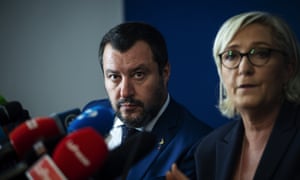


The far-right stuff … Matteo Salvini of Italy’s League and Marine Le Pen of France’s National Rally.  The far-right stuff … Matteo Salvini of Italy’s League and Marine Le Pen of France’s National Rally. Photograph: Antonio Masiello/Getty


T
he battle for Europe is coming to a head – but, surprise, surprise, the main focus is not Brexit. Across the continent, far-right populist and nationalist parties are mobilising ahead of next month’s EU parliamentary elections. Polls show their support growing. For Europe’s newly energised hard right, Brexit is both a spur and a sideshow.

Whipping up anti-immigrant, Islamophobic and anti-semitic sentiment, and exploiting public anger over austerity and the perceived arrogance of the Brussels political class, the populists aim to reassert the pre-eminence of national identity, narrowly defined, and halt the European project in its integrationist tracks.
It is, as yet, a rag-tag army with myriad rivalrous leaders and policy differences. Some prominent figures, such as Matteo Salvini, leader of Italy’s far-right League, occupy senior government positions. Others, such as Thierry Baudet, who leads the insurgent Dutch populist Forum for Democracy and likes to quote Cicero (in dog Latin), are eccentrics whingeing on the fringe. But Europe’s multi-party mainstream coalitions, which currently dominate the EU parliament, and the grand panjandrums of the EU Commission, where top jobs depend on the election outcome, have been put on notice. The days of comfortable centrist majorities are coming to an end. The far-right is knocking at the door.

The parliament’s own polling confirms this trend. The biggest groupings, the centre-right European People’s party and the centre-left Socialists & Democrats, are each expected to lose dozens of seats, the latest survey suggests. If Britain does not participate, about 150 MEPs out of a total of 705 will represent Eurosceptic parties.
The Europe of Nations and Freedom bloc, which includes Salvini’s League and Marie Le Pen’s French National Rally (formerly the National Front), could swell to more than 60 MEPs. Separate polling by the Politico website predicts that mainstream parties, including the Liberal group allied to French president Emmanuel Macron’s En Marche, may fare even worse.
Far-right populists are not about to take control of the EU. But their enhanced sway will intensify tensions over EU integration, increase disruption and deadlock, and complicate the process of appointing a new commission. As Salvini and his supporters tell it, the evolving realignments could end Franco-German “hegemony” over the EU.
Across the continent, signs of approaching upheaval are unmistakable. An early augury may come this month in Spain’s general election, where Vox is set to become the first far-right party to win seats in parliamentary since the close of the Franco era.
Social media form part of the electoral battlefield. According to research by Alto Analytics, online supporters of far-right populist and nationalist parties are disproportionately deluging platforms such as Facebook and Twitter with anti-immigration, Eurosceptic posts.
Attempts to organise Europe’s far-right into a united, cohesive force are continuing apace, though with mixed success. Following previous meetings with like-minded politicians in Austria, Hungary and Poland, Salvini plans to host a rally involving up to 20 countries in Milan next month. On Monday he will hold talks with German, Finnish and Danish right-wingers. He wants a joint electoral platform akin to the League’s manifesto, which pledges to “underline and reaffirm common Christian roots, defend national identity and the supremacy of [national laws] over European laws and directives”. The manifesto also trumpets opposition to immigration, austerity and integration.
It’s unclear at this point whether leading lights on Europe’s populist right such as Le Pen, Hungary’s prime minister, Viktor Orbán, and Poland’s ruling party leader, Jarosław Kaczyński, will attend next month. This uncertainty reflects personal jealousies and policy differences, for example over engagement with Russia (which the Poles oppose and Salvini and Le Pen favour).
It’s plain that, like Europe’s mainstream parties, the populist-nationalist camp will struggle to unite around a shared vision. Speaking last week, the chief election candidate for Germany’s anti-Islam, anti-immigrant Alternative for Germany, Jörg Meuthen, said personality clashes would probably prevent the creation of a pan-European “patriotic alliance”. But he predicted big gains for the hard right and urged parties to work together.
That’s a lesson the pro-European mainstream also needs to heed. It, too, has an opportunity if it can be grasped. A Eurobarometer survey, published last year, found the highest level of support for the EU in 35 years, with two-thirds of Europeans believing their country had benefited from membership. Last month’s million-strong Remain march in London was “the greatest public outpouring of pro-EU sentiment that Europe has witnessed in years”, wrote analyst Mark Leonard. Yet at the same time, there appears little doubt eurosceptic forces have electoral momentum behind them.
Among Europe’s leaders, only Macron is actively making the case across national borders for a more deeply integrated, tolerant and reformed EU. He recently appealed directly to Europe’s citizens to reject the “anger-mongers” of the right and embrace “renewal”. Salvini and Orban, promoting a sinister-sounding new “European spring”, view Macron as opponent-in-chief.
If the far-right surge is to be repelled, Macron needs help. But strong leadership is lacking. Angela Merkel, Germany’s chancellor and a natural ally, is on her way out. Other pro-EU governments and parties are struggling with multiple policy splits of their own. An ugly brawl is in prospect over who will replace Jean-Claude Juncker as commission president.
And then there is Brexit, distracting attention from the main battlefront at a vital juncture. As Europe prepares for an imminent showdown with the forces of reaction, Britain’s dishonourable retreat from the fray might never be forgiven.

UK poised to embrace authoritarianism, warns Hansard Society


UK poised to embrace authoritarianism, warns Hansard Society

Public attitudes emerge that ‘challenge core tenets of our democracy’, says report


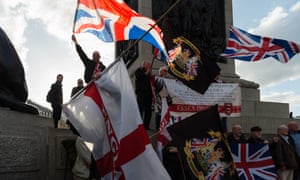
Far-right activists in London Far-right activists in London. ‘When people do not trust traditional political systems, they look elsewhere. That’s when support for political extremes grows,’ said a Hope Not Hate spokeswoman. Photograph: Wiktor Szymanowicz/Barcroft


 Political correspondent

Mon 8 Apr 2019 

The UK public is increasingly disenchanted with MPs and government and ever more willing to welcome the idea of authoritarian leaders who would ignore parliament, a long-running survey of attitudes to politics has shown.
Amid the Brexit chaos, overall public faith in the political system has reached a nadir not previously seen in the 16-year history of the Hansard Society’s audit of political engagement, lower even than at the depths of the crisis over MPs’ expenses.
Almost three-quarters of those asked said the system of governance needed significant improvement, and other attitudes emerged that “challenge core tenets of our democracy”, the audit’s authors stated.
The study, compiled annually by the democracy charity, found that when people were asked whether “Britain needs a strong ruler willing to break the rules”, 54% agreed and only 23% said no.
In all, 42% of respondents agreed with the idea that many national problems could be dealt with more effectively “if the government didn’t have to worry so much about votes in parliament”.
Ruth Fox, the director of the Hansard Society, said scepticism about politics, a feeling that the system was rigged and a willingness to consider radical solutions was a potentially dangerous combination.
She said: “Preferring a strong leader who is willing to break the rules, or thinking that the government should be able to tackle the country’s problems without worrying about the approval of parliament, would challenge core tenets of our democracy.
“The public feel strongly that the system of governing favours the rich and powerful and that political parties don’t care about the average person. And people are not confident that politicians act in the public interest. Unless something changes, this is a potentially toxic recipe for the future of British 
Hope Not Hate, which monitors extreme groups, said the suspicion of politicians, if coupled with a post-Brexit economic downturn, would be “fertile ground for a far-right populist surge”.
Rosie Carter, a senior policy officer with the group, said: “We are facing a crisis of political mistrust. And when people do not trust traditional political systems, they look elsewhere. That’s when support for political extremes grows.”
The report was based on face-to-face interviews with a representative sample of more than 1,000 people, who were asked a mix of new questions and those asked each year. The proportion who said the system of governing needed “quite a lot” or “a great deal” of improvement rose by five points from 2018, to 77%, the highest level recorded.
The survey found that 25% of the public had confidence in MPs’ handling of Brexit, and overall they were more likely to have faith in the military, judges, civil servants, TV broadcasters, councils, unions and banks to “act in the public interest”.
Fifty-six per cent of respondents said they believed Britain was in decline, while 63% agreed that “Britain’s system of government is rigged to the advantage of the rich and powerful”.

The overall picture was one of people engaged in politics but with little faith in their ability to shape matters, with 47% saying they felt they had no influence at all over the national direction.
One of the few areas where the populist mood has subsided is backing for referendums. Before the Brexit vote, 76% of people supported more issues being put to the public in referendums, but this has now slumped to 55%, three points lower than 2018.
-------------------------------------------------------------------------------------
The Hansard Report 2019 in full, to be downloaded
-------------------------------------------------------------------------------------

My Comments  :

I have been warning for this sinister development since decades now :

1.  Our precious democratic experiment - and not just in the UK - seems to be under severe threat by the very people who are inhabiting our democratic institutions; the very people who are supposed to safeguard our democratic values and rights.

2. Especially with the rise of the public arena of social media, that has the almost unique ability to directly expose malafide politicians and ditto public servants, the electorate is rapidly losing confidence, not just in the inhabitants of our democratic institutions, but  in our very democratic institutions themselves.

3. However, as the latest Hansard study-poll does seem to indicate,  the public at large - by observing politicians and civil servants who do often abuse their special powers, and are hardly ever punished for doing so - does not just lose their faith in the democratic institutions, but are steadily and certainly losing faith in the very  fundamental  democratic principals under our society.

4. So, it is hardly a coincidence, that the extreme-right has become increasingly omni-present within our western societies and has never been more organized, more determined and more popular among the disenfranchised electorate since the thirties.

5. The extreme-right demagogues though - often generously bankrolled by cynical financial and economic global powerhouses and by other cryptic sources of dark money deriving from obscure special interest groups - are offering the frustrated and demotivated people only false hopes and simple solutions to complex problems, or are denying the existence of the problems at all.

6.  Although it is not too late to change this highly dangerous tendency of looming calamity, I would suggest, it might be a few minutes to midnight now, before irrevocable dark political structures might become  established in our civilized societies. 

7. One of the more acute problems for the democratically minded specimens among us, is the dangerous probability-scenario, that once the core of the electorate has been fully intoxicated by the highly poisonous and highly divisive narratives of the extreme-right, people will have lost their democratic points of reference altogether and the extremist ideology will have become mainstream.

8.   Do not under-estimate the resilience  of the neo-authoritarians to conquest power and their utter preparedness to strip the citizens of their human rights, if and when it will suit them..

9. Do not under-estimate their absolute willingness to entertain brute force to defend their newly acquired positions against anyone who might be willing to resist their will to submit the people to a state of neo-feudalism.. 

10. Do not underestimate either their pathological preoccupation with national borders, their obsession with militarism and their strong resolve to be engaged in warfare in order to defend those borders and to recycle historic geo-political claims with military force if they will have decided to "take back what is rightfully ours".

11. Do not underestimate either their pathological preoccupation with racial superiority and racial majority, and with the demographics and religion of minorities, which are perceived an existential threat to the privileges  of the white communities.

12. And do never ever underestimate one of the main objectives of the extreme right neo-fascists, to radically "purify our societies from deviant elements", thereby in the process all too willing to entertain the obsolete tactics of scapegoating the weak and exploiting feelings of ressentiment among the crowds of their followers.

13. So again : It is not just the UK that might be under severe threat of stealthily autocratisation, but our very western civilisation might be the very subject of a fundamental cultural and political change for the worse in the years ahead. 

14. Be vigilante and be prepared to defend our core values, before they will have been totally consummated by the brutal strength of the anti-democratic forces....   


------------------------------------------------------------------------------------

zondag 31 maart 2019

Theresa May was dealt the worst of hands and has played it spectacularly badly


Theresa May was dealt the worst of hands and has played it spectacularly badly


She got the keys to Number 10 because Tory MPs thought her a safe bet. She’s been anything but


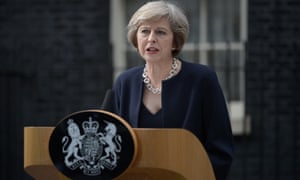
Theresa May outside Downing Street on her first day in the job in 2016.


I
t nearly always ends in tears, whether they are shed publicly or just inside, but few premierships have drawn to a close with such wretchedness as that visited on Theresa May. She’s not quite out of the door yet and other Tories are already describing her as the worst prime minister in a hundred years. That is a savage verdict when the competition for this dismal accolade includes Neville ChamberlainRamsay MacDonaldAnthony Eden and David Cameron.

I think we can safely say she will not be remembered as one of the more strong and stable occupants of Number 10. Hilarious as it may seem today, she seized the keys in the summer of 2016 because colleagues thought her “a safe pair of hands”. She commended herself to Tory MPs – and was pretty popular with a lot of voters – as she seemed to promise a premiership of common sense and calm after the anarchic orgy of backstabbing unleashed by the Cameronian, Johnsonian and Goveite cliques. In that largely forgotten period when she appeared to be monarch of all she surveyed, and the cabinet was terrified of her, she was variously compared to Boudicca and Elizabeth I. To some of us, the early cult of Theresa was ridiculous even at the time. It is now so risible that thinking about it for too long risks permanent injury to your abdomen.
Now her cabinet plots her downfall. Her whips tell her to go – and to her face. She has lost the confidence of her European peer group. Her government has been held in contempt of parliament. She has set a new historical record for a parliamentary defeat. The country, some parts of which did have sympathy for the difficulties of her position, is signalling that it has had enough.
It became her self-defined mission to “make a success” of Brexit by delivering on the referendum result while mitigating damage to the economy and without splitting her party. She has failed in each one of those objectives. The original withdrawal date has been scrubbed. Business leaders are tearing out what remains of their hair about Brexit blight. The Tory party is so vividly divided that it could be heading for a terminal split. Even promising to sacrifice herself wasn’t enough to get her withdrawal agreement through parliament at the third time of asking. The “safe pair of hands” has piloted Britain into extremely dark waters.
I think we can identify her three most significant strategic errors. The first was to act at the start as if the only people who mattered were the 52% of voters who backed Brexit while treating the 48% as an irrelevance to be ignored or insulted. Where she might have endeavoured to bind together a fractured nation and forge an alliance of the sane Brexiters and the pragmatic Remainers, her language and approaches have further polarised the country and radicalised opinion on both sides. This was compounded by concentrating her energies on trying to please the unsatisfiable subset of Brexiters who wanted the most impossibilist versions of the enterprise. One of the more delicious spectacles of the past few days has been watching Jacob Rees-Mogg, Boris Johnson, Dominic Raab and others in their gang of ultras crack and switch behind a withdrawal agreement that they had previously decried as “vassalage”. They flipped because they finally twigged that their game was up and they did not have the numbers to inflict a no-deal outcome on Britain. They never did have the support for that. Mrs May could have worked that out much earlier and shaped her strategy accordingly.
The second major mistake was to call the hubristic snap general election in the spring of 2017, squander her majority with an atrocious campaign and then respond as if, to use one of her most notorious phrases, nothing had changed. A bolder and more agile leader would have reached out to the opposition benches to see if a consensus could be moulded. I grant you that this would not have been easy when Labour is led by Jeremy Corbyn, as tribalistic as Mrs May in his own fashion. She could still have made an effort to build bridges with the many reasonable people on the opposition benches, but she didn’t even try. She instead made the fatal choice to turn herself into a hostage of the Democratic Unionists and the Brextremists on the Tory benches.
Her third large misjudgment has been the conduct of the endgame. Once it was very apparent her withdrawal agreement was neither popular in parliament nor attractive to the country, she persisted with trying to bludgeon it through. When it became evident this simply was not going to work, she might have pivoted to another strategy. She could have looked at alternative versions of Brexit. She might have allowed MPs to explore other ways forward, as they are very belatedly doing now. She might have embraced the offer from the opposition benches to allow her deal through the Commons subject to it then being put to the people for the final say in a confirmatory referendum. Fixity of purpose can be a virtue in a leader, but the durable ones are successful because they also understand when it is necessary to flex.
The rigidity of her personality has been a key component of her failures. She is not the first prime minister to find it difficult to trust anyone, but she is such a secretive operator even those closest to her struggle to fathom her intentions and motives. She is not the first prime minister to be awkward, shy and introverted, but these are very serious disadvantages in a political age that demands a high level of communication skills from leaders.
No one accuses her of being lazy or trivial. After the essay-crisis, seat-of-the-pants style of the Cameron premiership, the Tory party thought it would do better with a serious swot. One of her few friends once told me that Mrs May approached Brexit as if the country had set her a piece of fiendishly difficult homework. The downside of this doggedness has been inflexibility. When Ken Clarke described her as “a bloody difficult woman”, she embraced the label as a compliment. During their days in government together, Nick Clegg used to call her a “one-eyed politician”, by which he meant that she did not have the imagination to find creative solutions to problems.
She also has a vengeful streak. Many colleagues have been rubbished by her briefers, directly scorned and disdained by the prime minister, sacked or threatened with the boot. They know this vicar’s daughter does not follow the biblical injunction to turn the other cheek. A powerful leader can get away with being punitive towards those who cross them. But when authority drains away, your victims come back to bite you. Her paucity of friends is not just down to her lack of gregariousness – it is also because her conduct towards colleagues has made a great many enemies across the Tory factions.
It is premature to award her the title of worst prime minister in 100 years. How history sees her will depend on what happens next and who follows her. It is not at all a given that any other prime minister would be better than Theresa May – there are candidates who could be much worse. Perspective will likely soften judgments of her tortured premiership. We should remember that Mrs May is not the first Tory prime minister to be incinerated in the crucible of the European Question. Three decades ago, it was a trigger for the downfall of Margaret Thatcher. The party’s long uncivil war made a misery of John Major’s time at Number 10. David Cameron self-immolated by recklessly promising the referendum that he then lost. These were all very different personalities to each other and to Mrs May. She didn’t have the largeness of character and the breadth of political skills necessary to handle the vast complexity of the Brexit challenge, but then it is arguable that such a person does not exist. Even a leader with the power to inspire of Churchill, the team-building talent of Lincoln and the capacity to heal of Mandela would have struggled.
The Tory party is now preparing to find a new chief for its cannibalistic tribe. It will be convenient for a lot of people, especially those planning to contest for the corroded crown, to cast all the blame for 33 months of unrelenting and still unresolved chaos on the woman who will soon be leaving Number 10. Convenient, but not altogether accurate. The problem with the Conservative party is not Mrs May. The problem with the Conservative party is the Conservative party. The problem with Brexit is not Mrs May. The problem with Brexit is Brexit.
 Andrew Rawnsley is Chief Political Commentator of the Observer

My Comments :

1. I do might have expected a few more names in the presented narrative about the Rise and Downfall of the premiership of Theresa May.
2. The name Leadsom comes to mind, and so does Timothy and Hill, the alleged Rasputinian couple, that had been brutally sacrificed after the disastrously bad outcome of the 2017 snap elections.
3. Another name to be considered might very well have been Gina Miller, who single-handedly had been dealing a fatal blow to the commonly carried illusion, that Brexit could be (easily) delivered by the UK Government only, rather than by UK Parliament.
4. The overambitious "hostile environment" May apparently had only one final career wish on her sleeves, and that has been becoming PM at all cost.
5. She however succeeded only to fulfil that ultimate wish, by heavily compromising on her original Remainer points of view.
6. After all, to avoid an enduring and time consuming leadership contest in 2016, she and Leadsom did agree on the Tory party supported proposition, that in exchange for the keys to No 10, May had to not only defend Brexit, but had to deliver Brexit as well on a silver plate to the Nation.
7. That construction of mutual convenience did present her with the infamous red-lines during the two years of negotiating (only) the terms of the withdrawal agreement with the EU.
8. So by insisting on her burning ambition to stay PM at all cost, in the end she did lose out to the diehard Leave campaigners Leadsom, Gove and Johnson, to just name a few Brexit canons.
9. What did not help May either was the fact, that the unexpected judicial success of Gina Miller, did change the fundamentals of the Brexit dynamics at a blistering way, by obliging from that victorious decision, the final say of Parliament on the conditions of the UK leaving the EU bloc.
10. May also had to silence the critics that kept on mentioning, that May in her heart has always been a Remainer, by exercising a strict rule of dogmatically repeating the mantra, that "we have to fulfill the democratic will of the people".
11. Taking absence thereby of course from the notion, that a voters ignorance based (*), highly polarised and highly demagogic Remain versus Leave campaign never ever could have led to the valid conclusion, that this campaign had been a truly democratic exercise.
12. The other Brexit guidance that May did receive during the first leg of her PM ship (and most probably on an informal base until this very day) has been taken in from her old Home Office advisers Timothy and Hill, who allegedly had been introducing a (rather impopulair) culture of cabinet-bullying into No 10.
13. In the end she had to give in to the harsh reality of ruling with a deeply divided party within the parameters of a hung parliament, depending on the ultra-right religious militants of the DUP, mirrored in rigidness by the Looney Right of the ultra neo-nationalist and hyper-Xenophobe ERG, by acknowledging that she had not been blessed by a parliamentary majority for her WA.
14. Do remember, that May - in order to be able to cling on to her much desired Premiership - deliberately had been taking the risk of the UK crashing out of the EU with no Deal, a scenario, that has been haunting many on each side of the Channel from day one.
15. From that very same erratic logic she simply had to persist on a partisan approach during the last three years, because any move to a more bi-partisan approach would have set her on collision course with the Hard Border-liners from the DUP-ERG (**) sect.
16. A sect, that only does seem to care for steering towards a Hard Brexit, in the context of aggressively opting for the regressive ideology of a new Feudal UK, where the citizens do have to unconditionally obey their supposed Rulers from Heaven.

(*) Not to mention the relative X-factor of the professional electioneering by obscurantist NATO / CIA associated firms like Cambridge Analytica and AggregateIQ, that did covertly address the unconscious area of the electorate by brainwashing the Remain voters with the rejectionist voting concept, that might have (to a high degree that is) delivered Trump the Keys to the White House as well.
(**) The ERG seems to be leaning on right-extremist ideologues like Camus and Houllebecq.
NB. Apart from the ignorance-based aspect of the referendum - that already did remove any pretence of democracy on its own merit - one simply would have had written some decisive mechanism into the (ADVISORY) referendum rules such as a two third majority and / or an eighty percent voter turn-out.
Plus of course, a highly qualified awareness campaign, including well-explained, scientifically based future projection scenarios on all the possible relevant elements that had to be taken into account before the electorate could have made any responsible decision at all.