
maandag 24 juli 2017

Whistleblower at the CIA: An Insider’s Account of the Politics of Intelligence
new york journal of books
Whistleblower at the CIA: An Insider’s Account of the Politics of Intelligence

Release Date:
February 13, 2017
Publisher/Imprint:
City Lights Publishers
Pages:
300
Reviewed by:
Author Melvin Goodman spent 42 years in government, including a 25-year stint in the CIA. Whistleblower at the CIA focuses on Goodman’s years at the CIA, and on the dysfunctional relationship between the president and Congress on matters of national security.
Goodman writes, “As long as Congress defers to the president on the conduct of national security; the courts intervene to prevent any challenge to the power of the president in national security policy making; and the media defer to its official and authorized sources, the nation will need courageous whistleblowers to make sure that CIA actions are legal, ethical, and moral.”
Whistleblower at the CIA jumps back and forth across years of Goodman’s service in government though Goodman keeps returning to the CIA. Goodman provides historical context—why the CIA exists and what the CIA does.
The CIA is comprised of two culturally distinct branches, Operations and Analysis. The purpose of Operations is data collection—spying. In spying, Goodman says the CIA is not rogue but carries out the orders of the president with plausible deniability so when the CIA’s activities are uncovered, anger will be directed at the CIA, not at the president.
The purpose of analysis is to study data from various sources to determine foreign nations’ capabilities and intent. Analysis is nominally to be kept separate from Operations to be an “honest broker” in providing information to the President. Goodman, worked as an intelligence analyst at the CIA and believes intelligence analysts who best serve their country, will ignore pressure to arrive at ideological conclusions.
The CIA was created by President Truman as a civilian organization specifically to counter inflated military assessments made by analysts in the Department of Defense of the Soviet Union. President Truman never intended the CIA to be under control of the department of defense or to be a spy agency. Against Truman’s intent, through the years the CIA has become a spy agency, led by Director of National Intelligence (DNI), which is a department of defense position, and has become an organization that provides ideologically driven national security analyses.
Goodman lists his bonefides: A three-year tour in U.S. Army as cryptographer, two years in Greece as part of U.S. military mission, and he was present the Suez crisis of 1956. He was behind the scenes at the U.S. invasion of Lebanon in 1958. He was polygraphed four times. Employed by the State Department in the Bureau of Intelligence Research from 1974 to 1976, he spent the summer of 1976 on embassy duty at the U.S. embassy in Moscow.
Goodman studied Russian history in graduate school, graduating with a PhD in Soviet-American relations. He then worked from 1964 to 1990 as an intelligence analyst at the CIA. After retiring from the CIA, Goodman taught as a professor of international security at the National War College (NWC), retiring after 18 years to join the Center for International Policy, a think tank.
When Goodman joined the CIA in the 1960s, the CIA was a male-oriented club with great esprit de corps. Goodman received no training as an analyst, and he admits he was naïve. When he joined the CIA, he believed the CIA to be a research institution in international relations and not involved in clandestine operations.
Goodman describes the work of an analyst, noting that the CIA is good at determining capabilities but poor at discerning intent. Goodman describes what goes into the president’s Daily Brief and the excitement that he, a junior analyst with no formal training, could contribute to an intelligence document for the POTUS. He believes intelligence information provided by the CIA is be useful for any negotiation arena, serving as an independent source of information from the State Department or Department of Defense.
While a CIA analyst during the Vietnam War, Goodman attended antiwar rallies without repercussion, and claims that there were a number of CIA analysts who were antiwar. However, CIA analysts who were on the “Vietnam account” who were opposed to the war or critical of the President’s policy were reassigned. He claims the Secretary of Defense McNamara lied to President Johnson about CIA intelligence by suppressing reports that the war was unwinnable. In the end, “the CIA became a whipping post for failed policy.”
Scapegoating appears to be a common tactic. Goodman was an insider at the first Strategic Arms Limitation (SALT) talks under President Nixon. The role of the CIA was treaty pre-verification, needed before the senate would vote. Goodman claims the Department of Defense did not want an arms treaty with the Soviet Union and lied to the President about Soviet capabilities.
In exchange for the senate’s consent on the treaty, the senate leaders demanded and received a purge of the State Department negotiation team. Punishing the State Department for successful negotiations happened again after SALT II when President Clinton bowed to Senate pressure to abolish the Arms Control and Disarmament Agency after.
Whistleblower at the CIA contains a chapter on Goodman’s testimony on Robert Gates who was nominated for the position of CIA director by President George H. W. Bush in 1991. And though Goodman claims the status of whistleblower in this instance he was an approved whistleblower, as Goodman was invited to speak to the Senate Subcommittee that vetted Gates. In a blow-by-blow account, Goodman documents Gates’ distortions of intelligence, showing readers the dirty politics kept hidden from the American public. Goodman writes, “Policies and process are often discernable; politics are the best kept secrets of Congress.”
Goodman points out the cost to revealing corruption, “There is no protection for whistleblowers in the intelligence community, and the intelligence officers face the possible loss of security clearance for going public regarding abuses.” For those employed by the CIA and NSA, the loss of a security clearance is equivalent to being fired.
Though the chairman of the senate intelligence committee warned Gates not to take action against those who testified against him but could not back up his warning, and retribution started immediately against two of those who testified against Gates, Lyn Ekedahl and John Hibbits. Goodman, too, was threated and his credibility attacked.
Goodman provides a litany of Gate’s misdeeds: William Casey (the CIA director) and Gates (CIA assistant director) were never committed to providing objective intelligence. Gates advocated bombing Nicaragua after Daniel Ortega’s election in the premise that Nicaragua would become a Russian base—a belief with no evidence.
As for Iran, the White House received specious intelligence from National Intelligence officers that there were moderates in the Iran government. When President Reagan publically stated there were moderates in Iran interested in opening ties with the U.S., the president was acting on fake intelligence provided by the CIA.
We may never know how deep Gates and Casey were in the Iran-Contra scandal. Casey died of a brain tumor soon after the Iran-Contra hearings, and President George H. W. Bush pardoned any and all CIA officials who might have been involved. Gates claimed he was not involved at all, something not believed by Congress. Goodman likens Gates disavowal to the more recent CIA Director John Brennan’s disavowal of knowing anything about CIA directed torture of prisoners.
Jumping ahead to 1991, President George H. W. Bush considered the confirmation of Robert Gates to CIA director as a test of loyalty, no matter how damaged Gates was as candidate, no Republican senator was willing to go against the president. The senate was able to keep one of its members on the intelligence committee in line on the vote by threat. One Republican senator on the intelligence committee was in trouble with the ethics committee in a banking scandal, and he voted for Gates in return for a pass on ethics.
Robert Gates was confirmed to direct the CIA by a vote of 64 to 31.
Goodman points out the senate intelligence committee was politicized then and is just as politicized today. “The recent skirmish over the committee’s authoritative report over CIA torture was the most recent example of politicization. No Republican staffer from the committee was permitted to work on the report; no Republican member supported it.”
Goodman also claims the vetting process is not just bad but so bad that a series of “bizarrely” bad CIA directors have been chosen. Goodman writes, “The CIA is deeply damaged, but no one appears to want to fix it or know how, including congressional intelligence committees charged with oversight.”
Goodman believes the CIA’s lack of accountability is intended by the president, and it doesn’t matter which president. By intent, the CIA directorship is caught in a double bind. If you (as director) do a poor job, you will be fired by the president but if you do a good job (in the eyes of Congress) and limit the president’s will, you still will be fired.
The only safe job is to do what the president wants, right or wrong. If it all goes south, you did what the president wanted and the president will protect you. The consequence is the CIA leadership is encouraged to lie to Congress and the American people. If caught in a lie, the important will be pardoned (or given misdemeanors), only the less important will be given jail sentences.
In another chapter, Goodman lists acknowledged CIA intelligence analysis failures:
the failure to anticipate
* the North Korean invasion in 1950,
* the Soviet invasion of Hungary 1in 1956,
* the Cuban Missile Crisis 1962,
* the Soviet invasion of Czechoslovakia in 1968.
* After the CIA failed to anticipate Egyptian-Syrian attack on Israel in 1973 (known as The October war),
* the CIA then failed again by predicting Israel would win quickly.
* The CIA did not anticipate the Iranian Revolution in 1979,
* or the Soviet invasion of Poland in1980,
* China’s Tiananmen Square revolt in 1989,
* the Iraq invasion of Kuwait in 1990,
* the Arab Spring of 2010,
* the rise of ISIS in Iraq in 2014,
* the Russian seizure of Crimea in 2014, or
* the Russian intervention in Syria 2015.
Goodman notes, “The sad fact is that accurate intelligence is no assurance of effective national security policy, but intelligence failure will surely compromise the possibility of effective policy.”
Goodman also lists CIA analysis successes (and this list seems shorter): CIA intelligence gave enough time for President Kennedy to react before Soviet missiles were ready to be launched from Cuba. The CIA provided intelligence that allowed President Nixon to force Israel to a ceasefire in the October War. The CIA successfully predicted the expulsion of Russian civilian military advisors from Egypt after the October War; however, when Egyptian President Sadat hinted he wanted the U.S. to replace the departing Russians, Secretary of State Henry Kissinger did not follow up.
Goodman claims there was CIA infighting over how to react to the Soviet invasion of Afghanistan in 1979. Evidence shows the Soviet’s move into Afghanistan was defensive, a response to Islamic terrorism. However, the U.S. reacted as if the Russian moves were offensive. To counter the Soviets, the U.S. then supported Islamic terrorists. Goodman writes, “I believe the most vehemently anti-American Islamists currently operating in Afghanistan are part of the very organizations . . . that the CIA assisted.”
Misunderstanding Russian intent seems to be a trademark of the CIA. The Soviets believed the U.S. was going attack Russia with nuclear weapons during NATO military exercises in 1983, code named Able Archer. Goodman writes, “[the year] 1983 was the most dangerous year in Soviet-U.S. relations since the Cuban Missile Crisis.” During the crisis the CIA was at a disadvantage because the Pentagon was unwilling to share their knowledge of U.S. military maneuvers and weapons deployment with the CIA, so the CIA only saw one-half of the equation: the Soviet response to U.S. military provocation. Some good did come from this. Once President Reagan realized how close we came to nuclear annihilation, he began improving relations with the Soviet Union, culminating in the 1985 Reagan-Gorbachev summit.
In the chapter The Press and the Whistleblower, Goodman covers the cozy relationship between media and the government—friendly coverage is the price of access.
The CIA sponsors academia in trade for good press, including symposia and academic exchanges where the CIA gets to choose the speakers.
Goodman identifies media events from which he was invited then disinvited. He believes disinvitation came from fear the CIA would cause problems for his hosts. He tells the story of a CIA analyst who was stopped at the door of a public event that hosted a high-ranking U.S. official. The analyst was turned away, Goodman believes, because the event included a question and answer session.
Goodman notes, “Most of what appears in the media on international security is a reflection of what the government wants you to read.”
The concluding chapter of Whistleblower at the CIA is worth the price of the book, providing context for national security from the past to today.
woensdag 19 juli 2017
A despot in disguise: one man’s mission to rip up democracy

A despot in disguise: one man’s mission to rip up democracy
James McGill Buchanan’s vision of totalitarian capitalism has infected public policy in the US. Now it’s being exported

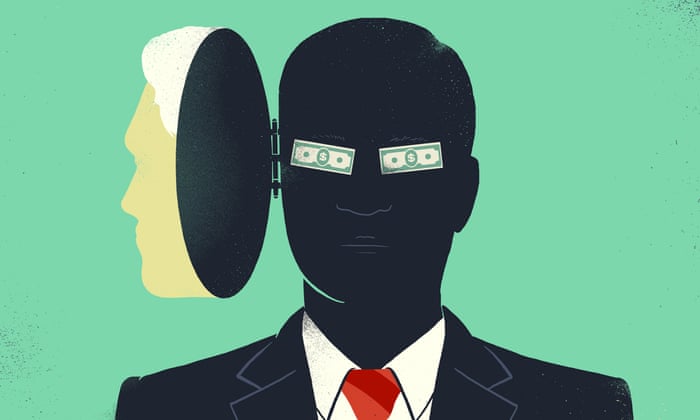 ‘Buchanan has developed a hidden programme for suppressing democracy on behalf of the very rich. It is reshaping politics.’ Illustration: Sébastien Thibault
It’s the missing chapter: a key to understanding the politics of the past half century. To read Nancy MacLean’s new book, Democracy in Chains: The Deep History of the Radical Right’s Stealth Plan for America, is to see what was previously invisible.
The history professor’s work on the subject began by accident. In 2013 she stumbled across a deserted clapboard house on the campus of George Mason University in Virginia. It was stuffed with the unsorted archives of a man who had died that year whose name is probably unfamiliar to you: James McGill Buchanan. She says the first thing she picked up was a stack of confidential letters concerning millions of dollars transferred to the university by the billionaire Charles Koch.
Her discoveries in that house of horrors reveal how Buchanan, in collaboration with business tycoons and the institutes they founded, developed a hidden programme for suppressing democracy on behalf of the very rich. The programme is now reshaping politics, and not just in the US.
Buchanan was strongly influenced by both the neoliberalism of Friedrich Hayek and Ludwig von Mises, and the property supremacism of John C Calhoun, who argued in the first half of the 19th century that freedom consists of the absolute right to use your property (including your slaves) however you may wish; any institution that impinges on this right is an agent of oppression, exploiting men of property on behalf of the undeserving masses.
James Buchanan brought these influences together to create what he called public choice theory. He argued that a society could not be considered free unless every citizen has the right to veto its decisions. What he meant by this was that no one should be taxed against their will. But the rich were being exploited by people who use their votes to demand money that others have earned, through involuntary taxes to support public spending and welfare. Allowing workers to form trade unions and imposing graduated income taxes were forms of “differential or discriminatory legislation” against the owners of capital.
Any clash between “freedom” (allowing the rich to do as they wish) and democracy should be resolved in favour of freedom. In his book The Limits of Liberty, he noted that “despotism may be the only organisational alternative to the political structure that we observe.” Despotism in defence of freedom.
His prescription was a “constitutional revolution”: creating irrevocable restraints to limit democratic choice. Sponsored throughout his working life by wealthy foundations, billionaires and corporations, he developed a theoretical account of what this constitutional revolution would look like, and a strategy for implementing it.
He explained how attempts to desegregate schooling in the American south could be frustrated by setting up a network of state-sponsored private schools. It was he who first proposed privatising universities, and imposing full tuition fees on students: his original purpose was to crush student activism. He urged privatisation of social security and many other functions of the state. He sought to break the links between people and government, and demolish trust in public institutions. He aimed, in short, to save capitalism from democracy.
In 1980, he was able to put the programme into action. He was invited to Chile, where he helped the Pinochet dictatorship write a new constitution, which, partly through the clever devices Buchanan proposed, has proved impossible to reverse entirely. Amid the torture and killings, he advised the government to extend programmes of privatisation, austerity, monetary restraint, deregulation and the destruction of trade unions: a package that helped trigger economic collapse in 1982.
None of this troubled the Swedish Academy, which through his devotee at Stockholm University Assar Lindbeck in 1986 awarded James Buchanan the Nobel memorial prize for economics. It is one of several decisions that have turned this prize toxic.
But his power really began to be felt when Koch, currently the seventh richest man in the US, decided that Buchanan held the key to the transformation he sought. Koch saw even such ideologues as Milton Friedman and Alan Greenspan as “sellouts”, as they sought to improve the efficiency of government rather than destroy it altogether. But Buchanan took it all the way.
MacLean says that Charles Koch poured millions into Buchanan’s work at George Mason University, whose law and economics departments look as much like corporate-funded thinktanks as they do academic faculties. He employed the economist to select the revolutionary “cadre” that would implement his programme (Murray Rothbard, at the Cato Institute that Koch founded, had urged the billionaire to study Lenin’s techniques and apply them to the libertarian cause). Between them, they began to develop a programme for changing the rules.
The papers Nancy MacLean discovered show that Buchanan saw stealth as crucial. He told his collaborators that “conspiratorial secrecy is at all times essential”. Instead of revealing their ultimate destination, they would proceed by incremental steps. For example, in seeking to destroy the social security system, they would claim to be saving it, arguing that it would fail without a series of radical “reforms”. (The same argument is used by those attacking the NHS). Gradually they would build a “counter-intelligentsia”, allied to a “vast network of political power” that would become the new establishment.
Through the network of thinktanks that Koch and other billionaires have sponsored, through their transformation of the Republican party, and the hundreds of millions they have poured into state congressional and judicial races, through the mass colonisation of Trump’s administration by members of this network and lethally effective campaigns against everything from public health to action on climate change, it would be fair to say that Buchanan’s vision is maturing in the US.
But not just there. Reading this book felt like a demisting of the window through which I see British politics. The bonfire of regulations highlighted by the Grenfell Tower disaster, the destruction of state architecture through austerity, the budgeting rules, the dismantling of public services, tuition fees and the control of schools: all these measures follow Buchanan’s programme to the letter. I wonder how many people are aware that David Cameron’s free schools project stands in a tradition designed to hamper racial desegregation in the American south.
In one respect, Buchanan was right: there is an inherent conflict between what he called “economic freedom” and political liberty. Complete freedom for billionaires means poverty, insecurity, pollution and collapsing public services for everyone else. Because we will not vote for this, it can be delivered only through deception and authoritarian control. The choice we face is between unfettered capitalism and democracy. You cannot have both.
Buchanan’s programme is a prescription for totalitarian capitalism. And his disciples have only begun to implement it. But at least, thanks to MacLean’s discoveries, we can now apprehend the agenda. One of the first rules of politics is, know your enemy. We’re getting there.
Abonneren op:
Posts (Atom)