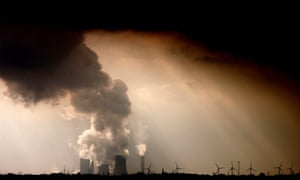
Billions of tonnes of carbon dioxide are sent into the atmosphere every year from coal, oil and gas burning. Photograph: Oliver Berg/AFP/Getty Images
The problem – rising carbon dioxide in the atmosphere
The level of CO2 has been rising since the industrial revolution and is now at its highest for about 4 million years. The rate of the rise is even more striking – the fastest for 66m years – with scientists saying we are in “uncharted territory”.
The causes – fossil fuel burning
Billions of tonnes of CO2 are sent into the atmosphere every year from coal, oil and gas burning. There is no sign of these emissions starting to fall rapidly, as is needed.
The causes – forest destruction
The felling of forests for timber, cattle, soy and palm oil is a big contributor to carbon emissions. It is also a major cause of the annihilation of wildlife on Earth.
The consequences – global temperature rise
The planet’s average temperature started to climb steadily two centuries ago, but has rocketed since the second world war as consumption and population has risen. Global heating means there is more energy in the atmosphere, making extreme weather events more frequent and more intense.
The consequences – ice melting in Greenland
Greenland alone is now losing almost 4 trillion tonnes of ice per year. Mountain ranges from the Himalayas to the Andes to the Alps are also losing ice rapidly as glaciers shrink. A third of the Himalayan and Hindu Kush ice is already doomed.
As heating melts the sea ice, the darker water revealed absorbs more of the sun’s heat, causing more heating – one example of the vicious circles in the climate system. Scientists think the changes in the Arctic may be responsible for worsened heatwaves and floods in Eurasia and North America.
The upside (I) – wind and solar energy is soaring
Huge cost drops have seen renewable energy become the cheapest energy in many places and the rollout is projected to continue. Analysts also expect coal use to fall. But much government action is still required to reach the scale needed, and solve difficult problems such as aviation and farming.
The upside (II) – electric vehicles
The global fleet of electric cars and vans is still small compared with those running on fossil fuels. But sales are growing very fast. Electric cars are cheaper to run, suggesting they will become mainstream.
The upside (III) – battery costs
Renewable energy is intermittent, depending on when the sun shines or wind blows. So storage is vital and the cost of batteries is plummeting. But other technologies, such as generating hydrogen, will also be needed.
1. This crisis - whereby human kind is knowingly and rapidly destroying its own and only habitat (and the habitat of many other now endangered species) - does transcend ALL other crises concerning our planet.
2. But (up to this very day) this crisis does receive only a fraction of the political effort (versus the odd tidal waves of media attention) needed to effectively counter and solve this existential problem of global magnitude....
3. Reports, composed already a decade or so ago by agencies like the CIA, do warn, that if mankind does not engage this existential crisis immediately structurally and systematically, this will necessarily lead to deadly regional climate catastrophes, accumulating into major migration movements, leading up to major climate wars.
4. Democracy - a relatively recent and rather vulnerable phenomenon in the struggle for social emancipation - in all probability will be the first victim in the race for survival, triggered by the human originated devastating climate change (and major health-threats produced by other forms of pollution, like ultra-fine toxic particles).
5. Hard-right populism, racism, fascism and ultra-nationalism (the proponents par excellence of climate denial and the self-declared opponents of science and international bodies like the UN / IPCC) will be - apart from unlimited predatory consumerism and all the mechanisms connected to it - the first adversaries to combat in the years to come.
6. This political (and physical) struggle in itself might appear to be the first hurdle to overcome....
N.B. Do be aware of the astonishing fact that major oil companies like Shell and Exxon had already established high standard scientific knowledge from secret studies by these companies about the devastating effect from carbon dioxide on the atmosphere in the seventies and eighties.
The USA department of Energy did possess the very same information at the very same time, only to suppress any political measure that might have prevented the apocalyptic and dystopian future mankind has to encounter sixty years later.
We still do owe much of our gratitude and intellectual appreciation to the founding father of climate science James Hansen who in the eighties laid the groundwork for the understanding of global warming, only to be hounded away by the captains of mineral oil and coal mining industries like the Koch Brothers.
The Koch Brothers nowadays are notorious for manipulating the USA legislative and executive branches by organised scientific deception, dis-informing the electorate and systematically (lawfully among others by super-PAC constructs) bribing politicians.
Revealed: how US senators invest in firms they are supposed to regulate
Alex Kotch of Sludge
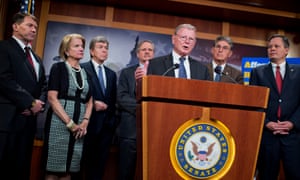
Senators Mike Rounds, Shelley Moore Capito, Roy Blunt, John Hoeven, Jim Inhofe, Joe Manchin and Steve Daines in 2015. Senators are far wealthier than most constituents, and in a prime position to increase wealth via policymaking. Photograph: Tom Williams/Getty Images
Analysis of financial disclosure data shows 51 senators and their spouses have as much as $96m invested in corporate stocks
A
s they set national policy on important issues such as climate change, tech monopolies, medical debt and income inequality, US senators have glaring conflicts of interest, an investigation by news website Sludge and the Guardian can reveal.
An analysis of personal financial disclosure data as of 16 August has found that 51 senators and their spouses have as much as $96m personally invested in corporate stocks in five key sectors: communications/electronics; defense; energy and natural resources; finance, insurance and real estate; and health.
The majority of these stocks come from public companies, and some are private.
Overall, the senators are invested in 338 companies – including tech firms such as Apple and Microsoft, oil and gas giants including ExxonMobil and Antero Midstream, telecom companies including Verizon, and major defense contractors such as Boeing – in the five sectors as categorized by Sludge.
Congressional financial disclosures present investments in dollar ranges, not exact amounts, so all data in this report comes in ranges, some very wide. The median stock investment range in the five sectors for the 51 senators is between $100,000 and $365,000, while the average range of the investments is between $551,000 and nearly $1,874,000.
Not only are the senators far wealthier than most of their constituents, but they’re in a prime position to increase their wealth via policymaking.
It’s not illegal for members of Congress to have personal financial stakes in the industries on which they legislate. But such investments raise questions about lawmakers’ motivations. If a representative on the House financial services committee owns hundreds of thousands of dollars worth of stock in Bank of America, how might this investment affect their questioning of Bank of America’s CEO in a hearing? Could it influence how they legislate and vote on banking issues?
While some members of Congress do try to limit possible conflicts of interest others claim their personal finances could never influence their conduct as elected representatives of the people, or fail to acknowledge concerns about their finances.
Senator Joe Manchin, the ranking member on the Senate energy and natural resources committee, owns between $1m and $5m worth of non-public stock in his family coal business, Enersystems, making him the only Democratic senator who is directly profiting from the environmentally devastating coal business.
Despite pressure from the left, the Senate minority leader, Chuck Schumer, made Manchin the ranking member of the committee, and Manchin did not divest his coal holdings.
Some senators want to do away with these perceived conflicts of interest. Senator Elizabeth Warren introduced anti-corruption legislation in August 2018 that included a ban on members of Congress, senior congressional staff, cabinet secretaries, White House staff, federal judges and other officials from owning individual stocks, bonds, commodities, futures and other types of securities while in office.
The senators Sherrod Brown and Jeff Merkley introduced the Ban Conflicted Trading Act in December to prevent members of Congress and senior staff from trading individual corporate stocks.
Financial firms lead the way
Senators own between $28.1m and $95.6m worth of stock in the five sectors examined by Sludge and the Guardian. They have the most money invested in the finance, insurance and real estate sector due in part to the Republican senator John Hoeven’s investment in Westbrand, Inc, a private holding company that owns multiple banks, worth between roughly $5m and $25m.
Altogether, 37 senators and their spouses own between $12.8m and $48.2m worth of stock in the finance, insurance and real estate sector. They have the most money invested in the commercial banking industry, between $8.3m and $32.9m.
Senator Richard Shelby, a Republican member of the Senate banking, housing and urban affairs committee, owns between $1m and $5m worth of stock in private real estate insurance firm Tuscaloosa Title Company. Shelby sits on the housing, transportation and community development subcommittee, which has jurisdiction over the US Department of Housing and Urban Development, affordable housing, foreclosure mitigation and other housing matters, and the securities, insurance and investment subcommittee, which oversees the insurance industry.
Nine other banking committee members are personally invested in the financial companies they oversee including the Republican John Kennedy and the Democrats Doug Jones, Robert Menendez and Tina Smith.
Mining, communications and healthcare
The same phenomenon of senators owning stock in industries they oversee exists in many other Senate committees.
Senators have between $8.3m and $22m invested in the communications and electronics sector, including up to $4.2m in internet companies and as much as $4.1m in computer software businesses. Senator Shelley Moore Capito, a member of the commerce, science, and transportation committee’s subcommittee on communications, technology, innovation and the internet and the subcommittee on manufacturing, trade and consumer protection, owns between $53,000 and $194,000 worth of Microsoft stock, as much as $99,000 of Intel stock and up to $30,000 each in AT&T and Verizon stock.
Senator Jacky Rosen, who is also on both subcommittees, owns between $310,000 and $1m worth of communications and electronics stock. Her largest potential investments are as much as $265,000 in Amazon, up to $115,000 in AT&T and $100,000 in software company Adobe.
Energy and natural resources companies come up frequently in the senators’ investments; members own between $3.5m and $13.9m in stocks in this sector. As the world hurtles towards a potential climate catastrophe by 2030, senators own as much as $6.1m worth of stock in oil and gas companies. In addition, members have between $1.1m and $2.8m invested in electric and natural gas utilities stocks.
While medical debt piles up and tens of millions of Americans are still uninsured, senators own as much as $9.5m in health sector companies including insurers UnitedHealth Group and Anthem, pharmaceutical companies Abbott Labs, Johnson & Johnson and Pfizer, and pharmacy benefit manager CVS Health.
Tech stocks are most popular
While the financial sector has drawn the most investment dollars from senators, stocks in the internet and computer software and hardware industries are the most popular.
Fifteen senators own stock in Apple and in Microsoft; eleven are invested in Amazon and in Intel, and 10 own stock in Google’s parent company, Alphabet.
Republicans tend to be more eager to invest in corporate stocks; of the 25 most popular public stocks, Democrats invested outnumber Republicans in only three companies: General Electric, MetLife, and Pfizer. (General Electric is classified in the energy and natural resources sector for this report, due to its energy subsidiary, GE Power, which operates an oilfield services division.)
Overall, Republican senators own more in stock investments – between $18.8m and $63.7m – than Democrats, whose stock ownership is worth roughly half of that range, between $9.3m and $31.6m.
Aside from the Wireless Telecom Group, in which Senator Rick Scott of Florida has as much as $3m invested, the top public stocks by investment amount are Apple (between $798,000 and $2.2m), Microsoft ($588,000 to $2.2m), and Alphabet ($577,000 to $1.8m). Ownership in Amazon, which is vying for a $10bn defense contract, is not far behind at between $423,000 and $1.3m.
Wells Fargo, the financial giant that has paid numerous fines for its frequently fraudulent practices, is the bank that has attracted the most investment dollars from senators: as much as $1.5m. Also among the top stocks are telecom companies Crown Castle International ($385,000 to $1.2m), Verizon ($407,000 to $1m), and AT&T ($250,000 to $925,000).
Breaking down the Senators’ wealth
Because of Hoeven’s big investment in Westbrand Bank Holding Company, he has by far the most money in corporate stocks from the five sectors analyzed by Sludge and the Guardian.
In terms of total stock ownership in the five sectors, Senator Dianne Feinstein, who along with husband Richard Blum, an investment banker, is second, with up to $7m invested in the five sectors. Blum’s purchase of as much as $250,000 worth of Facebook stock three months before his wife questioned the Facebook CEO, Mark Zuckerberg, came under scrutiny after Sludge reported the trade. He has since sold off the stock, but the couple still owns up to $3.3m worth of communications and electronics sector stock, which is heavily represented their state of California, including between $150,001 and $650,000 invested in Alphabet.
Feinstein is followed by Senator David Perdue, who owns as much as $6.4m invested. In addition to his considerable financial sector stock, the former Dollar General CEO has stock holdings worth as much as $2.8m in the energy and natural resources sector and up to $2m in the communications and electronics sector.
This article was produced in partnership with Sludge, an investigative news website focused on money in politics. Sludge is funded by donations from its readers and supporters.
The Growing Affinity Between Netanyahu’s Israel and the West’s Far-right is Hardly Surprising
by Jonathan Cook /
September 18th, 2017
The eldest son of Israeli prime minister Benjamin Netanyahu has found himself an unlikely poster boy for David Duke, a former Ku Klux Klan leader, and neo-Nazi website Daily Stormer.
Last week, these cheerleaders for Jew hatred described 27-year-old Yair Netanyahu as “awesome” and “a total bro” for posting a grossly anti-Semitic image on social media.
It depicts an Illuminati-like figure and a reptilian creature controlling the world through money and dark arts. Alongside them are a cabal of conspirators, their faces altered to show Mr Netanyahu’s main opponents. They include George Soros, a Holocaust survivor who has invested billions in pro-democracy movements, and Ehud Barak, a former Israeli prime minister-turned-government critic.
This is not Yair’s first troubling outburst. Last month, he decried demonstrators who opposed a rally by white supremacists in Charlottesville, Virginia, that left a woman dead.
These might be dismissed as the immature rantings of a wayward son had Yair not been groomed by his father as Israel’s “crown prince”. Netanyahu Jr was supposedly behind an online media strategy that steered Mr Netanyahu to electoral victory in 2015. He can be seen at his father’s side at meetings with world leaders.
The Israeli media were shocked not only by the post but also by Mr Netanyahu’s refusal to criticise his son. An editorial in Haaretz concluded that the prime minister’s silence signalled his “consent to the ongoing demonisation of anyone who doesn’t get in line with the Israeli right”.
Yair’s choice of targets was revealing, particularly Mr Soros.
In July, Mr Netanyahu met his Hungarian counterpart Viktor Orban, an ultra-nationalist who has led a xenophobic campaign against immigrants. In a bid to crush opposition, the Orban government has vilified Mr Soros, an American-Hungarian who promotes progressive causes. A billboard campaign against the billionaire unleashed a wave of anti-Semitism across the country.
Mr Netanyahu ought to have rushed to Mr Soros’s defence. Instead, he echoed Mr Orban’s incitement. Mr Soros, he said, had “undermined” and “defamed” Israel too – by funding human rights groups opposed to the occupation.
Sympathy with the European and US far-right is not restricted to the Netanyahu camp. It is moving into the Israeli mainstream. Last week, the Herzliya Conference – an annual jamboree for Israel’s security establishment – invited Sebastian Gorka as a keynote speaker.
Mr Gorka, another American-Hungarian and Mr Trump’s former terrorism adviser, is a figurehead of the alt-right, a term for US white supremacist groups. Mr Gorka told the conference that Israel and the US were “founding members of the Judeo-Christian civilisation” and would defeat their “common enemies”.
Meanwhile, another US alt-right leader, Richard Spencer, appeared on Israeli TV last month to call himself a “white Zionist”.
The affinity between Netanyahu’s Israel and the West’s far-right is understandable. Both detest a human rights discourse they have yet to crush. Both mobilise their supporters with dog-whistle Islamophobia. Both prefer militarised, fear-based societies and both share an obsession with Jew hatred.
Israel is so esteemed by white supremacists because it offers a double whammy of anti-Semitism. For decades, Israel has sought to persuade the West that it faces an endless war against Arab and Muslim “terror”, while simultaneously declaring itself the only true home for Jews. For an alt-right bristling with hatred for all Semites, this is manna from heaven. It, too, wants an apocalyptic battle against Islam, and it, too, is happy to see the West cleared of Jews by herding them into the Middle East.
At first sight, that has created an ideological inconsistency on the Israeli right that Yair Netanyahu’s meme highlights.
The Israeli prime minister has repeatedly called on all Jews to come to Israel, claiming it as the only safe haven from an immutable global anti-semitism. And yet, Mr Netanyahu is also introducing a political test before he opens the door.
Jews supporting a boycott of Israel are already barred. Now, liberal Jews and critics of the occupation like Mr Soros are increasingly not welcome either. Israel is rapidly redefining the extent of the sanctuary it offers – for Jewish supremacists only.
The paradox may turn out to be more apparent than real, however. For Mr Netanyahu may believe he has much to gain by abandoning liberal Jews to their fate, as the alt-right asserts its power in western capitals.
The “white Zionists” are committed to making life ever harder for minorities in the West in a bid to be rid of them. Sooner or later, on Mr Netanyahu’s logic, liberal Jews will face a reckoning. They will have to accept that Israel’s ultra-nationalists were right all along, and that Israel is their only sanctuary.
Guided by this cynical convergence of interests, Jewish and white supremacists are counting on a revival of anti-Semitism that will benefit them both.
From weakening vehicle emissions to blocking warnings about how coastal parks could flood or the impact on the Arctic, the Trump administration is accused of muzzling climate science.
Here six whistleblowers and former government scientists describe being sidelined by the administration – and why they won’t be quiet.
What did the work involve?
“I was an engineer at the EPA, working for 40 years in a very technical job. In 2009, after the election of Barack Obama, the EPA started working on greenhouse gas standards for vehicles for the first time. It felt like we were making history.
“There was a team of around 25 people producing thousands of pages of analysis for the standards. We knew it would be controversial but it was a very big deal, the first critical steps to address the climate crisis.”
What changed under the Trump administration?
“Once Trump was elected it became pretty clear that things would change. The president came out to Michigan in March 2017 and gave a speech where he said he’d look at the standards, that they hurt economic activity and jobs. That was an obvious sign, really.
“In August 2018 the administration proposed an eight-year freeze of the greenhouse gas standards. It was unbelievable, really – for the first time in the history of the EPA the political leadership decided to change pollution standards that were doing well without allowing the career staff and experts to play any sort of role. We were completely locked out.
“There was no scientific or technical rationale to rolling back the standards, the analysis they used was the most biased thing I’ve ever seen. They cooked the books and changed every assumption they could to get the answer they wanted. It was so bad that some EPA career staff asked their bosses to take the EPA name off it all.”
How do you feel about your experience?
“It broke my heart. I’d had this wonderful career, playing a small role in making the world a better place. Then we had a political leadership making decisions on ideology, denying science, basically being climate deniers. It felt horrible.
“I was 62 years old and there were a few family things going on, but the Trump administration made a difficult decision to retire much easier. I felt I could do more good on the outside, educating the public on what’s going on. By the time I left, the morale was the lowest I’d seen in 40 years. Our work had become irrelevant.”
Response from the EPA
Asked by the Guardian on Monday about the concerns outlined by four former EPA scientists, the EPA spokesman Michael Abboud said in a statement: “The EPA under President Trump has strived to create an agency that is responsive to the American people.”
The statement said this included “proposing the Safe (Safer Affordable Fuel Efficient) rule that will save lives and produce savings for American consumers, working on the first major update to the lead and copper rule in nearly three decades”.
It added the agency was also “on track to become the first administration to complete an ozone NAAQS(National Ambient Air Quality Standards) in the five-year review cycle envisioned by Congress”, and had deleted 22 sites from the national priorities list of those eligible for Superfund cleanup, the most since the financial year 2005.
What did the work involve?
“I was studying how climate change will affect 118 coastal parks in the US for the National Park Service. I started this work in July 2013, it was my baby.”
What changed under the Trump administration?
“My study went through peer review and was ready to be released but I was told by the NPS a few days after Donald Trump’s inauguration that they were ‘waiting for messaging’ first. I thought that was no big deal but then nothing happened and I started calling up every few weeks to say, ‘We’ve got to get this out, it’s getting stale.’
“The excuses varied but became ever more vague, such as ‘we are ever so busy’ or that it would worry people during hurricane season because it mentions storm surge in coastal areas. A superior said they wanted to keep a low profile on climate change for four or maybe eight years while Trump was around, which really upset me because we don’t have four to eight years to do nothing. I felt I was being silenced.
“I went on maternity leave around Christmas 2017 and the report still hadn’t been released. I got an email from a colleague saying, ‘Congrats on the baby, by the way you should know they are editing your report.’
“We had a conference call and it became clear that any mention of human-caused climate change had been taken out. I was asked how I would feel if they didn’t release the report at all, which felt like a threat. I stood my ground and was told ‘they aren’t going to be happy about this from above.’ It was never clear who ‘they’ were – perhaps Trump himself or Ryan Zinke [the then secretary of the interior].
“I then had a meeting with a senior NPS official who came out from Washington DC. The other report co-authors were there, too. That’s when it all unravelled, it became incredibly hostile. I was told not to attribute changes in public lands to human actions.
“I felt like we worked for the American people and I didn’t want to lie to them. But a superior said that we in fact work for the executive branch of which the president is the head. The president is the boss and we are going to put our heads down and put out the line of the administration.
“A journalist did a freedom of information request and saw all the emails of us fighting over this and asked me for a statement. I ended up going on the record because I thought it was a very important issue. I was aghast I was being asked to lie. These people were violating the mission of the NPS.
“After I came back from maternity leave I was demoted to be an intern on $25,000 a year. And then in February this year they said there was no money left at all and that I would have to leave. It was devastating. I offered to work for free as a volunteer but was turned down, which shows that it wasn’t a money issue really. I packed up my office and I was gone. I filed a whistleblower complaint in July.”
How do you feel about your experience?
“I have faced retribution, I was threatened and placed in a hostile work environment. It’s clear in some agencies there’s a culture of fear where scientists are being intimidated. When I wrote this report, politics was the last thing on my mind, I was thinking about climate change and these coastal parks.
“It’s very frustrating, it’s not where I pictured where my career would be at this time in my life. I don’t even know if I have a career any more. What’s left is in tatters.”
The National Park Service did not respond to the Guardian’s request for comment.
What did the work involve?
“The Clean Air Science Advisory Committee (Casac) is required to inform the EPA administrator over air quality standards, if they are sufficient to protect public health or not [under the Clean Air Act]. The EPA’s Science Advisory Board is a much larger committee that takes on all sorts of things – clean water rules, vehicle greenhouse gas standards, rules about transparency and so on.”
What changed under the Trump administration?
“Initially there was a neglectful relationship with the new Trump administration; they seemed uninterested and the amount of scientific advisory board work dropped off. Then, from October 2018, there were the first signs of the ideological assault on scientific advice at the EPA.
“Scott Pruitt [then administrator of the EPA] wrote a memo that said that researchers that have received grants from the EPA aren’t allowed to serve on panels because of a perceived conflict of interest. But there was no prohibition on industry people serving and the number of them on the panels has increased. It’s been a way to kick qualified people off the boards and get cronies in their place.
“There was a complete turnover of Casac and it shows in meetings. They now bumble through things because they don’t understand the process and the Clean Air Act. Political appointees are interfering with the selection of candidates, essentially picking those sympathetic to the agenda of the administration, even if they have fringe views like climate change isn’t happening, that kind of stuff.
“I was on a panel looking at the risks posed by particulate matter. We had a lot more work to do but we were disbanded four days before the EPA released an assessment that we would’ve reviewed. The timing was mind-boggling. I found out by seeing a press release on the EPA website, which was followed by an email saying our services were no longer needed.
“I was also a nominee for a panel on ozone but then they said they wouldn’t go ahead with that. It was a little frustrating for me personally, but it’s more of a loss to the American public. The EPA has always been thought of as a science-based agency; what we see now is no basic respect for science.”
How do you feel about your experience?
“There’s not even lip service to the science. Science can’t be controlled like ideological spin, so the administration is afraid of that. They don’t want scientists and their evidence-based opinions – they’d rather have cronies trot out the same tired talking points on fringe scientific views.”
What did the work involve?
“I was at [the department of the] interior for nearly seven years. I started on 3 January 2011 – I know the exact date because of how excited and inspired I was at the thought of serving in the federal government. I was hired as a senior executive to run the office of policy analysis, which sits in the office of the secretary.
“One of the main areas of focus was addressing the impacts of climate change in the Arctic, which is warming two to three times faster than the rest of the planet. Entire Alaska native villages are threatened by rapid coastal erosion and storms because they no longer have a sea ice curtain to protect them from fierce Arctic storms in the fall and early winter, and the ground beneath their feet is falling away as the permafrost thaws.”
What changed under the Trump administration?
“The new Trump team was very thin and most of them knew very little about the agency mission – they were mostly oil and gas lobbyists and some campaign workers. Whatever they were talking about up on the secretary’s hallway, it sure wasn’t being shared with the career staff at the agency. So you basically had 70,000 employees scratching their heads and getting back to doing their jobs while a couple dozen political appointees tried to get their act together to lead them. It was surreal.
“But this neglect soon turned into scorn, characterized by comments from the new secretary, Ryan Zinke, that the staff were disloyal. Morale began to quickly plummet as the political ranks showed not only ignorance of, but disdain for the wide-ranging agency mission. Here you had tens of thousands of people working hard in public service and being told what they do is not important.
“The National Park Service and Fish and Wildlife Service had it worst because they didn’t have anything to do with oil and gas or mining permitting process, and the lobbyists in charge had no interest in wildlife, conservation or biodiversity.
“But every agency suffered, because the mantra of the administration was to drain the swamp – and it quickly became clear that the swamp was not the high-paid lobbyists, but the rank-and-file government professionals who serve the country.
“On a Thursday night in June, just a week after I’d been in New York to speak at the United Nations about climate change adaptation issues, I received an email that said I was being moved to a new position.
“It was quickly obvious that this was a retaliatory action, as I was moved away from any climate change work to the office that collects royalty income from oil, gas and mining companies – an auditing position for which I had zero expertise. The email explained that because I had economists on my policy staff that I must clearly know about numbers, so I’d be good in an auditing office.
“I’d heard that they were looking for a job that I would not want, in hopes that I would quit. It’s not unusual for senior executives to be reassigned, it’s part of the job, but reassignment can’t be used to get people to quit – and Secretary Zinke testified to Congress a week later that he was using reassignments, among other methods, to trim the workforce. Sadly, I was only one of dozens of executives who were reassigned that night, many of us for clearly retaliatory reasons.
“I found legal counsel and eventually filed a whistleblower complaint and went public with an op-ed in the Washington Post. I wasn’t worried too much about my job at that point, I was worried about the work I’d been doing on behalf of Alaska Natives, and it was clear they had no intention of continuing to work to help those frontline communities.
“A couple months later I decided that they’d already taken my job, but there was no way I’d let them take my voice, so I resigned and continued to speak publicly about these abuses and the implications for American health and safety.”
How do you feel about your experience?
“The Trump administration is threatened by evidence, by science and by expertise. These things interfere with their ability to hobble government agencies and reduce oversight. It’s mind-boggling and a profound threat to democracy but it also increases risks to American health and safety. Every American should be concerned, regardless of political stripe.”
Response from the interior department
A Department of the Interior spokesperson said in a statement to the Guardian: “The department works to ensure that the scientific activities that it carries out use the best science and are the result of robust and independent processes.”
The department said it was required by law to research and publish reports regarding the changing conditions of the climate and has a “rich and longstanding culture of scientific integrity that prevails independently of individual administrations”.
What did the work involve?
“I was at the EPA for 33 years, starting in 1984. I worked in the water program and on Superfund cleanups, working on the criteria for drinkable water.”
What changed under the Trump administration?
“I left in August 2017 and made a very public retirement statement about how bad this administration is and its assault on science. It went viral and since then I spend 20 to 30 hours a week helping the press and Congress understand the impact of what the Trump administration is doing.
“We’ve never seen anything like this complete abandonment of science, solely to maximize corporate profits. Everything changed after the election. The climate change section of the EPA website came down and Scott Pruitt came in and brought in a bunch of political appointees who didn’t need Senate confirmation.
“I was working on a chemical safety rule that was rewritten by Nancy Beck, someone from the American Chemistry Council [an industry lobby group] who Pruitt brought in. It basically repeated the talking points she used on the chemistry council.
“Pruitt never spoke to any of the career staff before he made decisions on replacing rules. I worked on a rule that would require coal-fired power plants to treat toxic waste rather than simply dump it into leaky ponds. Pruitt met with Bob Murray [head of the coalmining firm Murray Energy Corporation] and decided to postpone the rule and the first we knew about it was when we were asked to check a draft press release about the rollback.
“Scientists are really irrelevant at the EPA now, their input isn’t requested. They are simply directed by the political team to help fulfill the desires of political donors, no matter the cost to Americans. At the moment it’s just a logistical question of how fast they can go on this. They have something like 70 regulation repeals under way and because it will be hard to do this with legal challenges they want to undermine the underlying science.”
What happened after you left?
“Within a couple of days of me leaving an opposition research firm did a freedom of information request for all my emails and the EPA immediately handed them over. I found out they made a big effort to connect with all the rightwing media to trash me. They made up this lie that I was being paid more than a Congress member for every year of my retirement. It got really ugly, so I got off social media.
“The same opposition group then tried to find out if any EPA employees donated to [Bernie] Sanders or [Elizabeth] Warren. It’s stunning to target federal employees like that. I’ve never seen that before.”
What did the work involve?
“I was brought in by the EPA to do climate change work for the office that oversees the Superfund site program, which are toxic areas that require a federal cleanup.
“I was specifically working on the Superfund site program because President Obama had issued an executive order for any federal agencies that would put forward new federal dollars into infrastructure. Essentially, he wanted those agencies to incorporate climate change into flood risk for that infrastructure.
“The model essentially looks at how much sea level rise is expected over the next 100 years. Plus what did the extreme floods look like in those areas? And I combine those two sets of data to create a model that is predictive of these future extreme floods that we’re seeing more of currently and are expected to see more of in the future.”
What changed under the Trump administration?
“I knew from President Trump, then candidate Trump’s campaign, how he felt about climate change, that I was likely on the chopping block because I was a postdoctoral fellow and my contract was sort of on a year-to-year basis.
“And so after the transition occurred, I was there for a couple of weeks and then one day my boss came to my office and said: ‘I think you should probably start looking for another position.’”
How do you feel about your experience?
“It was a very difficult time for me, absolutely. I was extremely sad and depressed. I really liked the work that I was doing. I felt like I was doing research that was really going to have a significant impact.
“I had worked really hard on it. To see something like that just get sort of tossed out the window was really disheartening to see. And the fact that they were just going to completely dismiss this climate change work altogether was also really disheartening. So, yeah. It was a very sad time for me. I will not lie.
“There’s a ton of different scenarios that have occurred that show that this administration really does not care about progressing climate change or climate science, in general.
“I mean, any time you see some sort of report come out of the agency that even mildly mentions climate change and maybe its impacts to national parks, or something to that extent, the administration tries to downplay human connection to climate change. They try to downplay the role of climate change and federal scientists’ work in press releases.
“They try to downplay the role of climate change and research that they’re funding. So even in grants that the agencies are receiving, they’re now being vetted by political officials to essentially make sure that climate change is not mentioned in those proposals. It’s not a great time to be a climate change scientist in the federal government.”