maandag 10 mei 2021

Trump’s grip over Republicans hardens as party cleaves to election ‘big lie’


Donald Trump speaks to the media outside the White House on 12 January 2021. Photograph: Brendan Smialowski/AFP/Getty Image


David Smith
 in Washington

R

on DeSantis was exultant. “The way Florida did it I think inspires confidence; I think that’s how elections should be run,” the state governor told reporters last November. “Rather than us be at the centre of a Bush v Gore in 2020, we’re now being looked at as the state that did it right.”

This boast of a smoothly run election just six months ago makes DeSantis’s actions this week all the more curious. The governor suddenly found it necessary to impose sweeping reforms that limit mail-in voting and ballot drop boxes – and signed the new law live on the Fox News network on Thursday with no other media allowed.

It was perhaps the most brazen example yet of a renewed assault on American democracy crafted and led by former president Donald Trump and his Republican allies, electrified by the false claim “the big lie” of a stolen election in 2020.

Far from losing influence over the party, critics say, Trump has in fact burrowed far into its DNA so that the two are now all but inseparable. And far from treating the 6 January insurrection at the US Capitol as a catharsis to break the spell, Republican-controlled state legislatures are using his false claim of election fraud to justify a sweep of anti-democratic measures across America.

On Friday the Texas house of representatives backed a bill to bar election officials from sending voters unsolicited mail-in ballot applications, while giving party-affiliated poll watchers greater access to voting sites. Restrictions on voting rights have also been signed into law in Georgia and Iowa with similar moves afoot in Ohio and Michigan. Activists warn that people of colour will be disproportionately prevented or discouraged from voting.

Sylvia Albert, voting and elections director for Common Cause, which campaigns for expanded voter access, told the Associated Press: “We are seeing the strong effect of President Trump’s big lie. We are seeing the Republican party go all-in on supporting him and his lies. We are seeing them use this opportunity to create deliberate barriers to voting for Black and brown voters. It’s un-American.”

Hopes that Trump would fade quietly into retirement and golf at his Mar-a-Lago estate in Florida were shattered last week. Having remained relatively marginal during Joe Biden’s first hundred days, which restored a calm of sorts to Washington, the former president launched a new web page and posted several tirades reviving his preposterous claim that he was the true winner of the 2020 election.

Notably he challenged Democrats and the media’s use of the label “the big lie” as shorthand for his bogus allegations of election fraud, stating: “They are right in that the 2020 Presidential Election was a Big Lie, but not in the way they mean.” His own definition, he said, is the stolen election itself, “the greatest Fraud in the history of our Country!”, even bigger than the Russia investigation and his two impeachments.

Trump’s characteristically judo-like move – flipping the weight of his opponents against them – was reminiscent of the way he appropriated the phrase “fake news”, once used to describe misinformation widespread on the web, and weaponised it to go after the media.

The 45th president also used his playbook to sow doubt and distrust by egging on his supporters’ legally meaningless investigations of an election that he lost by 7m votes six months ago. The Republican-controlled senate in Arizona, for example, has ordered a private recount of 2.1m ballots in Maricopa county, hiring a Florida-based contractor called Cyber Ninjas.

The justice department has expressed concern about ballot security and potential voter intimidation arising from the extraordinary audit. Katie Hobbs, Democratic secretary of state in Arizona, warned in a letter that parts of the recount “appear better suited for chasing conspiracy theories”, including one that thousands of fraudulent ballots were flown in from Asia using paper with bamboo fibres.

But the former commander-in-chief is deadly serious about it. Maggie Haberman, Washington correspondent for the New York Times, tweeted: “Trump is obsessed with the controversial Arizona audit and has told people he thinks it could undo the election.” In fact the audit cannot change the outcome of the election because the results were certified months ago in the state and Congress.

In another statement this week, Trump recycled his spurious claims of late night vote “dumps” in Michigan and Wisconsin and demanded a review. Perhaps most bizarrely, he also saluted Windham, a town of 14,000 people in New Hampshire, where it transpired there had been an undercount of Republican votes in the election for the state legislature.

It would be easy for sceptics to dismiss 74-year-old Trump as a sore loser ranting into the void. But according to a CNN poll, 70% of Republicans believe that Biden did not win enough legitimate votes to be president. From the 30 state house controlled by Republicans to the party leadership in Capitol Hill, Trump’s power and influence now appear absolute and fealty to the “big lie” is the ultimate test of devotion.

Senator Ted Cruz of Texas this week proudly tweeted a photo of himself dining with Trump at Mar-a-Lago, assuring fans: “He’s in great spirits!” Dissenters, by contrast, face hostility and political exile. Senator Mitt Romney, the sole Republican to vote to impeach Trump twice, was loudly booed and called a “traitor” at a Utah Republican party convention.

Liz Cheney, the party’s number three in the House of Representatives, is set to be ousted this week after urging colleagues to renounce the ‘cult of personality’.
Liz Cheney, the party’s number three in the House of Representatives, is set to be ousted this week after urging colleagues to renounce the ‘cult of personality’. Photograph: Melina Mara/EPA

Liz Cheney, the party’s number three in the House of Representatives, is set to be ousted this week after urging colleagues to renounce the “cult of personality”. Senator Lindsey Graham countered that Republicans cannot “move forward” without Trump, telling Fox News: “I’ve always liked Liz Cheney, but she’s made a determination that the Republican party can’t grow with President Trump. I’ve determined we can’t grow without him.”

Cheney voted to impeach Trump after the US Capitol riot that left five people dead but her greatest offence appears to be denouncing “the big lie” for “poisoning our democratic system” and her call for true conservatives to abide by the rule of law. This is tantamount to heresy in the Republican party of 2021.

Kurt Bardella, a former spokesman and senior adviser on the House oversight committee, said: “What we’re seeing is the new really ideological core of the Republican party is fidelity to this lie that fueled an insurrection attempt on January 6. It’s something that I think is even bigger than Trump at this point because it’s really rooted in truth versus lies and it says a lot that the only ‘transgression’ that Liz Cheney is guilty of is telling the truth about the results of a free and fair election.

“When that is cause to purge somebody from your leadership ranks, what that says about your party is that you are codifying your status as an anti-democratic force in America. The things that are happening here are so radical that if they were happening anywhere else in the world, we would call that a lurch towards extremism, a lurch towards the ingredients that result in terrorism.”

The imminent demise of Cheney suggests that Kevin McCarthy, the minority leader in the House, and other senior Republicans have concluded that throwing in their lot with Trump is key to winning next year’s midterm elections, which often depend on a party’s most committed supporters.

There was evidence for this in Texas last weekend when Susan Wright, the widow of the first member of Congress to die after contracting Covid-19, advanced to a House runoff for her late husband’s seat with Trump’s endorsement, whereas an avowed anti-Trump candidate crashed and burned.

Now, as his return to the spotlight gathers pace, the reality TV star turned politician is set to endorse more “America first” candidates committed to “election integrity” and return to campaign rallies. He is also said to be considering another run for the White House in 2024 – a further stress test of America’s perilously fragile democracy.

Tara Setmayer, a political analyst and former Republican communications director on Capitol Hill, said: “They learned no lessons whatsoever and it’s clear that the Republican party can no longer be considered a party that supports our American democracy. It’s no longer a party that values our constitutional institutions because everything that Donald Trump represents and what he continues to spew - implying that there was some massive fraudulent election that delegitimises Joe Biden – is so antithetical to everything that the Republican party claims to stand for.”

https://www.theguardian.com/us-news/2021/may/10/republicans-trump-election-big-lie

zondag 9 mei 2021

[Parts of] Ben-Gurion’s Uncensored Diary Revealed: 'Pester and Motivate the Refugees to Move Eastward'


Ben-Gurion’s Uncensored Diary Revealed: 
'Pester and Motivate the Refugees to Move Eastward'

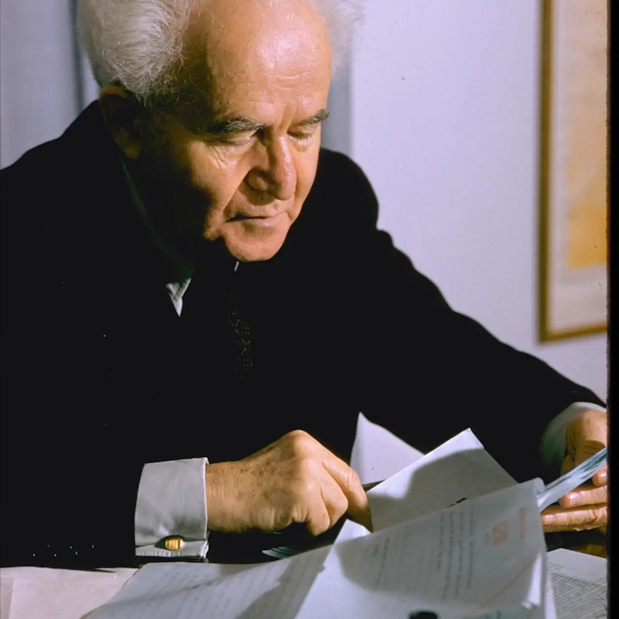
David Ben-Gurion's journals, written between 1948 and 1953, expose many secrets: having Mizrahi Jews surveilled, trying to get Palestinian refugees to leave and detailing rapes committed by soldiers are just a few of them.

David Ben-Gurion looking through documents at his Tel Aviv office, 1959. Credit: FRITZ COHEN / GPO

Ofer Aderet

In one of the pages of his diary, David Ben-Gurion details the targets surveilled by the intelligence agencies of the fledgling Israel, which was not yet a year old. The list, written in Ben-Gurion’s handwriting, includes “secessionists” (members of the Irgun and Lehi militias, who did not bow to the authority of the Yishuv’s elected institutions), “Mizrahi Jews” (specifically the North African immigrants living in transit camps), “political parties” (his political rivals) and the Israeli Communist Party, Maki. Ben-Gurion composed this list after a meeting with Isser Harel, the first head of the Mossad and the Shin Bet security service, who had complained that he had not been allocated sufficient funds or staff.

Since Ben-Gurion penned the list in 1949, it remained hidden in his diary. Only recently, 72 years after it was composed and 48 years after the death of its author, was it released for publication. The Akevot Institute for Israeli-Palestinian Conflict Research, which has been fighting to declassify documents kept in government archives, is responsible for the development. Akevot requested that the Ben-Gurion Research Institute, which owns the diary, to lift the censorship over broad swaths of the journal, as there is no discernable reason for hiding them from public scrutiny in 2021.

'Things are not right in the Negev. Again, our soldiers (Moroccans) caught two young Arab women, and raped and killed them'

After checking with the Israel State Archives, to which the Ben-Gurion Research Institute is subordinate, the latter acceded to the request and lifted the censorship over some of the documents. In the first phase, parts of the diary covering 1948 through 1953 that had been redacted or blacked out were restored.

Perusing the uncensored version does not reveal any state secrets, but does offer the reader a better understanding of various historical events, not to mention the way the author thought and felt about them.

On September 26, 1948, Ben-Gurion wrote about Arab refugees who fled or were expelled from their homes during Israel’s War of Independence. Ben-Gurion recounts a conversation he had with Yosef Weitz, the director of the Land and Afforestation Department at the Jewish National Fund. The two, it seems, were concerned about these refugees’ attempts to return to their homes in Israel.
Handwritten pages from David Ben-Gurion's diaryCredit: Israel State Archives

“There are cases of refugees from Ramle and Lod who reached Gaza through Ramallah, believing that from Gaza it will be easier to return to Ramle or Lod. What should we do?” says the diary, which does not specify whether it is quoting Weitz or expressing Ben-Gurion’s thoughts.

The answer comes in the second half of the sentence: “We have to ‘pester’ them relentlessly…We need to pester and motivate the refugees in the south to move eastward as well, since they won’t go towards the sea and Egypt won’t let them in,” he wrote of pushing these Palestinians toward Jordan. “Who will take care of this pestering?” wonders Ben-Gurion in his diary, answering: “Shiloah, with the help of Weitz’s committee.”

Reuven Shiloah was a leader in the intelligence community and the first director of Mossad. The committee he refers to is the Transfer Committee, which was established in the midst of the war in order to examine government policies regarding Arab refugees, or, more precisely, ways of encouraging them to leave the country.

On April 2, 1950, Ben-Gurion notes in his diary that “things are not right in the Negev,” detailing the murder and rape of Arab women by Israeli soldiers and reprisals by the Egyptian army. “Again, our soldiers (Moroccans) caught two young Arab women, and raped and killed them. In retaliation, the Egyptians laid a mine and an ambush, killing five people – three soldiers and two civilians.”

Ben-Gurion uses the moniker “a typical Nazi” to refer to Pinchas Rosen, Israel’s first justice minister

A month later, Ben-Gurion remarks on the health and mental state of then-Deputy Chief of Staff Mordechai “Motke” Maklef, following a meeting Ben-Gurion held with Maklef’s wife Orit. “Motke is tired and depressed. He’s shouldering a huge burden, which he believes in unbearable, both physically and mentally,” writes Ben-Gurion. “He has no family life, [Orit] doesn’t care because she has no choice,” he adds.

At the end of the paragraph Ben-Gurion writes: “I’m sorry about the missed family life, but in our generation, we have to be cruel – security is not an easy or soft issue. If needed, the defense minister will send people like Motke to be killed. The army needs him, and in my opinion he has to stay.” As usual with this diary, it’s not entirely clear whether he was quoting Maklef’s wife or adding his own thoughts, or whether it was a mix of both. Maklef would go on to become Israel’s third chief of staff.

David Ben Gurion in his study at his home in Sdeh Boker, Southern Israel, in 1954.Credit: COHEN FRITZ / GPO

Another newly uncensored section relates to the sinking of the Irgun arms ship Altalena by the newly created Israel Defense Forces in June 1948, an incident which roiled the Yishuv. In his diary, Ben-Gurion describes a stormy government meeting following pressure to release Irgun members who were detained after exchanging fire with the IDF. The diary refers to individual Knesset and cabinet members as “despicable,” “doormats,” “contemptible” and “worthless” (though it’s not always clear to whom he is referring). Ben-Gurion notes that “the lowlife” must resign, since “I told him that justice must be served for shooting at Jews.” He summarized the issue: “That’s the situation in the party. I’m in despair.”

Also uncensored is a section describing a 1951 meeting between Ben-Gurion and Ernst David Bergmann, a leading Israeli scientist who was responsible for several scientific projects for the military. “Dr. Bergmann came to see me. They’ve prepared some synthetic material that causes cancer, and it enables testing for cancer at a very early stage,” says Ben-Gurion. He does not elaborate.

The uncovering of these censored sections – dozens of them of varying lengths – took two years from the day historian and Akevot researcher Adam Raz filed his request to lift the censorship. However, much material still remains censored in these diaries, as well as in other documents in the possession of the Ben-Gurion Institute. In tandem, Akevot has also asked the State Archives that many other documents from the period be uncensored, as there is no obvious reason to keep them out of the public eye.

“Uncovering the blacked-out sections (partially so) of the diary is an important step,” says Lior Yavne, the director of Akevot, adding that “blacking out archived documents creates huge sinkholes into which important parts of the history of Israel and its society disappear.” These blackouts remain in place even many years after the law permits their removal, partly due to a lack of resources, awareness or willingness on the part of the archives.

David Ben-Gurion in the library of his home at Sde Boker, in 1968.Credit: COHEN FRITZ / GPO

Raz adds that historical research cannot be complete without a researcher approaching an archive in search of documents that are still censored, with a demand to disclose their contents.

Exposing these previously censored parts of Ben-Gurion’s diary illustrates how heavy-handed censorship can be when it comes to historical documents. In many cases, Yavne says, it shows that they were not kept from the public due to security, diplomatic or privacy reasons, “but for entirely different considerations, such as protecting the public image of some institution or figure, or withholding information or preventing discussions on the foundations of the Israeli-Palestinian conflict.” In other cases, sections of Ben-Gurion’s diary that were censored for decades were available in other archives, indicating that there is no consistent policy when it comes to the censorship of archived documents.

Historian Tom Segev, who wrote the Ben-Gurion biography “A State at Any Cost,” says that the newly uncensored texts document “Ben-Gurion’s vulgar speech.” He points to one uncovered section, in which Ben-Gurion uses the moniker “a typical Nazi” to refer to Pinchas Rosen, Israel’s first justice minister.

“He meant, of course, that Rosen was a pedant, a Yekke,” a term for Jews of German origin. “Ben-Gurion viewed him as a necessary nuisance. There was nothing he hated more than people who said no to him, especially lawyers,” says Segev. “The use of the term Nazi indicates the ease with which Ben-Gurion used this epithet,” Segev says, adding that Ben-Gurion’s rival Menachem Begin received a similar nickname.

Segev is calling for more sections of the diary and other documents at the Ben-Gurion archive to be uncovered. “There are truly important things which were never released for publication, such as the claim that Israel was behind an attack on a synagogue in Baghdad in 1951 in order to encourage Iraqi Jews to come to Israel, as well as the Lavon Affair in Egypt,” Segev says. “What’s the secret? There are more cases like this.”

zaterdag 8 mei 2021

Koloniaal Nederland was zelf een fascistische bezetter


OpinieOorlogsslachtoffers

Koloniaal Nederland was zelf een fascistische bezetter


Op zaterdag is het exact 400 jaar geleden dat Jan Pieterszoon Coen 47 Bandanese leiders liet vermoorden, het sluitstuk van een twintigjarige terreurcampagne van de VOC. De recente aandacht voor de genocide op de Banda-eilanden (1621) wist het bestaan van overlevenden uit. Het is tijd dat Nederland deze geschiedvervalsing erkent en de Bandanese diaspora recht doet, meent Marjolein van Pagee, oprichter van de stichting Histori Bersama.

Dodenherdenking ligt weer achter ons. Het jaarlijkse moment dat het Nederlandse volk wordt uitgelegd wie wij, historisch gezien, zouden zijn. De nationale identiteit draait sinds de Tweede Wereldoorlog hierbij om wit slachtofferschap van Duits en Japans fascisme. Daarbij wordt nadrukkelijk niet gesproken over het inherent fascistische aan het Nederlandse koloniale project, dat meer dan 400 jaar geleden begon. Laat staan dat het om de slachtoffers gaat. Sterker nog, het zijn juist koloniale daders die op 4 mei worden herdacht: militairen, zoals mijn opa, die tussen 1945 en 1949 naar Indonesië zijn gestuurd.

Ook dit jaar klonk op 4 mei de tekst dat ‘alle burgers die zijn omgebracht of omgekomen in Azië’ worden herdacht. Echter, uit de brochure De doden tellen van het Nationaal Comité 4 en 5 mei blijkt dat alleen de mensen die in de kolonie de Europese status genoten, worden meegeteld. De naar schatting 4 miljoen Indonesiërs die tijdens de Japanse bezetting omkwamen en die door Nederland als ‘koloniale onderdanen’ werden beschouwd, tellen niet mee. De meer dan 100.000 Indonesische burgers die door Nederlandse terreur om het leven kwamen ná 1945 worden al helemaal niet genoemd.

In hetzelfde jaar dat de Nederlandse regering de onafhankelijke Republiek Indonesië aanviel, besloot men om militairen die gedood waren in de strijd tegen de Duitsers nationaal te herdenken. Opvallend is dat de organisatoren zich niet bekommerden om Joodse genocide-slachtoffers. Mensen als Anne Frank, later gekaapt als nationaal symbool, deden er kennelijk niet toe.

4 mei begon met collectieve uitwissing van genocideslachtoffers

De start van de nationale herdenking kenmerkt zich door collectieve uitwissing van genocideslachtoffers. Ook al werden zij later toegevoegd, nadien werd er over de uitwissing zelf niet meer gesproken. In ieder geval is Dodenherdenking van oorsprong geen ‘grassroots-initiatief’ van de mensen om wie het zou moeten gaan. Ook nu Joodse slachtoffers (en Sinti en Roma) wél worden genoemd, wordt niet uitgelegd dat de meeste Nederlanders helemaal niet in opstand kwamen tegen de Duitse bezetter.

Vanuit de wereldgeschiedenis bezien zijn Nederlanders geen slachtoffers maar daders, bezetters van andermans land. Niet vijf jaar, maar 350 jaar lang voerde Nederland een fascistisch beleid tegenover niet-witte volken. Tussen 4 mei en 8 mei zitten maar vier dagen. Precies 400 jaar geleden, op 8 mei 1621, liet Jan Pieterszoon Coen 47 Bandanese leiders vermoorden, het sluitstuk van een twintigjarige terreurcampagne van de VOC.

Wat hadden Nederlanders op Banda te zoeken? De Banda-eilanden vormden in de zestiende eeuw het centrum van een goed functionerend handelsnetwerk in nootmuskaat en foelie. Daaraan kwam abrupt een einde toen Nederlandse schepen in 1599 de kleine archipel bereikten. De Nederlanders dwongen de Bandanezen de handel met andere volken te staken en uitsluitend aan hen te leveren. Natuurlijk verzetten de eilandbewoners zich tegen deze absurde eis, waarop het VOC-bestuur besloot om hen met geweld van hun land te verdrijven en er een plantagekolonie te stichten.

In de vorm van tentoonstellingen, publicaties en (online) bijeenkomsten wordt dit jaar meer dan ooit aandacht besteed aan Banda. Zo organiseert het Westfries Museum de tentoonstelling Pala – Nutmeg ­Tales of Banda. Het Scheepvaartmuseum toont het fotoproject I love Banda van Isabelle Boon. Verder hebben Nederlandse academici zich verenigd onder de noemer Banda Working Group. Ze werken samen met geschiedenisexperts uit Indonesië.

Overlevenden Banda uitgewist

Echter, net als bij dodenherdenking zijn dit geen initiatieven vanuit de gemeenschap die het leed is aangedaan. Zoals de identiteit van Anne Frank werd ‘gekaapt’, gebeurt dat nu met Banda, gebaseerd op uitwissing van de overlevenden. Om de ernst van Coens daad te benadrukken hebben historici vaak herhaald dat nagenoeg alle eilandbewoners omkwamen. Zo ontstond het beeld dat er geen Bandanese nazaten zijn die het kunnen navertellen. Ook mijn verbazing was groot toen ik tijdens het schrijven van mijn boek Banda. De genocide van Jan Pieterszoon Coen (2021) hoorde over een Banda-diaspora-gemeenschap. Christa Soeters, die eerder in 2016 de dodenherdenking fascistisch noemde en een storm van kritiek over zich heen kreeg, bracht mij in contact met drie nazaten die in Nederland wonen: Ridhwan Ohorella, Lukas Eleuwarin en Marcel Matulessy.

Wat blijkt? Vóórdat Coen met zijn oorlogsvloot op Banda aankwam, was een aanzienlijk deel van de bewoners mét hun leiders tijdig naar andere eilanden uitgeweken. Hun vertrek was een weloverwogen beslissing, geen vlucht, ze spreken zelf over ‘migratie’. Zeshonderd Bandanezen vestigden zich op de Kei-eilanden, waar hun nazaten tot op de dag van vandaag leven. Hun lange geschiedenis hebben zij op schrift staan.

Als we vanuit Nederland aandacht aan Banda willen besteden, laten we dan beginnen met de erkenning dat de genocide gepaard ging met geschiedvervalsing. Het is hoog tijd om recht te doen aan de fakkeldragers van de gemeenschap die moest verdwijnen maar niet verdwenen is.

https://www.trouw.nl/opinie/koloniaal-nederland-was-zelf-een-fascistische-bezetter~b58d058f/

--------------------------------------------------

     Mijn Commentaar :

1. Onderstaande is een thema-relevante uitsnede uit een schrijven dat ik de tiende februari 2020 aan belanghebbende derden deed toekomen.

2. Het bewuste schrijven, dat deel uitmaakt van mijn langjarige niet aflatende strijd tegen democratie ondermijnende activiteiten, handelde overigens onder meer over het als causaal te veronderstellen verband tussen veelvuldig machtsmisbruik door malafide overheden enerzijds en anderzijds de dreigende teloorgang van - niet alleen het publieke draagvlak onder onze kostbare en duur bevochten democratische rechtsstaat, maar van - het draagvlak voor de democratische beginselen an sich.

3. Door dit proces van steeds verdergaande erosie van het democratisch bewustzijn bij steeds grotere delen van de Nederlandse burgers, lijkt een navenante, steeds groter wordende bereidheid te zijn  ontstaan om zich aan te sluiten bij die partijen, die totalitair gedachtengoed en bijbehorend etnisch nationalisme voorstaan.

4. Gedachtengoed, dat in toenemende mate een steeds grotere overeenkomst lijkt te gaan vertonen met de nazistische ideeënleer.

5.  Ook hier is weer de stuitende hypocrisie zichtbaar tussen de jaarlijkse vierde mei herdenking van de slachtoffers van het verderfelijke nazi regime en de klaarblijkelijk relatief sterk toenemende tolerantie bij het grote publiek voor de ideologische nazaten van datzelfde regime, die inmiddels al vele zetels in ons parlement hebben veroverd.

-------

"De 1ste september 2019 : Zijnde de dag waarop wij wederom het formele begin in 1939, van WOII herdachten.

De Tweede Wereldoorlog, waarin de ver daarvoor reeds ingezette opkomst van autoritair extreemrechts-populisme, fascisme, militarisme, racisme en ultra- nationalisme uiteindelijk zouden culmineren in een jarenlange uitermate pijnlijke proeve van extreem gewelddadig kolonialisme binnen en buiten Europa.

Gewelddadig kolonialisme, als bekend, geëntameerd vanuit nazi-Duitsland-Oostenrijk en het Italië van Mussolini en later (vanuit het Japan van de wrede Hirohito) binnen delen van Azië.

Dit expansionistische en etnisch-suprematistische kolonialisme heeft als bekend, tientallen miljoenen doden tot gevolg gehad, en een veelvoud daarvan aan gewonden, verminkten en ontheemden, alsmede een megabedrag aan pure kapitaalvernietiging.

De Tweede Wereldoorlog, die tevens een eerste grote aanval was op de toen net voorzichtig ontluikende democratische ontwikkelingen in onze contemporaine westerse wereld.

Een aanval op onze kostbare jonge democratische maatschappijen, die als bekend, deze keer - zij het ternauwernood, want pas in tweede instantie en niet, dan met de inzet van een moeizaam bijeen gebrachte, grote overmacht van mensen en middelen - gelukkig kon worden afgeslagen, voordat de grootscheepse koloniale usurpatie onomkeerbaar zou zijn geworden.

    "De Bevrijding" (van de verschrikkingen van WOII) heeft trouwens eveneens geleid tot de eerste golf van (gedwongen) westerse dekolonisatie, waarbij - zij het al evenzeer met vele miljoenen onschuldige slachtoffers als gevolg - eindelijk een einde werd gemaakt aan de schandelijke praktijken van vele wrede, niets en niemand ontziende westerse ethnic-supremacist regimes, die veel wingewesten over de gehele wereld eeuwenlang ten deel waren gevallen.

Daarmee werd tevens een stuitende innerlijke tegenstrijdigheid binnen de gelederen van de toenmalige deelnemers aan de westerse democratische processen opgelost.

De innerlijke tegenstrijdigheid namelijk, waarbij het zich als (vaak semi-) democratische mogendheid afficherende moederland, zich buiten haar landsgrenzen schaamteloos als een onvervalst dictatoriaal ethnic-supremacist regime manifesteerde en in die hoedanigheid op uiterst ondemocratische wijze de door haar met grof geweld veroverde koloniale wingewesten bejegende (lees : de autochtone populatie van deze wingewesten gewelddadig onderdrukte, terwijl deze koloniën tegelijkertijd even ruecksichtslos als stelselmatig werden leeggeroofd)."

----------


dinsdag 4 mei 2021

Omstreden posteractie FVD heeft voor partij geen bestuurlijke consequenties


Omstreden posteractie FVD heeft voor partij geen bestuurlijke consequenties

Tweede Wereldoorlog Kamerleden keuren de oorlogsvergelijking van FVD af. Maar VVD en CDA zeggen de samenwerking in Brabant niet op

Thierry Baudet staat met de zogenoemde ‘vrijheidskaravaan’ van FVD op een parkeerplaats in Tholen, waar hij campagne voert tegen de coronamaatregelen  Foto Venema Media/ANP

Reageren of negeren? VVD’er Ton Elias weet het wel: volgens het oud-Kamerlid heeft Forum voor Democratie een grens overschreden met de poster die de partij de afgelopen dagen op Twitter verspreidde. En dat kan niet zomaar worden weggewuifd, vindt Elias. „Mensen moeten wakker worden.”

Op de poster is de bekende vrijheidsvlam te zien, het symbool van Dodenherdenking en Bevrijdingsdag. Die begeleidt normaliter de slogan ‘Op 4 en 5 mei staan we samen stil bij vrijheid’. Maar deze poster zegt iets anders: ‘Op 5 mei herdenken we 75 jaar vrijheid’. De vrijheid die Nederland herwon aan het eind van de Tweede Wereldoorlog, is de suggestie, is in 2020 – 75 jaar later – geëindigd met de invoering van de coronamaatregelen.

De poster maakte verontwaardigde reacties los bij Kamerleden. Lilian Marijnissen (SP) schreef op Twitter: „Hoe triest ben je om het immense leed van zoveel mensen, een gitzwarte periode in onze geschiedenis, te misbruiken om aandacht te krijgen?”. Anderen noemden het „een dieptepunt” (D66-leider Sigrid Kaag), „heel, heel fout” (VVD-Kamerlid Dilan Yesilgöz), „walgelijk” (PvdA-leider Lilianne Ploumen en GroenLinks-leider Jesse Klaver) en „niet te geloven” (CU-leider Gert-Jan Segers).

Forum voor Democratie, dat vorig jaar als eerste voor een ‘harde lockdown’ pleitte, schroomt inmiddels niet meer om het coronabeleid te vergelijken met de oorlog. Volgens Baudet politiseren zijn „tegenstanders” de oorlog „al decennia”, twitterde hij maandag. „Wat een hypocrisie.”

Vorige week vergeleek FVD-Kamerlid Pepijn van Houwelingen het vooruitzicht van een quarantaineplicht voor reizigers die zich niet willen laten vaccineren al met de oorlog. „Zoals u wellicht weet, hadden we in de Tweede Wereldoorlog ook last van een totalitaire samenleving”, zei Van Houwelingen. „De vergelijking zit op het punt dat je dus langzaam kruipt richting een totalitaire samenleving.”

Het is een bont gezelschap waarmee FVD op de poster prijkt, van ukuleleband ‘Ukes for Freedom’, die volhoudt dat vaccinaties onnodig zijn als je immuunsysteem maar op orde is, tot complotgroepen als Stichting Properganda, dat beweert dat de pandemie is „gesimuleerd en uitgerold”.

‘Glashard aanpakken’

In Den Haag kunnen Baudets uitingen doorgaans op rituele afkeuring rekenen. Dat is nu niet afdoende, vindt Elias. Andere Kamerleden moeten Baudet en FVD „glashard aanpakken”, zegt hij. „Het volstaat niet om er alleen wat op Twitter over te zeggen, politici moeten handelen in de Tweede Kamer. Tegenspreken, met feiten klem zetten, excuses eisen, dát is wat er moet gebeuren.” Negeren is volgens Elias geen goede strategie: „Dat is hoe het in de Weimarrepubliek kiemde.”

Dave Ensberg is het met hem eens. De directeur van Jantje Beton zegde dit weekend zijn CDA-lidmaatschap op, ook omdat zijn partij zich in zijn ogen veel te zacht opstelt richting Forum. In de poster zag hij die vrees bevestigd. „Waartoe ben je als politieke partij op aarde? Je waarden trouw zijn. Kwaad benoemen wat kwaad is. Laten we niet normaal maken wat niet normaal is, zoals de koning vorig jaar zei.”

Buiten Den Haag zien Haagse principes er soms anders uit, blijkt. VVD en CDA keurden Baudets herdenkingsposter af, maar de twee partijen vormen in Brabant nog altijd een coalitie met FVD, samen met JA21 en Lokaal Brabant. Ensberg „prijst de dag” dat die coalitie sneuvelt, maar Elias is daar „voorzichtig” over. „Ik ken de feiten niet, ik weet niet of de FVD-afdeling er iets over gezegd heeft. Het gaat daar om het uitvoeren van een gezamenlijk bestuursakkoord. Er is geen extreem-rechtse manier om het over lantaarnpalen te hebben.”

Elias’ redenering lijkt op de boodschap die CDA en VVD vertolken sinds ze vorig jaar in Brabant met FVD in een provinciale coalitie stapten. Brabant is Brabant en niet Baudet, zo klonk het toen.

Ook nu zien de partijen geen reden om een punt achter de samenwerking te zetten. Ankie de Hoon, CDA-fractievoorzitter in de Brabantse Staten, vindt dat FVD „een hele onsmakelijke vergelijking” heeft gemaakt, maar wil er niet te veel woorden over kwijt. „Je wilt het gewoon geen aandacht geven.” VVD-fractieleider Suzanne Otters-Bruijnen noemt de FVD-poster „walgelijk”. Ze heeft fractievoorzitter Camiel van der Meeren erover „bevraagd”, zegt ze. Uit zijn antwoord maakte ze op dat de Brabantse FVD-afdeling de link naar de oorlog niet gepast vond. Otters-Bruijnen wist daarmee genoeg: zij vindt niet dat de kwestie de samenwerking in Brabant verder in de weg staat.

Op een verzoek van NRC om een reactie reageerde Van der Meeren kort: het gaat om een „landelijk bericht” en de Brabantse FVD-fractie wil dit „ook als zodanig behandelen”.

Willem Rutjens, die in januari overstapte van FVD naar JA21, en nu fractievoorzitter is van de Brabantse afdeling, zegt: „Ik heb zelf niet voor niets met Forum gebroken. Om dit soort dingen. Maar hier rekenen we elkaar af op het bestuursakkoord.”

Ensberg heeft lang getobd voor hij zijn CDA-lidmaatschap opzegde, maar spijt heeft hij niet. „Het bedrijfsfiliaal Brabant kun je niet los zien van het hoofdkantoor. Dit gaat om hoe je naar mensen kijkt.”

https://www.nrc.nl/nieuws/2021/05/04/is-de-rituele-afkeuring-nu-voldoende-rond-de-vrijheidsposter-van-fvd-a4042370

----------------------------------------------------------

Mijn commentaar :

1. Hoe geloofwaardig is het om met droge ogen te stellen, per heden (de vierde mei) de vele slachtoffers van de nazi’s te herdenken, als anno 2021 meerdere politieke partijen (mede) in onze nationale volksvertegenwoordiging hebben plaatsgenomen die - niet alleen gelijksoortige abjecte racistische en fascistische ideeën propageren als die ideeën, die tijdens het zogenoemde derde rijk werden gepropageerd, maar – zelfs lieden in hun midden tolereren die diezelfde nazi’s en hun abjecte ideeënleer openlijk vereren en propageren. 

2. Voornoemde partijen gebruiken (behalve via tal van alternatieve propaganda-kanalen) langs deze "formele", want  "institutionele" weg op cynische wijze ons zwaarbevochten democratische systeem om hun abjecte ideeënleer wit te wassen en aldus salonfähig te maken.

3. Dit witwassen kan gebeuren, aangezien ontegenzeglijk een legitimerende werking uitgaat van hun aanwezigheid en politieke acteren in onze publiek-bestuurlijke gremia en zij daarnaast diezelfde instituties schaamteloos gebruiken als (vaak buitengewoon effectief) propaganda platform.

4. Echter, een van de belangrijkste voedingsbodems voor de relatieve exponentiele toename van (de omvang van) deze partijen is op paradoxale wijze gelegen in het ernstig disfunctioneren van een aantal van onze (locale, provinciale en nationale) overheden binnen het democratisch bestel van ons land, zoals het recent blootgelegde kinderopvangtoeslag schandaal weer eens pijnlijk duidelijk heeft gemaakt.

5. Als gevolg van malafide opererende overheden raken steeds meer burgers gedesillusioneerd, zowel in onze democratische overheid als in onze democratische instituties als geheel.

6. Deze levensgevaarlijke desillusie ontwikkelt zich de laatste jaren zelfs in die mate, dat een toenemend aantal burgers zelfs het vertrouwen is verloren in de democratische principes van en dito idealen achter onze kostbare rechtsstaat als geheel.

7. Het gevaar is derhalve verre van denkbeeldig, dat zij daardoor mede (extra) ontvankelijk worden voor de lokroep van extreem rechts-radicale denkbeelden, die met de regelmaat van de klok door malicieuse lieden als Baudet en Wilders worden gepredikt.  

8. Extreem rechts-radicale denkbeelden, waaronder bijpassende autoritaire staatsvormen en de door dezen van harte aanbevolen geweldsspiralen, te ontketenen tegen medeburgers met een voorkeur voor meer inclusieve, meer kosmopolitische in plaats van (bijvoorbeeld) wit-suprematistische / ultra etnisch-nationalistische waardenstelsels.