
When Palestinian peasants brought an empire to its knees
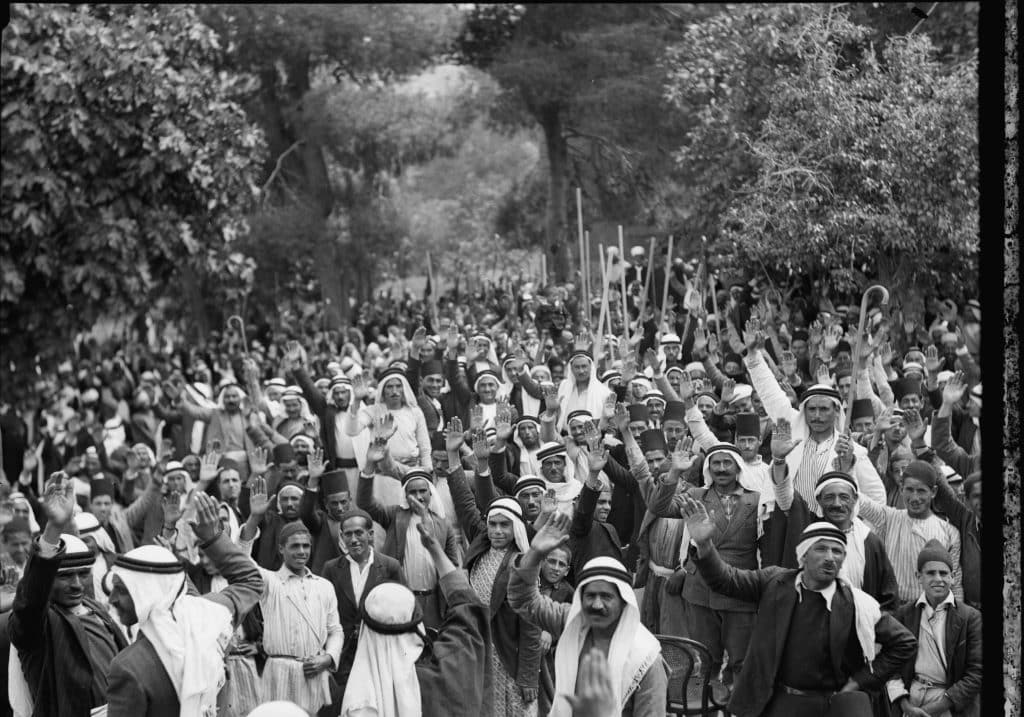
There was a time in Palestine when the greatest empire in the world lost control of entire areas, when highly educated lawyers followed the orders of simple illiterate peasants, and when wearing the Palestinian scarf, or koufiyyeh, became a political statement. Just like Palestine’s name, it has almost been forgotten from the world’s memory.
Palestinian director Annemarie Jacir’s recent film, “Palestine 36,” tells part of that story, shedding light on one of the most dramatic and crucial episodes of Palestinian history: the 1936-1939 revolution.
The film takes place between Jerusalem and the nearby fictionalized village of al-Basma, spanning the years in which Palestinians launched an uprising against the British Mandate and Zionist settler colonialism. The story follows the lives of several characters descended from the rural Palestinian peasant class, the urban middle class, and the traditional elites. A fair bit of the movie is devoted to unearthing the divisions between them, especially differences over how to respond to the increasingly aggressive Zionist settler movement, which operated under the discriminatory protection of the British. Some continued to opt for diplomacy with the British out of concern for their social and financial privileges. Others, directly impacted by British colonial policies and Zionist land grabs, joined the uprising in earnest, facing brutal repression.
“Palestine 36” is the first rendition of the 1936 revolution for the big screen. The international audience for which it was largely intended knows little of this history, and in that respect, the film aptly delivers, and with aesthetic finesse. But for Palestinians, recent years have seen a renewed interest in the 1936 revolution, especially for the younger generation of Palestinians who grew up under the Oslo Accords and the era of Palestinian defeat. That’s why the planned screenings of the movie in Ramallah had to be repeated several times to accommodate the intense local interest in seeing it.
The renewed interest in the 1936 revolution could be traced back to the period of revived political consciousness among young Palestinians during the past decade, becoming increasingly present in cultural circles and activist groups. Youth organized local visits to West Bank villages following in the footsteps of the revolution’s protagonists and their local stories. Folk artists featured stories about how the Palestinian peasant “fallahi” culture came to represent national liberation in those years. Young historians and researchers produced dozens of articles on specific aspects of that period, including the short-lived “state” proclaimed by revolutionaries in the hills of Hebron, the historical figure behind an iconic 1936 poem, and the real story of the Palestinians who collaborated with the British against the revolution.
“Palestine 36” can be seen as a continuation of this Palestinian effort to reclaim the narrative of a key period of Palestine’s modern history.
Palestinian writer and founder of Palestine’s “Popular University” project, Khaled Odetallah, has been an important figure in this recent revival. He says that the 1936 revolution was “a foundational event of Palestinian nationalism.”
“Because contrary to previous attempts by Palestinian urban elites to formulate a national movement after the end of WWI, the 1936 movement erupted from the popular base of Palestinian society,” Odetallah told Mondoweiss.
“‘Palestine 36’ captures this historical event successfully and in a highly aesthetic manner, and it does deliver the essentials about it to an international audience that might not be familiar with it,” Odetallah continued.
But as a well-made artistic work, Odetallah believes the movie still couldn’t capture all the dimensions of the poor peasant uprising that had posed a serious challenge to the British empire, “which controlled half of the world at the time,” he said.
Odetallah points out that the fictional film al-Basma is clearly inspired by the real-life village of al-Bassa in the Galilee, even though the film depicts the village as near Jerusalem.
Al-Bassa was a predominantly Christian village that would come to be ethnically cleansed in 1948. Before that, its residents were swept up in the revolution, as British soldiers, in an effort to put down the revolt, entered al-Bassa on September 6, 1938, and sprayed the villagers with machine gun fire for 20 minutes before burning it to the ground, according to the testimony of a British soldier.
“Many of the events portrayed in the film actually took place in al-Bassa, especially some of the cruelties committed by the British forces,” Odetallah explained.
Jacir’s historical epic also takes pains to shed light on some of the British figures behind the brutal repression of the revolt. This is perhaps best encapsulated in the character of Captain Wingate, clearly inspired by the real-life mastermind behind the British repression of Palestinian villages during the revolution, Orde Charles Wingate.
His cruelty and violence towards Palestinians, and his ideological Christian Zionism, are one of the film’s high points as far as historical portrayals go. But it “failed to show the more strategically important role of Wingate,” Odetallah said. “Wingate was the engineer of the Zionist military doctrine during the Nakba, and he was the person who trained the Zionist militias in how to repress and depopulate Palestinian villages, to the point that he introduced Zionist militia men into his troop during his counterinsurgency campaigns in the Palestinian countryside.”
One of those Zionist militia men was none other than Moshe Dayan, who would go on to become Israel’s Defense Minister and called Orde Wingate his “first teacher” in his diaries. Many of the methods used by the Israeli army today, like punitive home demolitions and mass arrest campaigns, were introduced by Wingate and other British officers in the 1930s. The film does show these British practices, but it doesn’t highlight the direct connection between the British military and Zionist paramilitary forces.
A class-based revolution
The film also sheds light on the social contradictions in Palestine during the 1930s, even highlighting aspects largely ignored by mainstream Palestinian narratives — namely, the collaboration of some Palestinian elites with the British against the revolution. The film shows, for example, a prominent Palestinian journalist and editor whose wife discovers that he had been on the payroll of the Zionist organization to publish articles unfavorable to the revolution, under the promise of helping him become mayor.
“The film does a courageous thing in breaking some taboos,” Odetallah noted. “This did happen, and it is difficult to write about these treasons in academia today, but what the film failed to capture, in my opinion, is the more structural, class-based type of collaboration with the colonizers,” he said.
“There is the petty collaboration of some individuals which needs to be hidden, but there were in the 1930s entire elite families and groups whose behavior was nothing more than the logical protection of their interests, and who openly acted against the revolution,” he explained. “Including that could have more deeply captured the class dynamics of the times.”
Understanding the class character of the revolution and the social and political forces that opposed it ultimately helps explain how it was crushed by 1939. The first Palestinian who took up the task of mapping these class dynamics was Palestine’s literary juggernaut, Ghassan Kanafani. The result was his pioneering in 1971 study of the revolt, which opened with the statement that the anti-colonial revolution in Palestine was defeated “by the alliance of British and Zionist colonial forces, the surrounding Arab regimes, and the local traditional elites.”
The importance of Kanafani’s study — the only historical piece he has written that isn’t literature or political journalism — lies in the fact that it isn’t really about the past.
Palestinian historian and educator Hazem Jamjoum, author of the latest English translation of Kanafani’s work, has pointed out that Kanafani wrote the study in the aftermath of Black September, the devastating war launched by the King of Jordan against the Palestine Liberation Organization, which ended with the Palestinian resistance leaving the country. Kanafani sensed that it was the beginning of a process that would pave the way for a politics of compromise and political capitulation instead of liberation. He identified this tendency as encapsulated in the Arab regimes and Palestinian elites’ class-based interests. According to Jamjoum, Kanafani’s study was essentially issuing a warning to his time.
As a self-proclaimed Marxist, Kanafani chose the 1936 revolution precisely for its obvious class character and its foundational nature in Palestine’s national struggle. He was laying the groundwork for a counter-narrative of the Palestinian struggle, told from below rather than from the top down.
“Palestine 36” doesn’t exactly adopt this particular reading of history, although it certainly isn’t hostile to it. It places the film’s characters at the center of the events, emphasizing their individual stories and trajectories, while avoiding foregrounding a single character as the hero. In this, the film hints at the spirit of collectivity in the revolt, keeping the story a collective one, just not of a specific class or group.
Some characters in the film remain somewhat flat in the background, but the main ones undergo an evolution in self-awareness. This happens to Yousef, the young man who wants to escape his rural village life and ends up fighting the British in its hills. But it also happens to Khuloud, the educated journalist in the city with close connections to British government employees, who starts out hoping that the uprising doesn’t spiral out of control and that the national leaders will unite. She ends up leaving her husband and joining protesters in the street.
Yet even though the film sets the revolution in the countryside, most of the political dialogue takes place in the city between Palestinian elites and the British. It is as if the events are centered in one world, and the reflection about them in another.
This is most starkly highlighted when the characters learn about the results of the British Peel Commission on Palestine, which recommended the partition of the country to give half of it to the Zionist movement. The dialogue concerning the commission and the ensuing argument over it all happens in a Jerusalem city house around a social dinner table, in the presence of a British government employee. This contrasts with the reaction in the village, where people pour out into the fields in anger and chase British patrols with stones.
This also applies to the movie’s portrayal of Palestinian social dynamics. We can clearly see how urban society is structured and how the relations among the political leaders, the journalists, the businessmen, and the British evolve. But we don’t learn much about the village — its family and clan structure, social hierarchies, or how the revolution sprang from Palestinian village society and impacted them. This tended to render the Palestinian village as something of an archetype, to the point that its culture was largely absent. Despite actors’ efforts to use the rural Palestinian pronunciation of certain letters, it didn’t capture the accent, mannerisms, or speech style of Palestinian villages. For an international audience, this isn’t an issue, but for a Palestinian audience, it sticks out like a sore thumb.
Yet in its most important task, “Palestine 36” does what few other films have done for an international audience: it places the 1936 revolution at the center of the Palestinian narrative. First-time viewers will come away from the movie knowing that they just learned of a key and foundational episode in the decades-long Palestinian struggle for freedom. More importantly, it makes up the core of what it means to adopt Palestinian identity: fighting for freedom demands a price, and even then, the results are never guaranteed.
This is most poignantly captured in one of the film’s final scenes. After the destruction of the village by the British, one of the characters tells a child, “It is not the first time, and it won’t be the last. There is still a long way to go.” With that, history comes full circle.
https://mondoweiss.net/2026/02/when-palestinian-peasants-brought-an-empire-to-its-knees/

Geen opmerkingen:
Een reactie posten
Opmerking: Alleen leden van deze blog kunnen een reactie posten.