woensdag 9 mei 2018

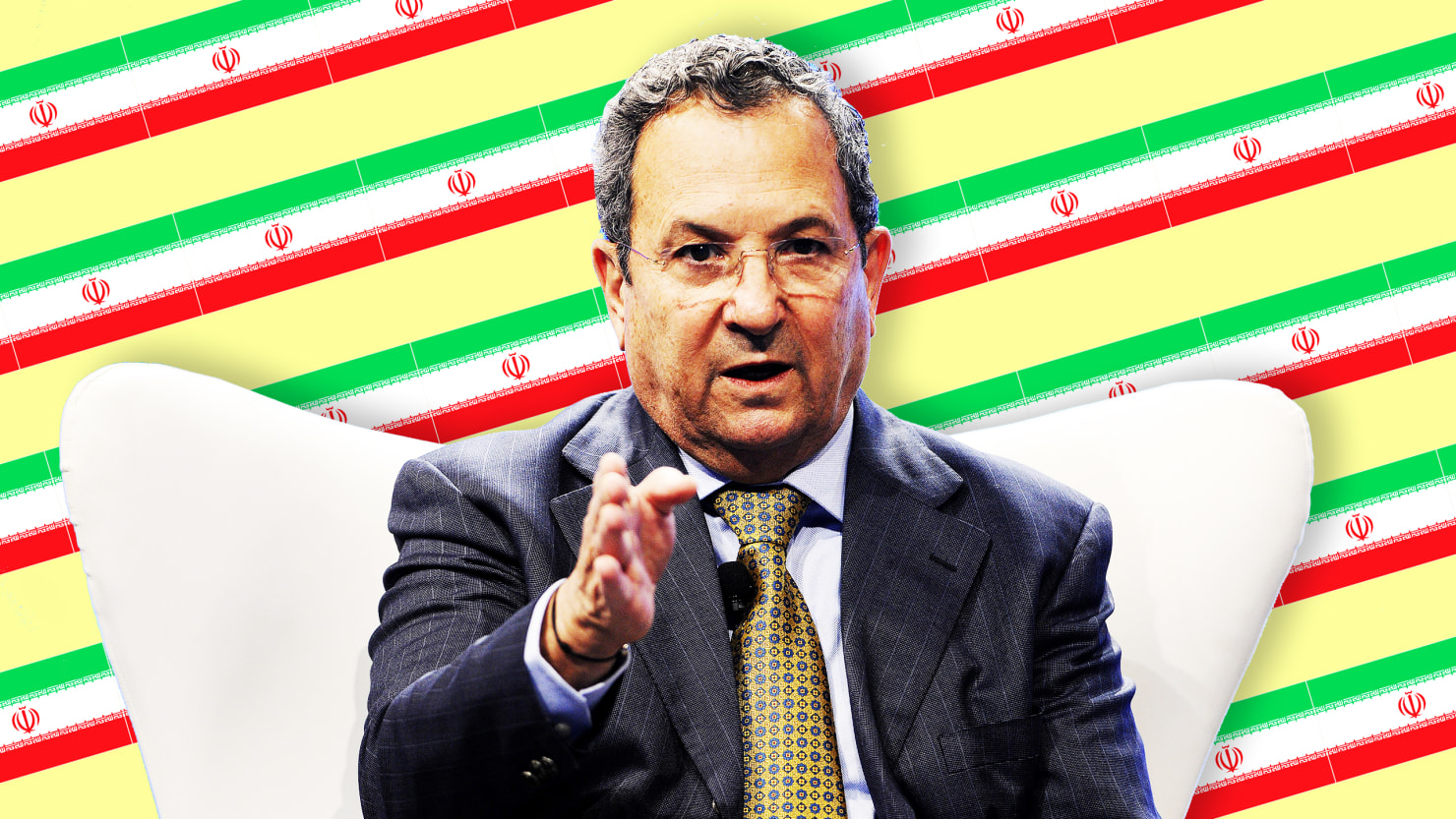
Israel’s Ex-Prime Minister Ehud Barak Says Keep the Iran Nuclear Deal


Afbeeldingsresultaat voor the daily beast


ALL THINGS CONSIDERED

Israel’s Ex-Prime Minister Ehud Barak Says Keep the Iran Nuclear Deal

Barak hated the Iran nuclear accord while it was being negotiated, but since it was signed, thinks it makes no sense to tear it up. And his big worry remains the Palestinians.

TEL AVIV—Ehud Barak—Israel’s most decorated soldier, former army chief of staff, and former prime minister—was in an introspective and relaxed mood one recent Friday.
Not surprising for a man, now 76 and sporting a late-age black beard, whose life began even before Israel’s creation and brought him to the state’s highest pinnacles of power. Also explaining the mood was the English-language memoir he has coming out this week in the U.S.—titled My Country, My Life: Fighting for Israel, Searching for Peacea “long and weighty effort,” he said with relief, that interweaves his own personal and political journey with that of his nation.
A notoriously evasive interview subject, Barak’s responses come out in torrents, like a university lecturer confident in both his own intellect and that of his audience. At various points during a long and expansive conversation—about Iran, Syria, Russia, the Palestinians, Benjamin Netanyahu, and more—he throws in references to Hume, Kant, Fukuyama and Jonathan Haidt, as well as the many Israeli and world leaders (Obama, Putin, Bill Clinton, Yasser Arafat, Yitzhak Rabin, Menachem Begin, to name a few) he has worked with going back decades.
He’s not obfuscating necessarily, but rather patiently explaining, trying to convince, trying to make you see things his way. If hesitation creeps into his voice—if he feigns uncertainty—then it’s likely for a greater purpose. “I do my best to open people’s eyes and make people aware of where this government is taking us,” he said, jibing with his recent reemergence on the public stage as a fierce critic of the current Netanyahu government.
There are few in Israeli politics with the experience and gravitas to make a stronger case. Yet he himself has been out of politics for five years now, his last position as Netanyahu’s defense minister, a role his left-wing (Labor Party) base likely still hasn’t forgiven. It’s precisely this fact, though, combined with the reality that he’s one of only three still-living prime ministers, that arguably gives him the most insight into the many fraught issues facing Israel today.
Take the perceived weightiest of them all: Iran. Barak, as defense minister from 2009 to 2013, was deeply involved in the run-up to the signing of the Iran nuclear agreement. Indeed, he, more than Netanyahu, was known to be a hardliner on the issue, even going so far as to ready Israel for a preemptive military strike against Iran’s nuclear facilities. “For a variety of reasons it didn’t happen,” he told me. “There was actually strong opposition from within the security establishment and also from the [Israeli] president and the media. A lot of opposition.”
“The Iranians “are bad guys and they remain bad guys,” but they have “kept the letter of the agreement quite systematically… [and] all in all it delays the new starting point or countdown towards a nuclear capability.””
— Ehud Barak
However, once U.S. President Barack Obama signed the nuclear deal with Iran, in 2015, Barak’s thinking changed—a point obviously relevant for the current moment. “I think this deal was bad, I said it in real time, and other approaches should have been taken. But once it was signed it’s no longer a philosophical question, it’s a practical question. Is it smarter to tear it apart or keep it in place?” he posited. “And here there are many points of view on both sides. There’s a lot of logic in maintaining it in place.”
The Iranians, according to Barak, “are bad guys and they remain bad guys,” but after the deal was signed and began to be implemented they “kept the letter of the agreement quite systematically… [and] all in all it delays the new starting point or countdown towards a nuclear capability.”
“Obama was an intelligent president,” Barak went on, “he understood that he took a certain gamble for the first half of the term of the agreement. It’s clear that the Iranians would do nothing because they want to harvest all the benefits. But about the second half, it’s only a gamble.”
If Barak had his way post-deal, Israel and the U.S.—including under Obama—would have come together behind closed doors to hedge against the risk: bringing all their intelligence assets to bear on monitoring Iran’s behavior, finding agreement on what exactly would constitute a nuclear “breakout,” as well as clear guidelines for putting the military option back on the table. “I thought we could do it,” he said, “but Bibi”—as he repeatedly called Netanyahu, using his nickname—“chose to do something else with the big speech [to the U.S. Congress in 2015] that I thought was a mistake. But that’s all about the past.”
This wasn’t the only time during the conversation that Barak diverged from his former boss on Iran strategy (and many issues besides). Even Netanyahu’s public reveal last week of over a hundred thousand documents from Iran’s nuclear archive, allegedly obtained via a daring Mossad operation, failed to sway Barak’s opinion.
As Barak put it, “it was a truly remarkable intelligence achievement... and there was lots of material [there], but nothing that’s new. Nothing substantive about what they did and didn’t do that wasn’t already known to intelligence for years now. Not one new item. In this respect, [Netanyahu] didn’t bring what he should have brought, i.e. the smoking gun.”
“The best is always to be extremely calculated and perceived as totally unpredictable. In the real world that’s not easy to execute.”
— Ehud Barak
Contra Netanyahu’s emphasis on Tehran’s perfidiousness, Barak stressed that “everyone knew the whole time that Iran is lying,” and that was one of the reasons for all the arrangements in the nuclear agreement. “There’s no proof that [Iran] continued doing things that aren’t permitted,” he stated flatly.
Netanyahu’s performance, though, may have served a different purpose: to sway public opinion in general, and support Donald Trump’s inclination to pull out of the nuclear deal on March 12 in particular. Barak assessed that this was almost a foregone conclusion, especially with John Bolton and Mike Pompeo now advising the U.S. president. For all that, he didn’t think that the U.S. pulling out would necessarily spell the end of the nuclear deal (a multinational agreement, it should be remembered, between Iran and five additional world powers) nor that Iran itself would pull out and race ahead towards a bomb.
“[The Iranians] aren’t backgammon players, they’re chess players,” he said, using a cliché that coming from someone else’s mouth, with less direct experience battling Iran and its proxies, would’ve seemed trite. “They are clever and self-controlled enough not to provide this excuse,” especially to this wildcard U.S. administration. Iran’s real fear, he observed, was a direct military clash with the U.S. that would spell the end of the Islamic Republic; they would, at least in the early going, likely avoid giving Trump this pretext.
In the longer term, however, the U.S. leaving the agreement may provide Tehran diplomatic cover if it was caught violating the terms of the deal. “The Americans started it, American behavior basically legitimized our own deviation,” Barak said, channeling his inner Iranian official.
Barak freely admitted that this was all speculation: an assessment, to be sure, based on his time at the highest levels of global politics, but also a dangerous game. There was no guarantee that Netanyahu and Trump’s wishes—to apply renewed pressure on Iran, in the hope of getting “a better deal”—would work out. Wouldn’t the chances of miscalculation and war increase?
“The best is always to be extremely calculated and perceived as totally unpredictable. In the real world that’s not easy to execute,” he said.
“I’ve known Putin from his first day in the Kremlin, he’s an extremely practical person, effective, with two feet well on the ground.”
— Ehud Barak
As with most Israeli officials who came up through the military, Barak maintains a remarkable equanimity regarding the prospects of potential future conflicts. He recalls, albeit as a young child, Israel’s first war, for its independence in 1947-48, and the American assessments that the fledgling Jewish community in the Holy Land wouldn’t survive. Put in this light, the looming confrontation, for instance, between Israel and Iran over Syria and possibly Lebanon too “isn’t inevitable… and nobody needs it, certainly not Israel,” he said, but more to the point, “we’re the strongest country in the region so if we’re compelled or coerced into a war we’ll hit back very strongly.”
The fact that this arena has come to the fore in recent months, with Tehran and Jerusalem now publicly trading threats and occasional direct fire, isn’t helpful—he would’ve much preferred to keep all of it “out of the public eye… and run through clandestine channels.” Surprisingly, he had relatively positive words for the Russian role in Syria.
“I’ve known Putin from his first day in the Kremlin, he’s an extremely practical person, effective, with two feet well on the ground,” Barak said. Russian interests in Syria, supporting their client Bashar al-Assad, were complicated, he allowed, but that didn’t mean that they were wholly in line with those of Iran or Hezbollah. “I met with Putin more than once during the critical stages of the Syrian civil war… we exchanged views very openly. We have to take the Russians as a fact, and a fact that’s not necessarily unfriendly to Israel,” he added. “[So] Russia is not just part of the problem—it could be part of the solution… They could be a stabilizer if we find ourselves on the verge of deterioration or escalation.”
Closer to home, Barak wasn’t too alarmed, either, by the recent bloodshed on the Gaza border, or the prospects of increased violence in the wider Palestinian Territories come mid-May when the 70th anniversary of Israel’s independence and what Palestinians call the Nakba, or catastrophe, coincides with the move of the U.S. embassy from Tel Aviv to Jerusalem.
“We should never underestimate anything, but we also shouldn’t be alarmed by everything. You need to walk between those two lines,” Barak said, like a man who had gone countless rounds in the Israeli-Palestinian conflict. “We’re in a tough neighborhood, but we have the tools to handle these types of things.” Indeed, in line with most Israelis, Barak was grateful to Trump for his “very important and positive” decision to move the U.S. embassy to Jerusalem on May 14.
In truth, though, the only real issue that alarmed him was the Palestinian question, and the lack of any tangible moves towards, if not peace, then a separation or “painful divorce.” Unlike Iran, Barak was adamant on this point: the only existential risk facing Israel was the prospect of a one-state reality. “We’ll end up either as a non-Jewish or a non-democratic entity, or probably both, with a lot violence or even a civil war. Something that has nothing to do with the Zionist vision or project.”
“Barak was adamant on this point: the only existential risk facing Israel was the prospect of a one-state reality. ”
The dilemma that began after the 1967 war, with the Israeli conquest of the West Bank and, subsequently, the massive settlement enterprise, had in Barak’s telling now morphed into a debate about what to do with the isolated settlements. “This is the entire heart of the argument,” he said. “At the end everyone in Israel agrees that eighty percent of the settlers that live in the settlement blocs and the [east] Jerusalem neighborhoods—whose entire territory is 5 percent [of the West Bank]—would leave approximately 94 percent of the territory for the Palestinians.”
“The Right wants everything, and at the end it’ll clash with the world who will demand that there’ll be nothing,” he continued. “There’s no logic, because strategically and truthfully we just need the settlement blocs. This is the technical argument. But anyone who wants one-state has to continue with the isolated settlements because that’s what helps him to undermine [the prospect of a two-state solution].”
And yet, hadn’t Barak been the one that seared in the Israeli consciousness the notion that there was “no partner” on the Palestinian side, coming out of the failed Camp David peace summit in July 2000 when he was prime minister? “This is a bit of an urban legend,” he replied forcefully. “What I actually said was ‘we don’t have a partner in Arafat this moment’… it’s not ‘no partner’ cosmically, universally… it was just an objective description of what I found.”
For nearly two decades this one statement had been “processed and simplified and distorted…into something that matches the feeling of frustration” in Israeli society, he continued.
“What really happened when I came to power?” he said. “I looked at it… as coming to a two-family home, us and the Palestinians. And a fire is about to break out on both sides. The leaders want to put the fire out, but the other guy [Arafat] already has a medal for being the best firefighter—the Nobel Peace Prize—but you can’t know if in reality he’s not a pyromaniac. And you can’t know! Unless you go to Camp David and try to make a very generous [offer].”
For Barak now this was all in the past. He stressed repeatedly that regardless of the leadership on the Palestinian side, Israel had to take certain steps in order to keep the option of two states alive. “It’s about us, our future, our identity, and our security.”
Given the stakes, how did he explain the fact that others in Israel, especially the current government, viewed things so diametrically different?
“There are cynical people in politics. They’re intelligent people—[so] it’s hard to assess that they don’t see what I see... [but] with political people you have no choice but to judge them not on what you think they understand but on their actions in practice.”
In this regard, his criticism of Netanyahu is unsparing, summing up years of disappointment with a man whom he has known since their days together in the elite Sayeret Matkal commando unit. “Bibi is serious, he’s not a lightweight. He’s a thoughtful person, but he developed a mindset that is extremely pessimistic, passive, anxious and self-victimizing. This is a good recipe for politics and a bad recipe for statesmanship.”
Netanyahu, in Barak’s telling, understood the risks outlined above, as well as the opportunities involved in the Palestinian issue—especially as a necessary precondition for a full, public alliance with the moderate Sunni Arab states in the region. “It’s on the table, and Bibi talks about it,” he said. “But somehow deep in his heart he’s rejecting it, he doesn’t want to move.”
“It wasn’t a coincidence, Barak said, that nearly all senior Israeli security officials, similar to him, who enter politics come out on the left side of the political spectrum. “I call it ‘the reality principle, stupid!’“”
It wasn’t a coincidence, Barak said, that nearly all senior Israeli security officials, similar to him, who enter politics come out on the left side of the political spectrum. “I call it ‘the reality principle, stupid!’ These people are dealing with life and death on a daily basis, protecting our people, so they make judgments on how to be most effective to protect the country to save lives. They don’t think politically. And it ended up that their positions are on the center-left side—it means something about the reality, not about them.”
For all that, though, the Israeli Right has been winning elections for most of the last 40 years (except for Barak and Yitzhak Rabin’s tenures in the 1990s). It seems that even with the Israeli security establishment firmly in favor of separating from the Palestinians, the Israeli public remains unconvinced. The power and political influence of the generals in Israeli society isn’t what it once was, was it?
Barak agreed, and chalked it up to, essentially, Israel being a victim of its own success. After 1967, and certainly by the 1980s, there was no real existential security threat facing Israel. Wars became smaller and less conclusive, special forces operations less “James Bond” and more surgical. Couple this with a modernizing society and booming economy, and “many other arenas were created,” he said, “from which people could distinguish themselves and reach high levels of public attention and recognition”—hi-tech, academia, journalism, television—“more than a general who does important things… but you don’t see him every day.”
Barak, inevitably, wouldn’t be drawn on whether he planned to re-enter politics. “I hope not,” he demurred, unconvincingly, “but you can never say never in politics.” Perhaps if there was an acute crisis he would “feel compelled” to come back, although he was at pains to stress that he hoped such a crisis wouldn’t arise.
Despite Netanyahu and the Palestinian question, he was very optimistic about the Jewish State’s future, an optimism, he said, that was “based on something concrete—it’s up to us.”
“Sometimes the greatest risk is being unable to take one,” he said. “The entire history of Zionism was built on a well-calibrated judgement of reality and the readiness to take important steps to avoid a future calamity… I’m a big believer in the abilities and talents and the capacity to come to our senses in time. And to take the appropriate actions so that our worst predictions don’t come true.”
Barak had built his career, and life, on just such bold action, some would say for both good and ill—whether as a commando, senior military officer, and statesman. As the interview came to a close, Barak’s next guest was already waiting. Like Barak in his day, this individual was a recently retired army chief of staff who was now weighing entering politics, as the latest “great white hope” of the Israeli Left.
“Are you two thinking of forming a party?” this reporter asked, only half-in-jest. Barak deflected the question, saying only that his guest was a big fan of heavy motorcycles. Sure.
Perhaps Ehud Barak has one more ride left on his journey, and one last chapter to write.


zondag 6 mei 2018

Revealed: Trump team hired spy firm for ‘dirty ops’ on Iran arms deal


Revealed: Trump team hired spy firm for ‘dirty ops’ on Iran arms deal

Israeli agency told to find incriminating material on Obama diplomats who negotiated deal with Tehran


Donald Trump promised the Israeli leader that Iran would never have nuclear weapons.Donald Trump promised the Israeli leader that Iran would never have nuclear weapons. Photograph: Manuel Balce Ceneta/AP

 and  in Washington

Sat 5 May 2018 

Aides to Donald Trump, the US president, hired an Israeli private intelligence agency to orchestrate a “dirty ops” campaign against key individuals from the Obama administration who helped negotiate the Iran nuclear deal, the Observer can reveal.

People in the Trump camp contacted private investigators in May last year to “get dirt” on Ben Rhodes, who had been one of Barack Obama’s top national security advisers, and Colin Kahl, deputy assistant to Obama, as part of an elaborate attempt to discredit the deal.
The extraordinary revelations come days before Trump’s 12 May deadline to either scrap or continue to abide by the international deal limiting Iran’s nuclear programme.

Jack Straw, who as foreign secretary was involved in earlier efforts to restrict Iranian weapons, said: “These are extraordinary and appalling allegations but which also illustrate a high level of desperation by Trump and [the Israeli prime minister] Benjamin Netanyahu, not so much to discredit the deal but to undermine those around it.”

One former high-ranking British diplomat with wide experience of negotiating international peace agreements, requesting anonymity, said: “It’s bloody outrageous to do this. The whole point of negotiations is to not play dirty tricks like this.”
Sources said that officials linked to Trump’s team contacted investigators days after Trump visited Tel Aviv a year ago, his first foreign tour as US president. Trump promised Netanyahu that Iran would never have nuclear weapons and suggested that the Iranians thought they could “do what they want” since negotiating the nuclear deal in 2015. A source with details of the “dirty tricks campaign” said: “The idea was that people acting for Trump would discredit those who were pivotal in selling the deal, making it easier to pull out of it.”


Benjamin Netanyahu on Israeli television, describing how Iran has continued with its plans to make nuclear weapons. Benjamin Netanyahu on Israeli television, describing how Iran has continued with its plans to make nuclear weapons. Photograph: Jim Hollander/EPA

According to incendiary documents seen by the Observer, investigators contracted by the private intelligence agency were told to dig into the personal lives and political careers of Rhodes, a former deputy national security adviser for strategic communications, and Kahl, a national security adviser to the former vice-president Joe Biden. Among other things they were looking at personal relationships, any involvement with Iran-friendly lobbyists, and if they had benefited personally or politically from the peace deal.

Investigators were also apparently told to contact prominent Iranian Americans as well as pro-deal journalists – from the New York Times, MSNBC television, the Atlantic, Vox website and Haaretz, the Israeli newspaper among others – who had frequent contact with Rhodes and Kahl in an attempt to establish whether they had violated any protocols by sharing sensitive intelligence. They are believed to have looked at comments made by Rhodes in a 2016 New York Times profile in which he admitted relying on inexperienced reporters to create an “echo chamber” that helped sway public opinion to secure the deal. It is also understood that the smear campaign wanted to establish if Rhodes was among those who backed a request by Susan Rice, Obama’s final national security adviser, to unmask the identities of Trump transition officials caught up in the surveillance of foreign targets.
Although sources have confirmed that contact and an initial plan of attack was provided to private investigators by representatives of Trump, it is not clear how much work was actually undertaken, for how long or what became of any material unearthed.

Neither is it known if the black ops constituted only a strand of a wider Trump-Netanyahu collaboration to undermine the deal or if investigators targeted other individuals such as John Kerry, the lead American signatory to the deal. Both Rhodes and Kahl said they had no idea of the campaign against them. Rhodes said: “I was not aware, though sadly am not surprised. I would say that digging up dirt on someone for carrying out their professional responsibilities in their positions as White House officials is a chillingly authoritarian thing to do.”

A spokesman for the White House’s national security council offered “no comment” when approached. However, the revelations are not the first time that claims of “dirty tricks” have been aimed at the Trump camp. Special counsel Robert Mueller is leading an investigation into apparent attempts by Trump’s inner-circle to dig up damaging information on Hillary Clinton during the 2016 presidential campaign.


Missiles are paraded through Tehran on Iran’s annual army day on 18 April. Missiles are paraded through Tehran on Iran’s annual army day on 18 April. Photograph: Atta Kenare/AFP/Getty Images

Of particular interest is a meeting involving the US president’s eldest son, Donald Trump Jr, his brother-in-law Jared Kushner and then-campaign chair Paul Manafort and a Kremlin-connected Russian lawyer who had promised damaging information about Clinton.

Trump has repeatedly signalled his intention to scrap the Iran deal, denouncing it as “the worst deal ever.” In a January speech the US president accused his predecessor of having “curried favour with the Iranian regime in order to push through the disastrously flawed Iran nuclear deal.”

Last Monday, Netanyahu, accused Iran of continuing to hide and expand its nuclear weapons know-how after the 2015 deal, presenting what he claimed was “new and conclusive proof” of violations.
However, European powers including Britain responded by saying the Israeli prime minister’s claims reinforced the need to keep the deal.
On Thursday the UN secretary general Antonio Guterres urged Trump not to walk away from the deal, warning that there was a real risk of war if the 2015 agreement was not preserved. The following day details emerged of some unusual shadow diplomacy by Kerry, meeting a top-ranking Iranian official in New York to discuss how to preserve the deal.
It was the second time in around two months that Kerry had met foreign minister Javad Zarif to apparently strategise over rescuing a pact they spent years negotiating during the Obama administration. Straw, who was foreign secretary between 2001 and 2006, said: “The campaign against the JCPOA has been characterised by abuse and misinformation. It is the best chance of ensuring Irannever develops a nuclear weapons programme, and it is insane to suggest abandoning the deal could do anything but endanger international security.”


------------------------------------------------


My Comments :

1. Finishing off Shiite (Syria, Lebanon, Yemen) Iran was one of the main motives behind the concerted effort from the two infamous Trump Super-Pack financiers, the Jew-zionists Mercer and explicit pro-Eretz-Israel proponent Adelson to have White Supremacist Trump catapulted into the White House.

2. One of tools at their disposal was Cambridge Analytica (in order to brainwash the electorate in key states, into voting for Trump and the GOP) while the Breitbart platform had been used to sow fear by releasing fake news messages on the Trump adversaries.
3. Although Mercer and Adelson tried hard to have all the preferred personnel installed in and ditto policies implemented by the Trump administration - and into the senior WH staff, such as the so-called special ME mediator the settler financier Jared Kushner and his influential wife Ivanka - they did not manage to have all the necessary bomb-bomb-bomb-Iran proponents in to the right places within the first round.
4. So they finally succeeded in removing Bannon, Tillerson and former security adviser McMaster, and replace them for the recognised neo-conservative war-hawks Bolton and Pompeo, who are both renowned for their unconditional love for the ultra-right Netanyahu regime and the Yinon Plan..
5. The infamous Yinon plan (*), written in the 80-ties as a long term future paper, contained the main objective of invading all those - mainly Shiite - countries in the ME that might be considered an obstacle on the route to the complete hegemony and dominance of the ME region by Israel and the USA.
6. Not just invading those countries was the aim, but also to have Western minded rulers installed and to have those countries divided up into small territorial entities along ethnic and religious lines.    
7. The Yinon plan - in close combination with the USA PNAC project (**) - formed the backbone of the Bush jr. military agenda for the ME, as has been clearly and convincingly revealed by the former four star NATO general Wesley Clark, who did mention in public in 2007 (***) the existence of a Pentagon memo from 2001, that did imply "regime change in seven countries, within five years".
8. Seven countries, including Iraq, Syria, Lebanon, Somalia, Sudan and Iran, the latter already having been the victim of brutal Western intervention and regime change during the fifties, when the CIA and MI6 staged a coup d'état against the legally elected Iranian president Mossadeq, who dared to have raised the subject of a fair distribution of the enormous profits from the Iranian oil industry, that until then, almost entirely disappeared into western bank-accounts
9. A Western initiated regime change in the fifties whereby the tyrant Reza had been forcibly put into a leading position by the CIA and MI6 which western intervention by the way, finally led up to the Iranian revolution in 1979, that was a direct Iranian revolt against the Western machinations in the ME. 
10. In spite of the fact that Obama in fact did overall continue the neo-colonial Bush doctrine within the ME, the neo-conservatives never ever forgave him the western nuclear deal with Iran, which - from their Yinon / PNAC perspective at least - might prevent the west from realising their colonial ambition of military intervention into Iran, under the ominous pre-text that "Iran might become a nuclear power"
11. In the face of this development, all of a sudden Netanyahu did appear at the world stage with wild accusations that Iran would have been continuing to develop its atomic program and thus "cheating" the west with the "wretched" Iran deal.
12. However, besides the EU (which on this dossier will not reach beyond the borders of diplomacy), it might be Russia and - to a lesser extend - China that may be the powers that might materially oppose the warmongering members of the determined Trump administration.
13. The warmongering factions within the Trump administration are somewhat in a hurry, for one never knows how long it will take, before Trump will be removed from the WH and one never knows what the Congressional elections in November might entertain with the still ongoing GOP-dominated Congress.  
14. So it does not exactly come as a big surprise, that Trump would have hired an "Israeli spy firm" to take care of the credibility of the USA Obama negotiating team, in order to definitively clear the road to a military intervention into Iran, be it by USA proxy SA, or in a united effort by a newly to be formed coalition of the willing.

vrijdag 27 april 2018

Landmark Bill Restricting Criticism of Israel Sneaks Through South Carolina Senate [ICH

]


Landmark Bill Restricting Criticism of Israel Sneaks Through South Carolina Senate

South Carolina is poised to be the first state to pass legislation to adopt an Israel-centric definition for “anti-Semitism.” This will then apply to the state’s campuses, potentially limiting discussion of Israel-Palestine to one-sided information that fosters U.S. policies that provide Israel $10 million per day. The bill has been heralded in Israel as a “a landmark bill” that will lead change across the U.S. and the world.


By Alison Weir

April 25, 2018 

The South Carolina Senate has recently passedlegislation that changes the definition of anti-Semitism to include criticism of Israel, and then applies this new definition to college campuses in a manner that experts say will impede free academic inquiry. The U.S. gives Israel over $10 million per day, and Congress frequently approves increases to that amount; restricting discussion on this issue could serve to bolster and increase these expenditures.

The legislation codifies a definition of anti-Semitism that significantly changes the meaning of the word, and it requires the state’s colleges to use this new definition when determining whether an action is “discriminatory” and therefore prohibited. This new definition declares statements that are critical of Israel—even when factual—“anti-Semitic” and therefore impermissible.

bill on this passed in the state House of Representatives, but when promoters failed to pass it in the state Senate, they resorted to a parliamentary maneuver that may have broken their own rules. They inserted the text at the last minute in South Carolina’s 545-page General Appropriations bill, which is considered a “must-pass” bill because it is required for state government to function. The insertion is on page 348, sandwiched between a section on “Statewide Higher Education Repair and Renovation” and a section that specifies the amount of money appropriated to one of the state’s colleges.

However, it appears unlikely that the sponsors will be held to account, for two reasons: 


1. In Israel the bill is considered extremely important, and some powerful organizations both in the U.S. and internationally support it. 

2. However, in South Carolina, legislators tend to consider it insignificant legislation that will have little, if any, impact and therefore see no reason to expend political capital in questioning it. (More on this below.)

Since the inserted text (section 11.22) does not appear germane to the bill in which it was inserted (and was ruled out of order on the first attempt to add it), the maneuver may have broken legislative rules.*

Not Law Yet

While pro-Israel groups are celebrating the passage as a “monumental” victory, there are actually two more steps before it becomes state law.

First, the bill must be reconciled with a previous appropriations bill passed by the House. This bill also contains an amendment redefining anti-Semitism and applying it to colleges, but uses different wording. Representatives of the two chambers will meet in the next week or so to create a compromise bill. After that has been accomplished, the Governor must sign it into law.

It is safe to assume neither of these steps will constitute obstacles, however. The governor is in an 8-candidate gubernatorial race where campaign donations are critical, and examination of campaign finance records indicate that pro-Israel donors, often from out of state, frequently play an outsized role in such elections. If history is any predictor, neither he nor any challengers are likely to oppose the legislation.

The Law Will Have Major Impact

The inserted legislation does several things:
First, it vastly expands the traditional, very clear meaning of anti-Semitism—hostility to or prejudice against Jewish people on the basis of their being Jewish—to a new definition that includes certain types of information about Israel.
The Senate bill spells out a long, hazy definition that consists of an array of types of actions, “certain perceptions,” “rhetorical manifestation,” etc., that would now legally constitute “anti-Semitism.” Half a dozen of them are related to the modern state of Israel.

The House bill, rather than spelling out the definition itself, codifies a definition adopted by a State Department special envoy in 2010, which also changed the traditional meaning of anti-Semitism to include statements critical of Israel. (Full text of both are below.)

The Senate bill requires South Carolina’s Commission on Higher Education to print copies of this new, Israel-centric definition of anti-Semitism and distribute them to all South Carolina public colleges and universities.

Finally, both bills mandate that academic institutions use this definition in deciding whether someone has violated a school’s policy prohibiting discrimination.

If the legislation goes through and becomes law, as proponents appear certain it will, the consequences could be two-fold: a significant loss of academic freedom at South Carolina colleges, and, indirectly, continued one-sided U.S. Middle East policies and massive expenditures.
But first let’s look at the historic and geopolitical background of this new definition.

Origin of the New Definition

The basic outline of this new, Israel-centric definition of anti-Semitism was first created by an Israeli minister in 2004. Israel partisans have successfully pushed its adoption by numerous entities around the world ever since, building on even the smallest endorsements to create momentum and a snowballing effect. (See this for details.)

In the U.S., a two-step process has achieved partial success in getting the nation to legally adopt the new definition, but the effort is ongoing—South Carolina’s law would be a major step forward for proponents of the definition, and the accompanying censorship of certain types of information.

The first step that would enable the adoption of the definition in the U.S. also occurred in 2004: Pro-Israel groups successfully promoted federal legislation to create a “special envoy” and State Department office to monitor anti-Semitism. This was done over the objections of state department officials, who said it was unnecessary.

The second step was accomplished by one of these envoys, who unilaterally adopted the new, Israel-centric definition in 2009. (All three envoys have been demonstrably pro-Israel, two later working for the Israel lobbying organization AIPAC—the American Israel Political Action Committee. President Trump, as part of his general cost-cutting measures, has not yet appointed a new envoy, causing many pro-Israel groups to call him anti-Semitic for this failure.)

Anti-Semitism Special Envoy Hannah Rosenthal (above) adopted the Israel-centric definition in 2009.
Since that time, Israel partisans have introduced legislation in the federal government and state legislatures—and even on some college campuses—to adopt this definition, which they call the “state department definition.” South Carolina, if the bill becomes state law, will be their first success in this effort.

Curtailing Freedom of Speech and Academic Inquiry

These bills usually contain a final sentence that says they don’t violate the Constitutional guarantee of free speech, and their sponsors make this claim to the people voting for them.
However, the reality seems to be the opposite.
Legal experts say the legislation will do just that, and there is a history of university administrators around the country censoring protected speech on the basis of such definitions.

In fact, the author of the definition adopted by the State Department anti-Semitism envoy has vehemently opposed legislating the definition into law, specifically writing that applying it to colleges “is a direct affront to academic freedom.”

In a letter opposing federal legislation to codify the definition as law, author Kenneth Stern stated: “The definition was never intended to be used to limit speech on college campuses; it was written for European data collectors to have a guide for what to include and what to exclude in their reports.”

Stern, the American Jewish Committee’s expert on anti-Semitism for 25 years, opposed  incorporating the definition into law in a way that he called “unconstitutional and unwise.” Stern warned that this would “actually harm Jewish students and have a toxic effect on the academy.”

Other legal experts agree with Stern.
An analysis by the Center for Constitutional Rights and other groups that examined the proposed federal bill (not yet passed) found that not only would it interfere with freedom of speech, but that such censorship was the motivation for the legislation: “The Act purports to address rising anti-Semitism on college campuses, but a close reading reveals that its true purpose is to silence campus advocacy for Palestinian rights and censor any criticism of Israeli government policies.”

The document continues: “This vague and overbroad re-definition conflates political criticism of Israel with anti-Semitism, infringing on constitutionally protected speech.”
Finally, the paper specifically emphasizes: “The re-definition is especially detrimental to universities, where freedom of speech, critical inquiry, and unfettered debate are integral.”

The American Civil Liberties Union (ACLU) also actively opposes such legislation, stating that the federal bill poses “a serious threat to the First Amendment free speech rights of those on campus who may hold certain political views.”

In its letter of opposition to the federal bill, the ACLU stated: “The First Amendment prevents the federal government from using its great weight to impose severe penalties on a person simply for sharing a political viewpoint critical of Israel.”
The chief of staff of the ACLU’s legislative office in Washington said that the legislation “opens the door to considering anti-Israel political statements and activities as possible grounds for civil rights investigations.”

How the Law Will Limit Free Speech in South Carolina

An examination of the South Carolina situation indicates how the new law could play out.
University of South Carolina guidelines contain the laudable statement that “all students should be able to learn and live” in an environment that is “free from discrimination … in all programs, activities, and services of the University.”

Since the new legislation defines many statements about Israel, no matter how factual, as “anti-Semitic” and therefore constituting discrimination, Israel partisans can be expected to invoke the law: to prevent public speakers from discussing information on Palestine, to prevent professors from educating students fully and accurately on the Middle East, and/or to punish professors or students who provide facts that Israel and its partisans don’t wish students to know. Anti-Palestinian activists have invoked the definition to accomplish all of these things elsewhere, in a number of instances.

In addition, the legislation could interfere with student groups’ ability to bring speakers to campus. While student groups are normally allowed to use student fees to bring outside speakers, under the new legislation this could change. While students could bring pro-Israel speakers without problems, groups wishing to bring speakers with different perspectives might not have an equal ability to do so. Ironically, a bill that many of its supporters intended to be against discrimination, might actually create discrimination against certain students, including those from ethnic or religious minorities.  

By blocking such speakers and information, the “free marketplace of ideas” would be severely limited on South Carolina campuses when it comes to Israel-Palestine—one of the most significant issues in today’s world, a critical factor in Middle East wars, and the core issue of the Middle East.

For decades, the U.S. has given Israel far more of our tax money than to other nation (on average, 7,000 times more per capita than to other people), as well as massive diplomatic cover. Most of the rest of the world therefore considers the U.S. as the sponsor responsible for Israel’s actions. Therefore, it is particularly crucial that Americans be fully informed on Israel and its actions. No one, including the most committed supporter of Israel, benefits from one-sided, incomplete information. Friends don’t let friends bury their heads in misinformation while supporting ethnic cleansing.

“Momentous” Breakthrough

Pro-Israel groups, both international and domestic, have been watching—and participating in—the South Carolina situation with great eagerness. Now that South Carolina seems poised to adopt the “anti-Semitism” legislation, many hope that “as goes South Carolina, so goes the nation”—and the world.

Israel’s Jerusalem Post newspaper called the South Carolina legislation “a landmark bill that is set to be the model for states across America and countries around the world.”

The pro-Israel Brandeis Center, which helped promote the legislation, declared: “Just as two dozen states followed South Carolina’s lead on legislation condemning the movement to boycott certain countries [Israel], we are hoping this momentous step will result in another national wave to, once and for all, begin defeating rising anti-Semitism.” 

Anti-Semitism, that is, defined to include many forms of criticism of Israel.

Supporters of these bills claim their efforts are necessary to battle rising anti-Semitism. Therefore, it is important to realize and scrutinize what they mean by “anti-Semitism.”

The much-cited Anti-Defamation League (ADL) and another group, AMCHA, classify many actions in support of international law and Palestinian human rights as supposedly “anti-Semitism.” Both organizations actively advocate for Israel. The ADL, which is often perceived as a civil rights organization, has been connected to some initiatives promoting Islamophobia, and it produced acampus guide describing how to block events about Palestine.

Despite what the legislation’s supporters would have us believe, a 2017 report found that Jewish students “reported feeling comfortable on their campuses, and, more specifically, comfortable as Jews on their campuses.” Fewer than 10 percent of the students articulated the belief that anti-Israel sentiment is anti-Semitism. Even some Israel partisans have said that reports of alleged anti-Semitism on campuses are inaccurate.

Barry Trachtenberg, who teaches in the Jewish Studies Department at Wake Forest University, saidit was a “factual distortion” to call colleges “hotbeds” of anti-Semitism, and said that that criticism of Israel is part of healthy academic debate.

“Students who engage in speech critical of Israeli policy are largely motivated by their concern for Palestinian human rights,” Trachtenberg said. “They are not motivated by anti-Semitic hate, but its opposite — a desire to end racial and religious discrimination of all kinds.”

The reality is that students who support Israel are extraordinarily well supported on American campuses. There are over two dozen organizations that collectively contribute millions of dollars to campaigns to promote Israel on campuses. 

Casino magnate Sheldon elson reportedly has raised at least $20 million to quash student speech critical of Israeli policies. Sheldon, who has said he wished he had served in the Israeli military rather than in the U.S. army, has created a task force that funds pro-Israel students to organize events on campuses, with the funding per campus reportedly in the six figures per year on at least forty campuses.

Israel has long recognized the need to promote its interests on campuses. The Israeli minister who created the original formulation for the new anti-Semitism definition said that college campuses were “one of the most important battlefields” for Israel.

An Israel lobby leader announced some years ago, after student government at U.C. Berkeley considered taking some measures to boycott Israel:  “We’re going to make certain that pro-Israel students take over the student government. That is how AIPAC operates in our nation’s capitol. This is how AIPAC must operate on our nation’s campuses.”

Organizations & individuals behind the bill

A number of pro-Israel organizations took credit for helping on South Carolina’s anti-Semitism legislation.

The Brandeis Center, named after former Supreme Court Justice Louis Brandeis (who for a periodheaded the world Zionist movement) announced that its representatives “testified at multiple South Carolina hearings on the bill and have been working closely with state legislators to ensure passage.”

Another group that helped promote the bill was the Israel Allies Foundation. Its U.S. executive director Joseph Sabag stated: “The IAF was honored to help lead the advocacy and surrounding educational efforts, as well as provided policy and legal resources to legislators for this effort.”

IAF is a multi-million 
dollar international organization that promotes Israel around the world. Sabag explained that the mission of IAF, “via its 37 pro-Israel Caucuses worldwide, and in the U.S. Congress and state legislatures, is to provide policymakers with the resources they need to craft sound public policy.” IAF particularly works to create support for Israel among Christians, putting on events at churches and other venues throughout the United States.
Sabag said that the Israel Allies Foundation “couldn’t be prouder of what’s been accomplished here in South Carolina.”

The Israel Project, with a budget of about $8 million, is another organization that helped on the legislation. Founded 16 years ago to support Israel, The Israel Project focuses on “informing the media and public conversation about Israel and the Middle East.” Its website proclaims that it “is the only organization dedicated to changing people’s minds about Israel through cutting-edge strategic communications. We don’t attack the media, we become a trusted partner and resource.”

Israel Project President Josh Block (annual salary half a million dollars) praised South Carolina: “South Carolina was the first state to pass anti-BDS legislation and now has become the first state in the nation to pass uniform definition of anti-Semitism legislation.” (BDS—boycott, divestment, sanctions—is an economic campaign to pressure Israel to end its violations of international law, U.S. law, and human rights.).
The Brandeis Center also credited CUFI (Christians United for Israel) and StandWithUs for their help on the legislation.

Founded in 2006, CUFI claims to have 3-4 million “members,” though this seems to actually be the number of emails the organization has gathered; the number of active supporters may be closer to 30,000 to 50,000. CUFI lobbies on behalf of Israel and disseminates pro-Israel spin on diverse issues to Americans and Canadians.

Charisma News reports: “It’s no secret that one of the most powerful lobbying groups in Washington, D.C., the American Israel Public Affairs Committee (AIPAC), has long wanted a ‘Gentile arm,’ and some believe they now have it in CUFI.”

While CUFI’s head is megachurch pastor and celebrity John Hagee, its executive director and co-founder David Brog may be the organization’s real mover and shaker. According to Charisma News, “Brog is the powerhouse behind the Christian organization, yet he’s also a conservative (non-Messianic) Jew.” The article reports: “Brog, who was chief of staff to liberal Sen. Arlen Specter of Pennsylvania for seven years, is said to run CUFI like a political campaign. He has talking points, stays focused and rallies his constituency.” Prime Minister Ehud Barak is his cousin.

Stand With Us is an international organization supporting Israel headquartered in Los Angeles that works in the U.S., Canada, Israel, England, South Africa, China, Europe, and Australia. CEO Roz Rothstein commended South Carolina’s legislation, saying: “Just as South Carolina took the lead in passing anti-BDS legislation, we hope that the passage of H3643 will be the first of many states to follow suit.”
The Brandeis Center also credited the Jewish Federations of Columbia and Charleston, South Carolina with helping on the legislation.

Representative Alan Clemmons

The official author of the House bill was Representative Alan Clemmons, known for his Israel advocacy. South Carolina’s Post and Courier newspaper reports that Clemmons is “Israel’s biggest supporter in a U.S. state legislature.”

Clemmons, a Mormon, has traveled to Israel four times, met with Prime Minister Netanyahu, sometimes leads South Carolina delegations to Israel, and was a drafter of the 2016 national Republican Party platform on Israel, parts of which have been adopted by the Trump administration. In 2017 Clemmons joined U.S. Ambassador to the U.N. and former South Carolina Governor Nikki Haley at special U.N. event sponsored by the World Jewish Congress.

Clemmons sometimes meets with extremist Israeli settlers (Israeli settlements are illegal under international law), and calls them his “great tutors” on the issue of Israel-Palestine. (But Clemons ignores the statements of religious leaders such as Dead Sea scholar Millar Burrows, Naturei Karta rabbis, and the American Council on Judaism, who have long opposed Israeli confiscation of Palestinian land.)
There is no record of Clemmons and his delegations ever traveling to Gaza or the West Bank on independent, fact-finding trips or having unscripted meetings with Palestinian Muslims and Christians.

Opposition to the Legislation

A number of South Carolinians objected to the legislation for diverse reasons.
Some argued it could “restrict thoughtful critiques of Israeli policy.” A Palestinian student activist wrote a letter to the editor in which she explained that her group, which included  Jewish members, “fully acknowledge and sympathize with the Jewish history, but assert our right to criticize the actions of Israel.”

South Carolina’s State newspaper reported on opponents who testified against the House bill: “Speaking hurriedly to meet a two-minute time limit lawmakers had imposed, they said the bill would discourage college discussions on the Israeli-Palestinian conflict and gag pro-Palestine student groups.”

The paper reported that Caroline Nagel, an associate professor of geography at the University of South Carolina, said she feared that the bill would “silence professors and student groups who are trying to explain and to give voice to a diversity of opinions about the Israeli-Palestinian conflict.”

“I am frankly baffled,” Nagel said, “as to why any legislator would consider an idea to curtail our freedom of speech.”
Some opponents felt that the House members who signed onto it had been “hoodwinked.”

“They just think it’s something that’s nice for Israel,” said David Matos, president of Carolina Peace Resource Center. “They don’t realize it’s a pretty nasty attempt to suppress free speech on college campuses … to suppress debate on college campuses on Israel and Palestine.”
“It’s clearly unconstitutional,” Matos said. “The intent is to suppress political speech and smear it as anti-Semitism.”

Some State Legislators Raise Questions
South Carolina State Senator Brad Hutto held up the Senate bill, leading its sponsors to slip it into the appropriations bill instead. Hutto said: “I have heard not one university trustee that I know come up here and tell me that they were having any problems understanding how to read the dictionary or make up their own mind and needing our help on it.”

The Israel Allies Foundation, angered at Hutto’s action, blasted Hutto, a longtime liberal who calls anti-Semitism “horrible,” for allegedly working “to benefit the forces of bigotry and intolerance.”
In reality, however, Hutto had explained that he would support the legislation if it applied to “all races, ethnicities and gender identities.”

In an interview for this article, Hutto said that he was opposed to the bill for several reasons.
Hutto felt there was no need for the legislation. While he emphasized that “anti-Semitism is a horrible thing,” he pointed out that the universities have an elected board of trustees fully capable of managing any complaints or problems. He said there was no need for the State Assembly to “micromanage conduct on campuses.”

Hutto also disliked that the bill focused on only one type of bigotry, and in only one place. He emphasized that “all bigotry of every kind is bad,” and said “it’s bad everywhere, in housing, at work, everywhere.” Hutto said he might consider supporting a broader bill that made a general statement against all bigotries in all their various forms and locations.

Hutto also felt it was a mistake to inject foreign policy into the state legislature when there are numerous pressing issues in South Carolina that the legislature needs to address.

The bottom line, however, was that Hutto didn’t think the law would have any impact, “other than getting one or two members free trips to Israel.”
For that reason, he said, most Senators considered the legislation unimportant. While some other Senators also opposed the legislation, he said—mostly out of freedom of speech concerns—they didn’t see the need to expend “political capital” on a law that they felt would “do nothing.”

Hutto, focused on South Carolina and the needs of his constituents, seemed surprised that the bill is considered so significant elsewhere.
A few people in the state house also opposed the bill.

One of them, Josiah Magnuson, said in an interview for this article that he supports Israel, but thought that the bill was “probably not the right approach” and was concerned that it might limit free speech. Like Hutto, though, he didn’t think the legislation was important or would do much.

Representative Jonathan Hill, a former sponsor who took his name off the bill, said that he thought it was wrong to apply to U.S. citizens a State Department definition of anti-Semitism intended for use abroad: “It does not necessarily account for the rights of American citizens to free speech. It’s designed for application in a geopolitical context.”

In an interview for this article, Hill noted that the State Department definition “was created for diplomatic purposes, not for use in the U.S.” and was concerned that applying it to colleges “could interfere with the Constitutional rights of Americans.”

Hill emphasized that he finds anti-Semitism “reprehensible,” but is focused on “the most appropriate way to handle the situation.” He said, “I’m not against what Senator Clemmons is trying to accomplish, but I feel that he is going about it the wrong way.”

“The First Amendment is a pretty big deal,” Hill said. “At the end of the day the government can’t start micromanaging the things that you say.”

Jewish Academics Oppose the Legislation

Some Jewish groups and individuals also opposed the new definition and codifying it in federal law or state law.

The American Council on Judaism’s Allan Brownfeld recently wrote: “There is a campaign to redefine anti-Semitism to mean criticism of Israel and opposition to Zionism. This campaign has as its goal the silencing of those who are critical of Israel’s 50-year occupation of Palestinian territories and are engaged in activities such as support for the boycott, divestment and sanctions (BDS) movement.”

Brownfeld concluded: “Real problems must be addressed with real discussion and debate. Only those who have something to lose by open debate would use the tactics we have seen deployed by Israel and its most fervent American supporters.”

Over 60 Jewish scholars signed a letter calling the federal bill “misguided and dangerous.”

Another 300 Jewish students signed a letter objecting that the federal bill conflated “legitimate criticism of the policies of the Israeli government with anti-Semitism, using a problematic definition of anti-Semitism never intended for use on college campuses … At a time when freedom of expression is under threat across the country, we need to be protecting and expanding speech, not restricting it.”

The letter said that such legislation would “limit our freedom of expression around the vital issues of our time.”

Truly a Vital Issue

The issue of Israel-Palestine is particularly relevant right now.
In the last few weeks there has been a massive uprising by men, women, and children in Gaza against the theft of their homes, their virtual imprisonment by Israel, and the decade-long blockade against them that has caused malnutrition among their children and severe hardship for their whole population.

Israeli forces have injured approximately 5,000 of the demonstrators, including a child who was shot in the head. During Easter, Israeli forces blocked hundreds of Palestinian Christians in Gaza from praying at the Church of the Holy Sepulchre in Jerusalem.

These are not pleasant facts to disseminate or to know. Israel partisans may wish to dispute details, and have the right to do so. But the proper way to go about this is with civil, open, fair debate—not by suppressing information, breaking the rules, cheating students of their rights, and violating a Constitution that has served the United States well for over 200 years, as we have striven ever closer to the ideal of equal rights for all.

Allowing a special interest group to censor important information from our country’s students, even for the most benign of motivations, is unfair to our young people, damages our way of government, and causes profound harm to all of us.

Let us hope that South Carolina’s legislators rethink their support for this bill. If they don’t, let us hope that other states don’t follow in a direction that violates some of our nation’s most fundamental principles. Our students and our nation deserve better. 

Alison Weir is executive director of If Americans Knew, president of the Council for the National Interest, and author of Against Our Better Judgment: The Hidden History of How the U.S. Was Used to Create Israel.

The first attempt to insert the text into the Senate appropriations bill, Amendment No. 49, was ruled not germane and ruled out of order. Supporters of the text then came back with Amendment No. 74, which added the requirement that the new definition be printed and distributed. Because this required an expenditure, this time the amendment squeaked through. Both amendments were introduced by Senator Larry Grooms, who had shepherded the bill in the Senate.


House Appropriations bill – 4950

Below is the section about anti-Semitism:
117.149. (GP: Prohibition of Discriminatory Practices) (A) In the current fiscal year and from the funds appropriated to public colleges and universities, when reviewing, investigating, or deciding whether there has been a violation of a college or university policy prohibiting discriminatory practices on the basis of religion, South Carolina public colleges and universities shall take into consideration the definition of anti-Semitism for purposes of determining whether the alleged practice was motivated by anti-Semitic intent.
(B) Nothing in this proviso may be construed to diminish or infringe upon any right protected under the First Amendment to the Constitution of the United States or Section 2, Article I of the South Carolina Constitution, 1895.
(C) For purposes of this proviso, the term ‘definition of anti-Semitism’ includes:
(1) the definition of anti-Semitism set forth by the Special Envoy to Monitor and Combat Anti-Semitism of the Department of State in the fact sheet issued on June 8, 2010; and
(2) the examples set forth under the headings ‘Contemporary Examples of Anti-Semitism’ and ‘What is Anti-Semitism Relative to Israel?’ in the fact sheet.

Senate General Appropriations bill 4950

Below is the text on pages 348-9 of General Appropriations bill 4950 passed by the Senate on April 12, 2018:
11.23. (CHE: Prohibition of Discriminatory Practices) (A) In the current fiscal year and from the funds appropriated to the 16 Commission on Higher Education, the commission shall print and distribute to all South Carolina public colleges and universities 17 the definition of anti-Semitism. 18 (B) For purposes of this proviso, the term “definition of anti-Semitism” includes: 19 (1) a certain perception of Jews, which may be expressed as hatred toward Jews. Rhetorical and physical manifestations 20 of anti-Semitism are directed toward Jewish or non-Jewish individuals and/or their property, toward Jewish community institutions 21 and religious facilities; 22 (2) calling for, aiding, or justifying the killing or harming of Jews; 23 (3) making mendacious, dehumanizing, demonizing, or stereotypical allegations about Jews as such or the power of Jews 24 as a collective; 25 (4) accusing Jews as a people of being responsible for real or imagined wrongdoing committed by a single Jewish person 26 or group, the state of Israel, or even for acts committed by non-Jews; 27 (5) accusing the Jews as a people, or Israel as a state, of inventing or exaggerating the Holocaust; 28 (6) accusing Jewish citizens of being more loyal to Israel, or to the alleged priorities of Jews worldwide, than to the interest 29 of their own nations; 30 (7) using the symbols and images associated with classic anti-Semitism to characterize Israel or Israelis; 31 (8) drawing comparisons of contemporary Israeli policy to that of the Nazis; 32 (9) blaming Israel for all inter-religious or political tensions; 33 (10) applying double standards by requiring of it a behavior not expected or demanded of any other democratic nation; 34 (11) multilateral organizations focusing on Israel only for peace or human rights investigations; and 35 (12) denying the Jewish people their right to self-determination, and denying Israel the right to exist, provided, however, that 36 criticism of Israel similar to that leveled against any other country cannot be regarded as anti-Semitic. SECTION 11 – H030 – COMMISSION ON HIGHER EDUCATION PAGE 349 1 (C) South Carolina public colleges and universities shall take into consideration the definition of anti-Semitism for purposes of 2 determining whether the alleged practice was motivated by anti-Semitic intent when reviewing, investigating, or deciding whether 3 there has been a violation of a college or university policy prohibiting discriminatory practices on the basis of religion. 4 (D) Nothing in this proviso may be construed to diminish or infringe upon any right protected under the First Amendment to the 5 Constitution of the United States or Section 2, Article I of the South Carolina Constitution, 1895.
Below is the earlier bill, that had been held up in the Senate:

South Carolina Bill 3643

 
TO AMEND THE CODE OF LAWS OF SOUTH CAROLINA, 1976, BY ADDING SECTION 59-101-220 SO AS TO DEFINE CERTAIN TERMS CONCERNING ANTI-SEMITISM, TO PROVIDE INSTITUTIONS OF HIGHER LEARNING IN THIS STATE SHALL CONSIDER THIS DEFINITION WHEN REVIEWING, INVESTIGATING, OR DECIDING WHETHER THERE HAS BEEN A VIOLATION OF AN INSTITUTIONAL POLICY PROHIBITING DISCRIMINATORY PRACTICES ON THE BASIS OF RELIGION, AND TO PROVIDE NOTHING IN THIS ACT MAY BE CONSTRUED TO DIMINISH OR INFRINGE UPON ANY RIGHTS AFFORDED BY THE FIRST AMENDMENT TO THE UNITED STATES CONSTITUTION OR SECTION 2, ARTICLE I OF THE CONSTITUTION OF THIS STATE.
Be it enacted by the General Assembly of the State of South Carolina:
SECTION    1. Article 1, Chapter 101, Title 59 of the 1976 Code is amended by adding:
“Section 59-101-220.    (A) For purposes of this section, the term ‘definition of anti-Semitism’ includes:
(1)    the definition of anti-Semitism set forth by the Special Envoy to Monitor and Combat Anti-Semitism of the Department of State in the fact sheet issued on June 8, 2010; and
(2)    the examples set forth under the headings ‘Contemporary Examples of Anti-Semitism’ and ‘What is Anti-Semitism Relative to Israel?’ in the fact sheet.
(B)    In reviewing, investigating, or deciding whether there has been a violation of a college or university policy prohibiting discriminatory practices on the basis of religion, South Carolina public colleges and universities shall take into consideration the definition of anti-Semitism for purposes of determining whether the alleged practice was motivated by anti-Semitic intent.
(C)    Nothing in this section may be construed to diminish or infringe upon any right protected under the First Amendment to the Constitution of the United States or Section 2, Article I of the South Carolina Constitution, 1895.”

SECTION    2. This act takes effect upon approval by the Governor.