donderdag 28 maart 2019


Afbeeldingsresultaat voor Open Democracy Home Page

Revealed: Trump-linked US Christian ‘fundamentalists’ pour millions of ‘dark money’ into Europe, boosting the far right

MEPs call for action as openDemocracy analysis reveals ‘shocking’ flows of cash crossing the Atlantic to push ultra-conservative agendas.
Claire ProvostMary Fitzgerald
27 March 2019

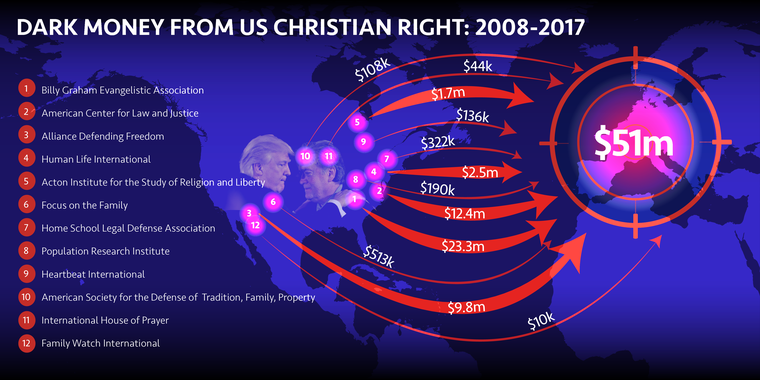
Dark money from US Christian right infographic
US Christian right ‘fundamentalists’ linked to the Trump administration and Steve Bannon are among a dozen American groups that have poured at least $50 million of ‘dark money’ into Europe over the last decade, openDemocracy can reveal today.
Between them, these groups have backed ‘armies’ of ultra-conservative lawyers and political activists, as well as ‘family values’ campaigns against LGBT rights, sex education and abortion – and a number appear to have increasing links with Europe’s far right.
They are spending money on a scale “not previously imagined”, according to lawmakers and human rights advocates, who have called our findings “shocking”. Reacting to openDemocracy’s findings, a cross-party group of more than 40 MEPs has called on the EU’s transparency tsar Frans Timmermans to look into the influence of “US Christian fundamentalists… with the greatest urgency” ahead of May’s European Parliament elections.
Among the biggest spenders is a group whose chief counsel is also Donald Trump’s personal lawyer, Jay Sekulow. 
Another organisation has collaborated with a controversial Rome-based ‘institute’ backed by Steve Bannon. 
And a number of the groups are connected to the World Congress of Families: a network of ultra-conservative activists which has links to far-right politicians and movements in several European countries, including Italy, Hungary, Poland, Spain and Serbia.
None of these American groups discloses who its donors are – though at least two have links to famous conservative billionaires, such as the Koch brothers (who helped bankroll the Tea Party Movement) and the family of Trump’s education secretary.[USA Education Secretary Betsy deVoss and Eric  Prince Blackwaters ]
Nobody should be in any doubt as to the insidious nature of these fundamentalist groups

Alyn Smith MEP
The increasing ties between some of these US Christian conservative groups and the European far right will be on display this weekend at a summit of the World Congress of Families (WCF) in Verona, Italy.
Right-wing politicians and their supporters from across the continent are expected to attend – including the Italian deputy prime minister, Matteo Salvini, who has described the WCF as a showcase for “the Europe that we like”.
In a letter copied to the presidents of the European Council, European Commission and European Parliament, the cross-party group of MEPs has demanded action to protect European democracy “against nefarious outside influences”.
Scottish National Party MEP Alyn Smith, who sits on the European Parliament’s foreign affairs committee and signed the letter, today said: "This investigation by openDemocracy is extremely timely and shines a light on a major challenge facing democracy in Europe.”
Our findings “are highly alarming and nobody should be in any doubt as to the insidious nature of these fundamentalist groups”, he continued. “No group of any kind should be able to use dark money to distort debate and to subvert democracy in Europe, least of all group such as these whose causes are deeply regressive”.

‘The Europe we like’

In the first analysis of its kind, openDemocracy has examined a decade of US Christian organisations’ financial accounts and found that several of them appear to have significantly increased their spending in Europe over the past five years.
Our findings come as far-right parties aim for big wins in the upcoming European Parliament elections in May, and show how large amounts of foreign money have supported the spread of their ‘traditional values’ messages.
openDemocracy has reviewed hundreds of pages of financial filings for a dozen religious conservative groups that are registered in the US as tax-exempt non-profit organisations, and thus are required to disclose some information about their foreign spending.
Some of these groups have been previously accused of supporting campaigns to criminalise homosexuality in Africa, “draconian” anti-abortion laws in Latin America and controversial projects to encourage gay people in the US to “leave homosexuality”.
But the extent of their European activity has – until now – received little scrutiny. Our investigation reveals that some of these groups have:
  • Sent teams of lobbyists to Brussels to influence EU officials
  • Challenged laws against discrimination and hate speech in European courts
  • Supported campaigns against LGBT rights in the Czech Republic and Romania
  • Funded a network of ‘grassroots’ anti-abortion campaigns in Italy and Spain
  • Deployed ‘ambulance-chasing’ evangelists after tragedies such as the Grenfell Tower fire, and in the wake of terrorist attacks
Five of the conservative groups have previously been listed as partners of the World Congress of Families (WCF) network, which is meeting in Verona this week.
It’s not just European politicians who are concerned about them: these groups are controversial in America too. The WCF itself has been described as an “anti-LGBT hate group” by the Southern Poverty Law Center (SPLC), which monitors extremist movements and tracks this network’s increasing connections with the far right.
The SPLC explains that “viewing homosexuality as unbiblical or simply opposing same-sex marriage” is not enough to be categorised as a “hate group”. Groups on this list go further – claiming that homosexuality is dangerous, linked to paedophilia and should be criminalised, disseminating “disparaging ‘facts’ about LGBT people that are simply untrue”.
This is, says SPLC, “no different to how white supremacists and nativist extremists propagate lies about black people and immigrants to make these communities seem like a danger to society”.
Joseph Grabowski, a WCF spokesperson, told openDemocracy: “We dispute entirely the premise [of the ‘hate group’ designation]... It’s an unfortunate slight for the countless Americans and the people around the world who hold the same views as we do on marriage, the nature of family and the right to life, that are part of the fabric of Christianity and also other traditional points of view,” he said.
The WCF is a project of the International Organization for the Family and the Illinois-based Howard Center for Family, Religion and Society, whose directors include an ultra-conservative Spanish activist linked to the leader of the far-right Vox party.
Other directors include a close associate of a Russian oligarch who sponsored a 2014 ‘secret meeting’ in Vienna with key French and Austrian far-right leaders – and an Italian politician facing corruption charges in his country.
Over the last decade, the WCF has hosted at least seven major meetings in Europe, attended by hundreds of religious right activists and a growing list of far-right politicians. Its 2017 meeting in Budapest was opened by Hungarian prime minister Victor Orbán.
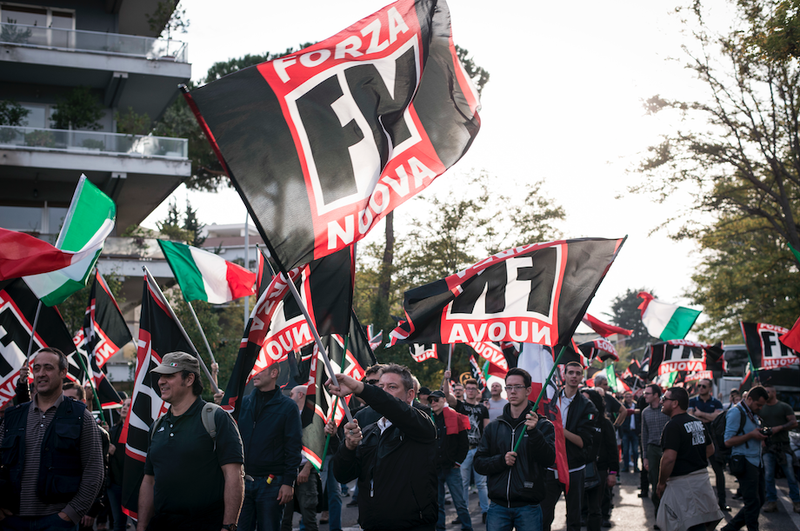
Among the conveners of this week’s event in Verona is an Italian anti-abortion group linked to the neo-fascist Forza Nuova party, whose leader is also expected to attend the WCF.

A Forza Nuova demonstration, 2017
A Forza Nuova demonstration, 2017 | NurPhoto/SIPA USA/PA Images. All rights reserved.

Trump, the far right and the Christian ‘legal army’

Two of the Trump-linked American groups examined by openDemocracy are Christian right legal powerhouses: Alliance Defending Freedom (ADF) and the American Center for Law and Justice. Together, they have spent more than $20 million in Europe since 2008.
ADF supported a 2016 law in Belize making gay sex punishable with 10 years in jail
They don’t disclose their funders, but US journalists have previously traced at least $1 million in grants to ADF from a foundation controlled by the billionaire family of Betsy DeVos, Trump’s education secretary, and Erik Prince, founder of the Blackwater mercenary firm.
ADF was co-founded by Alan Sears, a US Christian right leader who co-authored a book against “the homosexual agenda”. It is increasingly active internationally, including in Latin America. It supported a 2016 law in Belize making gay sex punishable with 10 years in jail.
This group tripled its annual spending in Europe between 2012 and 2016, to more than $2.6 million a year. It now has offices in Belgium, France, Austria, Switzerland and the UK, and spends hundreds of thousands of euros lobbying EU officials, according to separate transparency data.
Among its European projects, the group has supported the defence of a notorious German activist who compared abortion to the Holocaust and accused specific doctors of murder.
This year, ADF International also co-hosted an event with the French group La Manif Pour Tous, which has been previously been linked to the far-right party Front National.
Ahead of the last European Parliament elections in 2014, La Manif Pour Tous launched a ‘Europe for Family’ campaign which got 230 French candidates to sign a pledge opposing marriage equality, trans rights and sex education.
Speaking to openDemocracy, a spokesperson for ADF International said they are “exclusively privately funded by people from all over the world, who care about human rights” and that its activities include “advocating for freedom of speech in Europe”.
Asked for more detail about who the group gives its money to, they said: “Since our advocacy involves court cases in countries where people are harassed, stigmatised, and even killed because of their religious convictions, it is our general policy not to disclose any recipients of funding in order to protect their personal safety and livelihoods”.
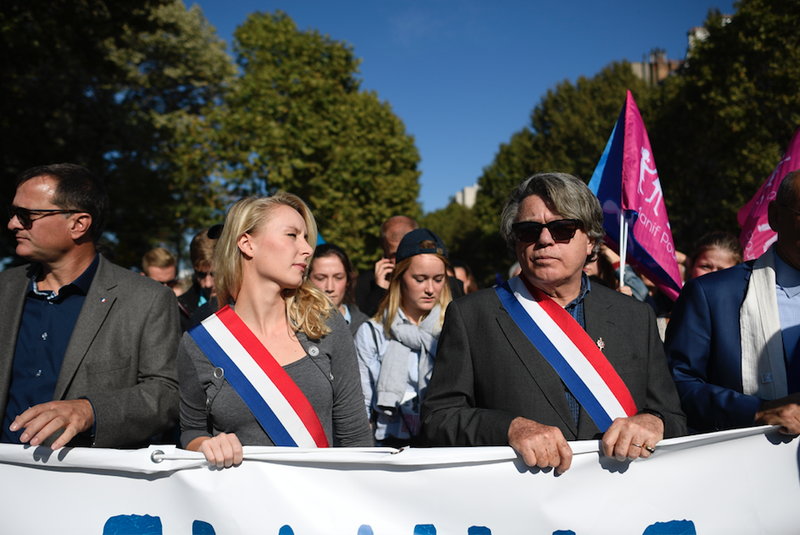
French far-right leaders Marion Maréchal-Le Pen and Gilbert Collard at a demonstration of La Manif Pour Tous in 2016
French far-right leaders Marion Maréchal-Le Pen and Gilbert Collard at a demonstration of La Manif Pour Tous in 2016 | Blondet Eliot/ABACA/ABACA/PA Images. All rights reserved.
The second of the two Trump-linked groups, the American Center for Law and Justice (ACLJ), also operates through the courts. It was founded in 1990 by American televangelist Pat Robertson to oppose the American Civil Liberties Union.
The ACLJ has praised Putin’s laws banning “gay propaganda”
The group’s current chief counsel is Jay Sekulow, a conservative talk-show host who has been described as “the top lawyer” on Donald Trump’s legal team in the Mueller inquiry.
For more than 20 years, this group has had an office in Strasbourg, France – home of the European Court of Human Rights – from where it has intervened in numerous cases on issues including same-sex marriage, abortion rights and artificial insemination.
The director of its Strasbourg outfit has also represented the Holy See at the Council of Europe, while its Moscow centre has praised Putin’s laws banning “gay propaganda”.

Trump, Franklin Graham and US-sanctioned Kremlin officials

The Billy Graham Evangelistic Association is another major spender. It is led by the famous US evangelical preacher’s son, Franklin Graham, who said Satan is the architect of same-sex marriage and described Islam as an “evil and very wicked religion”.
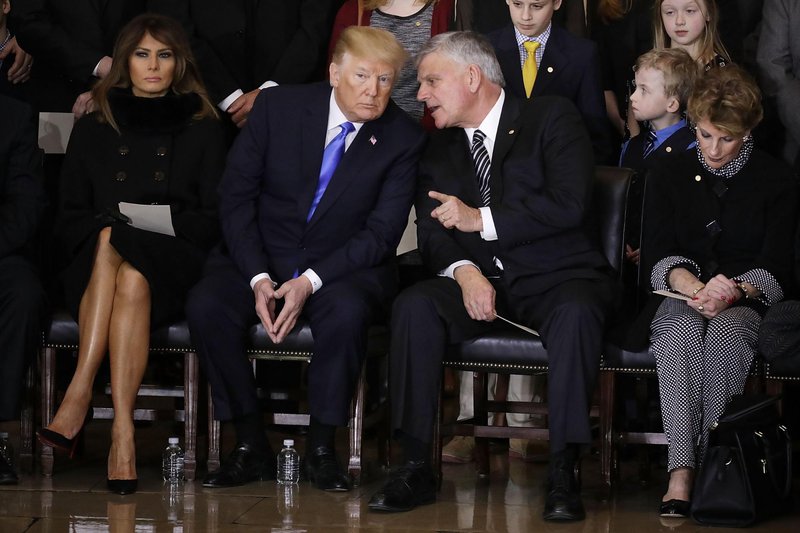
Melania Trump, Donald Trump, and Franklin Graham at his father Billy Graham’s funeral
Melania Trump, Donald Trump, and Franklin Graham at his father Billy Graham’s funeral | Chip Somodevilla/DPA/PA Images. All rights reserved.
Franklin Graham, who has supported Trump as someone who “defends the faith”, was in Russia earlier this month meeting Kremlin officials who are under US sanctions, on a trip that he said was personally signed off by Vice President Michael Pence.
In 2018, his group organised festivals in England and Scotland amid protests from Muslim and LGBT rights groups. It also supports “rapid response chaplains” that target crises and have been accused in the US of “chasing ambulances” and “exploiting tragedy”.
Its filings disclose more than $23 million spent in Europe through two different US entities between 2008 and 2014 – making it the largest spender in this region, of the American groups analysed by openDemocracy.
However, 2014 is the latest year for which we were able to find public documents for this group, which has offices in the UK, Germany, France and Spain, so the true extent of its influence in the region is not yet known.

Training Europeans, on the ‘front lines of the Culture War’

A number of groups spending smaller amounts of money appear to have increased their activities in Europe in recent years.
The Acton Institute for the Study of Religion and Liberty, which combines a conservative Christian worldview with free-market economics, has received hundreds of thousands of dollars from the Koch family foundations
This group spent more than $1.7 million in Europe since 2008, with its spending in the region rising in recent years (from around $166,000 in 2008 to almost $240,000 in 2017).
In Italy, it has collaborated with the Dignitatis Humanae Institute – of which Steve Bannon is a trustee – that has locally controversial plans to use a monastery outside Rome as a “gladiator school for culture warriors”.
Also on the list is the US branch of the Tradition, Family and Property (TFP), an ultra-conservative transnational Catholic movement that says it’s “on the front lines of the Culture War, peacefully defending the values of tradition, family and private ownership”.
This group said it spent about $100,000 in Europe since 2010. Its filings don’t detail where this money went but the TFP has been linked to a controversial ‘think tank’ in Poland that has helped develop policy for far-right Law and Justice (PiS) politicians.
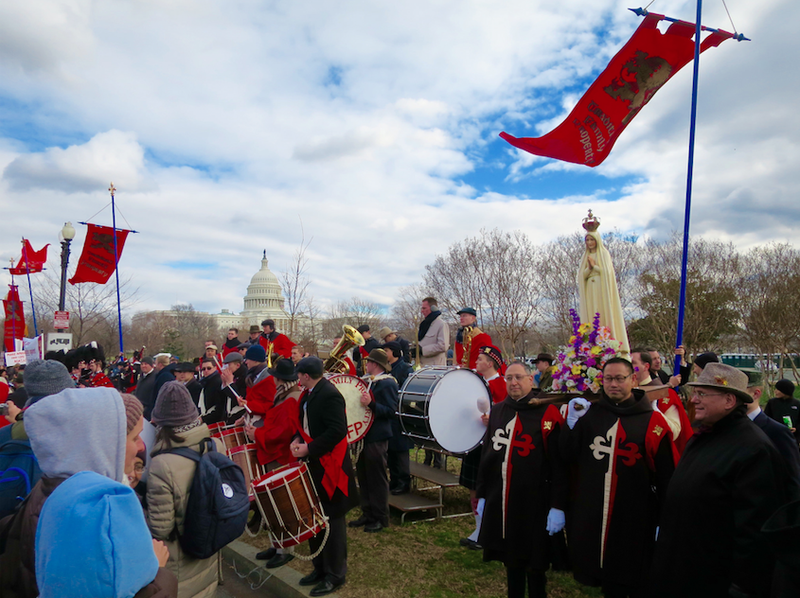
The American Society for the Defense of Tradition, Family and Property
The American Society for the Defense of Tradition, Family and Property | baldeaglebluff/Flickr. CC BY-SA 2.0. Some rights reserved.

A ‘wake-up call’ to prevent ‘foreign interference’

Under US law, the groups analysed by openDemocracy are required to publicly disclose some information about their foreign spending, but not the names of their overseas recipients, details of what activities they fund – or the identities of their own funders.
The $50 million figure drawn from openDemocracy’s analysis is also a likely underestimate of the resources that US conservatives have channelled into Europe in recent years.
Data for 2018 is not yet available; meanwhile there are some important loopholes. Religious organisations registered as churches, for example, don’t need to file the same disclosures.
A number of other US Christian conservative groups appear to be spending money in Europe, but do not disclose this on their US filings – including the Howard Center for Family, Religion and Society, which has coordinated the WCF network.
The scale of this meddling by US extremists is shocking

Caroline Hickson, International Planned Parenthood Federation
Reacting to our findings, German Green MEP Terry Rintke, who sits on equality-related committees at the European Parliament, has said: “This extreme extent of financial support flooding the EU is shocking – especially with the European elections ahead of us."
The SNP MEP Alyn Smith has said he and his fellow parliamentarians who signed today’s letter have called for the mobilisation of “EU institutions and member states in preventing malign actors such as those identified in the investigation from interfering in the European Parliament elections in May – and beyond”.
Caroline Hickson, regional director of the International Planned Parenthood Federation’s European Network, said: “The scale of this meddling by US extremists is shocking, but sadly no surprise to us. Every day European societies face concerted attacks by outside forces seeking to impose reproductive coercion… This is utterly at odds with the European values of democracy and human rights.”
“This is dark money coming into Europe to threaten human rights, and we're not doing anything about it”, warned Neil Datta, secretary of the European Parliamentary Forum on Population and Development, describing the amounts of money involved as “staggering”.
“It took the Christian right 30 years to get to where they are now in the White House,” he said. “We knew a similar effort was happening in Europe, but this should be a wake-up call that this is happening even faster and on a grander scale than many experts could have ever imagined.”
Additional reporting by Peter Geoghegan


woensdag 27 maart 2019

Far right groups' coded language makes threats hard to spot


Far right groups' coded language makes threats hard to spot

Sick jokes and deadly intentions can often be difficult to tell apart for those policing online culture
Large pile of floral tributes at a traffic light in Christchurch
 Tribute to victims of the mosque attacks near a police line outside Masjid Al Noor in Christchurch, New Zealand on Saturday. Photograph: Jorge Silva/Reuters
The irony-laden vocabulary of the far-right online communities that spawned the terror attack in Christchurch on Friday makes it “extremely difficult” to distinguish a sick joke from a deadly serious threat, according to experts on the international far right and online information warfare.
References to “shitposting”, YouTube stars and the 17th-century Battle of Vienna are hallmarks of “that online culture where everything can be a joke and extremist content can be a parody and deadly serious all on the same page,” said Ben Nimmo, a researcher at the Atlantic Council. “Distinguishing between the two is extremely difficult. You have these communities who routinely practise extreme rhetoric as a joke, so it’s very easy to fit in if you’re a real extremist.”
That confusion can lead to observers underplaying the risk from such communities, rendering it harder to secure convictions for crimes such as hate speech, and even missing obvious red flags until it’s too late.
“People will be asking why people didn’t flag this up, but it all sounds like that,” Nimmo said. “The problem is that’s the way that community speaks. You can’t just point to the comments they’re saying and say that should be a warning light. There are plenty of people who post like that and are not going to pick up a weapon and start massacring people.”
It also leads to situations where mainstream observers unknowingly aid terrorists by spreading propaganda without recognising it for what it is.
Shortly before launching a terrorist attack that killed 49 Muslim worshippers in Christchurch on Friday, the alleged attacker posted to the political subforum of 8Chan, a far-right message board set up in 2013. Describing a forthcoming attack as “a real life effort post”, a link to a 74-page manifesto and a Facebook live stream was shared.
Both were initially shared by mainstream publications, with the Daily Mail embedding a copy of the manifesto and the Mirror sharing a lengthy edited version of the live stream.
“The way we always have to look at manifestos like this: it’s a PR document, a propaganda document that’s meant to be analysed, exposed, read and thought about,” said Patrik Hermansson, a researcher at Hope Not Hate. “The more confusing it is, the more it might be spread.”
Mentioning YouTube stars in video footage of attacks has the same goal. In Christchurch, the Facebook live stream opens with a shout-out to a popular video-gaming star, who has himself flirted with far-right iconography, although he has not condoned violence. “He’s one of the biggest YouTube accounts in the world, who has a lot of followers on his side. There’s a large potential audience there,” Hermansson said. “It’s also a way to force [the YouTube star] to acknowledge him and to get attention.”
Even when the action falls short of violence, the coded language popular among online communities such as 8Chan and Stormfront can pose problems for law enforcement. “It changes quickly, so it requires you to follow it quite closely,” notes Hermansson. For those who do, the lack of originality makes it easy for dedicated observers to cut through the irony.
“They don’t come up with these things themselves,” Hermansson says. General digital culture concepts such as “Copypasta” – large chunks of text cut-and-pasted to continue a running joke – are just as prevalent in the online far right as many other niche internet communities.
But, for outsiders, distinguishing the jokes from the serious statements remains hard. “What is hate speech? What can our justice system handle? They might not use the N-word, they might use super-coded language instead. Even parents might not understand that their own children are using this coded language. It’s difficult for everyone.”
And then there’s the simple desire to “troll” – say or do extreme things and revel in the reaction. “Outrage is exciting, and they feel like they have influence,” Hermansson says. “That is how they have influence.”
But Hermansson cautions that, even if it can be hard to spot a potential terrorist hiding in plain sight among a hundred ironic racists, it doesn’t necessarily represent a worse position to be in than the recent past.
“In Nazi groups, people sit down around a table and joke about things as well, and talk in terms of race war and blood baths.
“It’s definitely been made more extreme, and an even bigger problem, because more people express these views. That’s what the online world does, it lowers the barriers.
“But a person like this 20, 30 years ago wouldn’t say anything anywhere. Yet we had far-right terrorism then as well.
“Yes, now we have a bit more information, there’s a lot and it’s hard to figure out what’s important. But a few decades ago, we would have had none. They might have written a manifesto and sent it off to a newspaper – but it would arrive after their attacks.
“So now we have this issue [of] could we have stopped it? But, before, we definitely could not have.”

zaterdag 23 maart 2019

The EU knows it, so do our own MPs – Theresa May is finished

The EU knows it, so do our own MPs – Theresa May is finished


European leaders have known for some time that the prime minister wasn’t up to the Brexit job. This week she’s proved it


 Theresa May speaks in the early hours after EU summit – video
The EU has no time for Theresa May, which doesn’t mean there is no flexibility in the Brexit timetable. Continental leaders have granted an article 50 extension, but not the one requested by the prime minister. She had pitched for a new departure date of 30 June. She was given 39 days fewer, until 22 May. And that date only stands if parliament ratifies the deal.
If May flunks another meaningful vote, the extension gets shorter – 12 April is the new cliff-edge that comes into view. That date marks the point at which Britain would have to start organising European parliament elections, should it want another even longer extension. A national change of heart on the whole Brexit business would still be welcome in Brussels but it is not expected, and the priority is to escort a troublesome ex-member off the premises with a minimum of disruption before those MEP ballots get under way.
Does May like this plan? It doesn’t matter. She wasn’t in the room where it happened. The summit conclusions were handed down to the petitioning nation as it paced around an antechamber. This is the power relationship between a “third country” and the EU. Britain had better get used to it.
The terms of the extension are not drafted for the prime minister’s benefit. They contain a message from the EU direct to the House of Commons. In crude terms: piss or get off the pot. If you want to leave with a deal, vote for the damned deal. If you are foolish enough to leave without a deal, do not blame us. Have a couple more weeks to think about it. But if you want something else, a referendum or a softer Brexit, work it out soon. And then send someone who isn’t Theresa May to talk to us about it.
EU leaders cannot say explicitly that they no longer want to deal with the current prime minister. Urging regime change is beyond the pale of normal diplomacy among democratic states. But there is no effort to conceal the frustration in May or the evacuation of confidence in her as a negotiating partner. The one thing everyone in Brussels, Berlin and Paris had most wanted to avoid from an article 50 extension was giving May a licence to carry on behaving as she has done for what feels like an eternity. They could no longer tolerate the hollow shell of a prime minister shuttling back and forth between Tory hardliners demanding fantasy Brexits and Brussels negotiators who trade in realities.
There is a difference between patience with the prime minister and readiness to help her country navigate through its current crisis. There are still stores of goodwill available for Britain in Brussels, but they cannot be unlocked by May.


The bankruptcy of May’s overseas enterprise has been coming since the day she set up shop in No 10. The squandering of credibility started almost at once, with the appointment of Boris Johnson as foreign secretary in 2016. Only someone with a tin ear for European sensibilities would have given the top diplomat job to a man known on the continent as a rogue peddler of anti-Brussels propaganda.
Then there was the early negotiating period, during which EU leaders thought May’s robotic, inscrutable manner concealed a deep, strategic intelligence. They came to realise that there was no mask. The inanity – the reciting of “Brexit means Brexit” even in private meetings – was not the cover story for a secret plan. It was the plan.
The point of no return was the summit in Salzburg last September. May was invited to make the case for what was left of her “Chequers plan” to European heads of government. It was late. They were tired. There were other difficult matters to attend to. And instead of speaking candidly, persuasively, passionately or even just coherently, the British prime minister read mechanically from a text that was, in substance, no different from an op-ed article already published under her name in a German newspaper that morning. It was embarrassing and insulting. Many European diplomats say that was the moment when Angela Merkel, Emmanuel Macron and others realised they were dealing with someone out of her depth, unable to perform at the level required for the job that needed doing.
A similar story is emerging from last night’s summit. May was asked about backup plans in the event that parliament rejects her deal a third time. She had nothing. She restated her determination that the deal should pass. This infuriating obtuseness is grimly familiar on this side of the Channel. Cabinet ministers recognise the experience of being desperate for some glimpse of the prime minister’s calculations. People who want to support her have needed some window into the workings of her political brain, maybe just a peek at her soul. They get nothing. It is hard to build trust with someone so closed and hard to stay loyal.
There was a Salzburg-style moment for pro-European Tories on Wednesday night, when the prime minister went on television to berate MPs for obstructing her deal. The spirit was demagogic, even if the style was typically charmless. Here was a besieged leader, emerging from her bunker, presenting herself as the champion of her people against a rotten parliament. This did not go down well with MPs of any stripe. But it was most counterproductive with moderate Conservatives who have voted for May’s deal twice already and both times seen her respond to defeat by borrowing ideas and rhetoric from the hardliners who have given her nothing but humiliation. She rewards enemies of compromise by becoming ever less compromising.
Wednesday night’s performance exposed something that many of May’s colleagues find uncomfortable to acknowledge: the prime minister’s failure at overseas diplomacy and her failure at domestic politics express a single fatal flaw. She is unable to communicate with others because she has lost the ability to be honest with herself. She has no outward-facing powers of persuasion but she also lacks the introspection necessary to take responsibility for the mess made by her obstinacy. She has crossed a line from stubbornness into megalomania.
That leads to a conclusion that Britain’s continental neighbours reached long ago. Even if the UK ends up leaving the EU on the terms outlined in the prime minister’s deal, her part in the story will very soon be over. She is finished. The problems with Brexit are much bigger than Theresa May’s failings as a leader. But those failings disqualify her from being part of a viable solution.
• Rafael Behr is a Guardian columnist
------------------------------------------------------------------------

My Comments :

European leaders have known for some time that the prime minister wasn’t up to the Brexit job. This week she’s proved it
1. Apart from the grotesquely frivolous and utterly irresponsible Cameron initiative, to set afloat an (entirely ignorance-based) ADVISORY referendum, in order to "once and for all" silence the ultra-nationalists within the Conservative party, it has been the leadership-contest AFTER Cameron had to relief himself prematurely from his Premiership after the unexpected referendum result, that finally set the conditions for the process of negotiating the withdrawal agreement between the UK and the EU over the past two years.
2. After all, after the contenders of this Tory leadership contest in 2016, either took themselves out by way of treasonous behaviour (Gove versus Johnson), or otherwise, the two remaining candidates - Leadsom and May - decided to avoid a prolonged battle over the months to come, by agreeing (after Leadsom proved to be rather too gaffe-prone and too politically inexperienced, to continue anyway)) that the "superior" May should be the successor (in name) of Cameron.
3. It is my well educated guess, that May only has been given the keys of No. 10 by her Party, in exchange for the definite condition, that she should rigorously follow the extreme-right ideological policy line of Leadsom (*) and her ultra-nationalist right-extremist bedfellows from the ERG et al..
4. So the (politically speaking, relatively moderate and pro-Remain May - having been led for long by the burning ambition of becoming PM et all cost - had voluntarily have herself taken prisoner by the Tory alt-right, that had been preaching hard-Brexit even long before it became known as such.
5. From that moment on she had been literately dictated by Leadsom and her reckless and ruthless ideological Brexit adventurists, the policies that she (May) had to pursuit and execute in exchange for what had been supposed to be the ultimate glamour-job of PM.
6. The so-called doctrinaire red lines of May, in reality have been all along the ideological red lines of Leadsom and her racist friends.
7. So, the reason that May had been monotonously and robotically repeating the same rigid Brexit mantras for the last two years, had been mainly, because she knew all along, that if she did not have done so, Leadsom and her gang of ultra-orthodox Christians exceptionalists would have removed her from the Throne immediately.
8. Theresa "hostile environment" May herself had already been deeply racialist orientated by conviction, so she never ever had any moral objection against the overtly xenophobe nature of her belligerent neo-nationalist policy whisperers.
9. Although she at the same time, had to frenetically keep her party from falling apart all of the time, she will have done so out of pure self-interest as well, because when her party would have split, the game of occupying No 10, would have been over for her.
10. Those deliberations are the main reason why she has been resisting any other approach but a strictly partisan one : At the very cost of the future fate of the United kingdom as a whole semi-sovereign nation of course.
11. A seriously complicating factor in all of this jockeying for positions in the parliamentary debate on Brexit and under what precise conditions the UK should leave, undoubtedly has been the (divine) intervention by Gina Miller, who almost barehandedly prevented Brexit from becoming a merely Tory-led, governmental executive exercise, whipped upon the UK population as a whole.
12. Another major contributing factor to the confusion of today, of course is the very fact, that the next generation of youth - at the time of the referendum not allowed to vote yet - appears to be dominantly Remain-orientated, and is desperately protesting any sort of Brexit (hard or soft) all-together.

(*) It has been rumoured though, that former City Banker Leadsom in 2013 might have declared, that "leaving the EU would be a disaster" : So much for selling one's soul to the devil (personified at that time by her main backer Boris Johnson, who - the personification of hypocrisy himself - also had been in the rich possession of an entire public history of explicitly pro-European sympathies.